Denis Auguste Raffet (1804-1860)
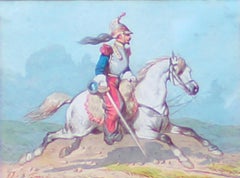
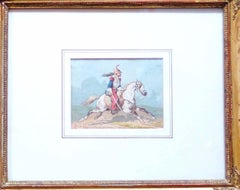
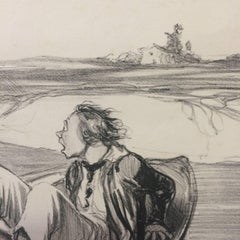
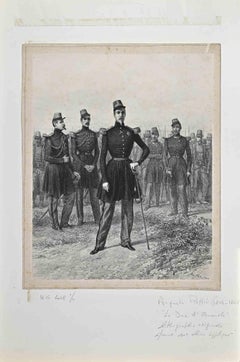
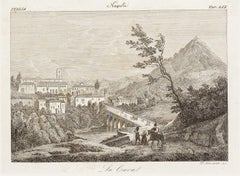
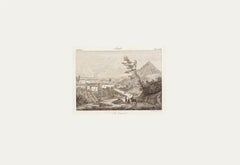
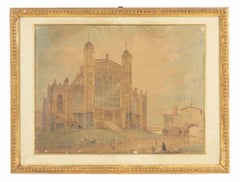
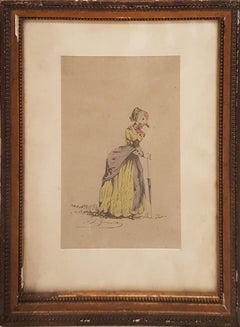
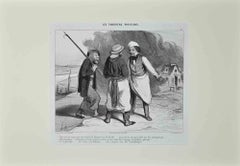
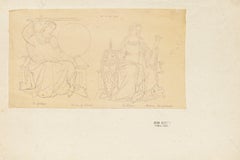
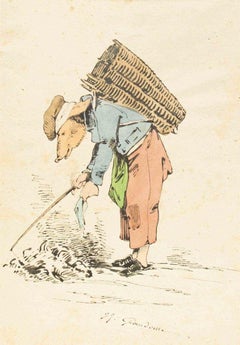
Studies of a Tiroler Kaiserjäger,
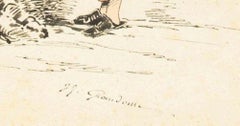
Signed and dated 1849 lower right
Ink on paper
16.5 x 25.5 cm
In a nice period frame : 33 x 42 cm
Raffet had the occasion to draw studies of austrian soldiers as he took part as observer to the first Italian Independance War (1848-1849). It was the the first of many conflicts between the Kingdom of Sardinia , which later became the Kingdom of Italy , and the Austrian Empire.
The Kaiserjäger (imperial hunters) were founded in 1815 by Emperor Franz I. It was a great honor to enter the Kaiserjäger as they were the only ones to be honored with the term "imperial". However, only Tyrolese, Voralbergers and Welschtirolers were allowed.
They wore this characteristic hat as a parade headdress, it was made of matte black, waterproof felt. It consisted of a crown and brim adorned with a circular, green cord, the Jäger emblem and a plume of black rooster feathers. The hat cord was made of sheep's wool, and had a button and an acorn covered with a green wool.
These two studies clearly evoke the interest of the artist for this part of their uniform.
Denis Auguste Marie Raffet (2 March 1804 – 16 February 1860) was a French illustrator and lithographer. He was a student of Nicolas Toussaint Charlet, and was a retrospective painter of the Empire.
At an early age he was apprenticed to a wood turner, but took up the study of art at evening classes. At the age of 18 he entered the workshop of Cabanel, where he applied his skill to the decoration of china, and where he met Rudor, from whom he received instruction in lithography, in the practice of which he was to rise to fame. He then entered the École des Beaux-Arts, but returned to lithography in 1830 when he produced on stone his famous designs of Lützen, Waterloo, Le bal, La revue, and Les adieux de la garrison, by which his reputation became immediately established.
Raffet's chief works were his lithographs of the Napoleonic campaigns, from Egypt to Waterloo, vigorous designs inspired by ardent patriotic enthusiasm. In this endeavor he was a contemporary of other French artist-lithographers of Napoleon and the French army including Hippolyte Bellangé, Horace Vernet, and Nicolas Toussaint Charlet. As an illustrator his activity was prodigious, the list of works illustrated by his crayon amounting to about forty-five, among which are Béranger's poems, the History of the Revolution by Adolphe Thiers, the History of Napoleon by de Norvins, the great Walter Scott by Auguste Defauconpret, the French Plutarch and Frédéric Bérat's Songs.
He went to Rome in 1849, and was present at the siege of Rome, which he made the subject of some lithographs, and followed the Italian campaign of 1859, of which he left a record in his Episodes de la campagne d'Italie de 1859. His portraits in pencil...
Category
Romantic 1840s Art