Located in Myrtle Beach, SC
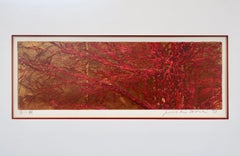
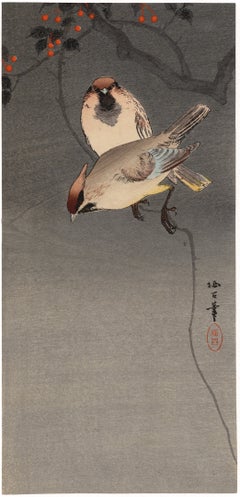
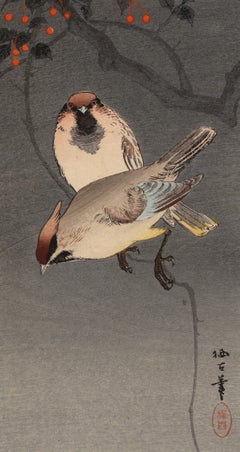
Okuhara Seiko, 'Tree Sparrows and Nandina', color woodblock print, c. 1900. Signed in Black ink with the artist’s red seal beneath, lower right. A fine impression on thin Japanese paper, with fresh colors and pronounced woodgrain, indicating an early impression. Apparently the full sheet, printed to the sheet edges, in excellent condition. Archivally sleeved, unmatted.
Image size/sheet size: 9 13/16 x 4 11/16 inches (249 x 119 mm).
ABOUT THIS WORK
Okuhara Seiko’s 'Tree Sparrows and Nandina' ('Birds and Nandina'), c. 1900, is a delicately printed color woodblock in the narrow ko-tanzaku format. Two Eurasian tree sparrows (Passer montanus) perch among slender branches of nandina. The composition combines close observation of nature with Seiko’s characteristically expressive approach to bird-and-flower subjects. The sparrows are rendered with remarkable subtley, their softly modeled plumage contrasting with the more calligraphic treatment of the branches and foliage. Particularly effective is the restrained use of color: muted brown, pink, blue, and grey allow the vermilion-red nandina berries to punctuate the composition, while delicate gradations (bokashi) create an atmospheric sense of depth.
The print exemplifies the sophisticated translation of Seiko’s painterly kachō-ga imagery into the woodblock medium during the late Meiji period, preserving the spontaneity of brush and ink within the exacting demands of color woodblock printing.
ABOUT THE ARTIST
Okuhara Seiko (1837–1913) was one of the foremost Japanese women artists of the nineteenth century and a leading exponent of Nanga, or Japanese literati painting, valuing personal expression over academic technique. Born into a samurai family in Koga, present-day Ibaraki Prefecture, she began studying painting in 1853 with Hirata Suiseki, an artist in the lineage of Tani Bunchō, and later studied the work of Watanabe Kazan as well as Chinese Ming and Qing dynasty painting...
Category
Early 1900s Woodblock Prints and Multiples