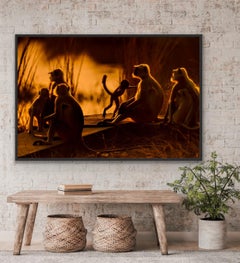
Baboon Prints and Multiples

to
2
5
1
Overall Width
to
Overall Height
to
2
1
5
1
2
6
5
3
25
39,662
20,894
13,527
12,842
11,345
9,245
8,193
5,779
4,476
3,950
3,808
3,729
3,672
3,516
3,394
3,334
2,946
2,897
2,575
6
6
2
1
1
6
2
Art Subject: Baboon
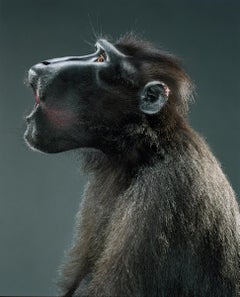
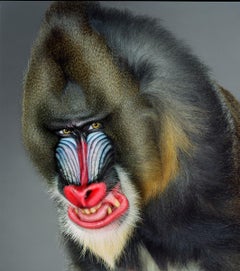
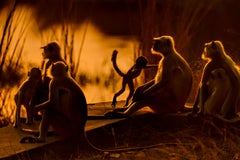
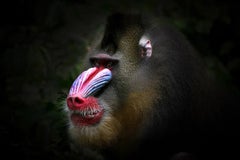
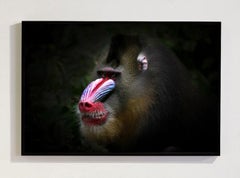
Mandrill, Africa series by Bjorn Persson Wildlife Photography

Mandrill, Africa series by Bjorn Persson Wildlife Photography

By Björn Persson

Located in New York City, NY

40x60 inches (100 x 150 cm) Edition of 15 Archival Pigment Print Unframed Certificate of Authenticity Signed by the artist Ask us for framing options. Björn Persson is an internat...

Category

2010s Contemporary Black and White Photography

Materials

Black and White, Inkjet, Archival Pigment

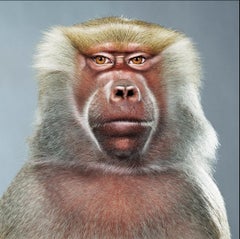
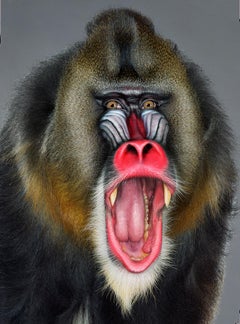
O-Face

O-Face

By Jill Greenberg

Located in New York, NY

Since the age of 10, Jill Greenberg has staged photographs and created characters using the media of drawing, painting, sculpture, film, and photography. She is known worldwide for her uniquely human animal portraits which intentionally anthropomorphize her subjects, as well as her infamous series “End...

Category

Early 2000s Color Photography

Materials

Archival Pigment

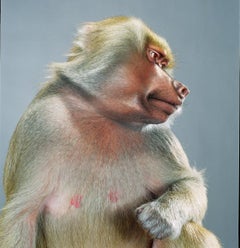
Georgia

Georgia

By Jill Greenberg

Located in New York, NY

Since the age of 10, Jill Greenberg has staged photographs and created characters using the media of drawing, painting, sculpture, film, and photography. She is known worldwide for her uniquely human animal portraits which intentionally anthropomorphize her subjects, as well as her infamous series “End...

Category

Early 2000s Color Photography

Materials

Archival Pigment

I'm Considering Rhinoplasty

I'm Considering Rhinoplasty

By Jill Greenberg

Located in New York, NY

Since the age of 10, Jill Greenberg has staged photographs and created characters using the media of drawing, painting, sculpture, film, and photography. She is known worldwide for her uniquely human animal portraits which intentionally anthropomorphize her subjects, as well as her infamous series “End...

Category

Early 2000s Color Photography

Materials

Archival Pigment

Thhhhh

Thhhhh

By Jill Greenberg

Located in New York, NY

Since the age of 10, Jill Greenberg has staged photographs and created characters using the media of drawing, painting, sculpture, film, and photography. She is known worldwide for her uniquely human animal portraits which intentionally anthropomorphize her subjects, as well as her infamous series “End...

Category

Early 2000s Color Photography

Materials

Archival Pigment

Mask

Mask

By Jill Greenberg

Located in New York, NY

Since the age of 10, Jill Greenberg has staged photographs and created characters using the media of drawing, painting, sculpture, film, and photography. She is known worldwide for her uniquely human animal portraits which intentionally anthropomorphize her subjects, as well as her infamous series “End...

Category

Early 2000s Color Photography

Materials

Archival Pigment

Related Items
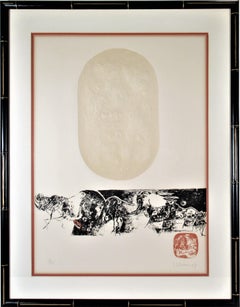
Emilio Vedova - Original Lithograph

Emilio Vedova - Original Lithograph

By Emilio Vedova

Located in Collonge Bellerive, Geneve, CH

Emilio Vedova - Original Lithograph Abstraction 1961 From the art revue XXe Siecle Dimensions: 32 x 24 Edition: G. di San Lazzaro. Unsigned and unumbered as issued

Category

1960s Modern Figurative Prints

Materials

Lithograph

Original "Wonderful Copenhagen" vintage travel poster

Original "Wonderful Copenhagen" vintage travel poster

Located in Spokane, WA

Original vintage poster: WONDERFUL COPENHAGEN created by the artist Viggo Vagnby. This antique poster is archival linen-backed, in excellent condition, and ready to frame. No da...

Category

1950s American Modern Animal Prints

Materials

Lithograph

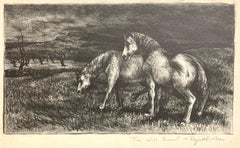
Reginald Wilson, Horses

Reginald Wilson, Horses

By Reginald Wilson

Located in New York, NY

Although this work is titled Horses. It nice to think it could be (Horses in a Field in Woodstock, NY), but it was printed by Will Barnet at the Art Students League, about 1938, and Wilson, who visited Woodstock with Arnold Blanche...

Category

1930s American Modern Animal Prints

Materials

Lithograph

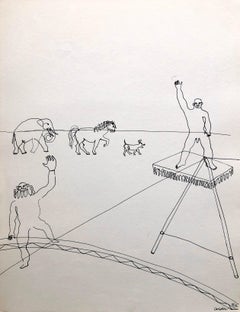
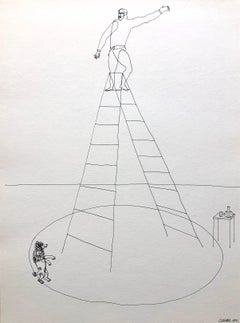
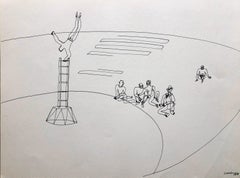
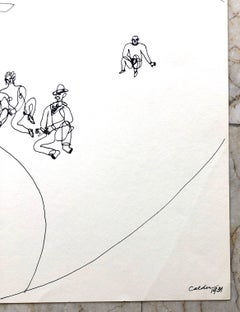
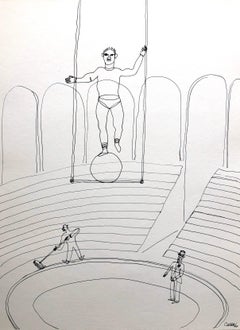
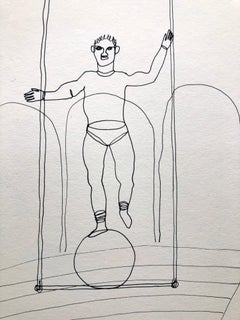
Alexander Calder Circus Reproduction Lithograph After a Drawing

Alexander Calder Circus Reproduction Lithograph After a Drawing

By (after) Alexander Calder

Located in Surfside, FL

(after) Alexander Calder "Calder's Circus" offset lithograph on wove paper after drawings by the artist Published by Art in America and Perls gallery in 1964 (from drawings done in the 1930's) these range slightly in size but they are all about 13 X 17 inches (with minor variations in size as issued.) These have never been framed. The outer folio is not included just the one lithograph. James Sweeny from the introduction “The fame of Calder’s circus spread quickly between the years 1927 and 1930. All the Paris art world came to know it. It brought him his first great personal success. But what was more important, the circus also provided the first steps in Calder’s development as an original sculptor” Clive Gray wrote ”A visit to the studio of Alexander Calder led to the chance discovery of some hundred masterful circus drawings completed over thirty years ago. We publish, for the first time, a choice of sixteen from that group.” With signed introduction by Miro. These whimsical drawings, done in the style of wire sculpture, include acrobats, clowns, jugglers, trapeeze artists, an elephant, dog and lion. they are great. Alexander Calder is widely considered to be one of the most important American sculptors of the 20th century. He is best known for his colorful, whimsical abstract public sculptures and his innovative mobiles, kinetic sculptures powered by motors or air currents, which embraced chance in their aesthetic. Born into a family of accomplished artists, Calder's work first gained attention in Paris in the 1930s and was soon championed by the Museum of Modern Art in New York, resulting in a retrospective exhibition in 1943. Major retrospectives were also held at the Solomon R. Guggenheim Museum (1964) and the Museum of Contemporary Art, Chicago (1974). Calder’s work is in many permanent collections, most notably in the Whitney Museum of American Art, but also the Guggenheim Museum; the Museum of Modern Art; the National Gallery of Art, Washington, D.C.; and the Centre Georges Pompidou. He produced many large public works, including .125 (at JFK Airport, 1957), Pittsburgh (Carnegie International prize winner 1958, Pittsburgh International Airport) Spirale (UNESCO in Paris, 1958), Flamingo and Universe (both in Chicago, 1974), and Mountains and Clouds (Hart Senate Office Building, Washington, D.C., 1976). Although primarily known for his sculpture, Calder was a prodigious artist with a restless creative spirit, whose diverse practice included painting and printmaking, miniatures (such as his famous Cirque Calder), children’s book illustrations, theater set design, jewelry design, tapestry and rug works, and political posters. Calder was honored by the US Postal Service with a set of five 32-cent stamps in 1998, and received the Presidential Medal of Freedom, posthumously in 1977, after refusing to receive it from Gerald Ford one year earlier in protest of the Vietnam War. Calder moved to New York and enrolled at the Art Students League, studying briefly with Thomas Hart Benton, George Luks, Kenneth Hayes Miller, and John Sloan. While a student, he worked for the National Police Gazette where, in 1925, one of his assignments was sketching the Ringling Bros. and Barnum & Bailey Circus. Calder became fascinated with the action of the circus, a theme that would reappear in his later work. In 1926, Calder moved to Paris, enrolled in the Académie de la Grande Chaumière, and established a studio at 22 rue Daguerre in the Montparnasse Quarter. In June 1929, while traveling by boat from Paris to New York, Calder met his future wife, Louisa James (1905-1996), grandniece of author Henry James and philosopher William James. They married in 1931. While in Paris, Calder met and became friends with a number of avant-garde artists, including Fernand Léger, Jean Arp, and Marcel Duchamp. Cirque Calder (on view at the Whitney Museum of American Art at present) became popular with the Parisian avant-garde. He also invented wire sculpture, or "drawing in space," and in 1929 he had his first solo show of these sculptures in Paris at Galerie Billiet. Hi! (Two Acrobats) in the collection of the Honolulu Museum of Art is an early example of the artist's wire sculpture. The painter Jules Pascin, a friend of Calder's from the cafes of Montparnasse, wrote the preface to the catalog. A visit to Piet Mondrian's studio in 1930, where he was impressed by the environment-as-installation, "shocked" him into fully embracing abstract art, toward which he had already been tending. Dating from 1931, Calder’s sculptures of discrete movable parts powered by motors were christened “mobiles” by Marcel Duchamp, a French pun meaning both "motion" and "motive." At the same time, Calder was also experimenting with self-supporting, static, abstract sculptures, dubbed "stabiles" by Jean Arp in 1932 to differentiate them from mobiles. Public commissions increasingly came his way in the 1960s. Notable examples are .125 for JFK Airport in 1957, Spirale for UNESCO in Paris 1958 and Trois disques, commissioned for Expo 67 in Montreal, Quebec, Canada. Calder's largest sculpture at 25.7 meters high was El Sol Rojo, constructed outside the Aztec Stadium for the 1968 Summer Olympics "Cultural Olympiad" events in Mexico City. Many of his public works were commissioned by renowned architects; I.M. Pei commissioned his La Grande Voile (1966), a 25-ton, 40-foot high stabile for the Massachusetts Institute of Technology. Part of Calder's repertoire includes pivotal stage sets for more than a dozen theatrical productions, including Nucléa, Horizon, and most notably, Martha Graham’s Panorama (1935), a production of the Erik Satie symphonic drama Socrate (1936), and later, Works in Progress (1968). In addition to sculptures, Calder painted throughout his career, beginning in the early 1920s. He picked up his study of printmaking in 1925, and continued to produce illustrations for books and journals.As Calder’s professional reputation expanded in the late 1940s and 1950s, so did his production of prints. Masses of lithographs based on his gouache paintings hit the market, and deluxe editions of plays, poems, and short stories illustrated with fine art prints by Calder became available for sale. One of Calder's most celebrated and unconventional undertakings was a commission from Dallas-based Braniff International Airways to paint a full-size Douglas DC-8-62 four-engined jet as a "flying canvas." Calder created over 2,000 pieces of jewelry over the course of his career, many of them as gifts for friends and relatives. For his lifelong friend Joan Miró, he set a shard of a broken porcelain vessel in a brass ring. Peggy Guggenheim received enormous silver mobile earrings and later commissioned a hammered silver headboard...

Category

1930s American Modern Animal Prints
Materials

Lithograph

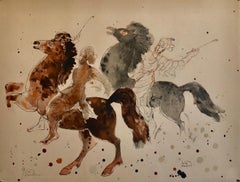
Modern Israeli Lithograph Reuven Rubin Views Of Israel Judaica Horses, Riders

Modern Israeli Lithograph Reuven Rubin Views Of Israel Judaica Horses, Riders

By Reuven Rubin

Located in Surfside, FL

Lithograph printed by Chez Daniel Jacomet, Paris, France 1960 offset lithograph in colors on Arches, signed in crayon on the justification sheet (this auction is just for the one lithograph pictured as the 1st photo, the justification sheet with the original drawing is just included for provenance and is not part of this sale), on Arches deckle edged paper. limited edition of 250. plate signed and hand signed in pencil. Israeli views Lithograph by Israeli Master. Reuven Rubin 1893 -1974 was a Romanian-born Israeli painter and Israel's first ambassador to Romania. Rubin Zelicovici (later Reuven Rubin) was born in Gala?i to a poor Romanian Jewish Hasidic family. He was the eighth of 13 children. In 1912, he left for Ottoman-ruled Palestine to study art at Bezalel Academy of Art and Design in Jerusalem. Finding himself at odds with the artistic views of the Academy's teachers, he left for Paris, France, in 1913 to pursue his studies at the École Nationale Supérieure des Beaux-Arts. At the outbreak of World War I, he was returned to Romania, where he spent the war years. In 1921, he traveled to the United States with his friend and fellow artist, Arthur Kolnik, with whom he had shared a studio in Cernovitzu. In New York City, the two met artist Alfred Stieglitz, who was instrumental in organizing their first American show at the Anderson Gallery.Following the exhibition, in 1922, they both returned to Europe. In 1923, Rubin emigrated to Mandate Palestine. Rubin met his wife, Esther, in 1928, aboard a passenger ship to Palestine on his return from a show in New York. She was a Bronx girl who had won a trip to Palestine in a Young Judea competition. He died in 1974 Artistic career Joseph Zaritsky...

Category

1960s Modern Figurative Prints

Materials

Lithograph, Offset

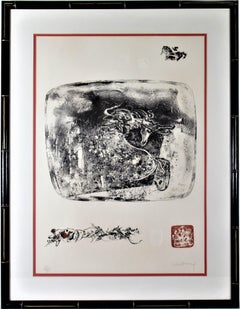
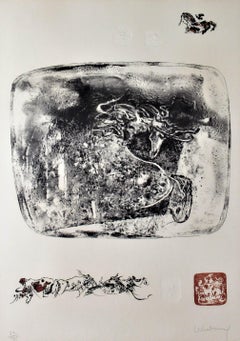
Horses #V
Horses #V

Hoi LebadangHorses #V, c.1974

$1,020

H 37 in W 28.5 in D 1 in

Horses #V

By Hoi Lebadang

Located in San Francisco, CA

This artwork "titled "Horses #V" 1974 is an original color lithograph, with embossing by French/Vietnamese artist Hoi Lebadang, 1922-2015. It is hand sign...

Category

Late 20th Century Modern Animal Prints

Materials

Lithograph

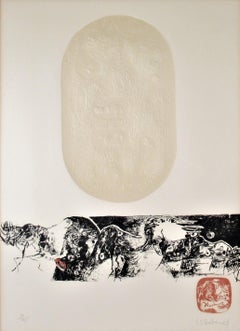
Horses #III
Horses #III

Hoi LebadangHorses #III, c.1974

$1,020

H 37 in W 28.5 in D 1 in

Horses #III

By Hoi Lebadang

Located in San Francisco, CA

This artwork "titled "Horses #III" 1974 is an original color lithograph, with embossing by French/Vietnamese artist Hoi Lebadang, 1922-2015. It is hand si...

Category

Late 20th Century Modern Animal Prints

Materials

Lithograph

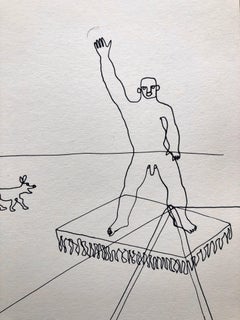
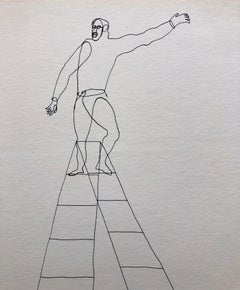
Alexander Calder Circus Reproduction Lithograph After a Drawing

Alexander Calder Circus Reproduction Lithograph After a Drawing

By (after) Alexander Calder

Located in Surfside, FL

(after) Alexander Calder "Calder's Circus" offset lithograph on wove paper after drawings by the artist Published by Art in America and Perls gallery in 1964 (from drawings done in the 1930's) these range slightly in size but they are all about 13 X 17 inches (with minor variations in size as issued.) These have never been framed. The outer folio is not included just the one lithograph. James Sweeny from the introduction “The fame of Calder’s circus spread quickly between the years 1927 and 1930. All the Paris art world came to know it. It brought him his first great personal success. But what was more important, the circus also provided the first steps in Calder’s development as an original sculptor” Clive Gray wrote ”A visit to the studio of Alexander Calder led to the chance discovery of some hundred masterful circus drawings completed over thirty years ago. We publish, for the first time, a choice of sixteen from that group.” With signed introduction by Miro. These whimsical drawings, done in the style of wire sculpture, include acrobats, clowns, jugglers, trapeeze artists, an elephant, dog and lion. they are great. Alexander Calder is widely considered to be one of the most important American sculptors of the 20th century. He is best known for his colorful, whimsical abstract public sculptures and his innovative mobiles, kinetic sculptures powered by motors or air currents, which embraced chance in their aesthetic. Born into a family of accomplished artists, Calder's work first gained attention in Paris in the 1930s and was soon championed by the Museum of Modern Art in New York, resulting in a retrospective exhibition in 1943. Major retrospectives were also held at the Solomon R. Guggenheim Museum (1964) and the Museum of Contemporary Art, Chicago (1974). Calder’s work is in many permanent collections, most notably in the Whitney Museum of American Art, but also the Guggenheim Museum; the Museum of Modern Art; the National Gallery of Art, Washington, D.C.; and the Centre Georges Pompidou. He produced many large public works, including .125 (at JFK Airport, 1957), Pittsburgh (Carnegie International prize winner 1958, Pittsburgh International Airport) Spirale (UNESCO in Paris, 1958), Flamingo and Universe (both in Chicago, 1974), and Mountains and Clouds (Hart Senate Office Building, Washington, D.C., 1976). Although primarily known for his sculpture, Calder was a prodigious artist with a restless creative spirit, whose diverse practice included painting and printmaking, miniatures (such as his famous Cirque Calder), children’s book illustrations, theater set design, jewelry design, tapestry and rug works, and political posters. Calder was honored by the US Postal Service with a set of five 32-cent stamps in 1998, and received the Presidential Medal of Freedom, posthumously in 1977, after refusing to receive it from Gerald Ford one year earlier in protest of the Vietnam War. Calder moved to New York and enrolled at the Art Students League, studying briefly with Thomas Hart Benton, George Luks, Kenneth Hayes Miller, and John Sloan. While a student, he worked for the National Police Gazette where, in 1925, one of his assignments was sketching the Ringling Bros. and Barnum & Bailey Circus. Calder became fascinated with the action of the circus, a theme that would reappear in his later work. In 1926, Calder moved to Paris, enrolled in the Académie de la Grande Chaumière, and established a studio at 22 rue Daguerre in the Montparnasse Quarter. In June 1929, while traveling by boat from Paris to New York, Calder met his future wife, Louisa James (1905-1996), grandniece of author Henry James and philosopher William James. They married in 1931. While in Paris, Calder met and became friends with a number of avant-garde artists, including Fernand Léger, Jean Arp, and Marcel Duchamp. Cirque Calder (on view at the Whitney Museum of American Art at present) became popular with the Parisian avant-garde. He also invented wire sculpture, or "drawing in space," and in 1929 he had his first solo show of these sculptures in Paris at Galerie Billiet. Hi! (Two Acrobats) in the collection of the Honolulu Museum of Art is an early example of the artist's wire sculpture. The painter Jules Pascin, a friend of Calder's from the cafes of Montparnasse, wrote the preface to the catalog. A visit to Piet Mondrian's studio in 1930, where he was impressed by the environment-as-installation, "shocked" him into fully embracing abstract art, toward which he had already been tending. Dating from 1931, Calder’s sculptures of discrete movable parts powered by motors were christened “mobiles” by Marcel Duchamp, a French pun meaning both "motion" and "motive." At the same time, Calder was also experimenting with self-supporting, static, abstract sculptures, dubbed "stabiles" by Jean Arp in 1932 to differentiate them from mobiles. Public commissions increasingly came his way in the 1960s. Notable examples are .125 for JFK Airport in 1957, Spirale for UNESCO in Paris 1958 and Trois disques, commissioned for Expo 67 in Montreal, Quebec, Canada. Calder's largest sculpture at 25.7 meters high was El Sol Rojo, constructed outside the Aztec Stadium for the 1968 Summer Olympics "Cultural Olympiad" events in Mexico City. Many of his public works were commissioned by renowned architects; I.M. Pei commissioned his La Grande Voile (1966), a 25-ton, 40-foot high stabile for the Massachusetts Institute of Technology. Part of Calder's repertoire includes pivotal stage sets for more than a dozen theatrical productions, including Nucléa, Horizon, and most notably, Martha Graham’s Panorama (1935), a production of the Erik Satie symphonic drama Socrate (1936), and later, Works in Progress (1968). In addition to sculptures, Calder painted throughout his career, beginning in the early 1920s. He picked up his study of printmaking in 1925, and continued to produce illustrations for books and journals.As Calder’s professional reputation expanded in the late 1940s and 1950s, so did his production of prints. Masses of lithographs based on his gouache paintings hit the market, and deluxe editions of plays, poems, and short stories illustrated with fine art prints by Calder became available for sale. One of Calder's most celebrated and unconventional undertakings was a commission from Dallas-based Braniff International Airways to paint a full-size Douglas DC-8-62 four-engined jet as a "flying canvas." Calder created over 2,000 pieces of jewelry over the course of his career, many of them as gifts for friends and relatives. For his lifelong friend Joan Miró, he set a shard of a broken porcelain vessel in a brass ring. Peggy Guggenheim received enormous silver mobile earrings and later commissioned a hammered silver headboard...

Category

1930s American Modern Animal Prints
Materials

Lithograph

“Europa and the Bull”

Alvar Sunol Munoz-Ramos“Europa and the Bull”

$1,350

H 30.75 in W 36.75 in D 2 in

“Europa and the Bull”

By Alvar Sunol Munoz-Ramos

Located in San Francisco, CA

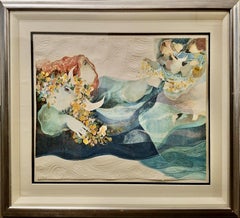
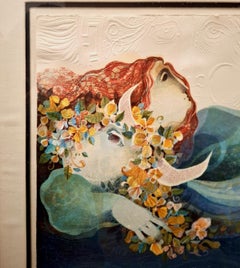
You have to hand it to the bull. Not just taking Europa with his unassailable power (he is Zeus in disguise, after all) he brings along a retinue for his seduction of the beautiful P...

Category

1980s Modern Figurative Prints

Materials

Paper, Lithograph

Previously Available Items
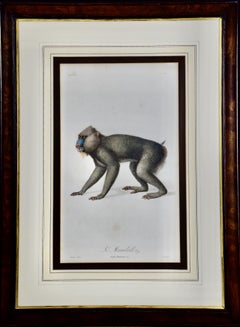
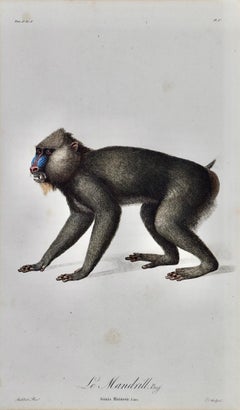
African Mandrill Monkey: A Framed 18th C. Hand-colored Engraving by Audebert

African Mandrill Monkey: A Framed 18th C. Hand-colored Engraving by Audebert

By Jean Baptiste Auderbert

Located in Alamo, CA

This is a framed 18th century folio-sized colored stipple engraving with hand-finishing entitled "Le Mandrill. Buff. Simia Maimon. Linn, which was drawn and engraved by Jean Baptiste Audebert...

Category

Late 18th Century Animal Prints
Materials

Engraving