Badger Prints and Multiples

to
1
3
2
1
Overall Width
to
Overall Height
to
4
1
1
1
1
1
3
2
1
4
2
8
39,656
20,889
13,528
12,842
11,344
9,244
8,190
5,779
4,476
3,950
3,808
3,730
3,672
3,516
3,393
3,333
2,946
2,897
2,576
2
2
2
1
1
3
5
Art Subject: Badger
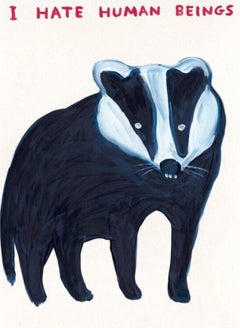
I Hate Human Beings

I Hate Human Beings

By David Shrigley

Located in Central, HK

David Shrigley I Hate Human Beings, 2021 Screen print on wove paper Signed, dated, and numbered on the COA Edition 86/125 on the verso Published by AllRightsReserved, Hong Hong Accom...

Category

2010s Animal Prints

Materials

Screen

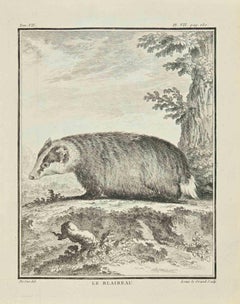
Le Blaireau - Etching by Louis Legrand - 1771

Le Blaireau - Etching by Louis Legrand - 1771

By Louis Legrand

Located in Roma, IT

Le Blaireau is an etching realized in 1771 by Louis Legrand (1723-1807). Titled and Signed on the plate. The artwork Belongs to the suite "Histoire naturelle, générale et particuli...

Category

1770s Modern Figurative Prints

Materials

Etching

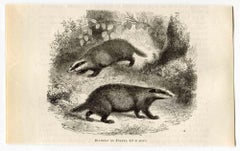
Blaireau de France - Lithograph by Paul Gervais - 1854

Blaireau de France - Lithograph by Paul Gervais - 1854

By Paul Gervais

Located in Roma, IT

Blaireau de France is an original lithograph on ivory-colored paper, realized by Paul Gervais (1816-1879). The artwork is from The Series of "Les Trois Règnes de la Nature", and was ...

Category

1850s Modern Animal Prints

Materials

Paper, Lithograph

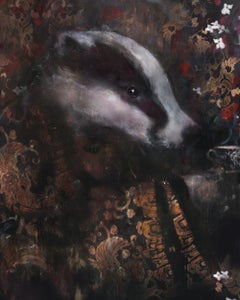
Tea For Two - Brock

Tea For Two - Brock

By Harry Bunce

Located in Deddington, GB

Tea for Two – Brock [2017] limited_edition Screenprint Edition number 156 Image size: H:31 cm x W:25 cm Complete Size of Unframed Work: H:49 cm x W:41 cm x D:0.3cm Sold Unframed Ple...

Category

21st Century and Contemporary Animal Prints

Materials

Screen

Related Items
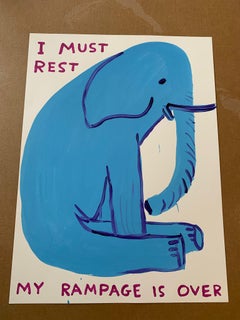
My Rampage is Over (Artist Proof)

My Rampage is Over (Artist Proof)

By David Shrigley

Located in Manchester, GB

David Shrigley, My Rampage is Over, 2019 21 Colour Screenprint with Varnish Overlay on Somerset Satin Tub Sized 410gsm Paper 29 1/2 × 22 in (76 × 56 cm) Edition of 125 / This bein...

Category

2010s Contemporary Animal Prints

Materials

Screen

20th century drypoint etching figurative animal print horses sketch signed

20th century drypoint etching figurative animal print horses sketch signed

By Claude Weisbuch

Located in Milwaukee, WI

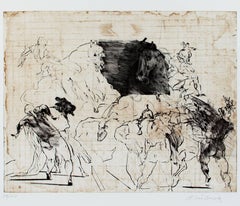
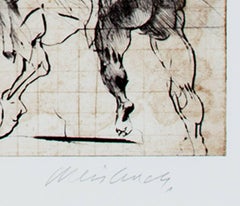
"Combat Equestre" is an original lithograph by Claude Weisbuch. The artist signed the piece lower right and wrote the edition number (24/100) in the lower left. This piece depicts mu...

Category

1970s Modern Figurative Prints

Materials

Drypoint, Etching

Leonor Fini - Cats - Original Etching

Leonor FiniLeonor Fini - Cats - Original Etching, 1985

$1,412

H 17.33 in W 11.03 in D 0.04 in

Leonor Fini - Cats - Original Etching

By Leonor Fini

Located in Collonge Bellerive, Geneve, CH

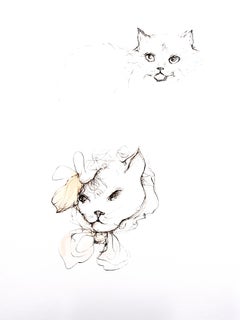
Leonor Fini - Cats - Original Engraving Mme.Helvetius' Cats Original etching created in 1985, Printed Signature (LF). Conditions: excellent Edition: 100 Support: Arches paper. Dimensions: Paper dimensions: 44 x 28 cm Editions: Moret, Paris. Leonor Fini is considered one of the most important women artists of the mid-twentieth century, along with Leonora Carrington, Frida Kahlo, Meret Oppenheim, Remedios Varo, and Dorothea Tanning – most of whom Fini knew well. Her career, which spanned some six decades, included painting, graphic design, book illustration, product design (the renowned torso-shaped perfume bottle for Schiaparelli’s Shocking), and set and costume design for theatre, ballet, opera, and film. In this compellingly readable, exhaustively researched account, author Peter Webb brings Fini’s provocative art and unconventional personal life, as well as the vibrant avant-garde world in which she revolved, vividly in life. Born in Buenos Aires in 1907 (August 30 – January 18, 1996, Paris) to Italian and Argentine parents, Leonor grew up in Trieste, Italy, raised by her strong-willed, independent mother, Malvina. She was a virtually self-taught artist, learing anatomy directly from studying cadavers in the local morgue and absorbing composition and technique from the Old Masters through books and visits to museums. Fini’s fledging attempts at painting in Trieste let her to Milan, where she participated in her first group exhibition in 1929, and then to Paris in 1931. Her vivacious personality and flamboyant attire instantly garnered her a spotlight in the Parisian art world and she soon developed close relationships with the leading surrealist writers and painters, including Paul Eluard, Salvador Dali, Man Ray, and Max Ernst, who became her lover for a time. The only surrealist she could not abide because of his misogyny was André Breton. Although she repeatedly exhibited with them, she never considered herself a surrealist. The American dealer Julien Levy, very much impressed by Fini’s painting and smitten by her eccentric charms, invited her to New York in 1936, where she took part in a joint gallery exhibition with Max Ernst and met many American surrealists, including Joseph Cornell and Pavel Tchelitchew. Her work was included in MoMA’s pivotal Fantastic Art, Dada and Surrealism exhibition, along with De Chirico, Dali, Ernst, and Yves Tanguy. In 1939 in Paris she curated an exhibition of surrealist furniture for her childhood friend Leo Castelli for the opening of his first gallery. Introductions to her exhibition catalogues were written by De Chirico, Ernst, and Jean Cocteau. A predominant theme of Fini’s art is the complex relationship between the sexes, primarily the interplay between the dominant female and the passive, androgynous male. In many of her most powerful works, the female takes the form of a sphinx, often with the face of the artist. Fini was also an accomplished portraitist; among her subjects were Stanislao Lepri...

Category

1980s Modern Animal Prints

Materials

Etching

Emilio Vedova - Original Lithograph

Emilio Vedova - Original Lithograph

By Emilio Vedova

Located in Collonge Bellerive, Geneve, CH

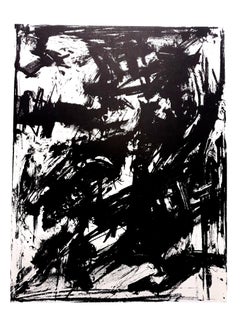
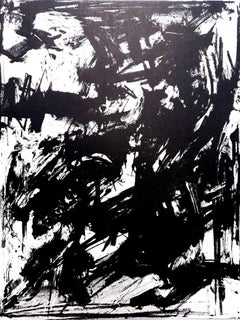
Emilio Vedova - Original Lithograph Abstraction 1961 From the art revue XXe Siecle Dimensions: 32 x 24 Edition: G. di San Lazzaro. Unsigned and unumbered as issued

Category

1960s Modern Figurative Prints

Materials

Lithograph

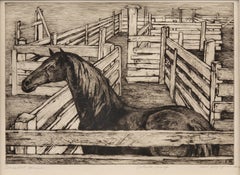
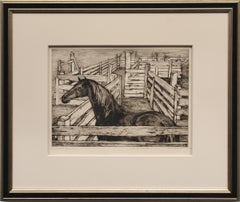
Ethel Magafan “Corralled Horse” 1940s WPA-Era Modernist Etching, Artist’s Proof

Ethel Magafan “Corralled Horse” 1940s WPA-Era Modernist Etching, Artist’s Proof

By Ethel Magafan

Located in Denver, CO

Corralled Horse is a rare WPA-era modernist etching by acclaimed American artist Ethel Magafan, created in the 1940s. This artist’s proof depicts a lone dark horse within a wooden co...

Category

1940s American Modern Figurative Prints

Materials

Etching

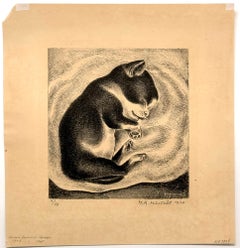
Slapende jonge kat (Sleeping kitten)

Slapende jonge kat (Sleeping kitten)

Located in Middletown, NY

Lithograph on cream wove paper with a large, modern geometric watermark, 10 x 9 5/8 inches (255 x 245 mm), the full sheet. Signed, dated and numbered 4/25 in pencil in the lower right.

Category

Late 19th Century Modern Animal Prints

Materials

Laid Paper, Etching

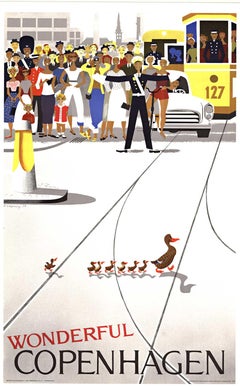
Original "Wonderful Copenhagen" vintage travel poster

Original "Wonderful Copenhagen" vintage travel poster

Located in Spokane, WA

Original vintage poster: WONDERFUL COPENHAGEN created by the artist Viggo Vagnby. This antique poster is archival linen-backed, in excellent condition, and ready to frame. No da...

Category

1950s American Modern Animal Prints

Materials

Lithograph

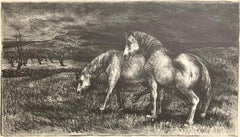
Reginald Wilson, Horses

Reginald Wilson, Horses

By Reginald Wilson

Located in New York, NY

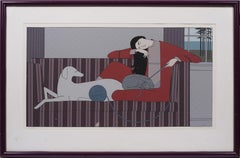
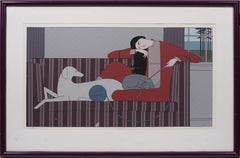
Although this work is titled Horses. It nice to think it could be (Horses in a Field in Woodstock, NY), but it was printed by Will Barnet at the Art Students League, about 1938, and Wilson, who visited Woodstock with Arnold Blanche...

Category

1930s American Modern Animal Prints

Materials

Lithograph

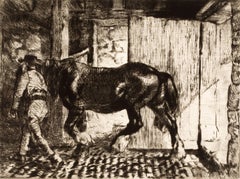
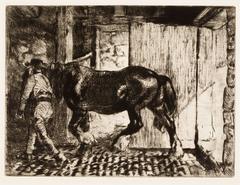
Returning to the Stable.

Edmund BlampiedReturning to the Stable., 1920

$800Sale Price|36% Off

H 8.75 in W 7.25 in D 0.5 in

Returning to the Stable.

By Edmund Blampied

Located in Plano, TX

Returning to the Stable. 1920. Drypoint. Appleby 64. 8 3/4 x 12 1/4 (sheet 11 7/16 x 16 1/8). Edition 100. A rich impression printed on cream laid paper wi...

Category

1920s Modern Interior Prints

Materials

Drypoint, Etching

Alexander Calder Circus Reproduction Lithograph After a Drawing

Alexander Calder Circus Reproduction Lithograph After a Drawing

By (after) Alexander Calder

Located in Surfside, FL

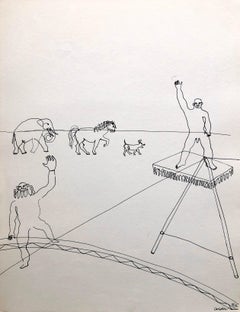
(after) Alexander Calder "Calder's Circus" offset lithograph on wove paper after drawings by the artist Published by Art in America and Perls gallery in 1964 (from drawings done in the 1930's) these range slightly in size but they are all about 13 X 17 inches (with minor variations in size as issued.) These have never been framed. The outer folio is not included just the one lithograph. James Sweeny from the introduction “The fame of Calder’s circus spread quickly between the years 1927 and 1930. All the Paris art world came to know it. It brought him his first great personal success. But what was more important, the circus also provided the first steps in Calder’s development as an original sculptor” Clive Gray wrote ”A visit to the studio of Alexander Calder led to the chance discovery of some hundred masterful circus drawings completed over thirty years ago. We publish, for the first time, a choice of sixteen from that group.” With signed introduction by Miro. These whimsical drawings, done in the style of wire sculpture, include acrobats, clowns, jugglers, trapeeze artists, an elephant, dog and lion. they are great. Alexander Calder is widely considered to be one of the most important American sculptors of the 20th century. He is best known for his colorful, whimsical abstract public sculptures and his innovative mobiles, kinetic sculptures powered by motors or air currents, which embraced chance in their aesthetic. Born into a family of accomplished artists, Calder's work first gained attention in Paris in the 1930s and was soon championed by the Museum of Modern Art in New York, resulting in a retrospective exhibition in 1943. Major retrospectives were also held at the Solomon R. Guggenheim Museum (1964) and the Museum of Contemporary Art, Chicago (1974). Calder’s work is in many permanent collections, most notably in the Whitney Museum of American Art, but also the Guggenheim Museum; the Museum of Modern Art; the National Gallery of Art, Washington, D.C.; and the Centre Georges Pompidou. He produced many large public works, including .125 (at JFK Airport, 1957), Pittsburgh (Carnegie International prize winner 1958, Pittsburgh International Airport) Spirale (UNESCO in Paris, 1958), Flamingo and Universe (both in Chicago, 1974), and Mountains and Clouds (Hart Senate Office Building, Washington, D.C., 1976). Although primarily known for his sculpture, Calder was a prodigious artist with a restless creative spirit, whose diverse practice included painting and printmaking, miniatures (such as his famous Cirque Calder), children’s book illustrations, theater set design, jewelry design, tapestry and rug works, and political posters. Calder was honored by the US Postal Service with a set of five 32-cent stamps in 1998, and received the Presidential Medal of Freedom, posthumously in 1977, after refusing to receive it from Gerald Ford one year earlier in protest of the Vietnam War. Calder moved to New York and enrolled at the Art Students League, studying briefly with Thomas Hart Benton, George Luks, Kenneth Hayes Miller, and John Sloan. While a student, he worked for the National Police Gazette where, in 1925, one of his assignments was sketching the Ringling Bros. and Barnum & Bailey Circus. Calder became fascinated with the action of the circus, a theme that would reappear in his later work. In 1926, Calder moved to Paris, enrolled in the Académie de la Grande Chaumière, and established a studio at 22 rue Daguerre in the Montparnasse Quarter. In June 1929, while traveling by boat from Paris to New York, Calder met his future wife, Louisa James (1905-1996), grandniece of author Henry James and philosopher William James. They married in 1931. While in Paris, Calder met and became friends with a number of avant-garde artists, including Fernand Léger, Jean Arp, and Marcel Duchamp. Cirque Calder (on view at the Whitney Museum of American Art at present) became popular with the Parisian avant-garde. He also invented wire sculpture, or "drawing in space," and in 1929 he had his first solo show of these sculptures in Paris at Galerie Billiet. Hi! (Two Acrobats) in the collection of the Honolulu Museum of Art is an early example of the artist's wire sculpture. The painter Jules Pascin, a friend of Calder's from the cafes of Montparnasse, wrote the preface to the catalog. A visit to Piet Mondrian's studio in 1930, where he was impressed by the environment-as-installation, "shocked" him into fully embracing abstract art, toward which he had already been tending. Dating from 1931, Calder’s sculptures of discrete movable parts powered by motors were christened “mobiles” by Marcel Duchamp, a French pun meaning both "motion" and "motive." At the same time, Calder was also experimenting with self-supporting, static, abstract sculptures, dubbed "stabiles" by Jean Arp in 1932 to differentiate them from mobiles. Public commissions increasingly came his way in the 1960s. Notable examples are .125 for JFK Airport in 1957, Spirale for UNESCO in Paris 1958 and Trois disques, commissioned for Expo 67 in Montreal, Quebec, Canada. Calder's largest sculpture at 25.7 meters high was El Sol Rojo, constructed outside the Aztec Stadium for the 1968 Summer Olympics "Cultural Olympiad" events in Mexico City. Many of his public works were commissioned by renowned architects; I.M. Pei commissioned his La Grande Voile (1966), a 25-ton, 40-foot high stabile for the Massachusetts Institute of Technology. Part of Calder's repertoire includes pivotal stage sets for more than a dozen theatrical productions, including Nucléa, Horizon, and most notably, Martha Graham’s Panorama (1935), a production of the Erik Satie symphonic drama Socrate (1936), and later, Works in Progress (1968). In addition to sculptures, Calder painted throughout his career, beginning in the early 1920s. He picked up his study of printmaking in 1925, and continued to produce illustrations for books and journals.As Calder’s professional reputation expanded in the late 1940s and 1950s, so did his production of prints. Masses of lithographs based on his gouache paintings hit the market, and deluxe editions of plays, poems, and short stories illustrated with fine art prints by Calder became available for sale. One of Calder's most celebrated and unconventional undertakings was a commission from Dallas-based Braniff International Airways to paint a full-size Douglas DC-8-62 four-engined jet as a "flying canvas." Calder created over 2,000 pieces of jewelry over the course of his career, many of them as gifts for friends and relatives. For his lifelong friend Joan Miró, he set a shard of a broken porcelain vessel in a brass ring. Peggy Guggenheim received enormous silver mobile earrings and later commissioned a hammered silver headboard...

Category

1930s American Modern Animal Prints
Materials

Lithograph