Mid-19th Century Sculptures

to
5
47
14
16
9
10
Overall Width
to
Overall Height
to
219
694
3,899
17,241
86
43
119
133
67
153
274
372
568
529
74
1
54
52
48
33
31
22
17
15
11
10
8
6
5
5
5
5
4
4
3
3
69
67
21
20
5
11
10
9
3
2
53
43
Period: Mid-19th Century
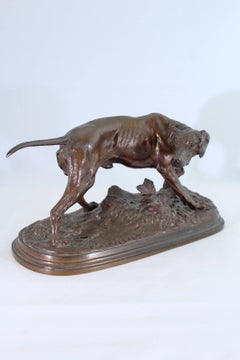
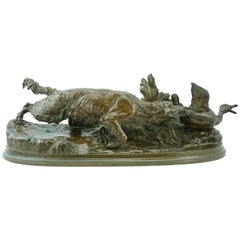
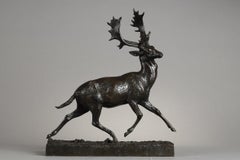
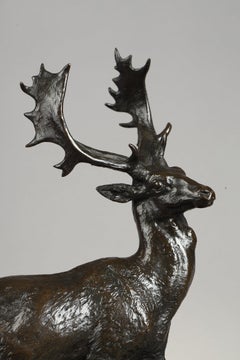
Running fallow deer
Running fallow deer

Running fallow deer

Located in PARIS, FR

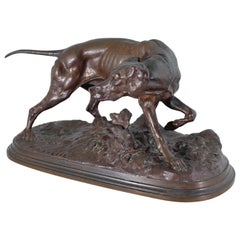
Running fallow deer by Pierre-Jules MENE (1810-1879) A rare bronze sculpture with a nuanced dark brown patina Signed on the base "P.J. Mêne" With the foundry mark "fondu par Eugène...

Category

French School Mid-19th Century Sculptures

Materials

Bronze

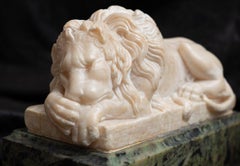
Pair of Italian "Alabaster Stone Lions" after Antonio Canova; Mid 19th Century

Pair of Italian "Alabaster Stone Lions" after Antonio Canova; Mid 19th Century

Located in SANTA FE, NM

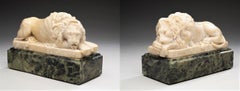
"Pair Recumbent Stone Lions" after Antonio Canova (1757-1822) Italian (possibly Florence) Mid 19th Century Alabaster, marble 6 x 9 x 4 inches This is an exquisite pair of Italian alabaster lions on marble bases based on the monumental lions carved by Antonio Canova (1757-1822), the greatest Italian neoclassical sculptor. Canova sculpted the marble lions for the monumental tomb of Pope Clement XIII in St. Peter’s, Rome in 1792 Canova Lions refers to the pair of copies of lion sculptures by Antonio Canova. When Canova created the sculptures in 1792, he installed them on the tomb of Pope Clement XIII. The marble sculptures are some of the most prominent features in St. Peter's Basilica in Rome. Given the intricacies of creating the original Canova lions, some artists created molds and replicated them. A good example is the pair of lion sculptures...

Category

Italian School Mid-19th Century Sculptures

Materials

Alabaster, Marble

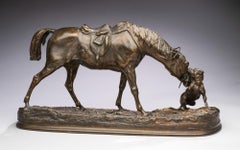
Cheval Libre (Free Horse)

Cheval Libre (Free Horse)

By Pierre Jules Mêne

Located in San Francisco, CA

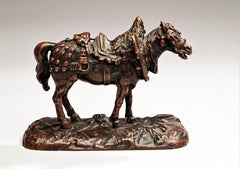
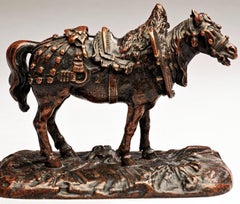
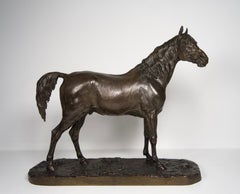
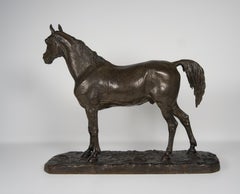
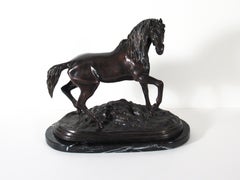
Artist: After Pierre Jules Mene (French, 1810-1879) Title: Cheval Libre (Free Horse) Year: 1868 Medium: Cast bronze sculpture with dark brown patina Edition: Unknown Size: Inclu...

Category

Realist Mid-19th Century Sculptures

Materials

Bronze

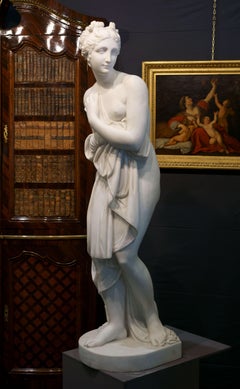
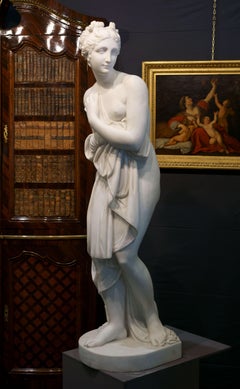
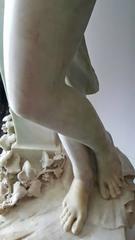
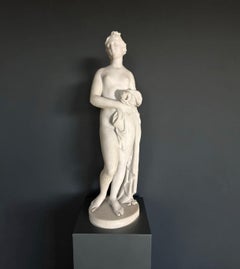
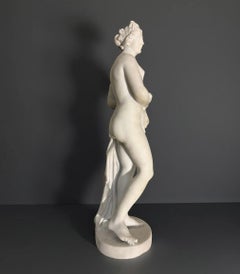
Large Neoclassical White Marble Sculpture Venus Italica mid-19th century

Large Neoclassical White Marble Sculpture Venus Italica mid-19th century

Located in Pistoia, IT

Venus Italica, imposing sculpture in white Carrara marble, mid-nineteenth-century Roman atelier. Antonio Canova made several sculptures depicting Venus. The first was made as compen...

Category

Italian School Mid-19th Century Sculptures

Materials

Marble

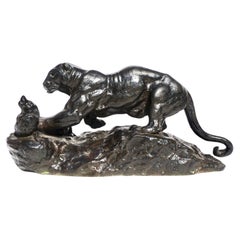
Lion and snake
Lion and snake

Lion and snake

By Antoine-Louis Barye

Located in PARIS, FR

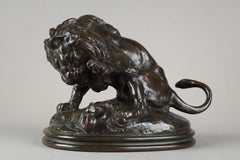
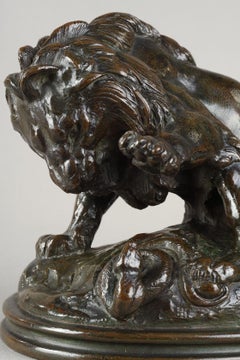
Lion and snake n°3 by Antoine-Louis Barye (1796-1875) Bronze sculpture with a nuanced dark greenish brown patina signed "Barye" on the base old edition cast – probably from the Bary...

Category

French School Mid-19th Century Sculptures

Materials

Bronze

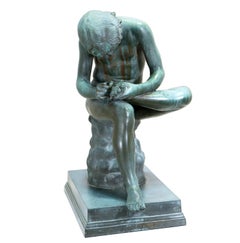
Seated Mercury, or Hermes - God of Speed

Seated Mercury, or Hermes - God of Speed

Located in New York, NY

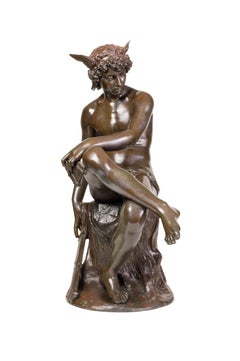
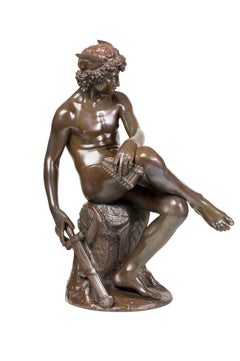
This Mercury by Montagne has lovely patina and surface and is a pleasingly different depiction of Winged speed as he is seated! It is an arresting pose and elegant and covers all fa...

Category

Academic Mid-19th Century Sculptures

Materials

Bronze

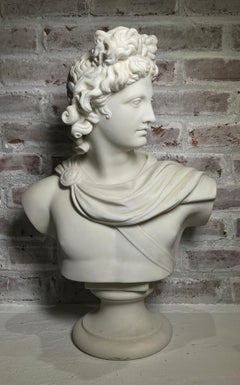
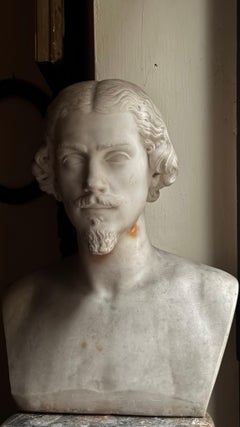
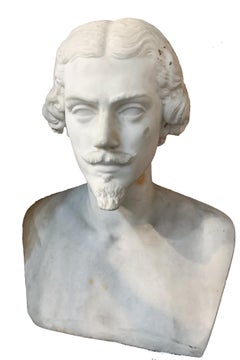
Italian Mid 19th century White Carrara Marble bust. Portrait of young male.

Italian Mid 19th century White Carrara Marble bust. Portrait of young male.

Located in Firenze, IT

Italian Portrait White Marble Bust in a Heroic Attitude. Carrara statuary Marble. Tuscan school. Circa 1850.  Bust depicting a young man with bare shoulders. This model draws inspira...

Category

Academic Mid-19th Century Sculptures

Materials

Marble

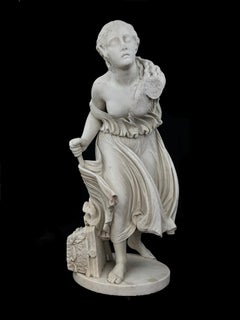
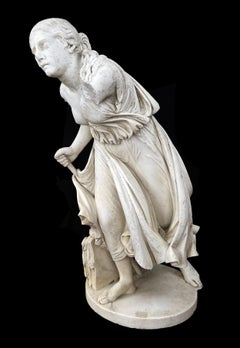
NYDIA, THE BLIND FLOWER GIRL OF POMPEII Marble Sculpture 1856-1870

NYDIA, THE BLIND FLOWER GIRL OF POMPEII Marble Sculpture 1856-1870

Located in Soquel, CA

Randolph John Rogers (American, 1825 - 1892) Randolph Rogers' Nydia, the Blind Flower Girl of Pompeii debuted in 1856 to critical and public acclaim, solidifying Rogers’ position as a pre-eminent American sculptor and it remains one of the artist’s most celebrated works today. The subject of Nydia is drawn from Edward Bulwer-Lytton's The Last Days of Pompeii 1834. After touring the ruins of the ancient city in 1833, and inspired by the stories of blinding volcanic ash, he composed the tale of Nydia, a slave who led her master, Glaucus, to safety. Rogers depicts Nydia at the moment that she and Glaucus have become separated in their perilous journey through the rubble and Nydia seeks familiarity in the surrounding chaos, her distress evident in her pained expression. The grace of the sculpture is at odds with the turmoil portrayed; a toppled Corinthian capital lies at her feet and obstructs her next step, indicated by the tilt of her back foot and grip on her walking stick. Examples of this model can be found in major American collections, including The Metropolitan Museum of Art, the Art Institute of Chicago, the Detroit Institute of Arts, the Los Angeles County Museum of Art, and the Museum of Fine Arts, Boston. Literature, Millard F Rogers, Jr. Randolph Rogers, American Sculptor in Rome. University of Massachusetts Press, 1971, American Figurative Sculpture in the Museum of Fine Arts Boston. Museum of Fine Arts, Boston, 1986. Joyce K Schiller. "Nydia, A Forgotten Icon of the Nineteenth Century." Bulletin of the Detroit Institute of Arts, Born in Waterloo, New York, Randolph John Rogers became an expatriate* sculptor of idealized figures, portraits, and commemorative works in Neo-Classical* and Realist* styles. He worked in clay, plaster, marble and bronze, and lived both in Italy and the United States. He made 167 examples of Nydia in two sizes (varies depending on base height) 36" and 54'. Rogers was raised in Ann Arbor, Michigan, and as a young man did woodcuts* for the local newspaper, The Michigan Argus, and also worked as a baker's assistant and a dry goods clerk. In 1847, he moved to New York City, where he hoped to find work as an engraver*, but failing to do so, worked in a dry goods store owned by John Steward...

Category

Italian School Mid-19th Century Sculptures

Materials

Marble

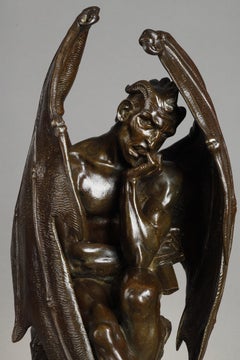
Mephistopheles
Mephistopheles

Mephistopheles

Located in PARIS, FR

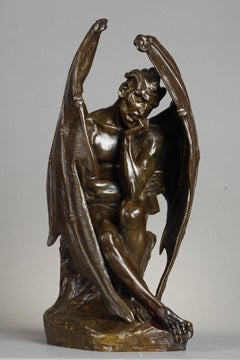
"Mephistopheles" also known as "Satan, The fallen angel" by Jean-Jacques FEUCHERE (1807-1852) A bronze sculpture with a nuanced brown patina Signed " J Feuchère 1833 " old edition c...

Category

French School Mid-19th Century Sculptures

Materials

Bronze

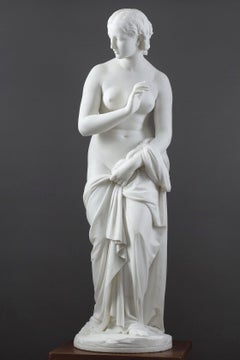
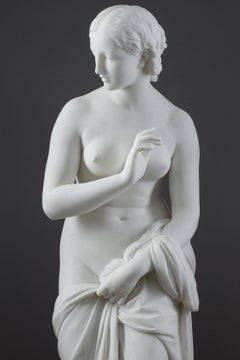
Musidora
Musidora

Musidora

Located in PARIS, FR

"Musidora" by Odoardo FANTACCHIOTTI (1809-1877) Sculpture made in white Carrara marble signed on the side on the base " O. Fantacchiotti " Italy around 1862 height 110 cm diameter ...

Category

Italian School Mid-19th Century Sculptures

Materials

Marble

Florentine singer / - The Renaissance of the Renaissance -

Florentine singer / - The Renaissance of the Renaissance -

By Paul Dubois

Located in Berlin, DE

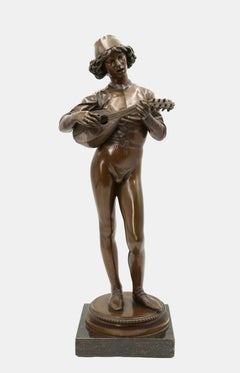
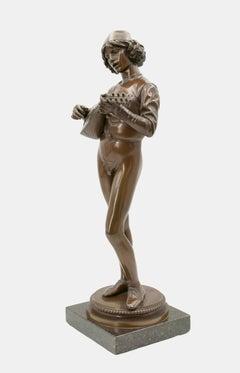
Paul Dubois (1829 Nogent-sur-Seine - 1905 Paris), Florentine singer, 1865. Light brown patinated bronze with cast round plinth mounted on a square marble base (3.5 cm high). Total height 53 cm. Bronze dimensions: 49.5 cm (height) x 20 cm (length) x 10 cm (width), weight 5.6 kg. Inscribed on the plinth "P.[aul] DUBOIS", dated "1865", with the foundry's mark "F. BARBEDIENNE FONDEUR" and the signet "REDUCTION MECANIQUE A. COLLAS". - Patina very occasionally darkened, lute with loss of one tuning peg, otherwise in excellent condition. - The renaissance of the Renaissance - The bronze is a precisely executed and masterfully cast contemporary reduction of Paul Dubois 155 cm tall masterpiece "Florentine Singer", which is exhibited in the Musée d'Orsay and for which the artist was awarded the Medal of Honor at the Paris Salon in 1865. The work acted as a beacon, and was followed by a plethora of depictions of juveniles. Inspired by Donatello and Luca della Robbia, but also by painters such as Piero della Francesca, Benozzo Gozzoli, and Pinturicchio, the "Florentine Singer" is not an epigonal work that pays homage to a vanished era, but a successful attempt to draw vitality from the art of the past and thus give it new life. The effect of vitality is the core of Italian Renaissance art theory. In order to fulfill itself as art, art had to appear like nature. This naturalism also characterizes the "Florentine Singer". The young man appears to have been taken from life, which is reinforced by the momentary nature of his action. He has just struck a now fading chord. In addition, the natural appearance is enhanced by the detailed shaping of the figurative details, such as the laces with the slightly curved leather of the shoes, the belt buckle, or the ornamentation on the body of the lute. Even the fingernails are clearly defined. Unlike the Renaissance, however, the effect of liveliness here is not based on the "discovery" of nature and the human body, but primarily on the rediscovery of the art of the Quattrocento. The liveliness of the artwork is therefore at the same time a revitalization of this art, so that we can speak of a Renaissance of the Renaissance, just as the Pre-Raphaelites in England at the same time transferred the Quattrocento to contemporary art. Dubois takes on the most difficult of all subjects, the depiction of singing through silent sculpture. He was preceded in this by Luca della Robbia and Donatello with their pulpits of singers created in the 1430s in the Museo dell'Opera del Duomo in Florence. Compared to these works, the physiognomy of Dubois singer is far less animated, yet he also depicts singing in a convincing manner. He uses the whole body. He takes the ancient contrapposto, which was essential to Renaissance sculpture, and transforms the standing leg-playing posture into a late medieval S-swing, giving the body an elegant beauty and at the same time setting it in melodic motion. In the equally elegant finger position, the music is expressed in a much more literal way with the beating of the lute. Finally, the musicality of the sculpture culminates in the face with the mouth open to sing. Through the act of singing, which is a great challenge to the artistic will to depict perfect beauty, the gracefulness of the classical face is not diminished, but enhanced. Starting from the face with the singing mouth and the gaze absorbed by the sounds, the inner vitality spreads, giving the bronze sculpture an intense aura, enhanced by the music. Dubois transfers the beauty of the Renaissance to the musical, sublimating the visible sculpture to the invisible of music. He took up the challenge of transcending the Renaissance with the Renaissance, thus responding to the Querelle des Anciens et des Modernes, which arose at the end of the 17th century around the French Academy and remained virulent into the 19th century, in which antiquity was regarded either as an unattainable ideal or as a standard to be surpassed. With his work, Dubois proved that the Renaissance, which had championed the art of the ancients, could lead to a new renaissance of art. About the artist Paul Dubois' great-uncle was the famous French Baroque sculptor Jean-Baptiste Pigalle, in whose footsteps the talented great-nephew followed. When he debuted at the Paris Salon in 1858, he signed his work "Dubois-Pigalle". At his father's request, however, he first studied law before devoting himself to sculpture under the tutelage of François Christophe Armand Toussaint in 1856 and entering the École des Beaux-Arts in 1858. From 1859 to 1863, he lived in Rome and traveled to Naples and Florence. Inspired by Florentine art of the quattrocento, Dubois initiated a school-forming neo-Florentine style that combined the elegantly simple forms of youthful grace with a precise wealth of detail.Two purchases by the French state (“envois de Rome”) were made during his stay in Rome, which brought him recognition in Paris. After his return there, he quickly became an internationally sought-after artist. Dubois was also active as a creator of monuments. His most famous work is the equestrian statue of Joan of Arc (1896) on the forecourt of Reims Cathedral. He was also a sought-after portraitist who produced around 50 busts and - Dubois was also a passionate painter - around 100 portraits in oil. From 1873 to 1878 he was curator of the Museum du Luxembourg, in 1876 he became a member of the Institut de France and from 1878 to 1905 he was director of the École des Beaux-Arts. In 1865, Dubois was awarded the Paris Salon Medal of Honor for his “Florentine Singer”. In 1867 he became Chevalier, in 1874 Officier, in 1886 Commandeur of the Légion d'honneur, which awarded Dubois the Grande Croix in 1896. Selected Bibliography Stole, Elmar: Paul Dubois. In: Saur. Allgemeines Künstlerlexikon, vol. 30, Munich - Leipzig 2001, pp. 677-678. GERMAN VERSION Paul Dubois (1829 Nogent-sur-Seine - 1905 Paris), Florentinischer Sänger, 1865. Hellbraun patinierte Bronze mit gegossener runder Plinthe auf quadratischem Marmorsockel montiert (3,5 cm Höhe). Gesamthöhe 53 cm. Maße der Bronze: 49,5 cm (Höhe) x 20 cm (Länge) x 10 cm (Breite), Gewicht 5,6 kg. Auf der Plinthe mit „P.[aul] DUBOIS“ bezeichnet, auf „1865“ datiert, mit dem Gießereistempel „F. BARBEDIENNE FONDEUR“ und dem Signet „REDUCTION MECANIQUE A. COLLAS“ versehen. - Patina sehr vereinzelt nachgedunkelt, Laute mit Verlust eines Stimmwirbels, ansonsten ausgezeichnet erhalten. - Die Renaissance...

Category

Realist Mid-19th Century Sculptures
Materials

Bronze

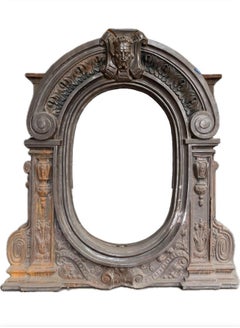
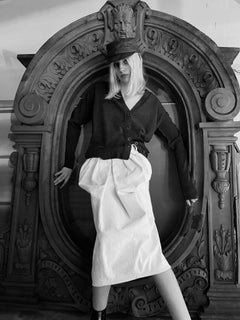
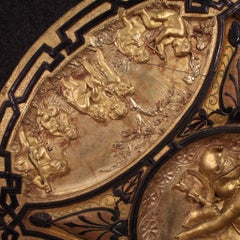
Neoclassical Style Cast Iron Window Surround

Neoclassical Style Cast Iron Window Surround

Located in Brooklyn, NY

A fabulous mid-to-late 19th-century cast iron window surround of exceptional scale—standing nearly six feet tall—now offered with the potential to be elegantly converted into a mirro...

Category

French School Mid-19th Century Sculptures

Materials

Iron

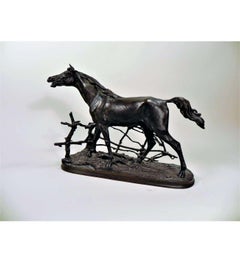
P.J. Mene 1846, Bronze cast+ Djinn, Arabian Stallion

P.J. Mene 1846, Bronze cast+ Djinn, Arabian Stallion

Located in Gent, VOV

Djinn, Arabian stallion 1846 A French bronze horse with a dark patina with brown undertones entitled 'Djinn étalon arabe' cast from the model by Pierre-Jules Mène (1810-1879), secon...

Category

French School Mid-19th Century Sculptures

Materials

Bronze

Jument arabe et son poulain n°2

Jument arabe et son poulain n°2

By Pierre Jules Mêne

Located in Ixelles, BE

Pierre Jules Mêne (1810 - 1879) fut l'un des sculpteurs français les plus importants du XIXe siècle, au même titre que d'autres animaliers célèbres tels qu'Antoine Louis Barye (1795 ...

Category

Naturalistic Mid-19th Century Sculptures

Materials

Bronze

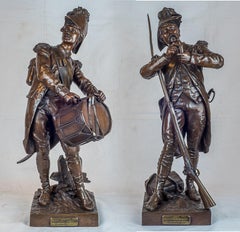
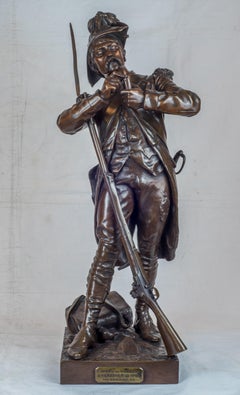
Avant Le Combat, Apres Le Combat

Avant Le Combat, Apres Le Combat

Located in New York, NY

ÉTIENNE-HENRI DUMAIGE French, (1830-1888) Avant Le Combat, Apres Le Combat Pair of patinated bronze; signed 'H. Dumaige' and titled ‘AVANT LE COMBAT, APRÈS LE COMBAT, GRENADIER D...

Category

Mid-19th Century Sculptures

Materials

Bronze

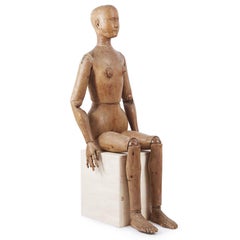
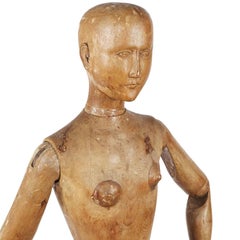
Female Life-size Mannequin Italian Articulated Sculpture In Beech Mid 1800s

Female Life-size Mannequin Italian Articulated Sculpture In Beech Mid 1800s

Located in Milano, IT

Female Painter's Manikin Mid-1800s jointed and articulated, life-size Italian sculpture, 167 cm tall 66 Inches, made of beech wood with traces of lacquer preparation. This extraordi...

Category

Italian School Mid-19th Century Sculptures

Materials

Wood

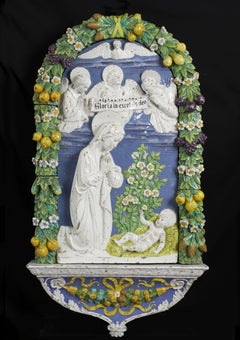
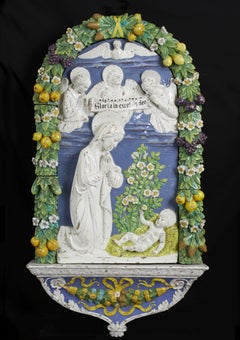
19th Century Madonna Adoring the Infant Jesus  Italian School Ceramic White Blue

19th Century Madonna Adoring the Infant Jesus Italian School Ceramic White Blue

Located in Sanremo, IT

Cantagalli-manufactured ceramics measuring 125 x 67 cm depicting a sweet Madonna adoring the Child Jesus and the Holy Spirit. At the beginning of the 19th century, Ulisse Cantagalli...

Category

Italian School Mid-19th Century Sculptures

Materials

Ceramic

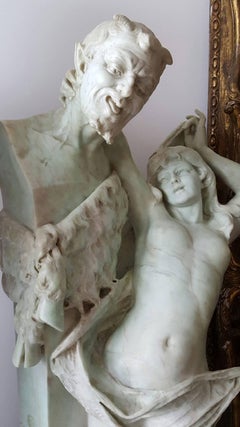
Erotic  Sexual Mythological Marble Figural, Nude woman, Bacchante and Satyr Herm

Erotic Sexual Mythological Marble Figural, Nude woman, Bacchante and Satyr Herm

Located in Miami, FL

Bacchic revelry. A sexy and nude curvaceous young Nymph/Bacchante makes amorous advances to a Herm - whose facial expression reflects her erotic touch. The Herm is stylized where his...

Category

Old Masters Mid-19th Century Sculptures

Materials

Marble

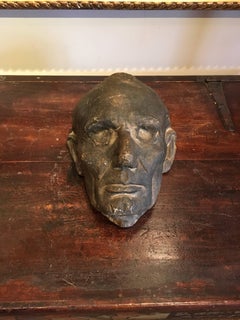
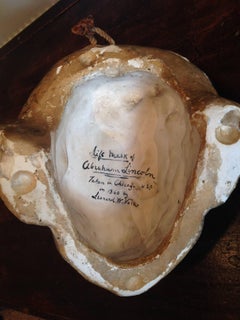
Life Mask of Abraham Lincoln

Life Mask of Abraham Lincoln

By Leonard Wells Volk

Located in London, GB

Leonard Wells Volk was a famous American sculptor. He went to posterity after making one of only two life masks of United States President Abraham Lincoln. I...

Category

Victorian Mid-19th Century Sculptures

Materials

Plaster

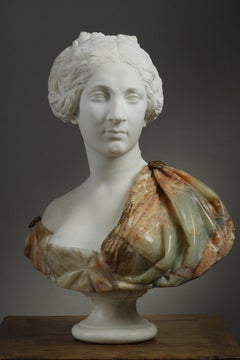
Portrait of a Lady
Portrait of a Lady

Portrait of a Lady

Located in PARIS, FR

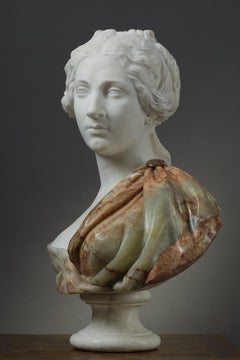
Portrait of a Lady by Charles CORDIER (1827-1905) A rare bust in white Carrara marble and onyx for the drape Signed on the backside " C. Cordier " Presented on a rounded white marbl...

Category

French School Mid-19th Century Sculptures

Materials

Marble

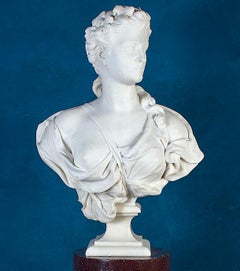
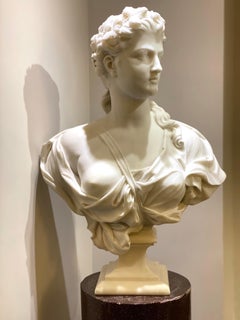
Superb Neoclassical White Marble Bust of Flora France 1850 '

Superb Neoclassical White Marble Bust of Flora France 1850 '

Located in Rome, IT

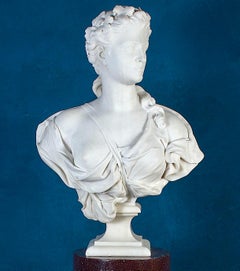
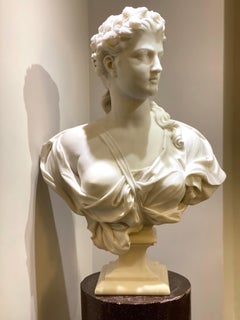
Superbly carved white statuary Carrara marble bust of Flora, the goddess of flowers. Flora was often associated with the coming of spring and the fertility of the land. She also sy...

Category

Mid-19th Century Sculptures

Materials

Marble

Monkey Match Holder
Monkey Match Holder

Monkey Match Holder

By Christophe Fratin

Located in PARIS, FR

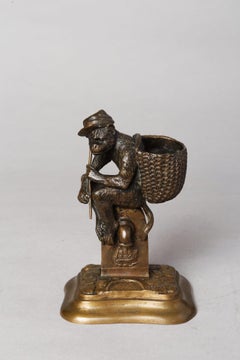
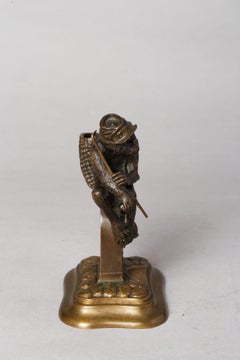
Monkey Match Holder by Christophe FRATIN (1801-1864) Bronze with nuanced brown patina Signed on the base "Fratin" Old edition cast France circa 1850 height 14,5 cm width 10 cm dep...

Category

French School Mid-19th Century Sculptures

Materials

Bronze

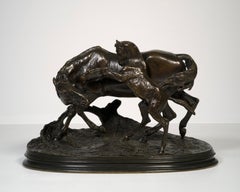
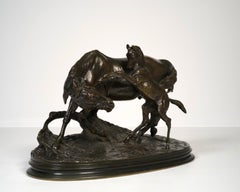
Cheval attaqué par un loup n°2

Cheval attaqué par un loup n°2

By Pierre Jules Mêne

Located in Ixelles, BE

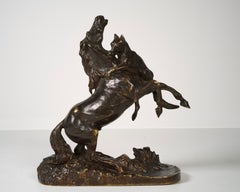
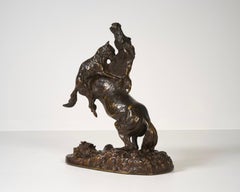
Le Cheval attaqué par un loup n° 2 est une réduction du premier modèle, qui fut exposé au Salon en 1840. Cette sculpture s’inscrit dans la production romantique de Pierre-Jules Mêne....

Category

Mid-19th Century Sculptures

Materials

Bronze

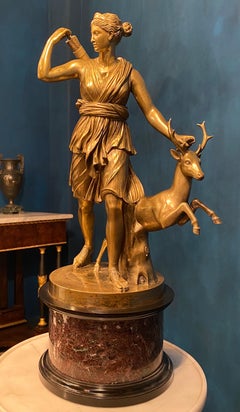
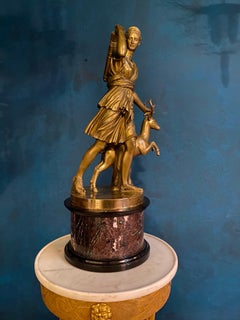
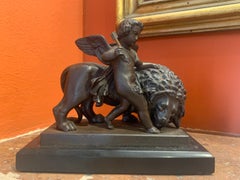
Allegorical mythological figurative bronze from the 19th century

Allegorical mythological figurative bronze from the 19th century

Located in Florence, IT

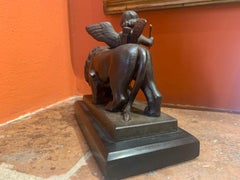
Marble-based bronze statuette depicting Cupid, holding an arrow in his hand, walking caressing a lion's mane, lowered in the act of affectionately licking his little foot. The subjec...

Category

Romantic Mid-19th Century Sculptures

Materials

Marble, Bronze

Antique 19th Century French Bonze Animalier Brown Bear Statue Sculpture Paris

Antique 19th Century French Bonze Animalier Brown Bear Statue Sculpture Paris

By Antoine-Louis Barye

Located in Portland, OR

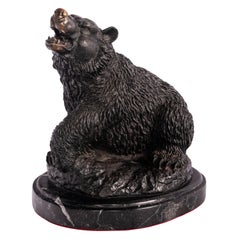
A good antique bronze sculpture of a brown bear by the celebrated French Animalier sculptor Antoine-Louis Barye, circa 1870. The bronze depicts a brown bear in a dynamic pose, head h...

Category

French School Mid-19th Century Sculptures

Materials

Marble, Bronze

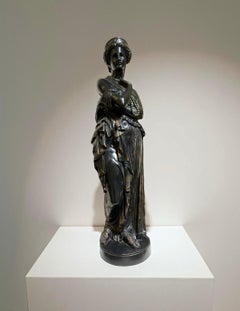
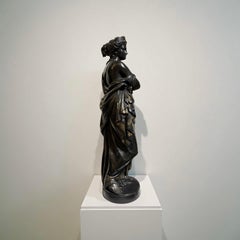
19th Century Austrian Sculpture of Fate

19th Century Austrian Sculpture of Fate

By Franz Melnitzky

Located in Los Angeles, CA

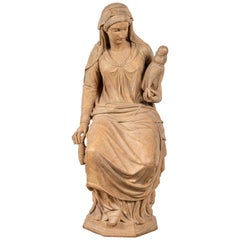
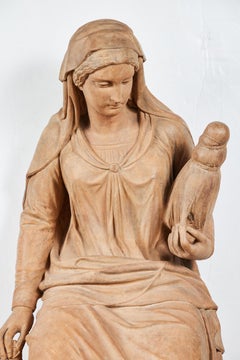
A signed, dated, 1855 terracotta, classical style sculpture of the robed figure of Fate holding the thread of life by listed, Austrian-born artist, Franz Melnitzky (1822-1876) whose ...

Category

Mid-19th Century Sculptures

Materials

Terracotta

Atelier of John Gibson Venus in Marble Neoclassical Sculpture

Atelier of John Gibson Venus in Marble Neoclassical Sculpture

Located in Pistoia, IT

Large white marble sculpture depicting Venus, from the workshop of John Gibson, Rome, circa 1850. Known as Venus Verticordia or Venus Colored, its history is fascinating. John Gibson (June 19, 1790 - January 27, 1866) was a prominent Welsh neoclassical sculptor. He studied in Rome with Canova and opened his own workshop there, where he worked until his death. Born in Wales and raised in Liverpool, John Gibson had a brilliant career. After completing his apprenticeship at the age of 26, this ambitious Welshman arrived in London as a promising artist. He exhibited several times at the Royal Academy and, within two years, realized the dream of every young sculptor of his time: to study in Rome. The next two years spent with Canova shaped his career and sculptural approach. Gibson also studied with Bertel Thorvaldsen and, at the age of 31, opened his workshop on Via della Fontanella, near Piazza del Popolo. John Gibson's workshop was one of the largest in Rome during his lifetime; it was an essential stop on the circuit of Roman sculptors' workshops, as described in Hawks Le Grice's famous 1840 manual. He employed specialized modelers, sculptors, and trainers and counted among his students several promising artists, such as Harriet Hosmer...

Category

English School Mid-19th Century Sculptures

Materials

Marble

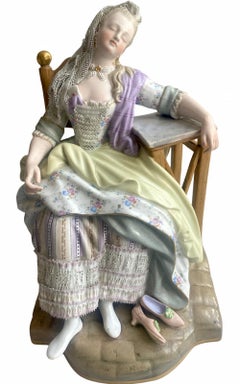
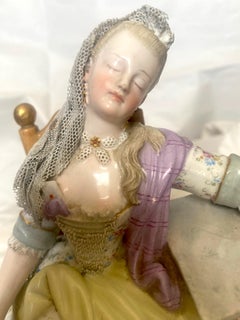
Meissen, Louise Sleeping, after a drawing by Greuze, 19th Century figurine

Meissen, Louise Sleeping, after a drawing by Greuze, 19th Century figurine

By (Circle of) Jean Baptiste Greuze

Located in Norwich, GB

As all of you will know, every Meissen figure is painted individually by an artist. While all Meissen is of high quality, I feel that the present figure is particularly fine, with th...

Category

Academic Mid-19th Century Sculptures

Materials

Porcelain

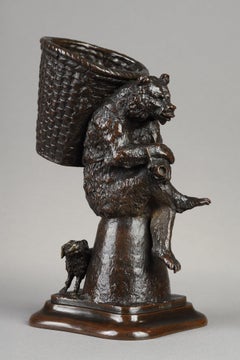
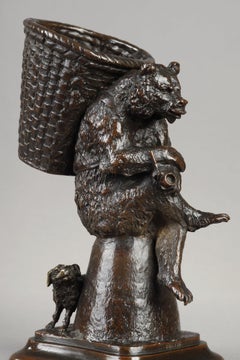
Bear carrying a basket, with a dog

Bear carrying a basket, with a dog

By Christophe Fratin

Located in PARIS, FR

Bear carrying a basket, with a dog Match holder by Christophe FRATIN (1801-1864) Cast in bronze with a dark brown patina Signed to the front of the base "Fratin" Old edition cast F...

Category

French School Mid-19th Century Sculptures

Materials

Bronze

Portrait of Lady Lucy Henderson

Portrait of Lady Lucy Henderson

Located in Saratoga Springs, NY

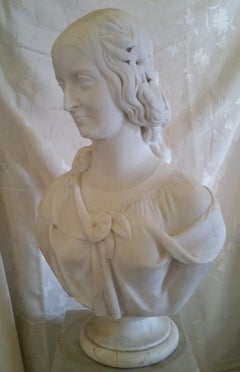
John Edward Jones (Irish – 1806-1862) “Portrait of Lady Lucy Henderson” Signed and dated London 1858, and inscribed, “Lucy Henderson, Nee Durham” 28 ½” high x 20 ½” wide x 11” deep Provenance: Collection Saratoga Springs, NY About John Edward Jones was born in Dublin on May 2nd, 1806. He was the son of a miniature painter Edward Jones. He was trained as an engineer under Alexander Nimmo and worked with him on many important works in Ireland, including the building of the bridge at Waterford between 1829 in 1832, of which he was in charge. A taste and an aptitude for sculpture induced him to relinquish his prospects as an engineer and he commenced practice in London as a sculptor. He achieved considerable success, especially in portrait busts, and was employed by many notable persons of the time. He first exhibited at the Royal Academy in 1844 and continue to do so until his death. He executed a considerable number of bust of Irish personages. He paid occasional visits to Dublin where he contributed to the Royal Hibernian Academy in 1847, 1852,1853 and 1854. A full-length statue by him of Sir Robert...

Category

Realist Mid-19th Century Sculptures
Le Rêve du Poète
Le Rêve du Poète

Le Rêve du Poète

By Mathurin Moreau

Located in New York, NY

MATHURIN MOREAU French, (1822-1912) Le Rêve du Poète Circa 1860, Patinated bronze; Signed ‘math moreau’ and Inscribed REVE DU POETE par MTH MOREAU, MEDAILL...

Category

Mid-19th Century Sculptures
Materials

Bronze

Self-portrait
Self-portrait

Self-portrait

By Christophe Fratin

Located in PARIS, FR

Self-portrait "Fratin by himself" by Christophe FRATIN (1801-1864) Bronze with nuanced dark brown patina Signed on the base "Fratin" Raised on a wooden base, with an old collector s...

Category

French School Mid-19th Century Sculptures
Materials

Bronze

Read More

At Hosfelt Gallery, Bertoia Masterworks Complement Dynamic Contemporary Art

For nearly three decades, San Francisco–based Todd Hosfelt has curated against the grain — with a show on the legendary modernist Harry Bertoia the latest case in point.

This Weathered-Steel Sculpture Distills a Form of Protest into a Minimalist Monument

Part of Alejandro Vega Beuvrin’s “Barricada” series, the work is a subversive tribute to the street smarts of citizen activists.

How the Chunky, Funky Ceramics of 5 Mid-Century American Artists Balanced Out Slick Modernism

Get to know the innovators behind the pottery countercultural revolution.

Art Brings the Drama in These Intriguing 1stDibs 50 Spaces

The world’s top designers explain how they display art to elicit the natural (and supernatural) energy of home interiors.

Chryssa’s 1962 Neon Sculpture Was Way ahead of the Art-World Curve

By working with lettering, neon and Pop imagery, Chryssa pioneered several postmodern themes at a time when most male artists detested commercial mediums.

How to Spot a Fake KAWS Figure

KAWS art toys have developed an avid audience in recent decades, and as in any robust collectible market, counterfeiters have followed the mania. Of course, you don’t have to worry about that on 1stDibs, where all our sellers are highly vetted.

A Giant Wedding Cake Has Us Looking at Portuguese Tiles in a New Light

At Waddesdon Manor, artist Joana Vasconcelos has installed a three-tiered patisserie inspired by the narrative tile work of her homeland. We take a look at the cake sculpture and how Portuguese tiles have been used in architecture from the 17th century to today.

These Soft Sculptures Are Childhood Imaginary Friends Come to Life

Miami artist and designer Gabriela Noelle’s fantastical creations appeal to the Peter Pan in all of us.