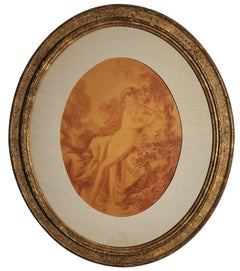
Ashcan School Art

to
21
108
20
8
5
3
Overall Width
to
Overall Height
to
2
141
1
11
13
26
44
7
1
116,642
63,532
56,302
28,479
14,637
9,520
6,631
5,841
4,179
3,139
2,489
2,326
2,139
599
81
58
3
106
63
50
41
24
20
8
7
7
7
7
6
6
6
5
4
4
4
3
3
39
32
31
23
18
10
7
6
6
6
34
5
143
Style: Ashcan School
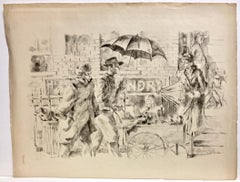
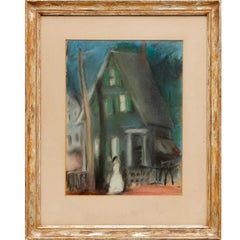
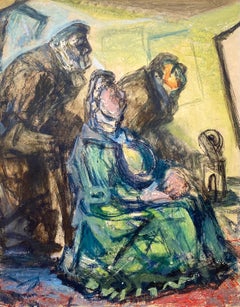
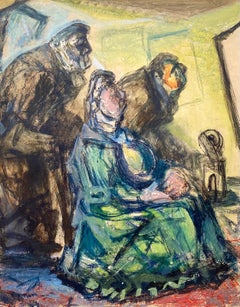
Modernist Oil Painting the Shop Window NYC 1940s WPA era

Modernist Oil Painting the Shop Window NYC 1940s WPA era

By Maurice Becker

Located in Surfside, FL

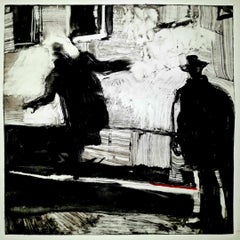
the Shop Window New York City, 1940s 17.75X25 sight size. Maurice Becker (1889–1975) was a radical political artist best known for his work in the 1910s and 1920s for such publica...

Category

Early 20th Century Ashcan School Art

Materials

Oil, Board

'The Sixth Avenue Spur, New York City '— American Expressionism

'The Sixth Avenue Spur, New York City '— American Expressionism

By Frederick K. Detwiller

Located in Myrtle Beach, SC

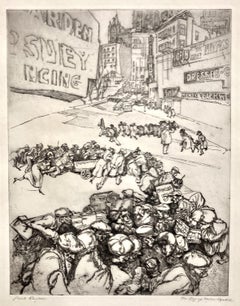
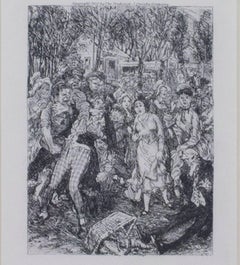
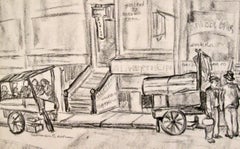
Frederick K. Detwiller, 'The Sixth Avenue Spur, New York City', lithograph, 1924, edition 20. Signed, dated, titled, and annotated 'Lith 20' in pencil. Inscribed 'To my Friend Herbert L. Jones' in pencil. Signed and dated, in the stone, lower right; initialed and dated '1927' in the stone, lower left. A fine, richly-inked impression, on cream wove paper, with margins (7/8 to 1 1/4 inches); slight toning in the top left sheet edge, otherwise in good condition. Scarce. Image size 20 1/2 x 14 inches (521 x 356 mm); sheet size 22 1/2 x 16 inches (572 x 406 mm). Archivally matted to museum standards, unframed. ABOUT THE IMAGE The Sixth Avenue El was constructed in the late 1870s by the Gilbert Elevated Railway and reorganized as the Metropolitan Elevated Railway. By 1878, it was running from Rector Street to 58th Street. Soon after that, it was taken over by the Manhattan Railway Company, with three other Manhattan elevated train lines. The company built a connection, the ‘spur’ by which it turned west on 53rd Street to merge with the 9th Avenue El—paralleling the present-day route of the 6th Avenue subway. The Sixth Avenue El served the “Ladies Mile” shops (including the Siegel-Cooper emporium, whose building now houses Bed...

Category

1920s Ashcan School Art

Materials

Lithograph

SISTERS AT THE WINDOW

SISTERS AT THE WINDOW

By John Sloan

Located in Portland, ME

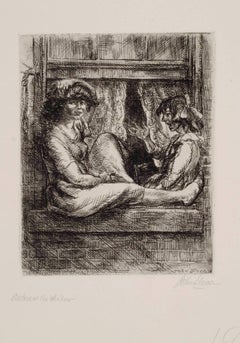
Sloan, John. SISTERS AT THE WINDOW. Etching, 1923 (M. 208). 5" x 4", signed and titled in pencil and inscribed "100 Proofs," of which only 76 were printed this being one of 25 early ...

Category

1920s Ashcan School Art

Materials

Etching

“The Maitre d’”
“The Maitre d’”

“The Maitre d’”, Circa 1900

$1,480Sale Price|20% Off

“The Maitre d’”

Located in Southampton, NY

Here for your consideration is a comical take on the position of maitre d’. Unsigned. Framed in a new African mahogany frame. Overall measurements are 25.5 by 17.5 inches. Oil pain...

Category

1910s Ashcan School Art

Materials

Oil, Fiberboard

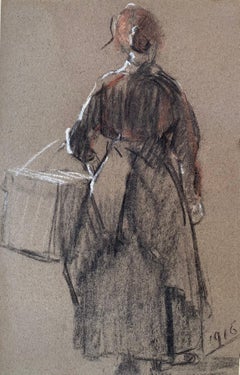
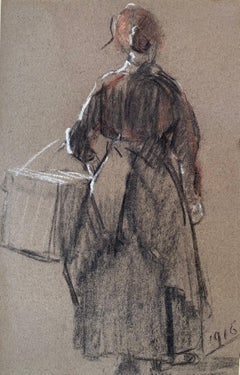
“Headed to Market, 1916”

“Headed to Market, 1916”

By Everett Shinn

Located in Southampton, NY

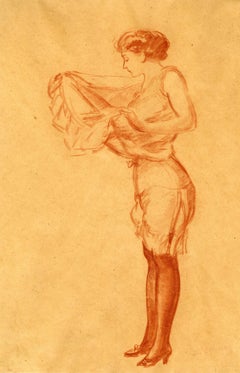
Original drawing of a woman heading to market by the well known American artist, Everett Shinn. Mixed media work created with charcoal, pastel and gouache. Signed with the artist’s initials lower right and dated 1916. Condition is very good. Under glass. Matted and in a period gold frame with restorations. Overall framed measurements are 23.5 by 17.25 inches. Provenance: A New York City estate. Everett Shinn (1876 – 1953) Everett Shinn, a realist artist associated with the Ashcan School and member of “The Eight” was born in New Jersey in 1876. After showing an aptitude for the arts as a child, at age 15, Shinn was enrolled at the Spring Garden Institute in Philadelphia. He quickly moved on to classes at the Pennsylvania Academy of the Fine Arts and by the age of 17, he was working as a staff artist for the Philadelphia Press. While working at the Press, Shinn befriended fellow artists William J. Glackens, George Luks, and John Sloan. This group, with Robert Henri and Joseph Laub, established the Charcoal Club, a social and intellectual sort of alternative art school. In 1897, Shinn moved to New York City to work as an illustrator at the New York World. He became fascinated by the drama of the city. While visiting Europe in 1900, Shinn took interest in the work of the Impressionists, particularly those of Degas. Degas’ influence can be read in Shinn’s depictions of American theater. From his acquaintances in the theater world, Shinn began to paint decorative “rococo revivalist” murals in the homes of the wealthy elite. He also worked extensively in pastel, portraying the rough life of the city. In 1908, Shinn exhibited alongside his Charcoal Club associates, with the addition of Arthur B. Davies, Ernest Lawson, and Maurice Prendergast...

Category

1910s Ashcan School Art

Materials

Charcoal, Pastel, Gouache

Lucile Haynes, (Two Women with Child in Baby Carriage)

Lucile Haynes, (Two Women with Child in Baby Carriage)

Located in New York, NY

It's clear to me that that baby carriage is so beautifully drawn that it could be re-constructed from here if necessary. Without really knowing anything about Lucile Haynes I'm sure...

Category

1930s Ashcan School Art

Materials

Etching

Ann Nooney, (Carnival Workers Resting, NYC)

Ann Nooney, (Carnival Workers Resting, NYC)

By Ann Nooney

Located in New York, NY

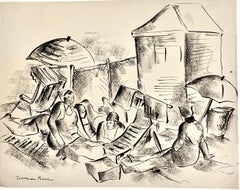
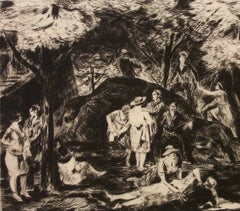
The dimensions are for the image; there are large margins. This lithograph is signed in pencil. A native New Yorker, Ann Nooney (1900-1970) recorded the urban scene while on the Wo...

Category

1930s Ashcan School Art

Materials

Lithograph

Lawrence Beall Smith, Solitude

Lawrence Beall Smith, Solitude

By Lawrence Beall Smith

Located in New York, NY

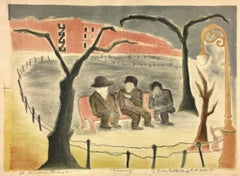
Lawrence Beall Smith draws four men in a park, each with his back to a giant, strong tree. The year is 1938 and the country is coming out of the Depression but World War II is alread...

Category

Mid-20th Century Ashcan School Art

Materials

Lithograph

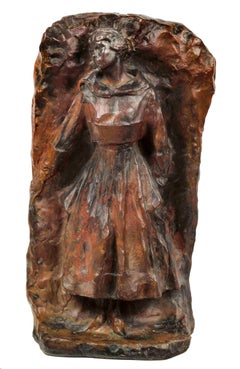
"Stepping Out" Margarett W. McKean Sargent, Female Figure, Emerging Forms

"Stepping Out" Margarett W. McKean Sargent, Female Figure, Emerging Forms

Located in New York, NY

Margarett W. McKean Sargent Stepping Out, 1916 Signed and dated on base Bronze 14 x 6 x 8 inches Provenance Private Collection, Hingham, Massachusetts Walker-Cunningham Fine Art, St. Louis, Missouri, 2007 Exhibited New York, Hawthorne Fine Art...

Category

Early 1900s Ashcan School Art

Materials

Bronze

Study of an Indian Model

Study of an Indian Model

By Arthur B. Davies

Located in Fairlawn, OH

Study of an Indian Model Unsigned Pastel and chalk on blue paper, mounted to support Provenance: Estate of the artist (per Graham and Sons, agent for the estate) James Graham & Sons,...

Category

1920s Ashcan School Art

Materials

Chalk, Pastel

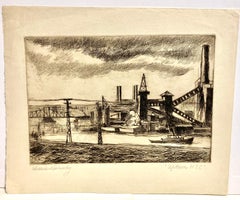
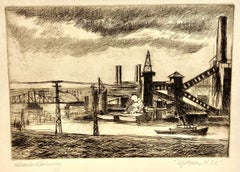
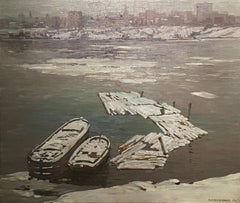
Fred Nagler, Harlem River (New York City)

Fred Nagler, Harlem River (New York City)

By Fred Nagler

Located in New York, NY

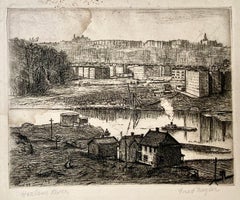
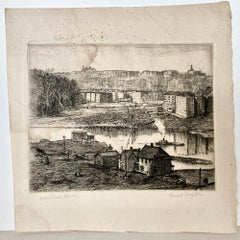
Massachusetts-born Fred Nagler studied at the Art Students League from 1914 to 1917, with George Bridgeman and Robert Henri, and eventually became a member of the Board of Control. ...

Category

1920s Ashcan School Art

Materials

Etching

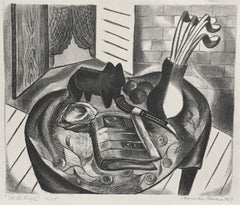
Norman Barr, Still Life

Norman Barr, Still Life

By Norman Barr

Located in New York, NY

Norman Barr made mural on the NYC-WPA; this lithograph was made in the WPA workshop but was not published by the WPA. The next year he was in the Army! Thi...

Category

Mid-20th Century Ashcan School Art

Materials

Lithograph

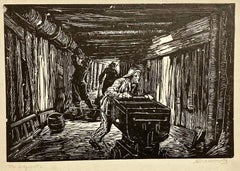
Charles Pont, Splicing

Charles Pont, Splicing

Located in New York, NY

An old sailor is shown at work on a what must be a huge sailing vessel. He's splicing, or joining ropes together -- probably still a useful skill in the mi...

Category

1930s Ashcan School Art

Materials

Woodcut

Moses Oley, Quarry
Moses Oley, Quarry

Moses Oley, Quarry

Located in New York, NY

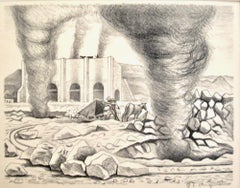
Moses Oley drew an industrial scene, but one very much in isolation. The quarry equipment looks both imposing and busy. There appears to be smoke coming fro...

Category

1930s Ashcan School Art

Materials

Lithograph

Norman Barr, Delancey Street (NYC)

Norman Barr, Delancey Street (NYC)

By Norman Barr

Located in New York, NY

Norman Barr recorded his beloved New York City from the Bronx, to Coney Island, to the Fulton Fish Market. In this period he was on the New Deal's Mural ...

Category

Mid-20th Century Ashcan School Art

Materials

Crayon, India Ink

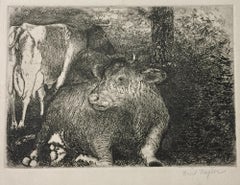
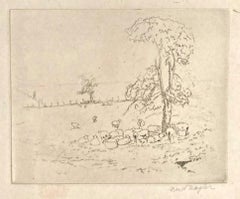
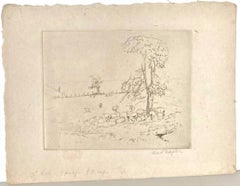
Fred Nagler, (Sheep under a Tree)

Fred Nagler, (Sheep under a Tree)

By Fred Nagler

Located in New York, NY

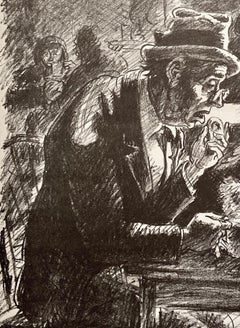
The etching (Sheep under a Tree) is signed in pencil and annotated (in lower margin) '3rd State, 4 proofs, JN imp.' in pencil. It's in an usually spare drawing style but one that Na...

Category

1920s Ashcan School Art

Materials

Etching

Ben Messick, Coffee and Donuts (Sinkers & Java)

Ben Messick, Coffee and Donuts (Sinkers & Java)

By Ben Messick

Located in New York, NY

Ben Messick perfectly captures the world of the 'Ashcan' period: Everyday life, local characters, people we could still meet today. He could draw like a son-of-a-gun! The date of 194...

Category

Mid-20th Century Ashcan School Art

Materials

Lithograph

James Penney, Test Stone, Touche

James Penney, Test Stone, Touche

By James Penney

Located in New York, NY

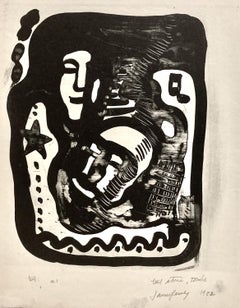
James Penney was widely known for his New Yorker covers as well as his paintings and prints. Penney was from Saint Joseph, Missouri. He trained in NYC at the Art Students League. The New-York Historical Society and the Library of Congress both have collections of his work. Signed, titled, and dated, and annotated 'Test #1' in pencil. Note entirely sure what's going on here...

Category

1930s Ashcan School Art

Materials

Lithograph

Alexander Kachinsky, Uptown, NYC

Alexander Kachinsky, Uptown, NYC

Located in New York, NY

Russian-born and European-educated Alexander Kachinsky was a designer of stage sets (for the Ballet Russe), furniture, and commercial interiors. His prints are in the collection of t...

Category

Mid-20th Century Ashcan School Art

Materials

Etching

Alexander Kachinsky, Graphite Factory

Alexander Kachinsky, Graphite Factory

Located in New York, NY

Russian-born and European-educated Alexander Kachinsky was a designer of stage sets (for the Ballet Russe), furniture, and commercial interiors. His prints are in the collection of t...

Category

Mid-20th Century Ashcan School Art

Materials

Etching

Norman Barr, Coney Island (New York City)

Norman Barr, Coney Island (New York City)

By Norman Barr

Located in New York, NY

An idyllic scene at New York City's favorite beach, Coney Island. Before the year was over Barr was in the Army. It is ink and litho-crayon. Barr liked that medium because it didn't ...

Category

Mid-20th Century Ashcan School Art

Materials

Mixed Media

Ray Euffa, Keys
Ray Euffa, Keys

Ray Euffa, Keys

Located in New York, NY

Russia-born Ray Euffa studied at the Detroit School of Fine Arts, the Educational Alliance Art School, and Art Students League in NYC. It is New York City i...

Category

Mid-20th Century Ashcan School Art

Materials

Screen

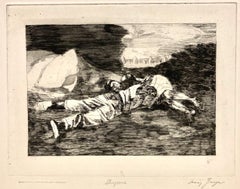
Irving Guyer, Sleepers

Irving Guyer, Sleepers

By Irving Guyer

Located in New York, NY

Classic American Depression-Era subject meets the French landscape? Clearly Guyer was looking at both Jean-Francois Millet and Vincent Van Gogh, who together informed this image. And...

Category

1930s Ashcan School Art

Materials

Etching

Joseph Hirsch, (Cutting the Beard)

Joseph Hirsch, (Cutting the Beard)

By Joseph Hirsch

Located in New York, NY

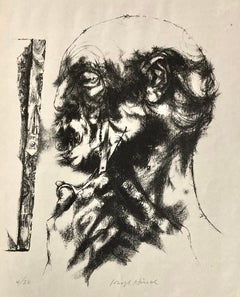
A man with lots of whiskers is trimming his facial hair while looking in a mirror. The male figure and his beard are carefully drawn but Hirsch has cleverly just briefly sketched in ...

Category

Mid-20th Century Ashcan School Art

Materials

Lithograph

Jane Rogers, Breakfast

Jane Rogers, Breakfast

Located in New York, NY

Jane Rogers was born in the artists' colony of Woodstock, New York. Most of her career was spent in New York. Although her dates are most often given as 18...

Category

Mid-20th Century Ashcan School Art

Materials

Lithograph

Don Freeman, (At the Booking Desk)

Don Freeman, (At the Booking Desk)

By Don Freeman

Located in New York, NY

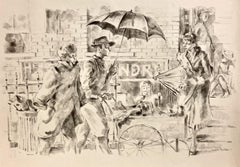
Don Freeman is best known for his paintings and works on paper of New York City's theatre industry: the signage, the stages and sets, the actors, the costumers and ushers, anything a...

Category

Mid-20th Century Ashcan School Art

Materials

Lithograph

Blanche Grambs, Unemployed

Blanche Grambs, Unemployed

Located in New York, NY

Blanche Grambs, known to friends as 'Grambs' (1916-2010) was born in China. She came to New York as a very young woman to study at the Art Students Leag...

Category

1930s Ashcan School Art

Materials

Etching

Head of a Woman (Margaret)

Head of a Woman (Margaret)

By Leon Kroll

Located in Fairlawn, OH

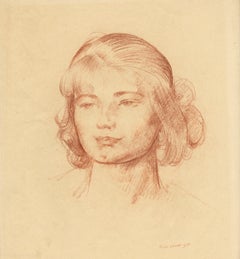
Head of a Woman (Margaret) conte on wove paper, 1925 Signed and dated lower right Annotated "Margaret" in ink verso A portrait of Margaret Cassidy Manship ( d. 2012), daughter in law...

Category

1920s Ashcan School Art

Materials

Conté

Barbershop

Barbershop

By John Sloan

Located in New York, NY

John Sloan (1871-1954), Barbershop, 1915, etching and aquatint, signed in pencil lower right, inscribed in pencil “For John Quinn, Esq. – John Sloan” lower left margin, (also signed ...

Category

1910s Ashcan School Art

Materials

Etching, Aquatint

Boys Sledding
Boys Sledding

Boys Sledding

By John Sloan

Located in Fairlawn, OH

Boys Sledding Etching, 1920 Signed and titled in pencil by the artist below image (see photos) Annotated in pencil by the artist "100 proofs" Signed and dated in the plate lower left...

Category

1920s Ashcan School Art

Materials

Etching

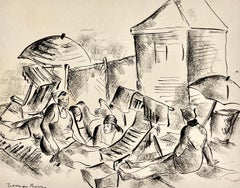
"Beach at Atlantic City, New Jersey" Amy Londoner, Ashcan School, Figurative

"Beach at Atlantic City, New Jersey" Amy Londoner, Ashcan School, Figurative

By Amy Londoner

Located in New York, NY

Amy Londoner Beach at Atlantic City, circa 1922 Signed lower right Pastel on paper Sight 23 x 18 inches Amy Londoner (April 12, 1875 – 1951) was an American painter who exhibited at the 1913 Armory Show. One of the first students of the Henri School of Art in 1909. Prior to the Armory Show of 1913, Amy Londoner and her classmates studied with "Ashcan" painter Robert Henri at the Henri School of Art in New York, N.Y. One notable oil painting, 'The Vase', was painted by both Henri and Londoner. Londoner was born in Lexington, Missouri on April 12, 1875. Her parents were Moses and Rebecca Londoner, who moved to Leadville, Colorado, by 1880. In 1899, Amy took responsibility for her father who had come to Los Angeles from Leadville and had mental issues. By 1900, Amy was living with her parents and sister, Blanche, in the vicinity of Leadville, Denver, Colorado. While little was written about her early life, Denver City directories indicated that nineteenth-century members of the family were merchants, with family ties to New York, N.Y. The family had a male servant. Londoner traveled with her mother to England in 1907 then shortly later, both returned to New York in 1909. Londoner was 34 years old at the time, and, according to standards of the day, should have married and raised a family long before. Instead, she enrolled as one of the first students at the Henri School of Art in 1909. At the Henri School, Londoner established friendships with Carl Sprinchorn (1887-1971), a young Swedish immigrant, and Edith Reynolds (1883-1964), daughter of wealthy industrialist family from Wilkes-Barre, PA. Londoner's correspondence, which often included references to Blanche, listed the sisters' primary address as the Hotel Endicott at 81st Street and Columbus Avenue, NYC. Other correspondence also reached Londoner in the city via Mrs. Theodore Bernstein at 252 West 74th Street; 102 West 73rd Street; and the Independent School of Art at 1947 Broadway. In 1911, Londoner vacationed at the Hotel Trexler in Atlantic City, NJ. As indicated by an undated photograph, Londoner also spent time with Edith Reynolds and Robert Henri at 'The Pines', the Reynolds family estate in Bear Creek, PA. Through her connections with the Henri School, Londoner entered progressive social and professional circles. Henri's admonition, phrased in the vocabulary of his historical time period, that one must become a "man" first and an artist second, attracted both male and female students to classes where development of unique personal styles, tailored to convey individual insights and experiences, was prized above the mastery of standardized, technical skill. Far from being dilettantes, women students at the Henri School were daring individuals willing to challenge tradition. As noted by former student Helen Appleton Read, "it was a mark of defiance,to join the radical Henri group." As Henri offered educational alternatives for women artists, he initiated exhibition opportunities for them as well. Troubled by the exclusion of work by younger artists from annual exhibitions at the National Academy of Design, Henri was instrumental in organizing the no-jury, no-prize Exhibition of Independent Artists in 1910. About half of the 103 artists included in the exhibition were or had been Henri students, while twenty of the twenty-six women exhibiting had studied with Henri. Among the exhibition's 631 pieces, nine were by Amy Londoner, including the notorious 'Lady with a Headache'. Similarly, fourteen of Henri's women students exhibited in the groundbreaking Armory Show of 1913, forming about eight percent of the American exhibitors and one-third of American women exhibitors. Of the nine documented works submitted by Londoner, five were rejected, while four pastels of Atlantic City beach scenes, including 'The Beach Umbrellas' now in the Remington Collection, were displayed. Following Henri's example, Londoner served as an art instructor for younger students at the Modern School, whose only requirement was to genuinely draw what they pleased. The work of dancer Isadora Duncan, another artist devoted to the ideals of a liberal education, was also lauded by the Modern School. Henri, who long admired Duncan and invited members of her troupe to model for his classes, wrote an appreciation of her for the Modern School journal in 1915. She was also the subject of Londoner's pastel Isadora Duncan and the Children: Praise Ye the Lord with Dance. In 1914, Londoner traveled to France to spend summer abroad, living at 99 rue Notre Dames des Champs, Paris, France. As the tenets of European modernism spread throughout the United States, Londoner showed regularly at venues which a new generation of artists considered increasingly passe, including the annual Society of Independent Artists' exhibitions between 1918 and 1934, and the Salons of America exhibition in 1922. Londoner also exhibited at the Morton Gallery, Opportunity Gallery, Leonard Clayton Gallery and Brownell-Lambertson Galleries in NYC. Her painting of a 'Blond Girl' was one of two works included in the College Art Associations Traveling Exhibition of 1929, which toured colleges across the country to broad acclaim. Londoner later in life suffered from illnesses then suffered a stroke which resulted in medical bills significantly mounting over the years that her old friends from the Henri School, including Carl Sprinchorn, Florence Dreyfous, Florence Barley, and Josephine Nivison Hopper, scrambled to raise funds and find suitable long-term care facilities for Londoner. Londoner later joined Reynolds in Bear Creek, PA. Always known for her keen wit, Londoner retained her humor and concern for her works even during her illness, noting that "if anything happens to the Endicott, I guess they will just throw them out." Sprinchorn and Reynolds, however, did not allow this to happen. In 1960, Londoner's paintings 'Amsterdam Avenue at 74th Street' and 'The Builders' were loaned by Reynolds to a show commemorating the Fiftieth Anniversary of the Exhibition of Independent Artists in 1910, presented at the Delaware Art Center, Wilmington, DE. In the late 80's, Francis William Remington, 'Bill Remington', of Bear Creek Village PA, along with his neighbor and artist Frances Anstett Brennan, both had profound admiration for Amy Londoner's art work and accomplishments as a woman who played a significant role in the Ashcan movement. Remington acquired a significant number of Londoner's artwork along with Frances Anstett Brenan that later was part of an exhibition of Londoner's artwork in April 15 of 2007, at the Hope Horn...

Category

1920s Ashcan School Art

Materials

Paper, Pastel

Battle Scene, Spanish American War

Battle Scene, Spanish American War

By Francis Luis Mora

Located in New York, NY

Francis Luis Mora was considered one of America's finest "sketchers". A collection of his Sketchbooks are at the Smithsonian and this work came out of one in the early 1990's from t...

Category

1890s Ashcan School Art

Materials

Graphite

Harry R. Rein, Competition, 1936-39, WPA linocut

Harry R. Rein, Competition, 1936-39, WPA linocut

Located in New York, NY

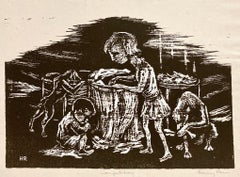
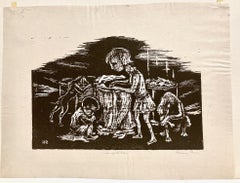
If ever there was an image that fit the description of 'Ashcan,' Harry Rein's Competition, made for the NYC WPA, is clearly it! Some impressions have the WPA sstamp, including the o...

Category

1930s Ashcan School Art

Materials

Linocut

"Night Stroll" Amy Londoner, Ashcan School, Figurative Nocturne

"Night Stroll" Amy Londoner, Ashcan School, Figurative Nocturne

By Amy Londoner

Located in New York, NY

Amy Londoner Beach at Atlantic City, circa 1922 Signed lower right Pastel on paper Sight 23 x 18 inches Amy Londoner (April 12, 1875 – 1951) was an American painter who exhibited at the 1913 Armory Show. One of the first students of the Henri School of Art in 1909. Prior to the Armory Show of 1913, Amy Londoner and her classmates studied with "Ashcan" painter Robert Henri at the Henri School of Art in New York, N.Y. One notable oil painting, 'The Vase', was painted by both Henri and Londoner. Londoner was born in Lexington, Missouri on April 12, 1875. Her parents were Moses and Rebecca Londoner, who moved to Leadville, Colorado, by 1880. In 1899, Amy took responsibility for her father who had come to Los Angeles from Leadville and had mental issues. By 1900, Amy was living with her parents and sister, Blanche, in the vicinity of Leadville, Denver, Colorado. While little was written about her early life, Denver City directories indicated that nineteenth-century members of the family were merchants, with family ties to New York, N.Y. The family had a male servant. Londoner traveled with her mother to England in 1907 then shortly later, both returned to New York in 1909. Londoner was 34 years old at the time, and, according to standards of the day, should have married and raised a family long before. Instead, she enrolled as one of the first students at the Henri School of Art in 1909. At the Henri School, Londoner established friendships with Carl Sprinchorn (1887-1971), a young Swedish immigrant, and Edith Reynolds (1883-1964), daughter of wealthy industrialist family from Wilkes-Barre, PA. Londoner's correspondence, which often included references to Blanche, listed the sisters' primary address as the Hotel Endicott at 81st Street and Columbus Avenue, NYC. Other correspondence also reached Londoner in the city via Mrs. Theodore Bernstein at 252 West 74th Street; 102 West 73rd Street; and the Independent School of Art at 1947 Broadway. In 1911, Londoner vacationed at the Hotel Trexler in Atlantic City, NJ. As indicated by an undated photograph, Londoner also spent time with Edith Reynolds and Robert Henri at 'The Pines', the Reynolds family estate in Bear Creek, PA. Through her connections with the Henri School, Londoner entered progressive social and professional circles. Henri's admonition, phrased in the vocabulary of his historical time period, that one must become a "man" first and an artist second, attracted both male and female students to classes where development of unique personal styles, tailored to convey individual insights and experiences, was prized above the mastery of standardized, technical skill. Far from being dilettantes, women students at the Henri School were daring individuals willing to challenge tradition. As noted by former student Helen Appleton Read, "it was a mark of defiance,to join the radical Henri group." As Henri offered educational alternatives for women artists, he initiated exhibition opportunities for them as well. Troubled by the exclusion of work by younger artists from annual exhibitions at the National Academy of Design, Henri was instrumental in organizing the no-jury, no-prize Exhibition of Independent Artists in 1910. About half of the 103 artists included in the exhibition were or had been Henri students, while twenty of the twenty-six women exhibiting had studied with Henri. Among the exhibition's 631 pieces, nine were by Amy Londoner, including the notorious 'Lady with a Headache'. Similarly, fourteen of Henri's women students exhibited in the groundbreaking Armory Show of 1913, forming about eight percent of the American exhibitors and one-third of American women exhibitors. Of the nine documented works submitted by Londoner, five were rejected, while four pastels of Atlantic City beach scenes, including 'The Beach Umbrellas' now in the Remington Collection, were displayed. Following Henri's example, Londoner served as an art instructor for younger students at the Modern School, whose only requirement was to genuinely draw what they pleased. The work of dancer Isadora Duncan, another artist devoted to the ideals of a liberal education, was also lauded by the Modern School. Henri, who long admired Duncan and invited members of her troupe to model for his classes, wrote an appreciation of her for the Modern School journal in 1915. She was also the subject of Londoner's pastel Isadora Duncan and the Children: Praise Ye the Lord with Dance. In 1914, Londoner traveled to France to spend summer abroad, living at 99 rue Notre Dames des Champs, Paris, France. As the tenets of European modernism spread throughout the United States, Londoner showed regularly at venues which a new generation of artists considered increasingly passe, including the annual Society of Independent Artists' exhibitions between 1918 and 1934, and the Salons of America exhibition in 1922. Londoner also exhibited at the Morton Gallery, Opportunity Gallery, Leonard Clayton Gallery and Brownell-Lambertson Galleries in NYC. Her painting of a 'Blond Girl' was one of two works included in the College Art Associations Traveling Exhibition of 1929, which toured colleges across the country to broad acclaim. Londoner later in life suffered from illnesses then suffered a stroke which resulted in medical bills significantly mounting over the years that her old friends from the Henri School, including Carl Sprinchorn, Florence Dreyfous, Florence Barley, and Josephine Nivison Hopper, scrambled to raise funds and find suitable long-term care facilities for Londoner. Londoner later joined Reynolds in Bear Creek, PA. Always known for her keen wit, Londoner retained her humor and concern for her works even during her illness, noting that "if anything happens to the Endicott, I guess they will just throw them out." Sprinchorn and Reynolds, however, did not allow this to happen. In 1960, Londoner's paintings 'Amsterdam Avenue at 74th Street' and 'The Builders' were loaned by Reynolds to a show commemorating the Fiftieth Anniversary of the Exhibition of Independent Artists in 1910, presented at the Delaware Art Center, Wilmington, DE. In the late 80's, Francis William Remington, 'Bill Remington', of Bear Creek Village PA, along with his neighbor and artist Frances Anstett Brennan, both had profound admiration for Amy Londoner's art work and accomplishments as a woman who played a significant role in the Ashcan movement. Remington acquired a significant number of Londoner's artwork along with Frances Anstett Brenan that later was part of an exhibition of Londoner's artwork in April 15 of 2007, at the Hope Horn...

Category

1910s Ashcan School Art
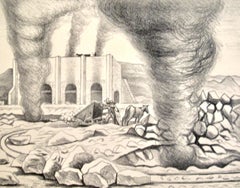
Materials

Paper, Pastel

Ashcan School art for sale on 1stDibs.
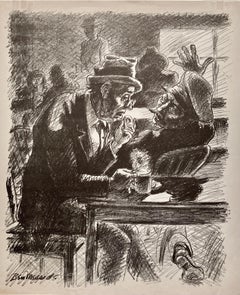
Find a wide variety of authentic Ashcan School art available for sale on 1stDibs. Works in this style were very popular during the 21st Century and Contemporary, but contemporary artists have continued to produce works inspired by this movement. If you’re looking to add art created in this style to introduce contrast in an otherwise neutral space in your home, the works available on 1stDibs include elements of orange, blue, purple and other colors. Many Pop art paintings were created by popular artists on 1stDibs, including John Sloan, James Penney, George Wesley Bellows, and Reginald Marsh. Frequently made by artists working with Lithograph, and Paint and other materials, all of these pieces for sale are unique and have attracted attention over the years. Not every interior allows for large Ashcan School art, so small editions measuring 2.75 inches across are also available. Prices for art made by famous or emerging artists can differ depending on medium, time period and other attributes. On 1stDibs, the price for these items starts at $250 and tops out at $112,000, while the average work sells for $1,480.