Men Art

47,202 Results
to
5,565
21,437
10,406
7,390
5,626
6,377
Overall Width
to
Overall Height
to
1,534
4,563
28,918
16,448
441
620
1,049
1,667
1,197
3,297
4,279
4,034
3,172
1,772
921
13,644
12,207
1,846
1,703
1,134
981
799
610
568
473
372
250
157
86
27,610
17,093
3,832
158,101
83,349
51,521
43,401
37,550
36,483
30,800
27,520
26,209
24,982
21,039
18,080
16,054
14,863
14,065
13,460
11,639
10,796
10,519
8,717
14,752
10,316
8,916
6,269
5,773
2,234
770
750
454
227
9,423
17,201
24,872
24,213
Art Subject: Men
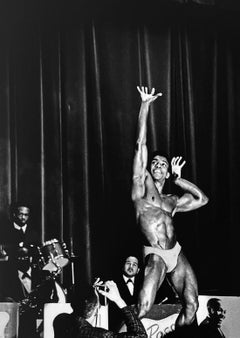
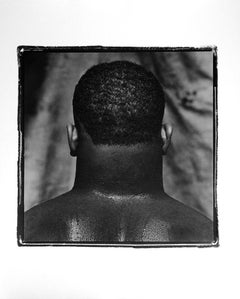
Mr. Harlem, Bodybuilder, Black-and-White Signed Gelatin Silver Photograph, 1960s

Mr. Harlem, Bodybuilder, Black-and-White Signed Gelatin Silver Photograph, 1960s

By Leonard Freed

Located in New york, NY

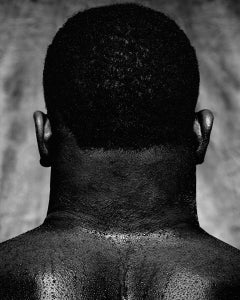
The image of a bodybuilder capturing African-American life in Harlem in the 1960s, Mr. Harlem, 1963 by Leonard Freed, is a 14” x 11” black-and-white photograph from the photographer'...

Category

1960s Contemporary Black and White Photography

Materials

Photographic Film, Photographic Paper, Silver Gelatin

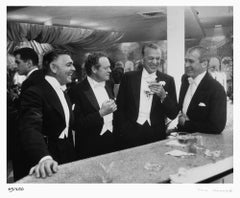
Kings Of Hollywood Slim Aarons Estate Print

Kings Of Hollywood Slim Aarons Estate Print

By Slim Aarons

Located in London, GB

Kings Of Hollywood 1957 - Slim Aarons Estate Print Enjoying a joke at a New Year’s party held at Romanoff’s in Beverly Hills, 31st December 1957. 20 x 24" inches / 51 x 61 cm paper...

Category

1950s Modern Black and White Photography

Materials

Silver Gelatin

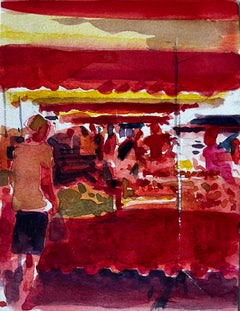
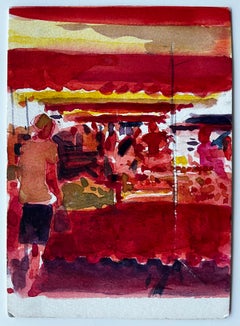
Provençal Market Scene Under Red and Yellow Awnings French Riviera Study

Provençal Market Scene Under Red and Yellow Awnings French Riviera Study

By Pierre Neveu

Located in Cirencester, Gloucestershire

Title: Provençal Market Scene Under Red and Yellow Awnings French Riviera Study Artist: Pierre Neveu (French b.1929) Medium: Watercolour on artists paper, unframed Size (H x W): 7 x ...

Category

Mid-20th Century Post-Impressionist Landscape Drawings and Watercolors

Materials

Watercolor

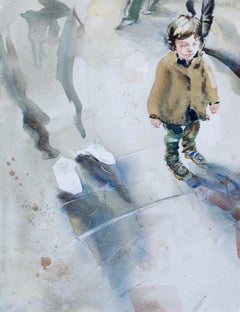
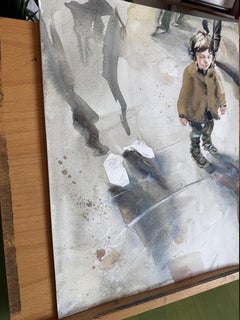
In the crowd. Childhood. Child. Watercolour. Small. Poignant. Boy. Grey. Brown.

In the crowd. Childhood. Child. Watercolour. Small. Poignant. Boy. Grey. Brown.

By Marina Skepner

Located in Oslo, NO

Amid some unfinished legs, a small boy stands quietly, hemmed in by the drifting crowd. The adults exist only in fragments—brushy shins, fading shoes, suggestions of motion—like mome...

Category

2010s Contemporary Figurative Drawings and Watercolors

Materials

Paper, Watercolor

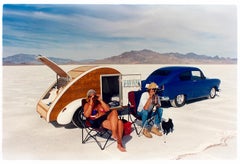
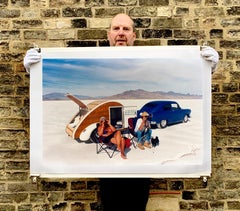
Christine's '52 Henry J & Teardrop Bonneville, Utah - Landscape Car Photo

Christine's '52 Henry J & Teardrop Bonneville, Utah - Landscape Car Photo

By Richard Heeps

Located in Cambridge, GB

'Christine's '52 Henry J & teardrop' was captured in Bonneville Salt Flats, Utah, the iconic home of speed. This photograph captures the mountains in the distance meeting and contras...

Category

21st Century and Contemporary Contemporary Color Photography

Materials

Photographic Paper, C Print, Color, Silver Gelatin

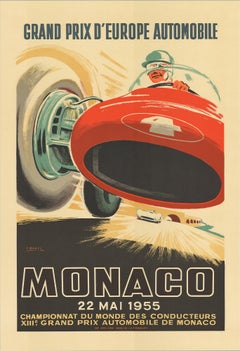
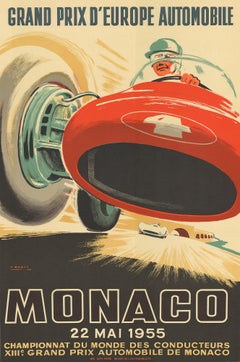
Jean Ramel 'Monaco Grand Prix 1955' 1985

Jean Ramel 'Monaco Grand Prix 1955' 1985

Located in Brooklyn, NY

This vintage lithographic reproduction commemorates the iconic Monaco Grand Prix race of 1955, designed by Jean Ramel. Renowned for its stunning coastal views and challenging circuit...

Category

1980s Art Deco Prints and Multiples

Materials

Lithograph

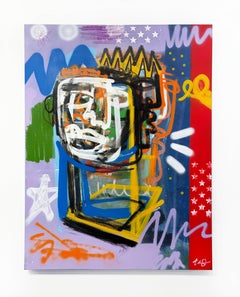
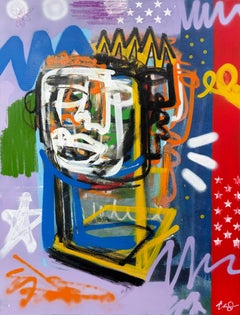
Clarence James "Be Your Self" painting on canvas

Clarence James "Be Your Self" painting on canvas

By Clarence James

Located in Boston, MA

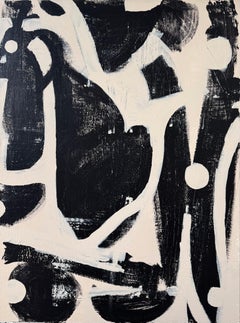
Artist: James, Clarence Title: Be Your Self Date: 2026 Medium: Acrylic, Aerosol, Oil Stick on Canvas Unframed Dimensions: 40" x 30" Signature: Signed by Artist on Verso Edition...

Category

2010s Contemporary Paintings

Materials

Oil, Spray Paint, Acrylic

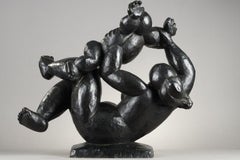
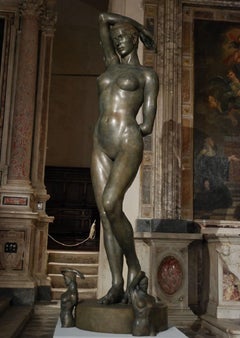
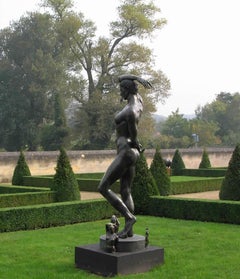
Mother and Child, with a base

Mother and Child, with a base

By Baltasar Lobo

Located in PARIS, FR

Mother and Child, with a base by Baltasar LOBO (1910-1993) A bronze group with a dark brownish green patina Signed on the base " Lobo " Cast by " Susse Fondeur Paris " (with the fou...

Category

Mid-20th Century French School Figurative Sculptures

Materials

Bronze

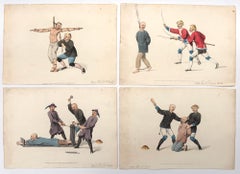
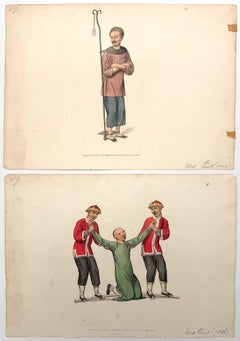
The Punishments of China, 8 plates

The Punishments of China, 8 plates

Located in Middletown, NY

A collection of gruesome 19th century images illustrating the barbarism of the Qing penal code. London: William Miller, 1801. Six (6) stipple point engravings with hand coloring in...

Category

Early 19th Century English School Portrait Prints

Materials

Handmade Paper, Watercolor, Engraving

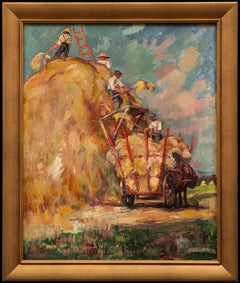
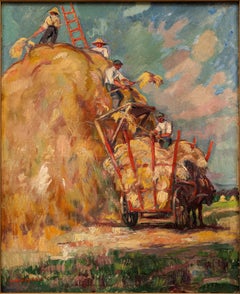
"The Harvesters" Raphaël Dubois aka Chanterou (Belgium, 1888-1960)

"The Harvesters" Raphaël Dubois aka Chanterou (Belgium, 1888-1960)

Located in SANTA FE, NM

"The Harvesters" Raphaël Dubois aka Chanterou (Belgium, 1888-1960) Signed bottom left under the pseudonym "Chanterou" Oil on canvas 23 1/2 x 19 1/4 (27 3/4 x 23 3/4 frame) inches Born in Liege in 1888, he enrolled at the age of fourteen at the Academy of Liege where he studied under Evariste Carpentier...

Category

1920s Landscape Paintings

Materials

Canvas, Oil

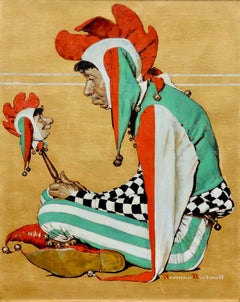
The Jester, Post Cover

The Jester, Post Cover

By Norman Rockwell

Located in Fort Washington, PA

Signed by Artist Lower Right The Saturday Evening Post, February 11, 1939, cover illustration Literature The Saturday Evening Post, February 11, 1939, cover illustration Thomas S....

Category

1930s Figurative Paintings

Materials

Oil

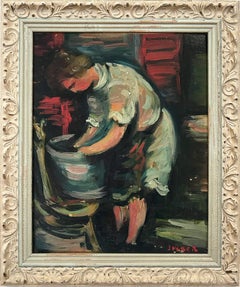
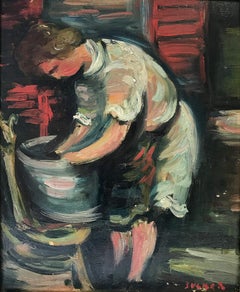
"Laundry" Post-Impressionism French Oil Painting Interior Scene Figure on Board

"Laundry" Post-Impressionism French Oil Painting Interior Scene Figure on Board

By Jacques Zucker

Located in New York, NY

This painting depicts a whimsical portrait of a young lady washing her laundry in front of a house. This piece was most likely executed in the 1930's, as the colors are darker than Z...

Category

1960s Post-Impressionist Figurative Paintings

Materials

Oil, Board

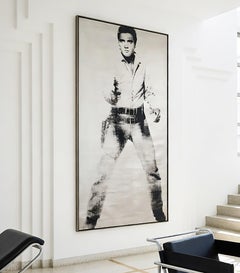
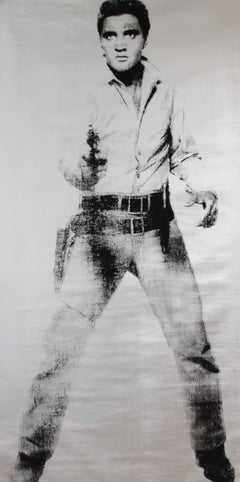
"Elvis", Denied Andy Warhol Silver & Black Pop Art Painting by Charles Lutz

"Elvis", Denied Andy Warhol Silver & Black Pop Art Painting by Charles Lutz

By Charles Lutz

Located in Brooklyn, NY

Elvis, Metallic Silver and Black Full Length Silkscreen Painting by Charles Lutz Silkscreen and silver enamel painted on vintage 1960's era linen with Artist's Denied stamp of the Andy Warhol Art Authentication Board. 82" x 40" inches 2010 Lutz's 2007 ''Warhol Denied'' series gained international attention by calling into question the importance of originality or lack thereof in the work of Andy Warhol. The authentication/denial process of the [[Andy Warhol Art Authentication Board]] was used to create value by submitting recreations of Warhol works for judgment with the full intention for the works to be formally marked "DENIED". The final product of the conceptual project being "officially denied" "Warhol" paintings authored by Lutz. Based on the full-length Elvis Presley paintings by Pop Artist Andy Warhol in 1964, this is likely one of his most iconic images, next to Campbell's Soup Cans and portraits of Jackie Kennedy, Marilyn Monroe, Liz Taylor, and Marlon Brando. This is the rarest of the Elvis works from the series, as Lutz sourced a vintage roll of 1960's primed artist linen which was used for this one Elvis. The silkscreen, like Warhol's embraced imperfections, like the slight double image printing of the Elvis image. Lutz received his BFA in Painting and Art History from Pratt Institute and studied Human Dissection and Anatomy at Columbia University, New York. Lutz's work deals with perceptions and value structures, specifically the idea of the transference of values. Lutz's most recently presented an installation of new sculptures dealing with consumerism at Frank Lloyd Wright's Fallingwater House in 2022. Lutz's 2007 Warhol Denied series received international attention calling into question the importance of originality in a work of art. The valuation process (authentication or denial) of the Andy Warhol Art Authentication Board was used by the artist to create value by submitting recreations of Warhol works for judgment, with the full intention for the works to be formally marked "DENIED" of their authenticity. The final product of this conceptual project is "Officially DENIED" "Warhol" paintings authored by Lutz. Later in 2013, Lutz went on to do one of his largest public installations to date. At the 100th Anniversary of Marcel Duchamp's groundbreaking and controversial Armory Show, Lutz was asked by the curator of Armory Focus: USA and former Director of The Andy Warhol Museum, Eric Shiner to create a site-specific installation representing the US. The installation "Babel" (based on Pieter Bruegel's famous painting) consisted of 1500 cardboard replicas of Warhol's Brillo Box (Stockholm Type) stacked 20 ft tall. All 1500 boxes were then given to the public freely, debasing the Brillo Box as an art commodity by removing its value, in addition to debasing its willing consumers. Elvis was "the greatest cultural force in the Twentieth Century. He introduced the beat to everything, and he changed everything - music, language, clothes, it's a whole new social revolution." Leonard Bernstein in: Exh. Cat., Boston, The Institute of Contemporary Art and traveling, Elvis + Marilyn 2 x Immortal, 1994-97, p. 9. Andy Warhol "quite simply changed how we all see the world around us." Kynaston McShine in: Exh. Cat., New York, Museum of Modern Art (and traveling), Andy Warhol: Retrospective, 1996, p. 13. In the summer of 1963 Elvis Presley was just twenty-eight years old but already a legend of his time. During the preceding seven years - since Heartbreak Hotel became the biggest-selling record of 1956 - he had recorded seventeen number-one singles and seven number-one albums; starred in eleven films, countless national TV appearances, tours, and live performances; earned tens of millions of dollars; and was instantly recognized across the globe. The undisputed King of Rock and Roll, Elvis was the biggest star alive: a cultural phenomenon of mythic proportions apparently no longer confined to the man alone. As the eminent composer Leonard Bernstein put it, Elvis was "the greatest cultural force in the Twentieth Century. He introduced the beat to everything, and he changed everything - music, language, clothes, it's a whole new social revolution." (Exh. Cat., Boston, The Institute of Contemporary Art (and traveling), Elvis + Marilyn 2 x Immortal, 1994, p. 9). In the summer of 1963 Andy Warhol was thirty-four years old and transforming the parameters of visual culture in America. The focus of his signature silkscreen was leveled at subjects he brilliantly perceived as the most important concerns of day to day contemporary life. By appropriating the visual vernacular of consumer culture and multiplying readymade images gleaned from newspapers, magazines and advertising, he turned a mirror onto the contradictions behind quotidian existence. Above all else he was obsessed with themes of celebrity and death, executing intensely multifaceted and complex works in series that continue to resound with universal relevance. His unprecedented practice re-presented how society viewed itself, simultaneously reinforcing and radically undermining the collective psychology of popular culture. He epitomized the tide of change that swept through the 1960s and, as Kynaston McShine has concisely stated, "He quite simply changed how we all see the world around us." (Exh. Cat., New York, Museum of Modern Art (and traveling), Andy Warhol: Retrospective, 1996, p. 13). Thus in the summer of 1963 there could not have been a more perfect alignment of artist and subject than Warhol and Elvis. Perhaps the most famous depiction of the biggest superstar by the original superstar artist, Double Elvis is a historic paradigm of Pop Art from a breath-taking moment in Art History. With devastating immediacy and efficiency, Warhol's canvas seduces our view with a stunning aesthetic and confronts our experience with a sophisticated array of thematic content. Not only is there all of Elvis, man and legend, but we are also presented with the specter of death, staring at us down the barrel of a gun; and the lone cowboy, confronting the great frontier and the American dream. The spray painted silver screen denotes the glamour and glory of cinema, the artificiality of fantasy, and the idea of a mirror that reveals our own reality back to us. At the same time, Warhol's replication of Elvis' image as a double stands as metaphor for the means and effects of mass-media and its inherent potential to manipulate and condition. These thematic strata function in simultaneous concert to deliver a work of phenomenal conceptual brilliance. The portrait of a man, the portrait of a country, and the portrait of a time, Double Elvis is an indisputable icon for our age. The source image was a publicity still for the movie Flaming Star, starring Presley as the character Pacer Burton and directed by Don Siegel in 1960. The film was originally intended as a vehicle for Marlon Brando and produced by David Weisbart, who had made James Dean's Rebel Without a Cause in 1955. It was the first of two Twentieth Century Fox productions Presley was contracted to by his manager Colonel Tom Parker, determined to make the singer a movie star. For the compulsive movie-fan Warhol, the sheer power of Elvis wielding a revolver as the reluctant gunslinger presented the zenith of subject matter: ultimate celebrity invested with the ultimate power to issue death. Warhol's Elvis is physically larger than life and wears the expression that catapulted him into a million hearts: inexplicably and all at once fearful and resolute; vulnerable and predatory; innocent and explicit. It is the look of David Halberstam's observation that "Elvis Presley was an American original, the rebel as mother's boy, alternately sweet and sullen, ready on demand to be either respectable or rebellious." (Exh. Cat., Boston, Op. Cit.). Indeed, amidst Warhol's art there is only one other subject whose character so ethereally defies categorization and who so acutely conflated total fame with the inevitability of mortality. In Warhol's work, only Elvis and Marilyn harness a pictorial magnetism of mythic proportions. With Marilyn Monroe, whom Warhol depicted immediately after her premature death in August 1962, he discovered a memento mori to unite the obsessions driving his career: glamour, beauty, fame, and death. As a star of the silver screen and the definitive international sex symbol, Marilyn epitomized the unattainable essence of superstardom that Warhol craved. Just as there was no question in 1963, there remains still none today that the male equivalent to Marilyn is Elvis. However, despite his famous 1968 adage, "If you want to know all about Andy Warhol, just look at the surface of my paintings" Warhol's fascination held purpose far beyond mere idolization. As Rainer Crone explained in 1970, Warhol was interested in movie stars above all else because they were "people who could justifiably be seen as the nearest thing to representatives of mass culture." (Rainer Crone, Andy Warhol, New York, 1970, p. 22). Warhol was singularly drawn to the idols of Elvis and Marilyn, as he was to Marlon Brando and Liz Taylor, because he implicitly understood the concurrence between the projection of their image and the projection of their brand. Some years after the present work he wrote, "In the early days of film, fans used to idolize a whole star - they would take one star and love everything about that star...So you should always have a product that's not just 'you.' An actress should count up her plays and movies and a model should count up her photographs and a writer should count up his words and an artist should count up his pictures so you always know exactly what you're worth, and you don't get stuck thinking your product is you and your fame, and your aura." (Andy Warhol, The Philosophy of Andy Warhol (From A to B and Back Again), San Diego, New York and London, 1977, p. 86). The film stars of the late 1950s and early 1960s that most obsessed Warhol embodied tectonic shifts in wider cultural and societal values. In 1971 John Coplans argued that Warhol was transfixed by the subject of Elvis, and to a lesser degree by Marlon Brando and James Dean, because they were "authentically creative, and not merely products of Hollywood's fantasy or commercialism. All three had originative lives, and therefore are strong personalities; all three raised - at one level or another - important questions as to the quality of life in America and the nature of its freedoms. Implicit in their attitude is a condemnation of society and its ways; they project an image of the necessity for the individual to search for his own future, not passively, but aggressively, with commitment and passion." (John Coplans, "Andy Warhol and Elvis Presley," Studio International, vol. 181, no. 930, February 1971, pp. 51-52). However, while Warhol unquestionably adored these idols as transformative heralds, the suggestion that his paintings of Elvis are uncritical of a generated public image issued for mass consumption fails to appreciate the acuity of his specific re-presentation of the King. As with Marilyn, Liz and Marlon, Warhol instinctively understood the Elvis brand as an industrialized construct, designed for mass consumption like a Coca-Cola bottle or Campbell's Soup Can, and radically revealed it as a precisely composed non-reality. Of course Elvis offered Warhol the biggest brand of all, and he accentuates this by choosing a manifestly contrived version of Elvis-the-film-star, rather than the raw genius of Elvis as performing Rock n' Roll pioneer. A few months prior to the present work he had silkscreened Elvis' brooding visage in a small cycle of works based on a simple headshot, including Red Elvis, but the absence of context in these works minimizes the critical potency that is so present in Double Elvis. With Double Elvis we are confronted by a figure so familiar to us, yet playing a role relating to violence and death that is entirely at odds with the associations entrenched with the singer's renowned love songs. Although we may think this version of Elvis makes sense, it is the overwhelming power of the totemic cipher of the Elvis legend that means we might not even question why he is pointing a gun rather than a guitar. Thus Warhol interrogates the limits of the popular visual vernacular, posing vital questions of collective perception and cognition in contemporary society. The notion that this self-determinedly iconic painting shows an artificial paradigm is compounded by Warhol's enlistment of a reflective metallic surface, a treatment he reserved for his most important portraits of Elvis, Marilyn, Marlon and Liz. Here the synthetic chemical silver paint becomes allegory for the manufacture of the Elvis product, and directly anticipates the artist's 1968 statement: "Everything is sort of artificial. I don't know where the artificial stops and the real starts. The artificial fascinates me, the bright and shiny..." (Artist quoted in Exh. Cat., Stockholm, Moderna Museet and traveling, Andy Warhol, 1968, n.p.). At the same time, the shiny silver paint of Double Elvis unquestionably denotes the glamour of the silver screen and the attractive fantasies of cinema. At exactly this time in the summer of 1963 Warhol bought his first movie camera and produced his first films such as Sleep, Kiss and Tarzan and Jane Regained. Although the absence of plot or narrative convention in these movies was a purposely anti-Hollywood gesture, the unattainability of classic movie stardom still held profound allure and resonance for Warhol. He remained a celebrity and film fanatic, and it was exactly this addiction that so qualifies his sensational critique of the industry machinations behind the stars he adored. Double Elvis was executed less than eighteen months after he had created 32 Campbell's Soup Cans for his immortal show at the Ferus Gallery, Los Angeles in July and August 1962, and which is famously housed in the Museum of Modern Art, New York. In the intervening period he had produced the series Dollar Bills, Coca-Cola Bottles, Suicides, Disasters, and Silver Electric Chairs, all in addition to the portrait cycles of Marilyn and Liz. This explosive outpouring of astonishing artistic invention stands as definitive testament to Warhol's aptitude to seize the most potent images of his time. He recognized that not only the product itself, but also the means of consumption - in this case society's abandoned deification of Elvis - was symptomatic of a new mode of existence. As Heiner Bastian has precisely summated: "the aura of utterly affirmative idolization already stands as a stereotype of a 'consumer-goods style' expression of an American way of life and of the mass-media culture of a nation." (Exh. Cat., Berlin, Neue Nationalgalerie (and traveling), Andy Warhol: Retrospective, 2001, p. 28). For Warhol, the act of image replication and multiplication anaesthetized the effect of the subject, and while he had undermined the potency of wealth in 200 One Dollar Bills, and cheated the terror of death by electric chair in Silver Disaster # 6, the proliferation of Elvis here emasculates a prefabricated version of character authenticity. Here the cinematic quality of variety within unity is apparent in the degrees to which Presley's arm and gun become less visible to the left of the canvas. The sense of movement is further enhanced by a sense of receding depth as the viewer is presented with the ghost like repetition of the figure in the left of the canvas, a 'jump effect' in the screening process that would be replicated in the multiple Elvis paintings. The seriality of the image heightens the sense of a moving image, displayed for us like the unwinding of a reel of film. Elvis was central to Warhol's legendary solo exhibition organized by Irving Blum at the Ferus Gallery in the Fall of 1963 - the show having been conceived around the Elvis paintings since at least May of that year. A well-known installation photograph shows the present work prominently presented among the constant reel of canvases, designed to fill the space as a filmic diorama. While the Elvis canvases...

Category

21st Century and Contemporary Pop Art Figurative Paintings
Materials

Enamel

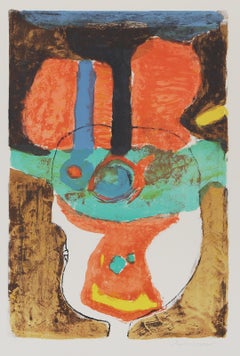
Modern Portrait, Art Brut Lithograph by Slavko Kopac

Modern Portrait, Art Brut Lithograph by Slavko Kopac

By Slavko Kopac

Located in Long Island City, NY

Slavko Kopac was born in Croation in 1913. He was one of the founding members and curators of Art Brut (Compagnie de L'Art Brut). 1948, Compagnie de L'Art Brut is founded by Slavko K...

Category

1980s Modern Figurative Prints

Materials

Lithograph

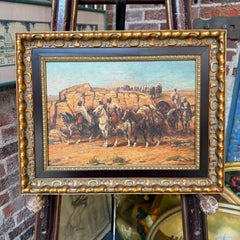
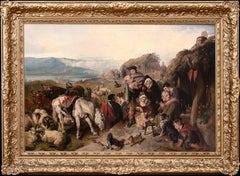
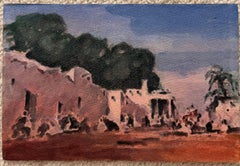
Orientalist Caravan Crossing Desert Rocks

Orientalist Caravan Crossing Desert Rocks

Located in Jacksonville, FL

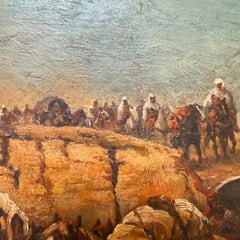
Title: “Orientalist Caravan Scene” – Oil on Board, Late 19th Century Description: This finely executed 19th-century Orientalist painting depicts a caravan of mounted riders and came...

Category

19th Century Figurative Paintings

Materials

Oil

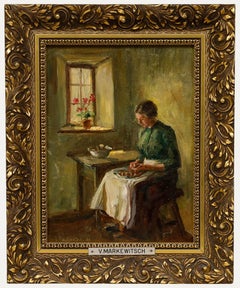
Viktor Markewitsch (1881-1932) - Framed 1929 Oil, By the Window

Viktor Markewitsch (1881-1932) - Framed 1929 Oil, By the Window

Located in Corsham, GB

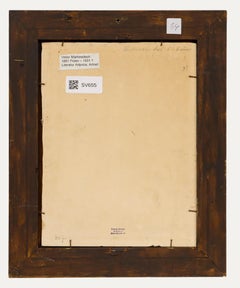
This genre scene by Polish artist Viktor Markewitsch (1881-1932) depicts a woman seated by a window, working within a humble interior setting. Signed and dated to the lower left. Wel...

Category

Early 20th Century Figurative Paintings

Materials

Oil

We Are Stardust
We Are Stardust

We Are Stardust

By Marie Cameron

Located in Burlingame, CA

Marie Cameron is a realist painter and mixed media assemblage artist whose work explores hope, awe, and loss in the age of the Anthropocene. Her paintings often consider the fragile ...

Category

2010s Surrealist Figurative Paintings
Materials

Gold Leaf

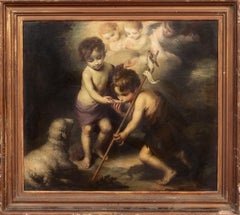
The Infant Christ, St John the Baptist & The Lamb, 18th Century Spanish School

The Infant Christ, St John the Baptist & The Lamb, 18th Century Spanish School

By Bartolomé Esteban Murillo

Located in Liphook, GB

The Infant Christ, St John the Baptist & The Lamb, 18th Century Spanish School Large 18th Century Spanish School depiction of Christ, St John and the lamb, oil on canvas. Excellent...

Category

Early 18th Century Portrait Paintings

Materials

Canvas, Oil

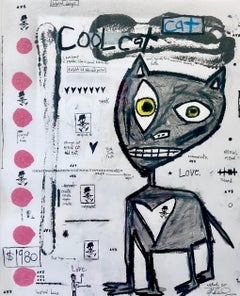
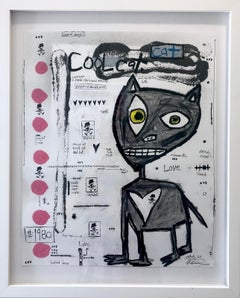
"Cool Cat" - Cat drawing on paper with text

"Cool Cat" - Cat drawing on paper with text

By Adam Baranello

Located in East Quogue, NY

Original mixed media work on paper by Adam Baranello. Mixed media, acrylic, spray paint on canvas. Size 17 x 14 in. Offered unframed. Ships rolled Multidisciplinary artist Adam Ba...

Category

2010s Contemporary Animal Drawings and Watercolors

Materials

Oil Pastel, Ink, Mixed Media, Spray Paint, Acrylic

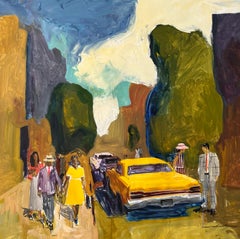
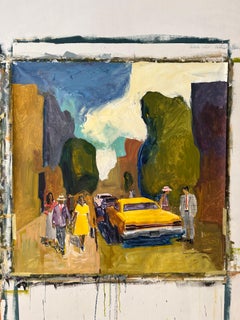
Stroll in the Sun
Stroll in the Sun

Stroll in the Sun

By Jacob Burda

Located in Zofingen, AG

From the City Stories series, this painting captures the vibrant rhythm of urban life bathed in sunlight. The golden tones of the vintage car and the bright dress at the center creat...

Category

2010s Contemporary Figurative Paintings
Materials

Canvas, Acrylic

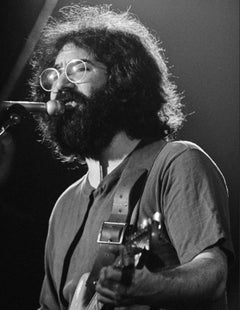
Jerry Garcia, NYC 1971

Jerry Garcia, NYC 1971

By Bob Gruen

Located in Toronto, ON

Open and Limited Edition Silver Gelatin Prints
 Hand Signed by Bob Gruen Please contact us for inquiries of desired size: 8" x 10" Unframed
Open Edition 11" x 14" Unframed
Open Edi...

Category

21st Century and Contemporary Black and White Photography

Materials

Silver Gelatin

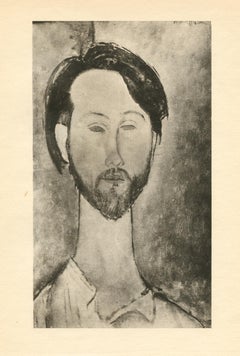
(after) Amedeo Modigliani "Portrait de Zborowski"

(after) Amedeo Modigliani "Portrait de Zborowski"

By Amedeo Modigliani

Located in Henderson, NV

Medium: collotype (after the painting). Printed in 1926 at the Leon Marotte atelier and published in an edition of 1000 by Editions des Quatre Chemins. Image size: 8 x 4 3/4 inches (...

Category

1920s Prints and Multiples

Materials

Photogravure

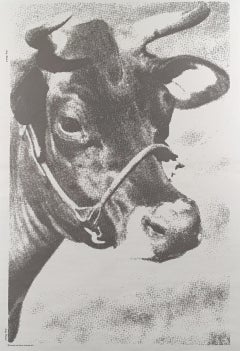
Venice Biennale COW

Venice Biennale COW

By Andy Warhol

Located in New York, NY

Created by Andy Warhol for the 1976 Venice Biennale, Venice Biennale COW is a lithograph on wove paper that contains the artist’s name twice as well as "Copyright Andy Warhol La Bien...

Category

20th Century Pop Art Animal Prints

Materials

Lithograph

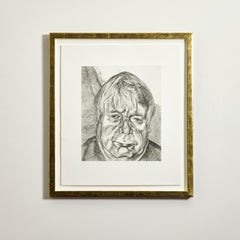
Donegal Man
Donegal Man

Donegal Man

By Lucian Freud

Located in Toronto, Ontario

Lucian Freud (1922-2011) was a seminal figure in 20th-century British art, celebrated for his raw and psychologically charged exploration of the human form. With his distinctive fi...

Category

Early 2000s Expressionist Portrait Prints

Materials

Etching

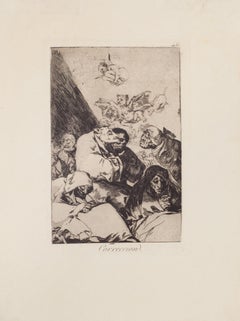
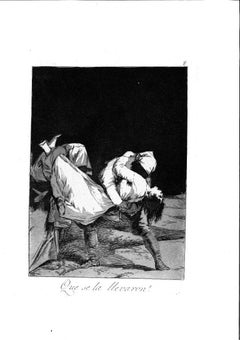
Que se la Llevaron! - Etching by Francisco Goya - 1799

Que se la Llevaron! - Etching by Francisco Goya - 1799

By Francisco Goya

Located in Roma, IT

Que se la Llevaron! is an original etching realized by Francisco Goya in 1799, from Los Caprichos series. The artwork is the plate 8 (as printed on plate on the higher right margin) from the series Los Caprichos, first edition. Good conditions. Los Caprichos. Put on sale the 6 February 1799, at the end of the last carnival of the century, Los Caprichos, first Goya’s printed...

Category

1790s Old Masters Figurative Prints

Materials

Etching

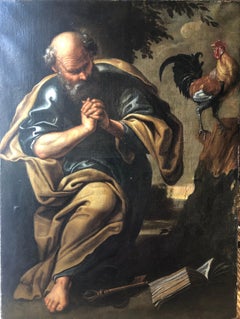
Large Beautiful Early 17th Century Painting of St Peter

Large Beautiful Early 17th Century Painting of St Peter

Located in London, GB

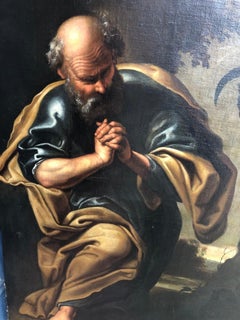
17th Century Italian School St Peter Oil on Canvas 55 1/2 x 41 inches This large and tender rendering of Saint Peter was painted by the hand of great Italian painter of the 17th Cen...

Category

Early 17th Century Baroque Portrait Paintings

Materials

Oil

1920s Italian Signed Drawing Portrait

1920s Italian Signed Drawing Portrait

By Lorenzo Viani

Located in Roma, IT

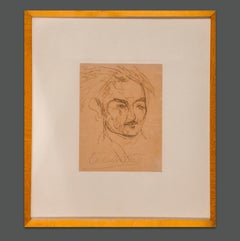
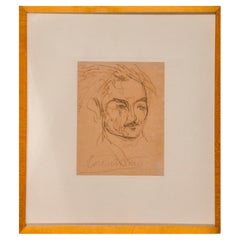
Rare and important pencil drawing by one of the most important Italian Avangarde Lorenzo Viani. It represent one of his typical subject: the portrait of the people of Viareggio, his ...

Category

Early 20th Century Italian School Portrait Drawings and Watercolors

Materials

Paper, Pencil

Women
Women

Women

By Jose Clemente Orozco

Located in Santa Monica, CA

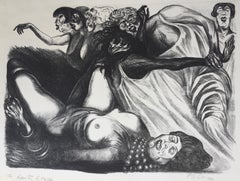
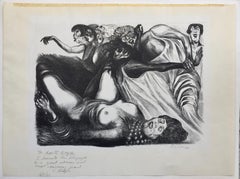
JOSE CLEMENTE OROZCO (1893 – 1949) WOMEN, 1934 ( Orozco 25) Lithograph, One of 127 signed & unnumbered impressions, (total printed 255) Printer Jesus Arteaga. Image 12 1/2 x 17 inches, sheet 17 x 23 inches. Large sheet. top sheet edge with deckle edge and with some remnants of old old tape. Some slight mat burn verso., just a hint on the recto. This impression is also dedicated to Rosita Boyce by Clemente Orozco - (the Artist's Son) in 1961 From "Jose Clemente Orozco - Graphic Work" by Clemente Orozco, University of Texas Press, 2004. "The image is a detail of the Mural "Contemporary World" in the Palace of Fine Arts, Mexico City. The mural depicts "the real prostitution of power is implied by prostitutes fighting for survival. in a game of exuberance and decadence. The theme of women, especially prostitutes, has a special significance in Orozco's work, from his early watercolors to this fresco.." This print is related to Orozco's MACHINES also on 1stdibs offered by this dealer. Mexican Prints...

Category

1930s Modern Figurative Prints

Materials

Lithograph

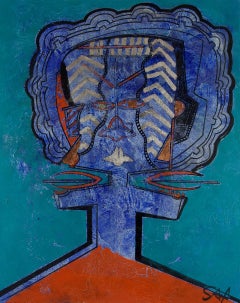
Janus:  Contemporary Figurative Painting

Janus: Contemporary Figurative Painting

By Sax Berlin

Located in Brecon, Powys

Janus, the ancient Roman god of beginnings and endings, transition, time and portals is depicted in this Neo-Expressionist painting from. Sax Berlin. The piece puts a 21st century in...

Category

2010s Contemporary Figurative Paintings
Materials

Oil

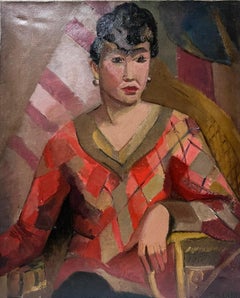
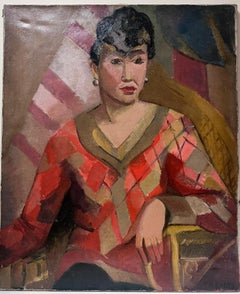
Antique French Fauvist 1920's Signed Oil Painting Portrait of Fashionable Lady

Antique French Fauvist 1920's Signed Oil Painting Portrait of Fashionable Lady

Located in Cirencester, Gloucestershire

Portrait of a Lady French School, fauvist style indistinctly signed circa 1920's period oil on canvas, unframed canvas: 22 x 18 inches provenance: private collection condition: very ...

Category

Early 20th Century Fauvist Portrait Paintings

Materials

Oil, Canvas

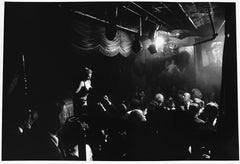
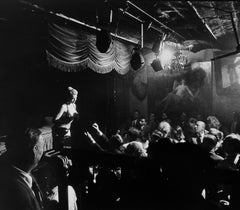
Stripper, Crazy Horse Saloon, Paris, France, 1956, Gelatin Silver Print, 8x10

Stripper, Crazy Horse Saloon, Paris, France, 1956, Gelatin Silver Print, 8x10

By Burt Glinn

Located in New york, NY

American photographer Burt Glinn's Stripper, Crazy Horse Saloon, Paris, 1956, is an 8" x 10" gelatin silver print, with notations and the photographer's magnum stamp on verso (back o...

Category

1950s Contemporary Black and White Photography

Materials

Photographic Film, Photographic Paper, Silver Gelatin

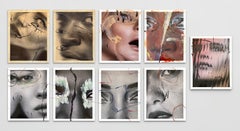
Jan and Josef

Jan and Josef

By Marina Stern

Located in Los Angeles, CA

This work is part of our exhibition Marina Stern Luminary, the first retrospective of the artist since 2007. This work consists of six oils on canvas framed together by the artist. ...

Category

1990s American Modern Landscape Paintings
Materials

Canvas, Oil

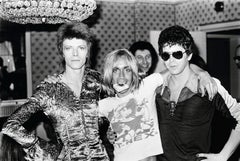
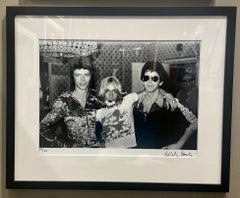
David Bowie, Iggy Pop & Lou Reed, London's Dorchester Hotel, 1972 by Mick Rock

David Bowie, Iggy Pop & Lou Reed, London's Dorchester Hotel, 1972 by Mick Rock

By Mick Rock

Located in Culver City, CA

David Bowie, Iggy Pop & Lou Reed, London's Dorchester Hotel, 1972 by Mick Rock Edition: 29/50 Signed and numbered by Mick Rock. Medium: Silver gelatin limited edition photographic print on paper Size framed: 27" x 33" inch "It was a press conference at the Dorchester Hotel in London. RCA Records had flown a bunch of American journalists to London in July 1972 to promote David’s upcoming US tour and the release of his Ziggy Stardust album. Iggy and Lou were both working on their new albums, Raw Power and Transformer and were hanging out at the conference. Even though Iggy and Lou were still basically “underground” artists, and David’s ascent was still in its early days, it was a photo that I really wanted to take. Only later did it become one of the classic rock images. So I hustled them together. The only thing I remember was Lou saying: “This will be a pretty picture!” When Mick Rock first met David Bowie, he had previously met and photographed both Iggy Pop and Lou Reed, so there was an immediate bond formed...

Category

20th Century Contemporary Black and White Photography

Materials

Silver Gelatin

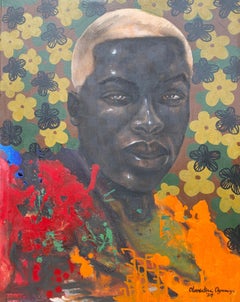
His Worth II - 21st Century, Contemporary, Figurative Portrait, Black Men Face

His Worth II - 21st Century, Contemporary, Figurative Portrait, Black Men Face

By Oluwatosin Ogunniyi

Located in Ibadan, Oyo

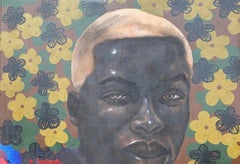
“Meet A man of unshakeable self-worth and conviction. He protects his essence and values, refusing to compromise his integrity while remaining true to himself. With quiet confidence ...

Category

21st Century and Contemporary Contemporary Portrait Paintings
Materials

Canvas, Charcoal, Acrylic

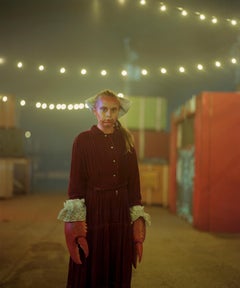
Lobster Girl, Fright Nights, West Palm Beach - Horror Show Florida Photography

Lobster Girl, Fright Nights, West Palm Beach - Horror Show Florida Photography

By Rachel Louise Brown

Located in Brighton, GB

"Lobster Girl. Fright Nights, West Palm Beach. 2017" is a Dye Sublimation Print on Aluminium. This print is available from an Edition of 10 + 2 Artis...

Category

21st Century and Contemporary Contemporary Portrait Photography

Materials

Dye, Photographic Paper, Color, Dye Transfer

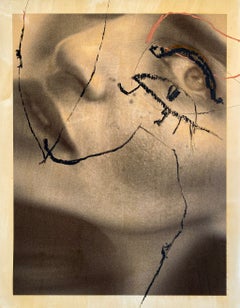
Pugna 056, by Chidy Wayne - Mixed Media on Canvas

Pugna 056, by Chidy Wayne - Mixed Media on Canvas

By Chidy Wayne

Located in Bruxelles, BE

Chidy Wayne (b. 1981, Spain) is an artist based in Barcelona. Over the years, he has established himself as a recognized figure in the art world, developing a personal artistic langu...

Category

2010s Contemporary Portrait Paintings
Materials
Gesso, Canvas, Mixed Media, Acrylic