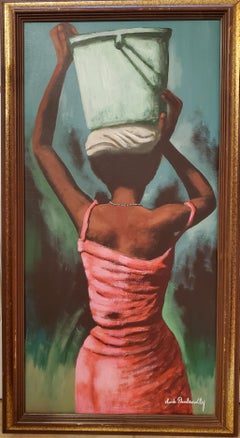
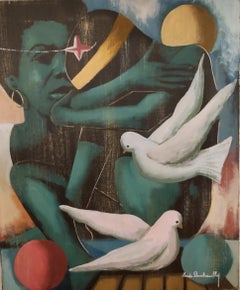
Claude Dambreville was born in Port au Prince, Haiti on December 17, 1934, and died on March 15, 2021. He was the director of Radio Tropiques, a commercial radio station from 1956 to 1968 before he joined the Centre d’ Art in Port au Prince in 1968 where he learned and perfected his painting technique. He further improved his drawing by taking correspondence courses at ABC school of Paris. Afterward, he studied artistic anatomy at "L' Atelier", a school owned by the famous artist Nehemy Jean. He married the daughter of Petion Savain, artist of the first generation of Haitian artists whom he met at the Centre d’ Art.
Dambreville’s work is essentially based on the play of shadow and light. Using blue and grey color tones, playing with shadows, the force and strength of his works rest in his ability to represent the strength, dignity, and grace of the persons, mostly market people, who are his subjects.
“My paintings made their entrance in a large number of Magazines such as Hemisphere, the monthly publication of United Airlines. Today, there is nothing unusual about seeing my white-dressed women illustrating the menus of certain great restaurants for tourists or decorating some postcards or some greeting cards”
Dambreville has exhibited in Haiti, New York, Boston, New Orleans, Guyana, Paris (1990), Ivory Coast, Mexico (1993). Dambreville is also a writer and journalist. Dambreville’s work is mentioned in most major Haitian art books. When he does not paint, Dambreville writes.
"Dambreville's work is essentially based on the play of shadow and light" (Peintres Haitiens by Gerald Alexis).
Figurative art, as opposed to abstract art, retains features from the observable world in its representational depictions of subject matter. Most commonly, figurative paintings reference and explore the human body, but they can also include landscapes, architecture, plants and animals — all portrayed with realism.
While the oldest figurative art dates back tens of thousands of years to cave wall paintings, figurative works made from observation became especially prominent in the early Renaissance. Artists like Michelangelo, Leonardo da Vinci and other Renaissance masters created naturalistic representations of their subjects.
Pablo Picasso is lauded for laying the foundation for modern figurative art in the 1920s. Although abstracted, this work held a strong connection to representing people and other subjects. Other famous figurative artists include Francis Bacon and Lucian Freud. Figurative art in the 20th century would span such diverse genres as Expressionism, Pop art and Surrealism.
Today, a number of figural artists — such as Sedrick Huckaby, Daisy Patton and Eileen Cooper — are making art that uses the human body as its subject.
Because figurative art represents subjects from the real world, natural colors are common in these paintings. A piece of figurative art can be an exciting starting point for setting a tone and creating a color palette in a room.
Browse an extensive collection of figurative paintings on 1stDibs.