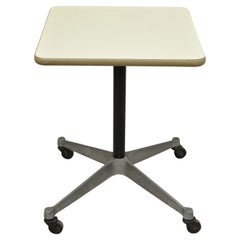
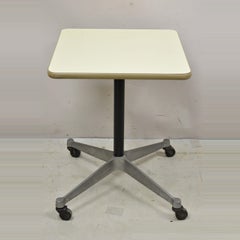
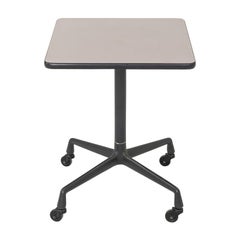
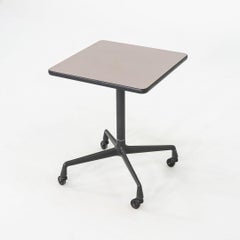
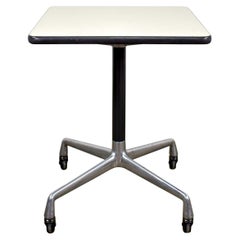
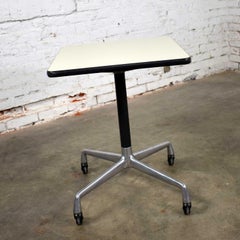
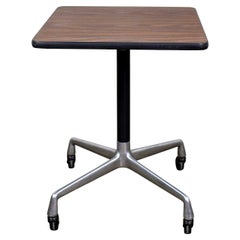
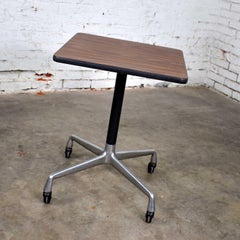
Eames Miller Rolling Table
Vintage 1980s American Modern Side Tables
Aluminum, Steel
Recent Sales
Mid-20th Century American Mid-Century Modern End Tables
Aluminum, Steel
Mid-20th Century American Mid-Century Modern End Tables
Aluminum, Steel
Charles and Ray Eames for sale on 1stDibs
Charles Eames and Ray Eames were the embodiment of the inventiveness, energy and optimism at the heart of mid-century modern American design, and have been recognized as the most influential designers of the 20th century. The Eameses were lovers of folk craft who had a genius for making highly original chairs, tables, case pieces and other furniture using traditional materials and forms.
As furniture designers, filmmakers, artists, textile and graphic designers and even toy and puzzle makers, the Eameses were a visionary and effective force for the notion that design should be an agent of positive change. They are the happy, ever-curious, ever-adventurous faces of modernism.
Charles Eames (1907–78) studied architecture and industrial design. Ray Eames (née Beatrice Alexandra Kaiser, 1912–88) was an artist, who studied under the Abstract Expressionist painter Hans Hofmann. They met in 1940 at the Cranbrook Academy of Art in suburban Detroit (the legendary institution where Charles also met his frequent collaborator Eero Saarinen and the artist and designer Harry Bertoia) and married the next year.
His technical skills and her artistic flair were wonderfully complementary. They moved to Los Angeles in 1941, where Charles worked on set design for MGM. In the evenings at their apartment, they experimented with molded plywood using a handmade heat-and-pressurization device they called the “Kazam!” machine. The next year, they won a contract from the U.S. Navy for lightweight plywood leg splints for wounded servicemen — vintage Eames splints are coveted collectibles today; more so those that Ray used to make sculptures.
The Navy contract allowed Charles to open a professional studio, and the attention-grabbing plywood furniture the firm produced prompted George Nelson, the director of design of the furniture-maker Herman Miller Inc., to enlist Charles and (by association, if not by contract) Ray in 1946. Some of the first Eames items to emerge from Herman Miller are now classics: the Eames chair, the LCW, or Lounge Chair Wood, and the DCM, or Dining Chair Metal, supported by tubular steel.
The Eameses eagerly embraced new technology and materials, and one of their peculiar talents was to imbue their supremely modern design with references to folk traditions.
Their Wire chair group of the 1950s, for example, was inspired by basket weaving techniques. The populist notion of “good design for all” drove their molded fiberglass chair series that same decade, and also produced the organic-form, ever-delightful La Chaise. In 1956 the Eames lounge chair and ottoman appeared — the supremely comfortable plywood-base-and-leather-upholstery creation that will likely live in homes as long as there are people with good taste and sense.
Charles Eames once said, “The role of the designer is that of a very good, thoughtful host anticipating the needs of his guests.” For very good collectors and thoughtful interior designers, a piece of design by the Eameses, the closer produced to original conception the better, is almost de rigueur — for its beauty and comfort, and not least as a tribute to the creative legacy and enduring influence of Charles and Ray Eames.
The original Eames furniture for sale on 1stDibs includes chairs, tables, case pieces and other items.
Finding the Right Side-tables for You
While the range of styles and variety of materials have broadened over time, the priceless functionality of side tables has held true.
Antique and vintage side tables are an integral accent to our seating and provide additional, necessary storage in our homes. They can be a great foundation for that perfect focal piece of art that you want all your guests to see as you congregate for cocktails in the living room. Side tables are indeed ideal as a stage for your decorative objects or plants in your library or your study, and they are a practical space for the novel or stack of design magazines you keep close to your sofa.
Sure, owning a pair of side tables isn’t as imperative as having a coffee table in the common area, though most of us would struggle without them. Those made of metal, stone or wood are frequently featured in stylish interiors, and if you’re shopping for side tables, there are a couple of things to keep in mind.
With respect to the height of your side tables, a table that is as high as your lounge chair or the arm of your couch is best.
Some folks are understandably fussy about coherence in a living room area, but coherence doesn’t necessarily mean you can’t mix and match. Feel free to introduce minimalist mid-century modern wooden side tables designed by Paul McCobb alongside your contemporary metal coffee table. If you think it isn’t possible to pair a Hollywood Regency–style side table with a contemporary sofa, we’re here to tell you that it is. Even a leggy side table can balance a chunky sofa well. Try to keep a limited color palette in mind if you’re planning on mixing furniture styles and materials, and don’t be afraid to add a piece of abstract art to shake things up.
As far as the objects you’re planning to place on your side tables, if you have heavy items such as stone or sculptures to display, a fragile glass-top table would not be an ideal choice. Think about what material would best support your collectibles and go with that. If it’s a particularly small side table, along with a tall, sleek floor lamp, it can make for a great way to fill a corner of the room you wouldn’t otherwise easily be able to populate.
Whether you are looking for an antique 19th-century carved oak side table or a vintage rattan side table (because rattan never went away!), the collection on 1stDibs has you covered — find Art Deco side tables, bamboo side tables, travertine side tables and more today.