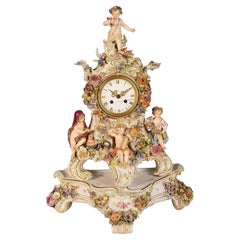
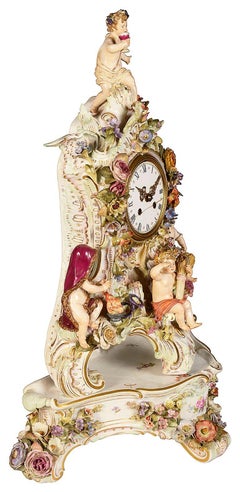
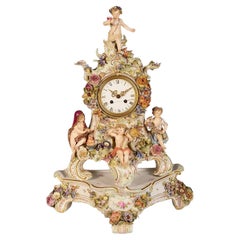
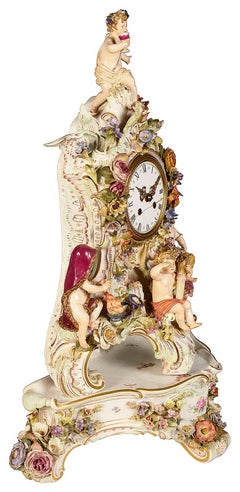
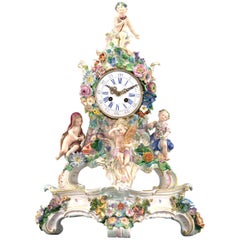
Meissen Clock Depicting The Four Seasons

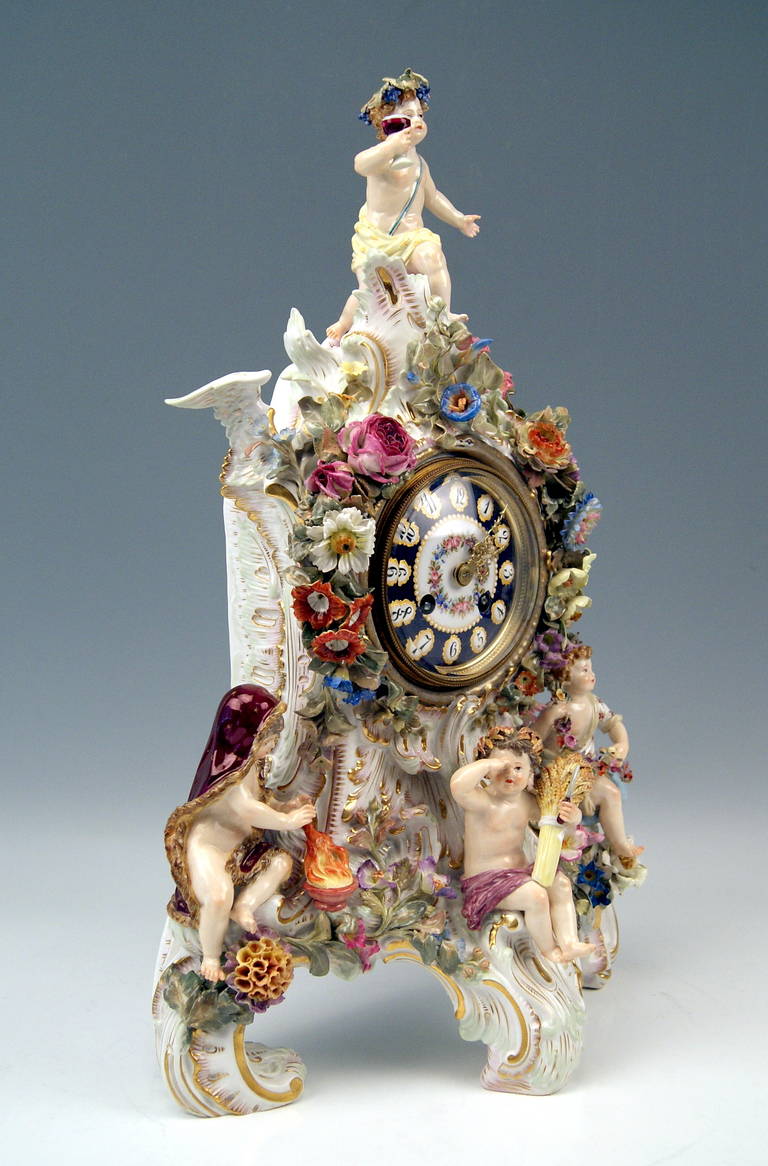
19th Century Meissen clock depicting the four seasons.
By Meissen Porcelain
Located in Brighton, Sussex
traditional colours, the figures representing the four seasons. The clock striking on the hour and half hour
Category

Antique 19th Century German Mantel Clocks

Materials

Porcelain

19th Century Meissen clock depicting the four seasons.
$11,804
H 22.84 in W 16.54 in D 7.88 in
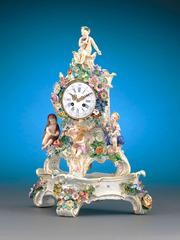
Copy - 19th Century Meissen clock depicting the four seasons.
By Meissen Porcelain
Located in Brighton, Sussex
traditional colours, the figures representing the four seasons. The clock striking on the hour and half hour
Category

Antique Mid-19th Century German Mantel Clocks

Materials

Porcelain

Recent Sales

19th Century Porcelain Four Seasons Clock by Meissen
By Meissen Porcelain
Located in New Orleans, LA
themes with its striking depiction of the Four Seasons. Winter is enveloped in a warm cloak, fall holds a
Category

Antique 19th Century German Rococo Mantel Clocks

Materials

Porcelain

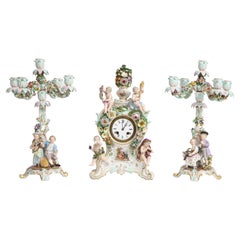
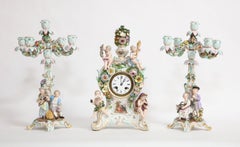
19th C. Meissen Porcelain Rococo 4 Seasons Clock & Candelabra Garniture Set
By Meissen Porcelain
Located in New York, NY
An impressive and rare 19th century Meissen Porcelain four seasons clock and Candelabra Garniture
Category

Antique 19th Century German Rococo Table Clocks and Desk Clocks

Materials

Bronze

Meissen Tall Mantle Table Clock Four Seasons Kaendler C. 1860
By Meissen Porcelain
Located in Vienna, AT
MEISSEN GORGEOUS MANTLE / TABLE CLOCK decorated with STUNNING FIGURINES depicting THE FOUR SEASONS
Category

Antique 19th Century German Rococo Revival Porcelain

Materials

Porcelain

People Also Browsed

19th Century French Bronze 12 Light Chandelier
Located in Dallas, TX
Handsome 19th century French bronze 12 light chandelier in gold and black. Nice decorative details and very fine quality! Super elegant!
Category

Antique 19th Century French Chandeliers and Pendants

Materials

Bronze

Cattle By Pond At Dusk, Mid-19th Century Tonalist Landscape by William Keith
By William Keith
Located in Soquel, CA
Cattle By Pond At Dusk, Mid-19th Century Tonalist Landscape by William Keith Gorgeous mid-19th century landscape painting by William Keith (American, 1838-1911), circa 1860. This im...
Category

1890s Pre-Raphaelite Figurative Paintings

Materials

Oil, Illustration Board

Art Deco Vase Daum Nancy Acid-Etched Glass Vase, circa 1910-1925 French Glass
Located in Amsterdam, Noord Holland
Step into the elegance of the Art Deco era with this exquisite Daum Nancy vase, a testament to the unparalleled craftsmanship and timeless beauty of French glassmaking. Dating back t...
Category

Antique 18th Century French Art Deco Planters, Cachepots and Jardinières

Materials

Porcelain

Late 17th C. Franco-Flemish Biblical Tapestry Reconciliation of Jacob and Esau
Located in New York, NY
This is a gorgeous antique Late 17th Century Franco-Flemish Biblical Tapestry depicting the Reconciliation of Jacob and Esau. The tapestry illustrates the Old Testament story of Jaco...
Category

Antique Late 17th Century Belgian Baroque Tapestries

Materials

Tapestry, Wool, Silk

The Spanish Mediterranean Islands Cookbook
Located in New York, NY
Explore the diverse cuisine of Spain’s Balearic Islands – Mallorca, Menorca, Ibiza, and Formentera – through 155 authentic home cooking recipes. Located off the Spanish Mediterranea...
Category

2010s Books

Materials

Paper

The Spanish Mediterranean Islands Cookbook
$40 / item
H 10.63 in W 8.13 in D 1.22 in
Sensational Maison Bagues Crystal Ship Chandelier
Located in East Hampton, NY
A 3-masted ship with gilt metal frame and allover crystal button prisms and tole flags.... a very special and unique piece....
Category

20th Century Chandeliers and Pendants

Materials

Crystal

Swiss Gold Musical Snuff Box
Located in New Orleans, LA
This special and important Swiss gold music box is chased and engraved with a set of musical instruments surrounded by elaborate swirls of ornate foliage. Embossed with a delightful ...
Category

Antique 19th Century Swiss Other Snuff Boxes and Tobacco Boxes

Materials

Gold

Swiss Gold Musical Snuff Box
$34,500
H 0.88 in W 3.25 in D 2 in
Royal Copenhagen Flora Danica Hand Painted Aquatic Theme Fish Gravy Boat & Stand
By Flora Danica
Located in Great Barrington, MA
A magnificent example of Royal Copenhagen's finest line of porcelain, this Flora Danica gravy boat is hand painted on both sides with aquatic scenes and swimming fish. The handle res...
Category

Vintage 1950s Danish Platters and Serveware

Materials

Porcelain

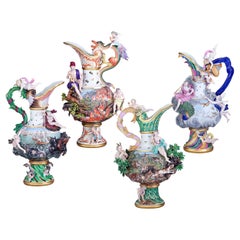
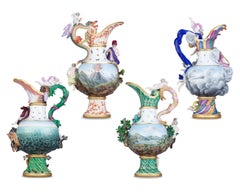
Meissen Four Elements Porcelain Ewers
By Meissen Porcelain
Located in New Orleans, LA
This extremely rare and important set of four Meissen ewers represents the Four Elements: Earth, Air, Water and Fire. Impressive in both size and artistry, they are among the most fa...
Category

Antique 19th Century German Other Porcelain

Materials

Porcelain

Meissen Four Elements Porcelain Ewers
$298,500 / set
H 27 in W 15 in D 10 in
Still Life of Peonies, Roses, Honeysuckle, Poppies, and other Flowers
Located in New York, NY
This painting demonstrates the source of Arnoldus Bloemers’ enduring popularity. A profusion of peonies, honeysuckle, and poppies share the confines of a terracotta urn sitting on a ...
Category

19th Century Romantic Still-life Paintings

Materials

Oil

Half Moon Beach
By John Terelak
Located in Greenwich, CT
John Charles Terelak is recognized as one of America's finest living impressionists. Born in Boston, Massachusetts, he received formal art instruction at the Vesper George School of ...
Category

2010s American Impressionist Landscape Paintings

Materials

Canvas, Oil

Half Moon Beach
$17,500
H 28 in W 36 in
Italian 19th Century Venetian St. Giltwood And Crystal Chandelier
Located in West Palm Beach, FL
A beautiful and extremely decorative Italian 19th century Venetian st. giltwood and crystal chandelier. The eight arm chandelier is centered by lovely and most unique bottom foliate ...
Category

Antique 19th Century Italian Chandeliers and Pendants

Materials

Crystal

Large Royal Copenhagen Porcelain Vase, Dated 1927
Located in New York, NY
Depicting a shipping vessel with the flag of Denmark on calm blue waters. Signed by Christian Benjamin Olsen.
Category

Vintage 1920s Danish Vases

Materials

Porcelain

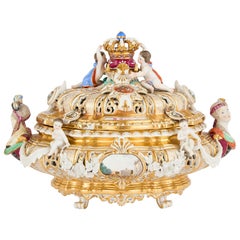
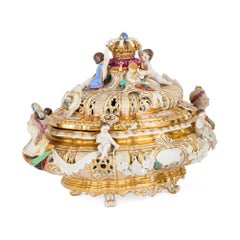
Antique German Porcelain Tureen with Cover by Meissen
By Meissen Porcelain
Located in London, GB
Antique German porcelain tureen with cover by Meissen German, Late 19th Century Height 20cm, width 25cm, depth 18cm This remarkable porcelain tureen, produced by Meissen in the la...
Category

Antique Late 19th Century German Baroque Porcelain

Materials

Porcelain

Antique German Porcelain Tureen with Cover by Meissen
$44,441
H 7.88 in W 9.85 in D 7.09 in
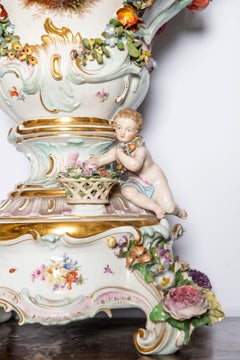
Large Pair Dresden Style Lidded Comports, Late 19th Century
By Dresden Porcelain
Located in Brighton, Sussex
An impressive pair of Dresden style porcelain lidded comports, each with cherubs seated or climbing around the lids, crowns to each with family crests, beautiful colored flowers surr...
Category

Early 20th Century German Vases

Materials

Porcelain

Large Pair Dresden Style Lidded Comports, Late 19th Century
$9,027 / set
H 28.35 in W 12.6 in D 9.85 in
19th Century winter landscape oil painting of figures skating on a Dutch lake
Located in Nr Broadway, Worcestershire
Louis Smets Dutch, (act. 1852-1896) A Winter’s Day Oil on canvas, signed Image size: 23.5 inches x 32.5 inches Size including frame: 30.5 inches x 39.5 inches This winter landscape...
Category

19th Century Victorian Landscape Paintings

Materials

Canvas, Oil

Get Updated with New Arrivals
Save "Meissen Clock Depicting The Four Seasons", and we’ll notify you when there are new listings in this category.

Meissen Porcelain for sale on 1stDibs

Meissen Porcelain (Staatliche Porzellan-Manufaktur Meissen) is one of the preeminent porcelain factories in Europe and was the first to produce true porcelain outside of Asia. It was established in 1710 under the auspices of King Augustus II “the Strong” of Saxony-Poland (1670–1733), a keen collector of Asian ceramics, particularly Ming porcelain.

In pursuing his passion, which he termed his “maladie de porcelaine,” Augustus spent vast sums, amassing some 20,000 pieces of Japanese and Chinese ceramics. These, along with examples of early Meissen, comprise the Porzellansammlung, or porcelain collection, of the Zwinger Palace, in Dresden.

The king was determined, however, to free the European market from its dependence on Asian imports and to give European artisans the freedom to create their own porcelain designs. To this end, he charged the scientist Ehrenfried Walther von Tschirnhaus and aspiring alchemist Johann Friedrich Böttger with the task of using local materials to produce true, hard-paste porcelain (as opposed to the soft-paste variety European ceramists in the Netherlands, Germany, France, Italy and Spain had been producing since the late Renaissance). In 1709, the pair succeeded in doing just that, employing kaolin, or “china clay.” A year later, the Meissen factory was born.

In its first decades, Meissen mostly looked to Asian models, producing wares based on Japanese Kakiemon ceramics and pieces with Chinese-inflected decorations called chinoiserie. During the 1720s its painters drew inspiration from the works of Watteau, and the scenes of courtly life, fruits and flowers that adorned fashionable textiles and wallpaper. It was in this period that Meissen introduced its famous cobalt-blue crossed swords logo — derived from the arms of the Elector of Saxony as Arch-Marshal of the Holy Roman Empire — to distinguish its products from those of competing factories that were beginning to spring up around Europe.

By the 1730s, Meissen’s modelers and decorators had mastered the style of Asian ceramics, and Augustus encouraged them to develop a new, original aesthetic. The factory’s director, Count Heinrich von Brühl, used Johann Wilhelm Weinmann’s botanical drawings as the basis for a new line of wares with European-style surface decoration. The Blue Onion pattern (Zwiebelmuster), first produced in 1739, melded Asian and European influences, closely following patterns used in Chinese underglaze-blue porcelain, but replacing exotic flora and fruits with Western varieties (likely peaches and pomegranates, not onions) along with peonies and asters.

During the same period, head modeler Joachim Kändler (1706–75) began crafting delicate porcelain figures derived from the Italian commedia dell’arte. Often used as centerpieces on banquet tables and decorated to reflect the latest fashions in courtly dress for men and women, these figurines were popular in their day, and are still considered among Meissen’s most iconic creations. Kändler also created the Swan Service, which, with its complex low-relief surface design and minimal decoration is considered a masterpiece of Baroque ceramics.

The rise of Neoclassicism in the latter half of the 18th century forced Meissen to change artistic direction and begin producing monumental vases, clocks, chandeliers and candelabra. In the 20th century, Meissen added to its 18th-century repertoire decidedly modern designs, including ones in the Art Nouveau style. The 1920s saw the introduction of numerous animal figures, such as the popular sea otter (Fischotter), which graced an East German postage stamp in the 1960s. Starting in 1933, artistic freedom was limited at the factory under the Nazi regime, and after World War II, when the region became part of East Germany, it struggled to reconcile its elite past with the values of the Communist government. In 1969, however, new artistic director Karl Petermann reintroduced the early designs and fostered a new degree of artistic license. Meissen became one of the few companies to prosper in East Germany.

Owned by the State of Saxony since reunification, in 1990, Meissen continues to produce its classic designs together with new ones developed collaboratively with artists from all over the world. In addition, through its artCAMPUS program, the factory has invited distinguished ceramic artists, such as Chris Antemann and Arlene Shechet, to work in its studios in collaboration with its skilled modelers and painters. The resulting works of contemporary sculpture are inspired by Meissen’s rich and complex legacy.

Find a collection of authentic Meissen Porcelain on 1stDibs.

Finding the Right Clocks for You

A sophisticated clock design, whether it’s a desk clock, mantel clock or large wall clock for your living room, is a decorative object to be admired in your home as much as it is a necessary functional element. This is part of the reason clocks make such superb collectibles. Given the versatility of these treasured fixtures — they’ve long been made in a range of shapes, sizes and styles — a clock can prove integral to your own particular interior decor.

Antique and vintage clocks can whisk us back to the 18th and 19th centuries. When most people think of antique clocks, they imagine an Art Deco Bakelite tabletop clock or wall clock, named for the revolutionary synthetic plastic, Bakelite, of which they’re made, or a stately antique grandfather clock. But the art of clock-making goes way back, transcending continents and encompassing an entire range of design styles and technologies. In short, there are many kinds of clocks depending on your needs.

A variety of wall clocks can be found on 1stDibs. A large antique hand-carved walnut wall clock is best suited to a big room and a flat background given what will likely be outwardly sculptural features, while Georgian grandfather clocks, or longcase clocks, will help welcome rainswept guests into your entryway or foyer. An interactive cuckoo clock, large or small, is guaranteed to bring outsize personality to your living room or dining room. For conversation pieces of a similar breed, mid-century modern enthusiasts go for the curious Ball clock, the first of more than 150 clock models conceived in the studio of legendary architect and designer George Nelson

Minimalist contemporary clocks and books pair nicely on a shelf, but an eye-catching vintage mantel clock can add balance to your home library while drawing attention to your art and design books and other decorative objects. Ormolu clocks dating from the Louis XVI period, designed in the neoclassical style, are often profusely ornate, featuring architectural flourishes and rich naturalistic details. Rococo-style mantel clocks of Meissen porcelain or porcelain originating from manufacturers in cities such as Limoges, France, during the 18th and 19th centuries, exude an air of imperial elegance on your shelves or side tables and can help give your desk a 19th-century upgrade.

On 1stDibs, find a range of extraordinary antique and vintage clocks today.