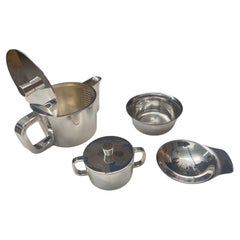
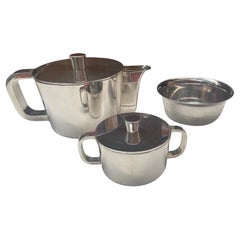
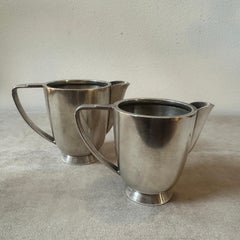
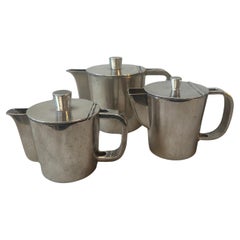
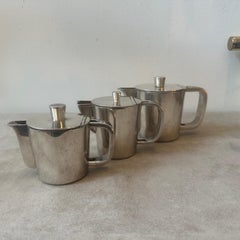
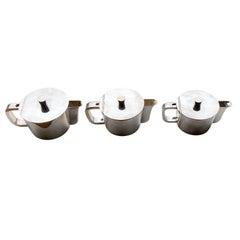
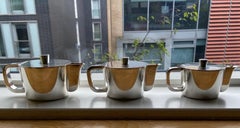
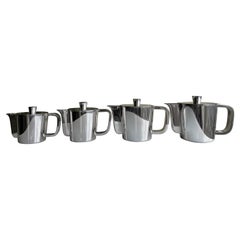
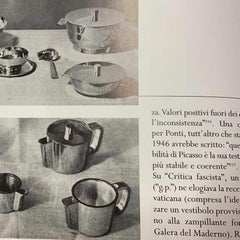
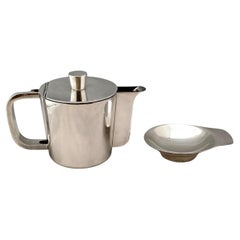
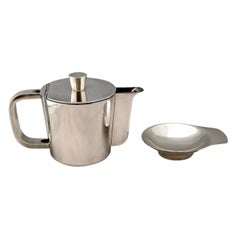
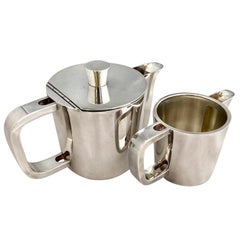
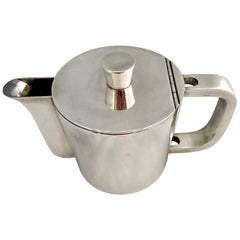
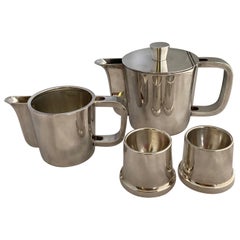
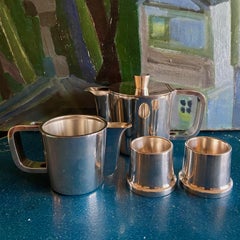
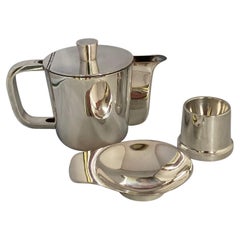
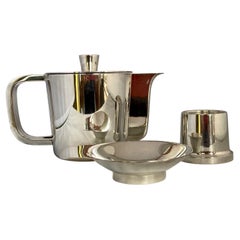
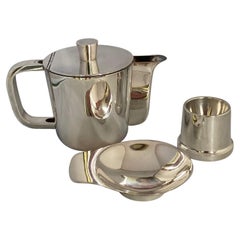
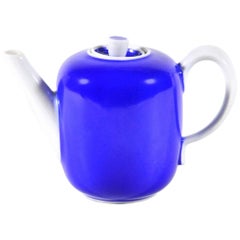
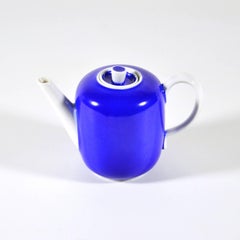
Choose from an assortment of styles, material and more with respect to the gio ponti tea pot you’re looking for at 1stDibs. A gio ponti tea pot — often made from
metal,
alpaca and
fabric — can elevate any home. You’ve searched high and low for the perfect gio ponti tea pot — we have versions that date back to the 20th Century alongside those produced as recently as the 20th Century are available. A gio ponti tea pot, designed in the
mid-century modern or
Art Deco style, is generally a popular piece of furniture.
Gio Ponti,
Arthur Krupp and
Art.Krupp Berndorf each produced at least one beautiful gio ponti tea pot that is worth considering.
An architect, furniture and industrial designer and editor, Gio Ponti was arguably the most influential figure in 20th-century Italian modernism.
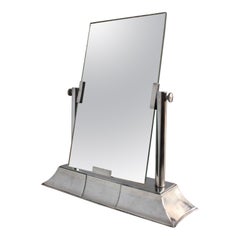
Ponti designed thousands of furnishings and products — from cabinets, mirrors and chairs to ceramics and coffeemakers — and his buildings, including the brawny Pirelli Tower (1956) in his native Milan, and the castle-like Denver Art Museum (1971), were erected in 14 countries. Through Domus, the magazine he founded in 1928, Ponti brought attention to virtually every significant movement and creator in the spheres of modern art and design.
The questing intelligence Ponti brought to Domus is reflected in his work: as protean as he was prolific, Ponti’s style can’t be pegged to a specific genre.
In the 1920s, as artistic director for the Tuscan porcelain maker Richard Ginori, he fused old and new; his ceramic forms were modern, but decorated with motifs from Roman antiquity. In pre-war Italy, modernist design was encouraged, and after the conflict, Ponti — along with designers such as Carlo Mollino, Franco Albini, Marco Zanuso — found a receptive audience for their novel, idiosyncratic work. Ponti’s typical furniture forms from the period, such as the wedge-shaped Distex chair, are simple, gently angular, and colorful; equally elegant and functional. In the 1960s and ’70s, Ponti’s style evolved again as he explored biomorphic shapes, and embraced the expressive, experimental designs of Ettore Sottsass Jr., Joe Colombo and others.
Ponti's signature furniture piece — the one by which he is represented in the collections of the Museum of Modern Art in New York, Germany’s Vitra Design Museum and elsewhere — is the sleek Superleggera chair, produced by Cassina starting in 1957. (The name translates as “superlightweight” — advertisements featured a model lifting it with one finger.)
Ponti had a playful side, best shown in a collaboration he began in the late 1940s with the graphic artist Piero Fornasetti. Ponti furnishings were decorated with bright finishes and Fornasetti's whimsical lithographic transfer prints of things such as butterflies, birds or flowers; the Montreal Museum of Fine Arts possesses a 1950 secretary from their Architetturra series, which feature case pieces covered in images of building interiors and facades. The grandest project Ponti and Fornasetti undertook, however, lies on the floor of the Atlantic Ocean: the interiors of the luxury liner Andrea Doria, which sank in 1956.
Widely praised retrospectives at the Queens Museum of Art in 2001 and at the Design Museum London in 2002 sparked a renewed interest in Ponti among modern design aficionados. (Marco Romanelli’s monograph, which was written for the London show, offers a fine overview of Ponti’s work.) Today, a wide array of Ponti’s designs are snapped up by savvy collectors who want to give their homes a touch of Italian panache and effortless chic.
Find a range of vintage Gio Ponti desks, dining chairs, coffee tables and other furniture on 1stDibs.
Ready to serve high tea and brunch for your family and friends? Start with the right antique, new or vintage tea set.
Tea is a multicultural, multinational beverage and isn’t confined to any particular lifestyle or age group. It has humble beginnings, and one of its best-known origin stories places the first cups of tea in 2700 B.C. in China, where it was recognized for its medicinal properties. Jump ahead to 17th-century England, when Chinese tea began to arrive at ports in London. During the early 1800s, tea became widely affordable, and the concept of teatime took shape all over England. Today, more than 150 million people reportedly drink tea daily in the United States.
Early tea drinkers enjoyed their beverage in a bowl, and English potters eventually added a handle to the porcelain bowls so that burning your fingers became less of a teatime hazard. With the rise in the popularity of teatime, tea sets, also referred to as tea service, became a hot commodity.
During Queen Victoria’s reign, teakettles and coffeepots were added to tea services that were quite large — indeed, small baked goods were served with your drink back then, and a tea set could include many teacups and saucers, a milk pot and other accessories.
During the early 1920s, a sterling-silver full tea service and tray designed by Tiffany & Co. might include a hot-water kettle on a stand, a coffeepot, teapot, a creamer with a small lip spout, a waste bowl and a bowl for sugar, which the British were stirring into tea as early as the 18th century.
But you don’t have to limit your tea set to Victorian or Art Deco styles — shake up teatime with an artful contemporary service. If the bold porcelain cups and saucers by Italian brand Seletti are too unconventional for your otherwise subdued tea circle, find antique services on 1stDibs from Japan, France and other locales as well as vintage mid-century modern tea sets and neoclassical designs.