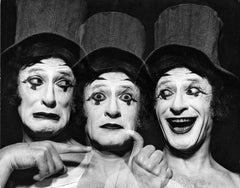
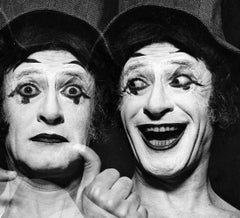
Surely you’ll find the exact jack and marcel you’re seeking on 1stDibs — we’ve got a vast assortment for sale. In our selection of items, you can find
modern examples as well as a
Expressionist version. If you’re looking for a jack and marcel from a specific time period, our collection is diverse and broad-ranging, and you’ll find at least one that dates back to the 20th Century while another version may have been produced as recently as the 21st Century. On 1stDibs, the right jack and marcel is waiting for you and the choices span a range of colors that includes
black,
silver,
brown and
beige. There have been many interesting jack and marcel examples over the years, but those made by
Fred McDarrah,
Julian Wasser,
Shimon Attie,
Jacques Villon and
Fred W. McDarrah are often thought to be among the most thought-provoking. Artworks like these — often created in
silver gelatin print,
paper and
photographic paper — can elevate any room of your home.
The price for an artwork of this kind can differ depending upon size, time period and other attributes — a jack and marcel in our inventory may begin at $275 and can go as high as $22,680, while the average can fetch as much as $1,500.
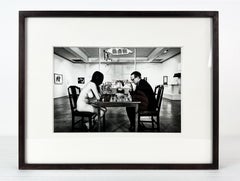
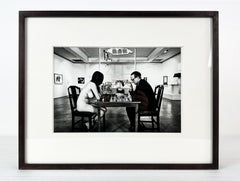
Julian Wasser started his career in photography in the Washington DC bureau of the Associated Press where he met and accompanied the famous news photographer Weegee – who would become a lasting influence on him. In the mid-60s Wasser moved to Los Angeles as a contract photographer for TIME, LIFE, and FORTUNE magazines and becoming internationally known as the go to guy for getting candid but memorably composed photographs. (His iconic images of Jack Nicholson and Anjelica Huston; Marcel Duchamp and Eve Babitz; and a young Jodie Foster are already classics.)
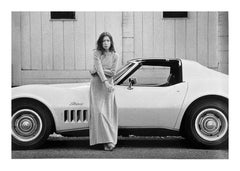
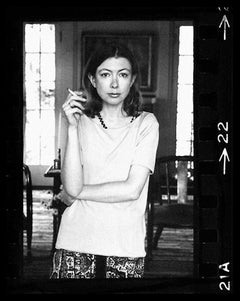
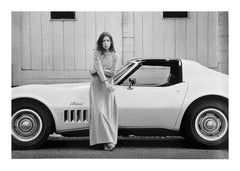
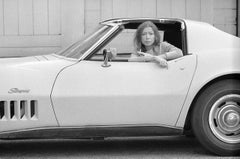
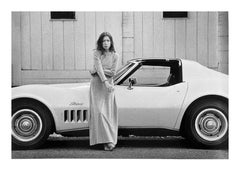
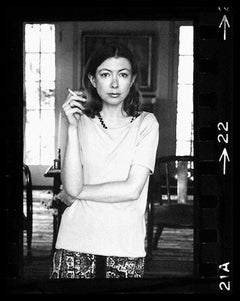
In 1968 TIME Magazine assigned Wasser to go to the home of the young writer Joan Didion whose book Slouching Towards Bethlehem was becoming a literary sensation. “I’d read her fiction,” said Wasser. “and she didn’t miss a thing. She was such a heavyweight person.”
Wasser shot Didion at her rented house on Franklin Avenue in Hollywood, where she lived with her husband, the writer John Gregory Dunne, and their daughter, Quintana Roo. “It was a nice, cozy house,” Wasser remembers. “And she was a very easy person to talk to. No Hollywood affectations.”
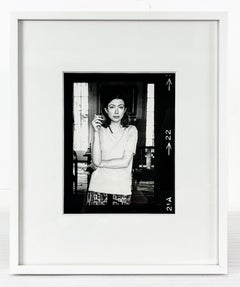
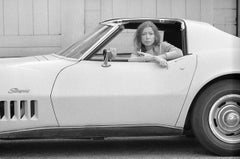
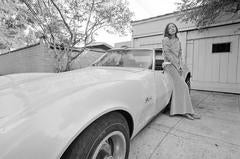
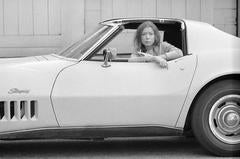
They started the shoot inside the house, and then moved outside where Wasser posed Didion with her recently acquired yellow Corvette Stingray. Didion has said that the photograph with Quintana Roo on her lap was her favorite, but the shots with the Stingray and the indoor three-quarter portrait became such icons of style that they inspired the fashion house Celine to do a campaign with the model Daria Werbowy posing in the window of a car just like Didion.
For our project show – Didion by Wasser – the gallery will be exhibiting selected published images as well as outtakes and never before seen contact sheets of Didion that with their repetitive variations take on a Warholian aura.
There’s a lot to love about black and white photography.
The unique and timeless quality of a black and white photograph accentuates any room. Some might argue that we’re naturally drawn to color photography because it’s the world we know best. This is a shared belief, particularly in the era of camera-phone photography, editing apps and the frenetic immediacy of sharing photos on social media. But when we look at black and white photography, we experience deep, rich shadows and tonal properties in a way that transfixes us. Composition and textures are crisp and engaging. We’re immediately drawn to the subjects of vintage street photography and continue to feel the emotional impact of decades-old photojournalism. The silhouettes of mountains in black and white landscape photography are particularly pronounced, while portrait photography and the skylines of urban cityscapes come to life in monochrome prints.
When decorating with fine photography, keep in mind that some color photographs may not be suitable for every space. However, you can be more daring with black and white photos. The gray tones are classic, sophisticated and generally introduce elegance to any corner of your home, which renders black and white prints amazingly versatile.
Black and white photography adapts to its surroundings like a chameleon might. A single large-scale black and white photograph above the sofa in your living room is going to work with any furniture style, and as some homeowners and designers today are working to introduce more muted tones and neutral palettes to dining rooms and bedrooms, the integration of black and white photography — a hallmark of minimalist decor — is a particularly natural choice for such a setting.
Another advantage to bringing black and white photography into your home is that you can style walls and add depth and character without worrying about disrupting an existing color scheme. Black and white photographs actually harmonize well with accent colors such as yellow, red and green. Your provocative Memphis Group lighting and bold Pierre Paulin seating will pair nicely with the black and white fine nude photography you’ve curated over the years.
Black and white photography also complements a variety of other art. Black and white photos pair well with drawings and etchings in monochromatic hues. They can also form part of specific color schemes. For example, you can place black and white prints in colored picture frames for a pop of color. And while there are no hard and fast rules, it’s best to keep black and white prints separate from color photographs. Color prints stand out in a room more than black and white prints do. Pairing them may detract attention from your black and white photography. Instead, dedicate separate walls or spaces to each.
Once you’ve selected the photography that best fits your space, you’ll need to decide how to hang the images. If you want to hang multiple photos, it’s essential to know how to arrange wall art. A proper arrangement can significantly enhance a living space.
On 1stDibs, explore a vast collection of compelling black and white photography by artists such as Mark Shaw, Jack Mitchell (a photographer you should know), Berenice Abbott and David Yarrow.