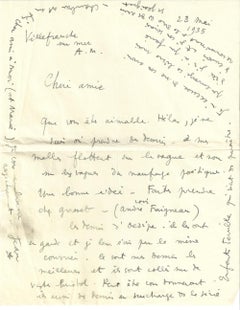
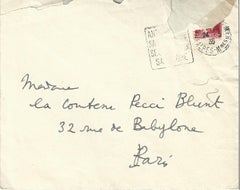
Autograph Letter by Jean Cocteau - 1935
By Jean Cocteau
Located in Roma, IT
This is an Autograph Letter Signed and dated by the French writer Jean Cocteau (1889-1963) to the
Category
1930s More Art
Materials
Paper
Autograph Letter by Jean Cocteau - 1935
By Jean Cocteau
Located in Roma, IT
This is an Autograph Letter Signed and dated by the French writer Jean Cocteau (1889-1963) to the
Paper
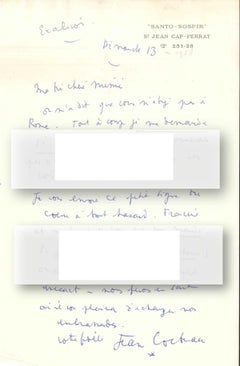
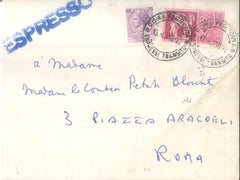
Letter by Jean Cocteau - 1958
By Jean Cocteau
Located in Roma, IT
This is a Cocteau's Letter. An Autograph Letter Signed and dated by the French writer Jean Cocteau
Paper
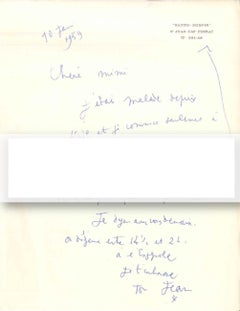
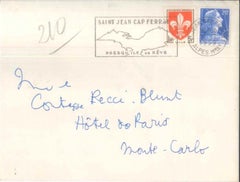
Autograph Letter by Cocteau - 1959
By Jean Cocteau
Located in Roma, IT
This is an Autograph Letter Signed and dated by the French writer Jean Cocteau (1889-1963) to the
Paper
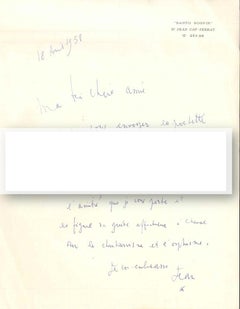
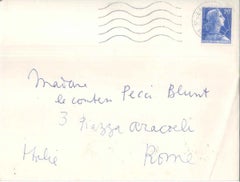
Surrealist Autograph Letter by Cocteau - 1959
By Jean Cocteau
Located in Roma, IT
This Surrealist Letter by Cocteau is a L.A.S.s.l. Autograph Letter Signed and dated by the French
Paper
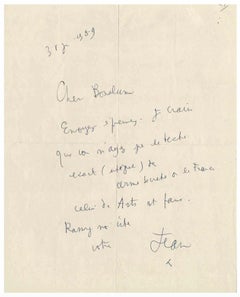
Jean Cocteau Autograph Letter - 1959
Located in Roma, IT
Autograph letter signed and dated [18.11] 1959 by the French poet and artist Jean Cocteau. In this
Ink, Paper
Jean Cocteau was a French painter, poet, designer, printmaker, playwright and filmmaker. He is one of the most important figures of French Surrealism, although he always denied being in any way connected to the movement.
Cocteau was born to a socially prominent Parisian family. His father, George Cocteau, was an amateur painter who committed suicide when Jean was only a child. Jean became famous in Bohemian circles as "The Frivolous Prince." In 1912, he collaborated with the Ballets Russes. After World War I, Cocteau met the poet Guillaume Apollinaire and the artist Pablo Picasso. In 1917, thanks to Sergei Diaghilev, a Russian impresario, Cocteau wrote a scenario for the ballet Parade — the set of this important ballet was realized by Pablo Picasso and the music was composed by Erik Satie. In the late 1920s, Cocteau wrote the libretto for Igor Stravinsky’s opera-oratorio Oedipus Rex. In 1918, he met the French poet Raymond Radiguet. They worked and went on many journeys together, and Cocteau promoted his friend's works in his artistic group.
Cocteau is well-known for his novel Les Enfants Terribles (1929) and the films The Blood of a Poet, Beauty and the Beast and Orpheus. During World War II, he created sets for the Théâtre de la Mode. In 1955, he was elected to the Académie Française and the Royal Academy of Science, Letters and Fine Arts of Belgium. He was commander of the Legion of Honour, a member of the Academié Mallarmé, the Academy of Arts (Berlin) and the American Academy of Arts and Sciences.
Find Jean Cocteau art today on 1stDibs.