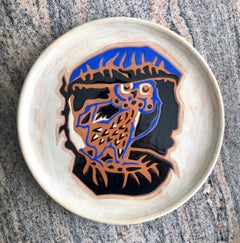
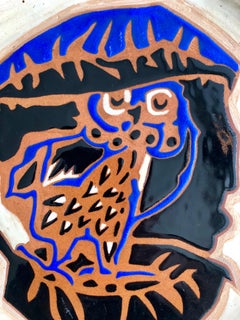
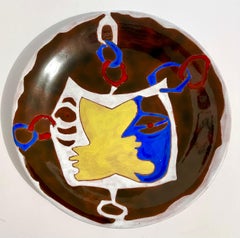
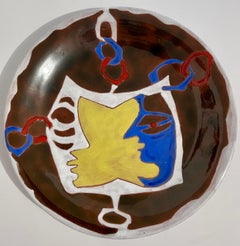
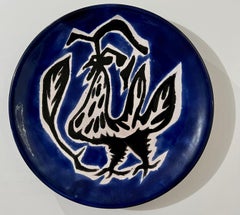
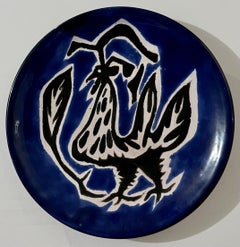
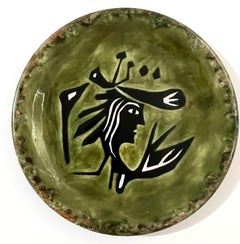
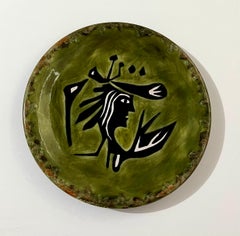
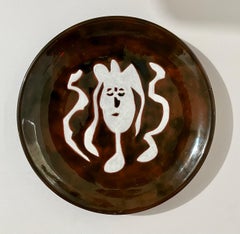
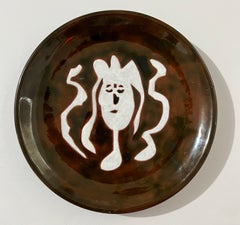
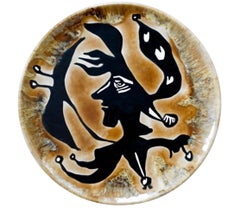
Surely you’ll find the exact jean lurcat plate you’re seeking on 1stDibs — we’ve got a vast assortment for sale. In our selection of items, you can find
contemporary examples as well as a
modern version. On 1stDibs, the right jean lurcat plate is waiting for you and the choices span a range of colors that includes
black,
beige,
blue and
gray. There have been many interesting jean lurcat plate examples over the years, but those made by
Yargo De Lucca,
Jean Lurcat and
Jean Picart Le Doux are often thought to be among the most thought-provoking. Frequently made by artists working in
lithograph,
ceramic and
drypoint, these artworks are unique and have attracted attention over the years. A large jean lurcat plate can be an attractive addition to some spaces, while smaller examples are available — approximately spanning 0.79 high and 9.85 wide — and may be better suited to a more modest living area.
The price for an artwork of this kind can differ depending upon size, time period and other attributes — a jean lurcat plate in our inventory may begin at $400 and can go as high as $1,948, while the average can fetch as much as $400.
Credited with helping revive the design and production of tapestries during the 20th century, French artist Jean Lurçat rubbed shoulders with some of the greatest painters in the world while weaving his own artistic narrative into the fabric of history.
Lurçat met artists Henri Matisse, Paul Cézanne and Pierre-Auguste Renoir in Paris in his early twenties — when the Bruyères native found himself fully immersed in the French art world. He had studied at Académie Colarossi and worked in the studio of sculptor Victor Prouvé, and later made paintings inspired by Fauvism. Lurçat first exhibited his tapestries in 1917.
Lurçat’s inaugural textiles were constructed with weaver Marthe Hennebert and were marked by Cubism and avant-garde–inspired art styles before he embarked on extensive travels that would enrich his work. Lurçat’s travels exposed him to other movements and styles that ranged from German Expressionism to Spanish and African influences that inspired his later works.
Lurçat’s tapestries found a regular home in 1925 at Jeanne Bucher’s gallery, which featured the work of other artists including Pablo Picasso, Hans Arp, Jacques Lipchitz, Georges Braque and Max Ernst. Between 1930 and 1936, Lurçat had solo exhibitions at the Flechtheim Gallery in Berlin and the Pierre Matisse Gallery in New York. In 1939 — when the popularity of tapestries had long been on the decline — Lurçat opened a factory with other artists in Aubusson, the home of a centuries-old tapestry production industry, in order to create modernist tapestries.
Over the course of his life, Lurçat designed more than 1,000 tapestries. One of his most notable, Apocalypse Tapestry (1948), is on display in the Church of Notre-Dame de Toute-Grâce and complements the original which dates back to the 14th century. His other highly acclaimed works include Song of the World (1957–64) and Four Seasons (1940).
While Lurçat’s best known works are his tapestries, he also produced engravings, book illustrations and ceramics. The Museum of Modern Art in New York City holds some of these book illustrations as well as a few other works in its permanent collection. Other works by Lurçat are held in the collections of the Detroit Museum of Fine Arts, the Musée Nationale d’Art Moderne, the Museum of Chicago, the Philadelphia Museum of Art and the National Gallery in Washington DC.
On 1stDibs, find a collection of Jean Lurçat wall decorations, decorative objects and ceramics.
The first decades of the 20th century were a period of artistic upheaval, with modern art movements including Cubism, Surrealism, Futurism and Dadaism questioning centuries of traditional views of what art should be. Using abstraction, experimental forms and interdisciplinary techniques, painters, sculptors, photographers, printmakers and performance artists all pushed the boundaries of creative expression.
Major exhibitions, like the 1913 Armory Show in New York City — also known as the “International Exhibition of Modern Art,” in which works like the radically angular Nude Descending a Staircase by Marcel Duchamp caused a sensation — challenged the perspective of viewers and critics and heralded the arrival of modern art in the United States. But the movement’s revolutionary spirit took shape in the 19th century.
The Industrial Revolution, which ushered in new technology and cultural conditions across the world, transformed art from something mostly commissioned by the wealthy or the church to work that responded to personal experiences. The Impressionist style emerged in 1860s France with artists like Claude Monet, Paul Cézanne and Edgar Degas quickly painting works that captured moments of light and urban life. Around the same time in England, the Pre-Raphaelites, like Edward Burne-Jones and Dante Gabriel Rossetti, borrowed from late medieval and early Renaissance art to imbue their art with symbolism and modern ideas of beauty.
Emerging from this disruption of the artistic status quo, modern art went further in rejecting conventions and embracing innovation. The bold legacy of leading modern artists Georges Braque, Pablo Picasso, Frida Kahlo, Salvador Dalí, Henri Matisse, Joan Miró, Marc Chagall, Piet Mondrian and many others continues to inform visual culture today.
Find a collection of modern paintings, sculptures, prints and other fine art on 1stDibs.