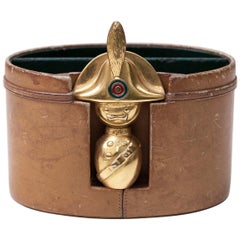
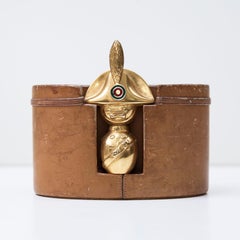
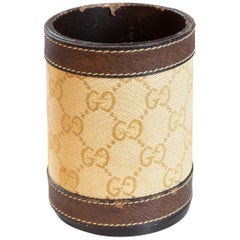
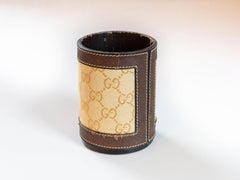
Long before trend-bucking creative director Alessandro Michele brought his hallucinatory “Utopian Fantasy” campaign to Gucci, it was a modest Italian leather shop. Today, it’s an internationally renowned luxury house with an iconic logo, and vintage Gucci clothing, handbags and shoes are among high fashion's most covetable goods.
Guccio Gucci (1881–1953) admired the stylish suitcases he saw wealthy guests arrive with at the Savoy Hotel in London, where he worked as a bellhop. So, in 1921, after a stint at Franzi, a luggage company in his hometown of Florence, he opened a leather goods shop of his own.
At first, Gucci’s Florence business specialized in equestrian accessories. But as its reputation flourished, particularly among the English aristocracy, so too did its footprint. In 1938, he brought three of his sons — Aldo, Vasco and Rodolfo — into the business and expanded it to Rome and later Milan. In the mid-1930s, a League of Nations embargo against Italy pushed Gucci to experiment with alternatives to imported leather. Its woven hemp fabric from Naples, adorned with the brand’s signature diamond print, was a hit, especially among A-list celebrities. The material was first used on suitcases before finding enduring popularity on handbags. (No list of revered designer purses would be complete without Gucci.)
In the 1950s, Elizabeth Taylor carried one of Gucci’s bamboo-handled tote bags, another adaptation to material rationing. After Jackie Kennedy was seen sporting a slouchy Gucci tote in 1961, it was renamed for the First Lady. Then Grace Kelly, on a visit to the boutique in Milan, inspired Rodolfo Gucci to work with Italian illustrator and Gucci textile designer Vittorio Accornero on the Flora print in 1966. Taking cues from Sandro Botticelli’s Primavera, with its pattern of flora and insects, it was painted entirely by hand and featured no fewer than 37 colors.
In 1953, just 15 days after opening his first store on New York’s 5th Avenue, Guccio passed away at 72. The early 1970s saw store openings in Tokyo and Hong Kong, but by the late 1980s, Gucci was floundering. Rodolfo Gucci took charge in 1982, but family drama and lawsuits ensued. In 1993, Rodolfo’s son, Maurizio, transferred his shares in the company to Investcorp, ending the family’s involvement in Gucci. Dawn Mello, then-president of Bergdorf Goodman, joined as creative director in 1989. But it was Tom Ford, who took over as creative director in 1994, who ultimately revived the brand.
Ford’s racy ads, shot by photographers such as Mario Testino, stirred controversy. And his potent vision of sexed-up femininity — with “jewel-toned satin shirts unbuttoned to there,” as Vogue described his breakthrough 1995 runway show — was wildly successful. The new millennium brought new ownership — Pinault Printemps Redoute in 2004 — and a more toned-down vision from Frida Giannini, who became sole creative director in 2006. Alessandro Michele was named creative director in 2015, and the storied brand took a giant leap forward.
Find vintage Gucci clothing and accessories on 1stDibs.
Whether you’ve carved out a space for a nifty home office or you prefer the morning commute, why not dress up your desk with antique and vintage desk accessories? To best tiptoe the line between desk efficiency and desk enjoyment, we suggest adding a touch of the past to your modern-day space.
Desks are a funny thing. Their basic premise has remained the same for quite literally centuries: a flat surface, oftentimes a drawer, and potentially a shelf or two. However, the contents that lay upon the desk? Well, the evolution has been drastic to say the least.
Thank the Victorians for the initial popularity of the paperweight. The Industrial Revolution offered the novel concept of leisure-time to Europeans, giving them more time to take part in the then crucial activity of letter writing. Decorative glass paperweight designs were all the rage, and during the mid-19th-century some of the most popular makers included the French companies of Baccarat, St. Louis and Clichy.
As paper was exceedingly expensive in the early to mid-19th-century, every effort was made to utilize a full sheet of it. Paper knives, which gave way to the modern letter opener, were helpful for cutting paper down to an appropriate size.
Books — those bound volumes of paper, you may recall — used to be common occurrences on desks of yore and where there were books there needed to be bookends. As a luxury item, bookend designs have run the gamut from incorporating ultra-luxurious materials (think marble and Murano glass) to being whimsical desk accompaniments (animal figurines were highly popular choices).
Though the inkwell’s extinction was ushered in by the advent of the ballpoint pen (itself quasi-obsolete at this point), there is still significant charm to be had from placing one of these bauble-like objets in a central spot on one’s desk. You may be surprised to discover the mood-boosting powers an antique — and purposefully empty — inkwell can provide.
The clamor for desk clocks arose as the Industrial Revolution transitioned labor from outdoors to indoors, and allowed for the mass-production of clock parts in factories. Naturally, elaborate designs soon followed and clocks could be found made by artisans and luxury houses like Cartier.
Find antique and vintage desk accessories today on 1stDibs.