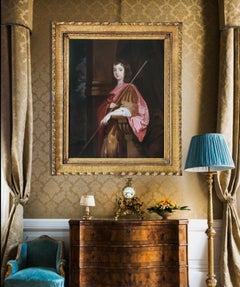
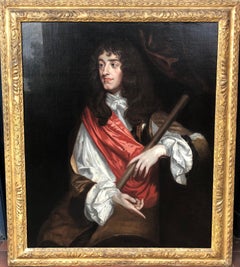
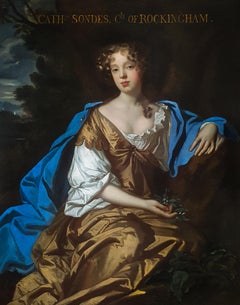
Studio of Sir Peter Lely Art

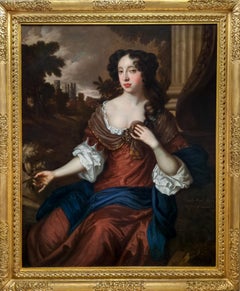
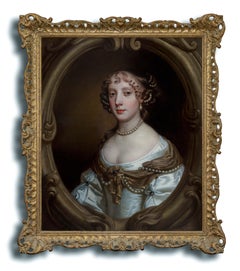
Sir Peter Lely was a painter of Dutch origin whose career was nearly all spent in England, where he became the dominant portrait painter to the court. Lely was born as Pieter van der Faes to Dutch parents in Soest in Westphalia. He studied painting in Haarlem, where he may have been apprenticed to Pieter de Grebber and became a master of the Guild of Saint Luke in Haarlem in 1637. Lely is reputed to have adopted his surname from a heraldic “Lely” on the gable of the house where his father was born in The Hague. After arriving in London around 1643, his early English paintings, mainly mythological or religious scenes or portraits set in a pastoral landscape, show influences from Anthony van Dyck and the Dutch baroque. Lely’s portraits were very well received and he succeeded van Dyck (who had died in 1641) as the most fashionable portrait artist in England. He became a freeman of the Painter-Stainers’ Company in 1647 and was portrait artist to Charles I. His talent ensure that his career was not interrupted by Charles’ execution and he was appointed as Charles II’s Principle Painter in Ordinary in 1661, with a stipend of £200 per year. Lely became a naturalised English subject in 1662 and his demand and workshop were prolific.

to
1
1
1
Overall Width
to
Overall Height
to
3
2
2
1
3
2
2
2
1
3
3
2
2
3
11,426
2,863
2,494
1,538
3
3
Artist: Studio of Sir Peter Lely
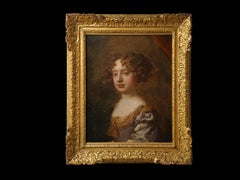
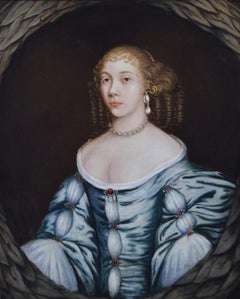
Studio of Sir Peter Lely, Portrait of Lady Anne (later Queen Anne)

Studio of Sir Peter Lely, Portrait of Lady Anne (later Queen Anne)

By Studio of Sir Peter Lely

Located in Oxford, GB

Studio of Sir Peter Lely (1618-1680) Portrait of Lady Anne (1665–1714), later Queen Oil on canvas 20⅞ x 16¾ in. c.1678 Provenance Capt. H. A. N. Forte of Polock, West Somerset; Chri...

Category

17th Century Old Masters Studio of Sir Peter Lely Art

Materials

Oil

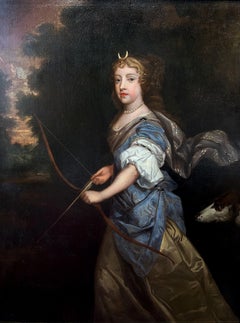
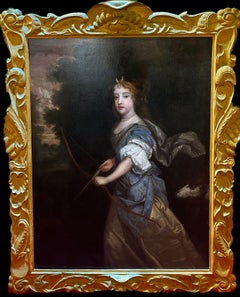
Queen Mary II, when Princess Mary of York, as Diana

Queen Mary II, when Princess Mary of York, as Diana

By Studio of Sir Peter Lely

Located in London, GB

Studio of Sir Peter Lely Diana Oil on canvas Image Size: 38 x 50 inches (96.5 x 127 cm)  Ornate auricular frame Provenance The collection of Mr Campbell Private Estate Mary II (16...

Category

17th Century Old Masters Studio of Sir Peter Lely Art

Materials

Canvas, Oil

Related Items
"Joni" - Mid Century Modern Portrait of a Girl in Yellow Dress in Oil on Canvas

"Joni" - Mid Century Modern Portrait of a Girl in Yellow Dress in Oil on Canvas

Located in Soquel, CA

"Joni" - Portrait of a Girl in a Yellow Dress in Oil on Canvas Skillful portrait of a young girl by Morris Zirlin (American, 1913-1990). A young girl with wide brown eyes poses for ...

Category

1950s Modern Studio of Sir Peter Lely Art

Materials

Canvas, Oil, Stretcher Bars

18th century French Garden or Féte a Bride and musicians  playing music

18th century French Garden or Féte a Bride and musicians playing music

Located in Woodbury, CT

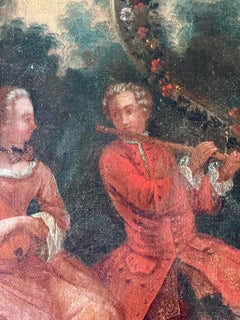
This enchanting 18th-century French fête galante captures the elegance and joy of aristocratic leisure, set amidst a lush garden adorned with flowers. A scene of refined celebration,...

Category

1780s Old Masters Studio of Sir Peter Lely Art

Materials

Canvas, Oil

Hercules Guercino Paint 17th Century OIl on canvas Old master Emilian school Art

Hercules Guercino Paint 17th Century OIl on canvas Old master Emilian school Art

Located in Riva del Garda, IT

Workshop of Giovanni Francesco Barbieri, Il Guercino (1591–1666) Attributed to Ercole Gennari (Cento, 1597–Bologna, 1658) Victorious Hercules oil on canvas 136 x 112 cm. In ...

Category

17th Century Old Masters Studio of Sir Peter Lely Art

Materials

Oil

Portrait Sibyl Lady Zanotti Paint Oil on canvas Old master 18th Century Italian

Portrait Sibyl Lady Zanotti Paint Oil on canvas Old master 18th Century Italian

Located in Riva del Garda, IT

Portrait of an Eritrean Sibyl who writes the prophecy Circle of Lorenzo Pasinelli (Bologna 1629 - 1700) - Attributable to Giampietro Cavazzoni Zanotti ...

Category

18th Century Old Masters Studio of Sir Peter Lely Art

Materials

Oil

Juliet and her Nurse..., Oil Painting on Canvas by Henry Perronet Briggs

Juliet and her Nurse..., Oil Painting on Canvas by Henry Perronet Briggs

By Henry Perronet Briggs

Located in Long Island City, NY

Artist: Henry Perronet Briggs, Attributed to, English (1793 - 1844) Title: Juliet and Her Nurse with the Page Peter from Shakespeare's Romeo and Juliet Year: circa 1820 Medium: Oil o...

Category

1820s Old Masters Studio of Sir Peter Lely Art

Materials

Canvas, Oil

Flemish painter in Italy - 17th century religious painting - Baptism Christ

Flemish painter in Italy - 17th century religious painting - Baptism Christ

Located in Varmo, IT

Flemish painter active in Italy (17th century) - Baptism of Christ. 122 x 74 cm (without frame) - 133 x 86 cm (with frame). Oil on canvas, in a wooden frame (not signed). The scen...

Category

Mid-17th Century Old Masters Studio of Sir Peter Lely Art

Materials

Oil, Canvas

Portraits King Louis XV Queen Gobert Paint Oil on canvas old master 18th Century

Portraits King Louis XV Queen Gobert Paint Oil on canvas old master 18th Century

Located in Riva del Garda, IT

Pierre Gobert (Fontainebleau 1662 - Paris 1744) Atelier of Pair of fine portraits Louis XV, King of France and his wife, Maria Leszczyńska oils on canvas (2), 41 x 32 cm., in frame 53 x 44 cm. It is easy to identify the sitters of this charming pair of portraits in the rulers of France, namely Louis XV of Bourbon, who ascended the throne in 1715 at the age of just thirteen and was nicknamed the 'Beloved', and Maria Leszczyńska, Queen Consort of France and Navarre and daughter of the King of Poland Stanislaus I. The queen is depicted in a three-quarter-length figure, her face smiling and turned towards the spectator. She wears a wig in shades of grey with her hair gathered around the nape of her neck and a diadem on her head, and pendants on her ears. She wears a dress with a wide neckline made of red velvet, brocaded with gold threads, with rich lace sleeves, and a bodice adorned with a jewelled bodice of diamonds and pearls. On the shoulders rests a blue velvet mantle embroidered with the heraldic...

Category

18th Century Old Masters Studio of Sir Peter Lely Art

Materials

Oil

Equestrian Portrait Florentine Painter 17/18th Century Paint Oil on canvas Italy

Equestrian Portrait Florentine Painter 17/18th Century Paint Oil on canvas Italy

Located in Riva del Garda, IT

Florentine painter, 17th-18th century Equestrian portrait of Pietro Strozzi (Florence, 1511 - Thionville, 1558) Oil on canvas 79 x 115 cm. - Framed cm. 92 x 127 A valiant knight, p...

Category

17th Century Old Masters Studio of Sir Peter Lely Art

Materials

Oil

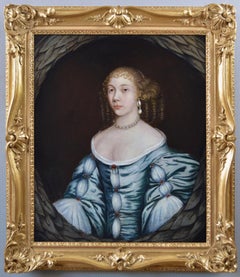
Portrait of Lady Diana Bruce in Blue Dress & Cut Sleeves c.1660-1670, Peter Lely

Portrait of Lady Diana Bruce in Blue Dress & Cut Sleeves c.1660-1670, Peter Lely

By Sir Peter Lely

Located in London, GB

Portrait of Lady Diana Bruce in a Blue Dress with Cut Sleeves c.1660-1670 Circle of Sir Peter Lely (1616-1680) Presented by Titan Fine Art is a captivating portrait of the noble Lad...

Category

17th Century Old Masters Studio of Sir Peter Lely Art

Materials

Oil, Canvas

Portrait Lady Pulzone Paint Oil on canvas Old master 16th Century Italian Roma

Portrait Lady Pulzone Paint Oil on canvas Old master 16th Century Italian Roma

Located in Riva del Garda, IT

Scipione Pulzone, called Il Gaetano (Gaeta 1544 - Rome 1598) - workshop of Portrait of Bianca Cappello (Venice, 1548 - 1587) Grand Duchess of Tuscany, second wife of Francesco I de 'Medici Second half of the 16th century oil on canvas, cm. 70 x 56 cm., Framed 103 x 87 cm. The proposed painting illustrates the portrait of Bianca Cappello (Venice, 1548 - 1587), a noblewoman of Venetian origins, second wife of the Grand Duke of Tuscany Francesco I de 'Medici, whose expressive power is wisely highlighted by the composite cut of light three quarters, with the head and gaze directed at the observer. The beam of light coming from her right brings out the volumes of her face plastically and lingers on her features, highlighted by the large white lace ruff that surrounds his neck and by the details of her precious clothing. Bianca wears a dark red dress, perhaps a zimarra, embroidered in gold with a plunging neckline and a raised collar of the shirt curled in a ruff and also edged with precious lace, embroidered with the motif of the Florentine lily.   The favorite jewels of the noblewoman were pearls: we see them on a choker that adorns the neckline, in the earrings and again in the hairstyle, which sees the hair gathered at the nape of the neck and adorned with a string of small black pearls and embellished with a clasp. It is a high-quality painting that can be confined to the workshop of the painter Scipione Pulzone called Gaetano, representing at best a pictorial genre, that of portraiture, in which the master excelled. This attribution would be confirmed by comparisons with the numerous portraits that Pulzone dedicated to the Medici family. Our painting, in particular, could represent one of the versions that the workshop has replicated, at the request of the numerous art collectors who wish to have a portrait of one of the most influential personalities of the Florentine scene. The characters drawn by Pulzone were icons of incomparable elegance: noblewomen, knights and religious lent their faces to the eye of the artist who was able to grasp every meticulous detail with his superb technique. A photographic wealth and surprising material attention that trace the pictorial prototypes of Flemish inspiration, in particular of Antonis Mor...

Category

16th Century Old Masters Studio of Sir Peter Lely Art

Materials

Oil

Shipping in Stormy Waters, Attributed to Italian Artist Francesco Guardi

Shipping in Stormy Waters, Attributed to Italian Artist Francesco Guardi

By Francesco Guardi

Located in Stockholm, SE

The splendour of the tragic sea Francesco Guardi and maritime painting in Venetian art No Venetian painter was a stranger to the sea. After all, Venice was not only one of the most prominent ports of the Mediterranean, but indeed a city literally submerged in the ocean from time to time. Curiously however, the famous Venetian school of painting showed little interest in maritime motifs, favouring scenes from the iconic architecture of the city rather than seascapes. That is why this painting is a particularly interesting window into not only the painter Francesco Guardi himself – but to the significance of the element of water in art history, in absence as well as in the centre of attention. Whether it be calm, sunny days with stunning views of the palaces alongside the canals of Venice or – more rarely – stormy shipwrecking tragedies at sea, water as a unifying element is integral to the works of painter Francesco Guardi (1712–1793). During his lifetime, Venetian art saw many of its greatest triumphs with names like Tiepolo or Canaletto gaining international recognition and firmly establishing Venice as one of the most vibrant artistic communities of Europe. While the city itself already in the 18th century was something of an early tourist spot where aristocrats and high society visited on their grand tour or travels, the artists too contributed to the fame and their work spread the image of Venice as the city of romance and leisure to an international audience, many of whom could never visit in person. Still today, the iconic image of Venice with its whimsical array of palaces, churches and other historic buildings is much influenced by these artists, many of whom have stood the test of time like very well and remain some of the most beloved in all of art history. It was not primarily subtility, intellectual meanings or moral ideals that the Venetian art tried to capture; instead it was the sheer vibrancy of life and the fast-paced city with crumbling palaces and festive people that made this atmosphere so special. Of course, Venice could count painters in most genres among its residents, from portraiture to religious motifs, history painting and much else. Still, it is the Vedutas and views of the city that seems to have etched itself into our memory more than anything else, not least in the tradition of Canaletto who was perhaps the undisputed master of all Venetian painters. Born into his profession, Francesco lived and breathed painting all his life. His father, the painter Domenico Guardi (1678–1716) died when Francesco was just a small child, yet both he and his brothers Niccolò and Gian Antonio continued in their fathers’ footsteps. The Guardi family belonged to the nobility and originated from the mountainous area of Trentino, not far from the Alps. The brothers worked together on more challenging commissions and supported each other in the manner typical of family workshops or networks of artists. Their sister Maria Cecilia married no other than the artist Giovanni Battista Tiepolo himself, linking the family to the most renowned Venetian name of the time. During almost a decade, Guardi worked in the studio of Michele Giovanni Marieschi, sometimes simply known as Michiel, a painted similar in both style and motif. Canaletto is, however, the artist Guardi is most often compared to since they shared a mutual fascination for depicting the architecture and cityscape of Venice. During the course of his career, Guardi tried his hand in many different genres. He was as swift in painting landscapes, Vedutas of Venice, sacred motifs, interiors and architectural compositions as he was in a number of other motifs. His style is typical of the Venetian school but also distinct and personal once we look a little closer. There is an absolute certainty in the composition, the choice of which sometimes feels like that of a carefully calculated photograph – yet it is also very painterly, in the best sense of the word: fluid, bold, sensitive and full of character. The brushwork is rapid, intense, seemingly careless and extraordinarily minute at the same time; fresh and planned in a very enjoyable mixture. His interiors often capture the breath-taking spacious glamour of the palaces and all their exquisite decor. He usually constructed the motif through remarkably simple, almost spontaneous yet intuitively precise strokes and shapes. The result was a festive, high-spirited atmospheric quality, far away from the sterile and exact likeness that other painters fell victim to when trying to copy Canaletto. The painting here has nothing of the city of Venice in it. On the contrary, we seem to be transported far away into the solitary ocean, with no architecture, nothing to hold on to – only the roaring sea and the dangerous cliffs upon which the ships are just moments away from being crushed upon. It is a maritime composition evoking both Flemish and Italian precursors, in the proud tradition of maritime painting that for centuries formed a crucial part of our visual culture. This genre of painting is today curiously overlooked, compared to how esteemed and meaningful it was when our relationship to the sea was far more natural than it is today. When both people and goods travelled by water, and many nations and cities – Venice among them – depended entirely on sea fare, the existential connection to the ocean was much more natural and integrated into the imagination. The schools and traditions of maritime art are as manifold as there are countries connected to the sea, and all reflect the need to process the dangers and wonders of the ocean. It could symbolize opportunity, the exciting prospects of a new countries and adventures, prospering trade, beautiful scenery as well as war and tragedy, loss of life, danger and doom. To say that water is ambivalent in nature is an understatement, and these many layers were something that artists explored in the most wondrous ways. Perhaps it takes a bit more time for the modern eye to identify the different nuances and qualities of historic maritime paintings, they may on first impression seem hard to differentiate from each other. But when allowing these motifs to unfold and tell stories of the sea in both fiction and reality – or somewhere in between – we are awarded with an understanding of how the oceans truly built our world. In Guardi’s interpretation, we see an almost theatrically arranged shipwrecking scene. No less than five ships are depicted right in the moment of utter disaster. Caught in a violent storm, the waves have driven them to a shore of sharp cliffs and if not swallowed by the waves, crushing against the cliffs seems to be the only outcome. The large wooden ships are impressively decorated with elaborate sculpture, and in fact relics already during Guardi’s lifetime. They are in fact typical of Dutch and Flemish 17th century ships, giving us a clue to where he got the inspiration from. Guardi must have seen examples of Flemish maritime art, that made him curious about these particular motifs. One is reminded of Flemish painters like Willem van de Velde and Ludolf Backhuysen, and this very painting has indeed been mistakenly attributed to Matthieu van Plattenberg...

Category

18th Century Old Masters Studio of Sir Peter Lely Art

Materials

Canvas, Oil

Allegory Of Europe Solimena 18th Century Paint Oil on canvas Old master Italy

Allegory Of Europe Solimena 18th Century Paint Oil on canvas Old master Italy

Located in Riva del Garda, IT

Francesco Solimena (Canale di Serino 1657 - Barra 1747) workshop/circle The Allegory of Europe oil on canvas 102 x 76 cm. - with frame: 119 x 92 cm. The work, which can be placed ...

Category

18th Century Old Masters Studio of Sir Peter Lely Art

Materials

Oil

Previously Available Items
Portrait of Mary of Modena, when Duchess of York c.1675; Studio of Peter Lely

Portrait of Mary of Modena, when Duchess of York c.1675; Studio of Peter Lely

By Studio of Sir Peter Lely

Located in London, GB

Portrait of Mary of Modena (1658-1718) when Duchess of York c.1675-80 Studio of Sir Peter Lely (1618-80) Presented by Titan Fine Art This attractive po...

Category

17th Century Old Masters Studio of Sir Peter Lely Art

Materials

Canvas, Oil

Portrait of Lady, Grace Saunderson, Viscountess Castleton Oil on canvas Painting

Portrait of Lady, Grace Saunderson, Viscountess Castleton Oil on canvas Painting

By Studio of Sir Peter Lely

Located in London, GB

Portrait of Grace Saunderson, Viscountess Castleton (1635-1667) c.1665-67 Sir Peter Lely and Studio (1618-1680) Titan Fine Art present this work, which formed part of a collection of family pictures and heirlooms of the Saunderson, Viscount Castleton family and their descendants, the Earls of Scarbrough, at their magnificent family seat Sandbeck Park, where the Earls still reside today almost four hundred years later. It was painted in the studio of Sir Peter Lely...

Category

17th Century Old Masters Studio of Sir Peter Lely Art

Materials

Canvas, Oil

Portrait of a Gentleman, William Seymour, 3rd Duke of Somerset, Oil Painting

Portrait of a Gentleman, William Seymour, 3rd Duke of Somerset, Oil Painting

By Studio of Sir Peter Lely

Located in London, GB

This exquisite portrait, presented by Titan Fine Art, of William Seymour is a product of the studio of the court painter, Sir Peter Lely. The sitter was Duke of Somerset...

Category

17th Century Old Masters Studio of Sir Peter Lely Art

Materials

Canvas, Oil

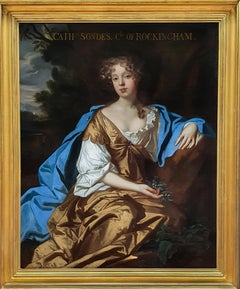
Portrait of Catherine Watson, Countess of Rockington (1658-1695)

Portrait of Catherine Watson, Countess of Rockington (1658-1695)

By Studio of Sir Peter Lely

Located in London, GB

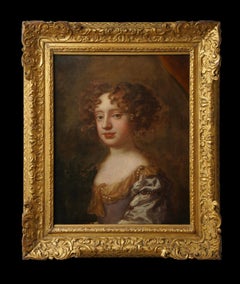
This work formed part of a collection of family pictures and heirlooms of the Smyth Baronets at their magnificent one-thousand-year-old stately home Ashton Court, where they resided for over 400 years. The sitter in this magnificent portrait descended from one of the best and most ancient families in England. From the studio of the most technically proficient painter in England after the death of Van Dyck, and the dominant court painter to Charles II and James, Duke of York, Sir Peter Lely. Titan Fine Art are pleased to present this elegant and beautiful painting, which is a classic example of English Baroque portraiture. Meticulously rendered, the sitter is three quarter length, holding a cluster of flowers. The painting abounds with ingenious flourishes and demonstrations of the painter's skill and superior pictorial technique. It was painted circa 1677 when Lely was at the height of his artistic powers and most likely on the occasion of the sitter’s marriage. Sir Peter Lely’s character and talent dominated the art world in the second half of the seventeenth century in England and everyone of significance sat to him. This elegant portrait of Catherine Watson, Countess of Rockington (1657-1695) portrays her in the finest dress and seated in a rocky outcrop with romantic autumnal landscape beyond. It was a popular pose that Lely used throughout the 1670’s and one which would have been chosen from a selection by the sitter. In line with tradition at the time the portrait was likely painted on the occasion of her marriage in 1677. It was common for more than one portrait to be produced to adorn the walls of the sitter’s various estates or to give to friends and family as gifts. One other version of this portrait is known to exist. Born Lady Catherine Sondes in 1658 to Sir George Sondes, 1st Earl of Feversham KB (1599-1677) and Mary Villiers (d.1688), daughter of Sir William Villiers, of Brooksby. The family of Sondes is found in Throwley, in Kent, as early as the fourteenth century. Catherine, who was the heiress of her father, married Lewis Watson, 3rd Baron Rockingham, later 1st Earl of Rockingham (1655-1724) on 17th July 1677. The Watson family had been settled at Rockingham, Northamptonshire, since the reign of Henry VIII. The family seat still remains - Rockingham Castle. Lewis was the grandson of the infamous Thomas Wentworth, 1st Earl of Strafford (1593-1641) - a major figure in the period leading up to the Civil War). Her father had died three months earlier and there followed an acrimonious court case over the Feversham inheritance, which led to a ruling by the House of Lords in July 1678 that his brother-in-law Louis de Duras, the 2nd Earl (widower of the elder daughter, Lady Mary Sondes d.v.p. in 1676), who had succeeded to the Feversham title by special remainder, should receive £3,000 p.a. for life out of the estates. The 2nd Earl therefore retained these Kentish estates. Lewis Watson succeeded to the Rockingham barony in 1689 and upon the death of the 2nd Earl Feversham in 1709 he finally inherited the remainder of the Feversham estates. By this time, however, Rockingham was already a power in his own right in Kent, having been appointed lord lieutenant of the county in 1705. Even so, the acquisition of the Feversham lands made the Watsons the largest landholders in the county. In 1714, Lewis was created Earl of Rockingham and on his death in 1724, his titles passed to their grandson, Lewis (2nd Earl of Rockingham). Lewis and Catherine’s great...

Category

17th Century Old Masters Studio of Sir Peter Lely Art
Materials

Canvas, Oil

Studio Of Sir Peter Lely art for sale on 1stDibs.

Find a wide variety of authentic Studio of Sir Peter Lely art available for sale on 1stDibs. You can also browse by medium to find art by Studio of Sir Peter Lely in canvas, fabric, oil paint and more. Much of the original work by this artist or collective was created during the 18th century and earlier and is mostly associated with the Old Masters style. Not every interior allows for large Studio of Sir Peter Lely art, so small editions measuring 32 inches across are available. Customers who are interested in this artist might also find the work of Sir Godfrey Kneller, Flemish School, 17th Century, and George Romney. Studio of Sir Peter Lely art prices can differ depending upon medium, time period and other attributes. On 1stDibs, the price for these items starts at $13,875 and tops out at $41,758, while the average work can sell for $15,855.
Artists Similar to Studio of Sir Peter Lely