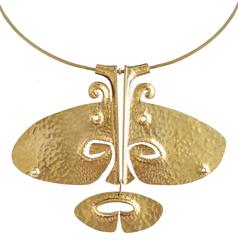
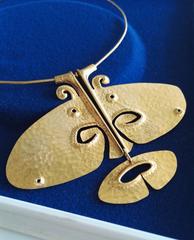
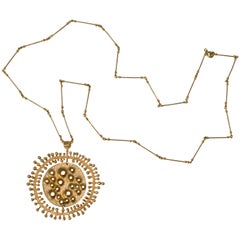
Along with architect Alvar Aalto, the designer Tapio Wirkkala was Finland’s leading contributor to the Scandinavian interpretation of modernism in the mid-20th century. Prolific and innovative, Wirkkala excelled in a wide range of fields, including glass, furniture, porcelain, jewelry and tableware. The hallmark of his talent was an ability to impart a craft aesthetic based on natural forms — leaves, ice, bubbles, birds — to industrially produced designs.
A native of Helsinki, Wirkkala studied at the national School of Applied Arts and took up a career in graphic design. After serving in the Finnish army during World War II, he joined the glassmaking firm Iittala, an association that would continue to the end of his life. Wirkkala learned every aspect of glassmaking in keeping with his belief that an artist-designer should be involved in all stages of production. His best-known works for Iittala are vases and drinking vessels that resemble either carved ice or icicles. In 1956, Wirkkala began a long relationship with the porcelain maker Rosenthal, for whom he designed elegant table pieces, such as the Finlandia coffee service and the biomorphic Pollo vases.
House Beautiful magazine declared Wirkkala’s Leaf platter the “most beautiful object” of 1951. (The acclaim led to his brief employment stint with industrial designer Raymond Loewy in New York.) That platter was one of the first designs Wirkkala made using laminated sheets of plywood sanded to a smooth surface that resembles an abstract leaf. It would go on to become a motif in many Wirkkala furniture pieces — most notably in inlaid coffee tables for Asko — and in a sense these are the works most emblematic of his personal aesthetic.
Wirkkala was a traditionalist in many ways, but he had a modernist’s practical approach, incorporating his leaf-like spirals into simple, functional objects. That is the core attraction of Wirkkala’s designs: They stand out with a striking, sculptural energy yet blend in as part of a warm and comfortable decor.
Find vintage Tapio Wirkkala furniture on 1stDibs.
Whether you’re layering multiple jewelry pieces or opting for a single strand, vintage pendant necklaces are versatile accessories that can elevate your casual wear as easily as they can add a creative flourish to your formal attire.
The earliest jewelry was less about accessorizing than it was about wearers arming themselves with amulets. In Ancient Egypt, some amulets featured a loop so that they could be strung around one’s neck. While rubies have long been one of the few gemstones that can give diamonds a run for their money, members of some ancient civilizations valued the stones from the get-go, donning ruby pendants as well as other stones with the belief that these adornments would bring protection, healing powers or strength. Today, we still wear our charm bracelets and charm pendants around our necks for good luck.
Later, pendant necklaces, like most fine jewelry, were worn strictly by royalty or the upper class and conferred wealth and prestige. This changed over time, thankfully, as wearing jewelry became more widespread, a democratized means of personal expression.
During the 18th and 19th centuries, pendant necklaces evolved from their status as spiritual amulets, but the jewels still carried deep personal significance. Victorian pendants, in particular, were part of the “mourning jewelry” tradition. Wearers would embed their pendants with locks of hair from a deceased loved one as a way of grieving in the wake of a loss. In the case of cameo jewelry, some pendants were even decorated with miniature hand-carved portraits in a detailed raised relief. Today, portraiture is still a characteristic of many of the hand-carved pendant necklaces offered by Italian jewelry house Scala Gioielli.
Luxury fine jewelry brands such as Cartier, BVLGARI and David Yurman offer their own unique interpretations of the cherished accessory, embellishing platinum or gold pendant necklaces with diamonds, sapphires and other stones.
On 1stDibs, find an extraordinary range of vintage pendant necklaces and other necklaces today.