Carlo Scarpa was born in Venice in 1906 and became one of the leading figures of architecture and international design during the 20th century. At merely 21 years old — and still a student at the Academy of Fine Arts — Scarpa began working as a designer for master Murano glassmaker M.V.M. Cappellin. Within a few years, he completely revolutionized the approach to art glass.
In a short time, under the guidance of Scarpa, the Capellin furnace not only established itself as the top glass company, but above all it introduced modernity and international fame to Murano glassmaking. Scarpa created a personal style of glassmaking, a new vision that irreversibly changed glass production.
The young Scarpa experimented with new models and colors: his chromatic combinations, impeccable execution and geometric shapes became his modus operandi. Thanks to Scarpa’s continuous research on vitreous matter, Cappellin produced a series of high-quality glass objects, that saw the company revisiting ancient processing techniques such as the watermark and Phoenician decoration.
When he encountered the challenge of opaque glass, Scarpa proposed introducing textures of considerable chromatic impact, such as glass pastes and glazed glass with bright colors. Scarpa also collaborated in the renovation of Palazzo da Mula in Murano, the home of Cappellin. At the academy, he obtained the diploma of professor of architectural design and obtained an honorary degree from the Venice University Institute of Architecture of which he was director.
In 1931, Scarpa's collaboration with Cappellin ended, following the bankruptcy of the company because it was not able to withstand the economic crisis linked to the Great Depression. But Scarpa did not go unnoticed by Paolo Venini — in 1933, the young designer became the new artistic director of the biggest glass company in Murano.
Master glassmakers thought Scarpa's projects and sketches were impossible, but the passionate and curious designer always managed to get exactly what he wanted. Until 1947 he remained at the helm of Venini & Co., where he created some of the best known masterpieces of modern glassmaking. Scarpa’s work with Venini was characterized by the continuous research on the subject, the use of color and techniques that he revisited in a very personal way, and the development of new ways of working with master glassmakers.
At the beginning of the 1930s, "bubble", "half filigree" and "submerged" glass appeared for the first time on the occasion of the Venice Biennale of 1934. A few years later, at the Biennale and the VI Triennale of Milan, Venini exhibited its lattimi and murrine romane pieces, which were born from a joint idea between Scarpa and Paolo Venini.
In 1938 Scarpa increased production, diversifying the vases from "objects of use" to sculptural works of art. In the same year he laid the foundation for the famous "woven" glass collection, exhibited the following year. In the subsequent years, Scarpa–Venini continued to exhibit at the Biennale and in various other shows their the "black and red lacquers," the granulari and the incisi, produced in limited series, and the "Chinese," which was inspired by Asian porcelain.
Scarpa's creations for Venini garnered an international response and were a great success, leaving forever an indelible mark on the history of glassmaking. The last Biennale in which Carlo Scarpa participated as artistic director of Venini was in 1942. He left the company five years later.
The time that Scarpa spent in the most important glass factory in Murano would attach a great artistic legacy to the company. His techniques and styles were resumed in the postwar period under the guidance of Tobia Venini, Paolo's son. In the 1950s, after the departure of Scarpa, Fulvio Bianconi was the new visionary at the Biennials with Venini.
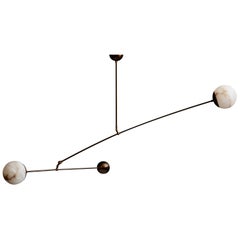
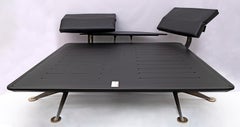
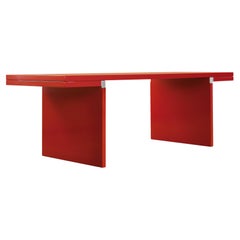
On 1stDibs, vintage Carlo Scarpa glass and lighting are for sale, including decorative objects, tables, chandeliers and more.
(Biography provided by Ophir Gallery Inc.)
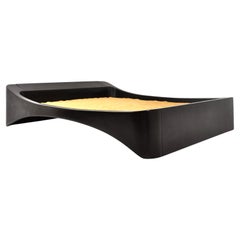
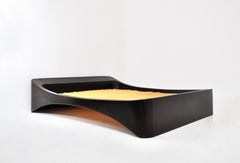
We find relaxation and solace in our bedrooms, which are often the most cherished rooms of a home. Your antique, new or vintage bed and bed frame are integral to this oasis of personal comfort.
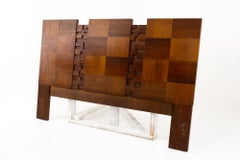
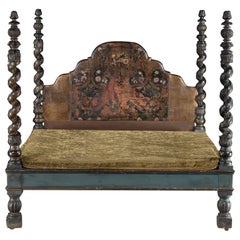
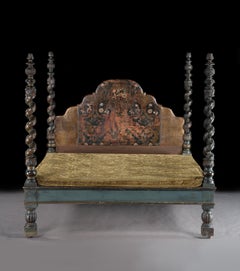
Beds and bed frames have long been an important part of the sanctuary that is the bedroom. For the upper class in countries such as England, the massive, costly beds of the 16th and 17th centuries were decorative and of the poster variety. Some were characterized by large painted wooden headboards, often made of oak, that featured ornate carvings and richly colored curtains affixed to each of the two or four posts — think of today’s sumptuous upholstered headboards as a distant cousin to these luxurious furnishings. The heavy fabric curtains were drawn across a fringed canopy to close out the sunlight that might’ve warmed your grandiose and opulent bedchambers. This feature could also offer privacy as desired, because, as we all know, a bedroom is for more than just sleeping.
Coiled springs didn’t make their way into mattresses until the 1800s, which likely made for a far more comfortable night’s sleep for many. Bed frames of cast iron and brass were introduced during the mid- to late-19th century. Later, the 20th century brought with it marvelous innovations for slumberland, among them daybeds from the likes of George Nelson and Ludwig Mies van der Rohe and Lilly Reich as well as convertible sofa beds.
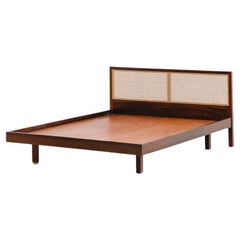
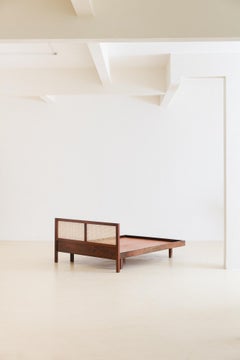
Today, you will find a range of beds geared toward your individual personality and preferred style of decor. When shopping for a bed and bed frame, keep in mind that you’ve got options. Sizes range from twin to California king. At 76 inches wide and 80 inches long, a king-size bed is roughly 16 inches wider than a queen-size mattress, and your bed frame will likely add two to five inches to each side. (The California king bed is 84 inches long.)
From dramatic bedroom designs to uncomplicated, minimalist approaches, the bedroom has evolved into the haven that it should be: a peaceful place of respite, where we begin and end every day. Take the time to create your very own oasis — you deserve it. Rest easy with an expansive collection of antique, new and vintage beds and bed frames available on 1stDibs.