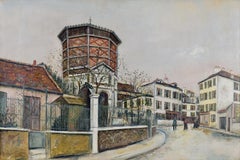
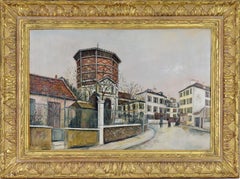
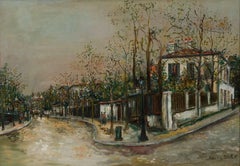
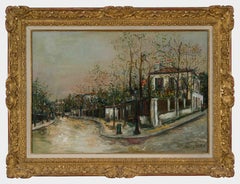
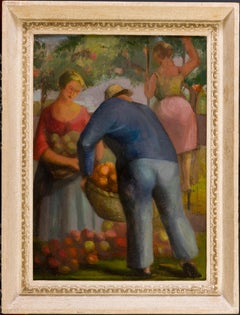
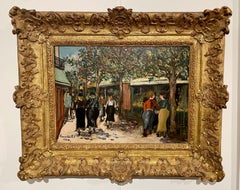
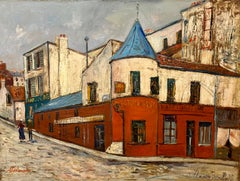
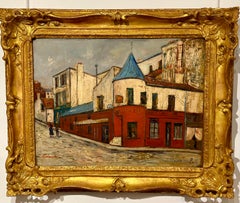
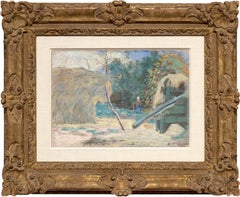
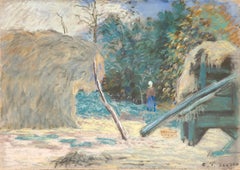
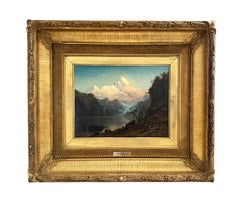
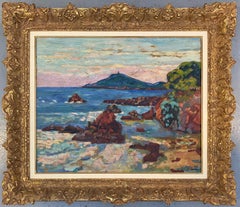
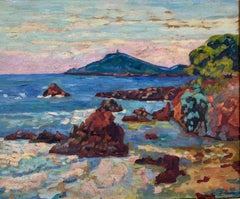
Maurice Utrillo V For Sale on 1stDibs
You are likely to find exactly the maurice utrillo v you’re looking for on 1stDibs, as there is a broad range for sale. There are many
Modern,
Post-Impressionist and
Contemporary versions of these works for sale. You’re likely to find the perfect maurice utrillo v among the distinctive items we have available, which includes versions made as long ago as the 19th Century as well as those made as recently as the 20th Century. When looking for the right maurice utrillo v for your space, you can search on 1stDibs by color — popular works were created in bold and neutral palettes with elements of
gray,
beige,
brown and
black. Finding an appealing maurice utrillo v — no matter the origin — is easy, but
Maurice Utrillo,
(after) Maurice Utrillo and
Suzanne Valadon each produced popular versions that are worth a look. Frequently made by artists working in
lithograph,
paint and
stencil, these artworks are unique and have attracted attention over the years.
How Much is a Maurice Utrillo V?
The price for an artwork of this kind can differ depending upon size, time period and other attributes — a maurice utrillo v in our inventory may begin at $250 and can go as high as $215,000, while the average can fetch as much as $1,600.
Maurice Utrillo for sale on 1stDibs
Maurice Utrillo, initially Maurice Valadon, was born in Paris, December 26, 1883, the illegitimate son of the artist Suzanne Valadon. She, who had become a model after a fall from a trapeze, ended her chosen career as a circus acrobat, found that posing for Berthe Morisot, Pierre-Auguste Renoir, Henri de Toulouse-Lautrec and others provided her with an opportunity to study their techniques; in some cases, she had also become their mistress. She taught herself to paint, and when Toulouse-Lautrec introduced her to Edgar Degas, he became her mentor. Eventually she became a peer of the artists she had posed for.
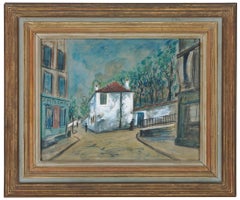
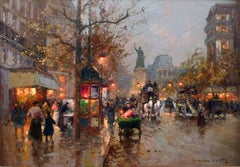
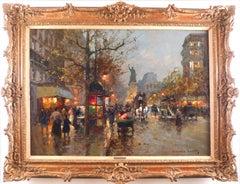
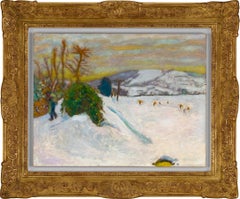
Meanwhile, Valedon's mother was left in charge of raising the young Utrillo, who soon showed a troubling inclination toward truancy and alcoholism. When a mental illness took hold of the twenty-one year old Utrillo in 1904, he was encouraged to paint by his mother. Under her tutelage, he began painting the streets of his childhood neighborhood, Montmartre. Working in the tradition of the conventional veduta, he depicted streets, buildings, fountains, and avenues, which he captured at different seasons of the year in a style influenced by the lyrical realism of Camille Pissarro and Albert Sisley. However, by deploying a subtle palette - mainly yellows, turquoise, maroon and zinc white - he suffused the scenes with atmospheric* qualities that evoke feelings either of familiarity or of alienation in the viewer.
Known as his 'White Period' (période blanche), the years between 1909 and 1914 represent the acme of Utrillo's creativity. During this time, he reduced his palette to white, shading into grays. He also mixed his paints with sand, plaster, and lime to render the physical substance of his subject matter, walls in particular. In 1910, art critics F. Jourdan and E. Faure discovered the artist. Their appreciation of his talent enabled Utrillo to take part for the first time in the 1912 Salon d'Automne*. Until 1914, Utrillo traveled in Brittany and Corsica; his works assumed an increasingly luminous* quality, which greatly enriched his earlier ascetic conception of reality. In 1924, he exhibited with his mother at the Galerie Bernheim-Jeune in Paris and was offered a contract for a year. However, that same year he also attempted to commit suicide, which was probably the result of years of alcohol abuse.
A powerful natural talent, Utrillo made an enormous contribution in consolidating painterly structure and texture. He was also important as a draughtsman*. In 1926, he designed stage scenery and costumes for Djaghilev's Ballets Russes. He received public recognition in 1928, when he was made a member of the Legion of Honour.
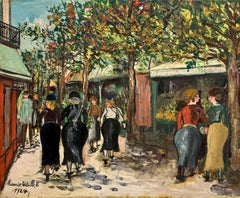
Starting where Impressionism* left off, Utrillo became the best-known portrayer of Paris, especially Montmartre, painting both from nature and from postcards. His poetic interpretations of the streets and squares of Montmartre contributed substantially to popularizing a romantic image of that quarter. However, when he painted people, they were always represented as solitary beings, lost in social isolation.
Finding the Right Paintings for You
Painting is an art form that has spanned innumerable cultures, with artists using the medium to tell stories, explore and communicate ideas and express themselves. To bring abstract paintings, landscape paintings, still-life paintings and other original paintings into your home is to celebrate and share in the long tradition of this discipline.
When we look at paintings, particularly those that originated in the past, we learn about history, other cultures and countries of the world. Like every other work of art, paintings — whether they are contemporary creations or works that were made during the 19th century — can often help us clearly see and understand the world around us in a meaningful and interesting way.
Cave walls were the canvases for what were arguably the world’s first landscape paintings, which depict natural scenery through art. Portrait paintings and drawings, which, along with sculpture, were how someone’s appearance was recorded prior to the advent of photography, are at least as old as Ancient Egypt. In the Netherlands, landscapes were a major theme for painters as early as the 1500s. Later, artists in Greece, Rome and elsewhere created vast wall paintings to decorate stately homes, churches and tombs.
Today, creating a wall of art is a wonderful way to enhance your space, showcase beautiful pieces and tie an interior design together.
No matter your preference, whether you favor Post-Impressionist paintings, animal paintings, Surrealism, Pop art or another movement or specific period, arranging art on a blank wall allows you to evoke emotions in a room while also showing off your tastes and interests. A symmetrical wall arrangement may comprise a grid of four to six pieces or, for an odd number of works, a horizontal row. Asymmetrical arrangements, which may be small clusters of art or large, salon-style gallery walls, have a more collected and eclectic feel.
Download the 1stDibs app, which includes a handy “View on Wall” feature that allows you to see how a particular artwork will look on a particular wall, and read about how to arrange wall art. And if you’re searching for the perfect palette for your interior design project, what better place to turn than to the art world’s masters of color?
On 1stDibs, you’ll find an expansive collection of paintings and other fine art for your home or office. Browse abstract paintings, portrait paintings, paintings by emerging artists and more today.