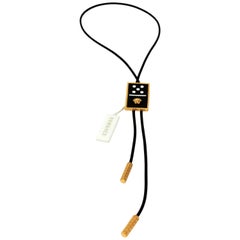
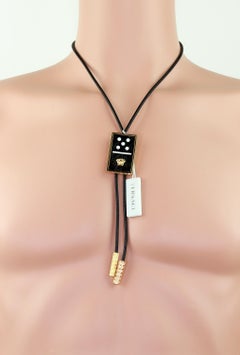
Versace Runway Leather Dice Medusa Pendant Necklace for Men
By Versace
Located in Montgomery, TX
VERSACE Runway necklace for men. Leather, metal. Adjustable. Pendant features Medusa head and
Category
Versace Runway Leather Dice Medusa Pendant Necklace for Men
By Versace
Located in Montgomery, TX
VERSACE Runway necklace for men. Leather, metal. Adjustable. Pendant features Medusa head and
Subversive, maximalist and unabashedly seductive, Gianni Versace’s (1946–97) designs infused high fashion with an entirely new ethos. “I don’t believe in good taste,” the legendary Italian couturier once explained. Instead, he had a sexy good time with fashion — as he did with life. Today, vintage Versace clothing, handbags and other accessories look astonishingly fresh and freshly relevant.
More than any designer before him, Versace mined celebrity, music and Pop art for inspiration. In fact, the New York Times noted in 1997 that the fashion industry “is now driven by contemporary culture because Mr. Versace made it that way.”
Insiders consider his 1991/1992 Autumn/Winter runway show — which featured supermodels Christy Turlington, Cindy Crawford, Naomi Campbell and Linda Evangelista lip-synching George Michael’s “Freedom! '90” — the moment when the two worlds of fashion and pop culture became one, changing both forever.
Versace was born in Reggio di Calabria, Italy. His mother was a successful dressmaker who employed more than 40 seamstresses. As a child, little Gianni marveled at her workshop, which would become a university of sorts, where he learned the exceptional construction techniques that were at the foundation of his creative expression.
In 1972, at age 25, Versace moved to Milan to work in fashion. He launched his first collection — and his label — in 1978, with his older brother Santo managing the business concerns. Soon, sister Donatella, whom Gianni dressed and took to discos when she was still a child, joined the family venture, where she had a creative role and managed enormously popular ready-to-wear lines such as Versus.
Vintage Versace — and Gianni Versace Couture, which debuted in 1989 — has become catnip for modern fashion enthusiasts who seek out the now-iconic house codes that originated in the designs of the 1980s and 1990s. His glamorous and seductive apparel — the clingy skirts and slender, strappy party dresses, as well as the erotic magazine ads that publicized them — looms large, but Versace’s art and historical influences were also vast.
Versace was an art collector, and he took on commissions to create costumes for theatrical performances during the 1980s and spoke of looking to numerous cultures for inspiration. This adventurous spirit of design resulted in his creating jewel-toned prints rooted in Grecian motifs, Etruscan symbols, the Italian Baroque and Andy Warholʼs Marilyn Monroe. There were slinky dresses in Oroton, his patented chain-mail textile that draped like satin, and leather bondage ensembles. Sex sold, for both women and men. Wrote the late curator Richard Martin, “[Versace] became the standard-bearer of gay men’s fashion because he eschewed decorum and designed for desire.”
Following Versace’s tragic murder in 1997, Donatella took over the role of artistic director and continued to evolve the house codes with a twist of her feminine and feminist perspective. Today, Santo Versace is chief executive officer of Versace and Donatella is its chief creative officer.
Browse an extraordinary collection of vintage Versace evening dresses, handbags, day dresses, accessories and more on 1stDibs.
Whether you’re layering multiple jewelry pieces or opting for a single strand, vintage pendant necklaces are versatile accessories that can elevate your casual wear as easily as they can add a creative flourish to your formal attire.
The earliest jewelry was less about accessorizing than it was about wearers arming themselves with amulets. In Ancient Egypt, some amulets featured a loop so that they could be strung around one’s neck. While rubies have long been one of the few gemstones that can give diamonds a run for their money, members of some ancient civilizations valued the stones from the get-go, donning ruby pendants as well as other stones with the belief that these adornments would bring protection, healing powers or strength. Today, we still wear our charm bracelets and charm pendants around our necks for good luck.
Later, pendant necklaces, like most fine jewelry, were worn strictly by royalty or the upper class and conferred wealth and prestige. This changed over time, thankfully, as wearing jewelry became more widespread, a democratized means of personal expression.
During the 18th and 19th centuries, pendant necklaces evolved from their status as spiritual amulets, but the jewels still carried deep personal significance. Victorian pendants, in particular, were part of the “mourning jewelry” tradition. Wearers would embed their pendants with locks of hair from a deceased loved one as a way of grieving in the wake of a loss. In the case of cameo jewelry, some pendants were even decorated with miniature hand-carved portraits in a detailed raised relief. Today, portraiture is still a characteristic of many of the hand-carved pendant necklaces offered by Italian jewelry house Scala Gioielli.
Luxury fine jewelry brands such as Cartier, BVLGARI and David Yurman offer their own unique interpretations of the cherished accessory, embellishing platinum or gold pendant necklaces with diamonds, sapphires and other stones.
On 1stDibs, find an extraordinary range of vintage pendant necklaces and other necklaces today.