Alessandro Mastro-Valerio Art

1889-1953

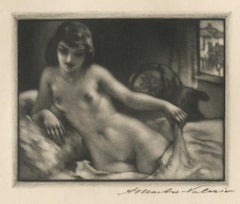
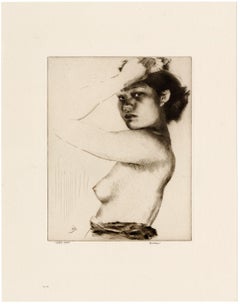
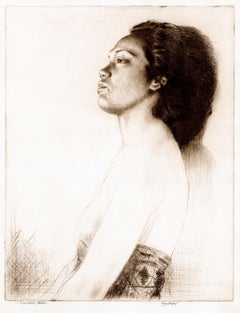
Painter and printmaker Alessandro Mastro-Valerio was educated at the Salvador Rosa Institute in Naples, Italy (1906–12), and came to the United States in 1913. He settled in Chicago and after a brief period as a commercial artist, established a reputation as a portrait painter. Among his patrons were the industrialists Harvey S. Firestone and Anheuser Busch. Mastro-Valerio was also the owner and editor of the progressive magazine La Tribuna Transatlantica. He wrote and published articles supporting the cause of Italian immigrants. He helped form the Giordano Bruno Club, which campaigned against the entrenched political and religious powers supporting the prevailing bias against Italian immigrants coming to the US at the turn of the century. Mastro-Valerio moved to Ypsilanti in 1919 and received a mural commission the following year from the National Bank of Ypsilanti. Mastro-Valerio taught at Ypsilanti Normal College (now Eastern Michigan University) during the summers of 1922 and 1923. He was also on the part-time faculty at the University of Michigan (1924–26), where after a trip to Italy in 1927, he was appointed to the full-time faculty. In addition to portraits and murals, Mastro-Valerio’s oeuvre includes landscapes, seascapes, and figure studies in oil and watercolor. He is best known for his mezzotint prints of female nudes. His highly sensitive renderings achieved rich depth and luminosity, and his work contributed to the revival of the exacting mezzotint medium in the United States. Mastro-Valerio was a member of the Ann Arbor Arts Center, the Chicago Society of Etchers, and the Design Society(Associate 1951). He retired from teaching at the University of Michigan in 1952. Mastro-Valerio’s mezzotint nudes are in the following museum collections, the Dallas Museum of Art, the Five Colleges and Historic Deerfield Museum Consortium, the Library of Congress, the Minneapolis Institute of Art, the New York Public Library and the Smithsonian American Art Museum.

to
1
3
Overall Width
to
Overall Height
to
3
3
1
2
1
1
1
1
1
3
3
3
10,922
2,844
2,494
1,424
1
3
Artist: Alessandro Mastro-Valerio
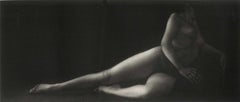
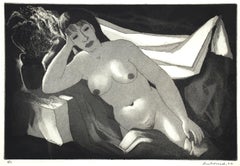
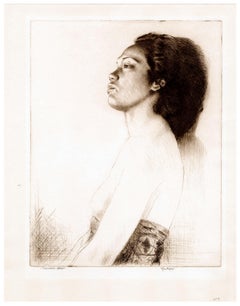
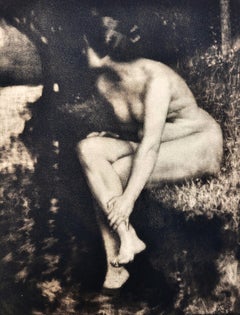
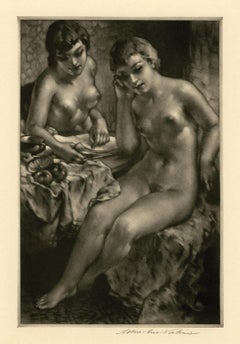
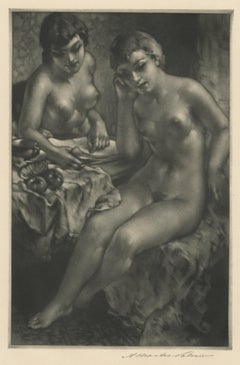
'Morning Paper' — Mid-20th Century American Realist Mezzotint

'Morning Paper' — Mid-20th Century American Realist Mezzotint

By Alessandro Mastro-Valerio

Located in Myrtle Beach, SC

Alessandro Mastro-Valerio, 'Morning Paper', 1941, mezzotint, edition 350. Signed in pencil. A superb, richly-inked, luminous impression, on cream, wove paper, with wide margins (1 9/...

Category

1940s American Realist Alessandro Mastro-Valerio Art

Materials

Mezzotint

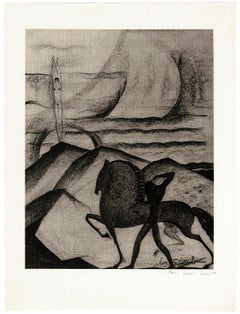
Arising
Arising

Arising

By Alessandro Mastro-Valerio

Located in Fairlawn, OH

Arising Mezzotint, 1942 Signed in pencil lower right (see photo) Publisher : Issued by the Miniature Print Collectors Society. Edition: 200 Condition: Mint Archival framing wit...

Category

1940s American Modern Alessandro Mastro-Valerio Art

Materials

Mezzotint

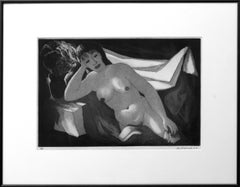
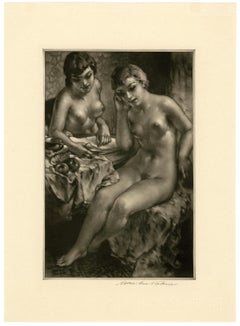
Morning Paper
Morning Paper

Morning Paper

By Alessandro Mastro-Valerio

Located in Fairlawn, OH

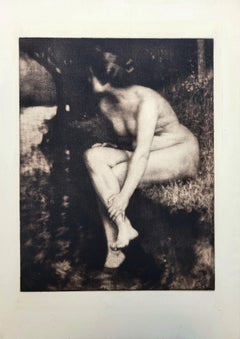
Morning Paper Mezzotint, 1941 Signed in pencil lower right Publisher: 32nd Presentation Print of the Chicago Society of Etchers Edition: 350 Illustrated in GREAT AMERICAN PRINTS 1900...

Category

1940s American Realist Alessandro Mastro-Valerio Art

Materials

Mezzotint

Related Items
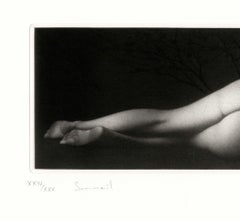
Signed Mezzotint Print of Nude Woman, Contemporary, XXIV Edition

Signed Mezzotint Print of Nude Woman, Contemporary, XXIV Edition

By Mikio Watanabe

Located in New Orleans, LA

Stone and Press Gallery is excited to offer several works in celebration of the LGBTQ community. In this mezzotint, the sensual profile of a young nude woman is seen sleeping with ...

Category

1990s Contemporary Alessandro Mastro-Valerio Art

Materials

Mezzotint

Eclipse Mezzotint Print, Modern Figurative Art, Signed Edition

Eclipse Mezzotint Print, Modern Figurative Art, Signed Edition

By Mikio Watanabe

Located in New Orleans, LA

Stone and Press Gallery is excited to offer several works in celebration of the LGBTQ community. Eclipse I is from an edition of 90 Mezzotint artist Mikio Watanabe was born in 19...

Category

Early 2000s Modern Alessandro Mastro-Valerio Art

Materials

Mezzotint

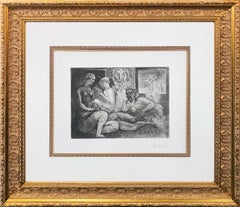
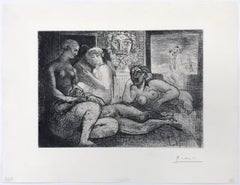
Homme Nu Debout avec un Cheval Drypoint Etching, French School, 1938

Homme Nu Debout avec un Cheval Drypoint Etching, French School, 1938

By Pablo Picasso

Located in Fairlawn, OH

One of only a handful of etchings done in the style of the painting Guernica. from 1937, one the artist's most famous works. Homme Nu Debout avec un Cheval Drypoint, 1938 Unsigned (...

Category

1930s French School Alessandro Mastro-Valerio Art

Materials

Drypoint

An Exquisite 1940s Modern Lithograph of a Female Nude Model, "Flying Figure"

An Exquisite 1940s Modern Lithograph of a Female Nude Model, "Flying Figure"

By Harold Haydon

Located in Chicago, IL

An Exquisite, 1940s Modern Lithograph of a Voluptuous Female Nude Model, "Flying Figure" by Notable Chicago Artist, Harold Haydon (Am. 1909-1994). Completed in 1949, this is a uniqu...

Category

1930s American Modern Alessandro Mastro-Valerio Art

Materials

Paper, Lithograph

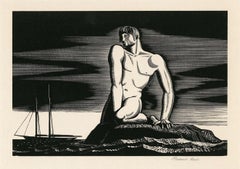
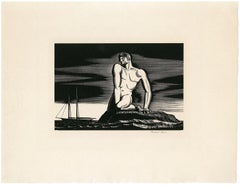
'Mountain Climber' — American Modernism

'Mountain Climber' — American Modernism

By Rockwell Kent

Located in Myrtle Beach, SC

Rockwell Kent, 'Mountain Climber', wood engraving, 1933, edition 250, Burne Jones 93. Signed in pencil. A brilliant, black impression, on cream, wove Japan paper; the full sheet with margins (2 9/16 to 3 5/8 inches); slight skinning at the top sheet edge verso, where previously hinged; otherwise, in excellent condition. Archivally matted to museum standards, unframed. Image size 7 7/8 x 5 7/8 inches (200 x 149 mm); sheet size 14 x 11 1/8 inches (356 x 283 mm). Printed by Pynson Printers, New York. Distributed by The Print Club of Cleveland, Publication No. 11, 1933. Literature: 'Rockwellkentiana,' Harcourt, Brace and Company, New York, 1933. '101 of The World’s Greatest Books', edited by Spencer Armstrong, 1950. Impressions of this work are held in the following museum collections: Akron Art Institute, Burne Jones Collection, IL; Cincinnati Art Museum; Cleveland Museum of Art; Columbus Gallery of Fine Arts; Crystal Bridges Museum of American Art; Davis Museum at Wellesley College; Fine Art Museums of San Francisco; H. M. de Young Museum; Hermitage Museum; Kent Collection, NY; Library of Congress; Memorial Art Gallery, University of Rochester; Metropolitan Museum of Art; New York Public Library; Philadelphia Museum of Art; Princeton University Library; Smithsonian American Art Museum, Spector Collection, NY; SUNY, Plattsburg. ABOUT THE ARTIST Rockwell Kent (1882-1971), though best known as a painter, graphic artist, and illustrator, pursued many careers throughout his life, including architect, carpenter, explorer, writer, dairy farmer, and political activist. Born in Tarrytown, New York, Kent was interested in art from a young age. These ambitions were encouraged by his aunt Jo Holgate, an accomplished ceramicist. Jo came to live with the family after Kent’s father passed away in 1887 and took him to Europe as a teenager, undoubtedly kindling his interest in exploring the world. Kent attended the Horace Mann School in New York City, where he excelled at mechanical drawing. His family’s financial circumstances prevented him from pursuing a career in the fine arts; however, after graduating from Horace Mann in 1900, Kent decided to study architecture at Columbia University. Before matriculating at Columbia, Kent spent the first of three consecutive summers studying painting at William Merritt Chase’s art school in Shinnecock Hills, Long Island. There he found a community of mentors and fellow students who encouraged him to pursue his interest in art. At the end of Kent’s third summer at Shinnecock, Chase offered him a full scholarship to the New York School of Art, where he was a teacher. Kent began taking night classes at the art school in addition to his architecture studies but soon left Columbia to study painting full-time. In addition to Chase, Kent took classes with Robert Henri and Kenneth Hayes Miller, where his classmates included the artists George Bellows and Edward Hopper. Kent spent the summer of 1903 assisting the eccentric painter Abbott Handerson Thayer at his studio in Dublin, New Hampshire—a position he secured through the recommendation of his Aunt Jo. Thayer’s naturalist lifestyle and almost mystical appreciation for natural phenomena greatly influenced Kent; he returned to Dublin for many years to visit Thayer and his family. Thayer gave the young artist time to pursue his work, and that summer Kent painted several views of the New Hampshire landscape, including Mount Monadnock. In 1905 Kent moved from New York to Monhegan Island in Maine, home to a summer art colony, where he continued to find inspiration in nature. Kent soon found success exhibiting and selling his paintings in New York, and in 1907, he was given his first solo show at Claussen Galleries. The following year he married his first wife, Kathleen Whiting (Thayer’s niece), with whom he had five children. The couple divorced in 1924, and Kent married Frances Lee the following year. They divorced after 15 years of marriage, and the artist married Sally Johnstone. For the next several decades, Kent lived a peripatetic lifestyle, settling in several locations in Connecticut, Maine, and New York. During this time he took several extended voyages to remote, often ice-filled, corners of the globe, including Newfoundland, Alaska, Tierra del Fuego, and Greenland, to which he made three separate trips. For Kent, exploration and artistic production were twinned endeavors, and his travels to these rugged, elemental locations inspired his visual art and his writings. He developed a stark, realist landscape style in his paintings and drawings that revealed both nature’s harshness and its sublimity. Kent’s human figures, which appear sparingly in his work, often allude to the mythic themes of isolation, individualism, heroism, and the quest for self-connection. Important exhibitions of works from these travels include the Knoedler Gallery’s shows in 1919 and 1920, featuring Kent’s Alaska drawings...

Category

1930s American Modern Alessandro Mastro-Valerio Art

Materials

Woodcut

'The Bather' — Iconic American Modernism

'The Bather' — Iconic American Modernism

By Rockwell Kent

Located in Myrtle Beach, SC

Rockwell Kent, 'The Bather', wood engraving, 1931, edition 120, Burne Jones 63. Signed in pencil. A brilliant, black impression, on cream, wove Japan paper; the full sheet with margins (2 1/2 to 3 1/4 inches); slight skinning at the top sheet edge, verso, otherwise in excellent condition. Archivally matted to museum standards, unframed. Image size 5 3/8 x 7 7/8 inches (137 x 200 mm); sheet size 11 1/8 x 14 1/2 inches (283 x 368 mm). Impressions of this work are held in the following public collections: Burne Jones Collection (Illinois), Chazen Museum of Art, Chegodaev Collection (Moscow), Kent Collection (New York), National Gallery of Art, Philadelphia Museum of Art; SUNY Plattsburg Art Museum, Princeton University Library, Pushkin Museum (Moscow), Smithsonian American Art Museum, Spector Collection (New York), University of Illinois. ABOUT THE ARTIST Rockwell Kent (1882-1971), though best known as a painter, graphic artist, and illustrator, pursued many careers throughout his life, including architect, carpenter, explorer, writer, dairy farmer, and political activist. Born in Tarrytown, New York, Kent was interested in art from a young age. These ambitions were encouraged by his aunt Jo Holgate, an accomplished ceramicist. Jo came to live with the family after Kent’s father passed away in 1887 and took him to Europe as a teenager, undoubtedly kindling his interest in exploring the world. Kent attended the Horace Mann School in New York City, where he excelled at mechanical drawing. His family’s financial circumstances prevented him from pursuing a career in the fine arts; however, after graduating from Horace Mann in 1900, Kent decided to study architecture at Columbia University. Before matriculating at Columbia, Kent spent the first of three consecutive summers studying painting at William Merritt Chase’s art school in Shinnecock Hills, Long Island. There he found a community of mentors and fellow students who encouraged him to pursue his interest in art. At the end of Kent’s third summer at Shinnecock, Chase offered him a full scholarship to the New York School of Art, where he was a teacher. Kent began taking night classes at the art school in addition to his architecture studies but soon left Columbia to study painting full-time. In addition to Chase, Kent took classes with Robert Henri and Kenneth Hayes Miller, where his classmates included the artists George Bellows and Edward Hopper. Kent spent the summer of 1903 assisting the eccentric painter Abbott Handerson Thayer at his studio in Dublin, New Hampshire—a position he secured through the recommendation of his Aunt Jo. Thayer’s naturalist lifestyle and almost mystical appreciation for natural phenomena greatly influenced Kent; he returned to Dublin for many years to visit Thayer and his family. Thayer gave the young artist time to pursue his work, and that summer Kent painted several views of the New Hampshire landscape, including Mount Monadnock...

Category

1930s American Modern Alessandro Mastro-Valerio Art
Materials

Woodcut

'Sea And Sky' — 1930s Modernism

'Sea And Sky' — 1930s Modernism

By Rockwell Kent

Located in Myrtle Beach, SC

Rockwell Kent, 'Sea and Sky', wood engraving, edition 150, 1931 (published 1932). A brilliant, richly-inked impression on cream wove Japan; the full sheet with margins (2 to 2 1/2 in...

Category

1930s American Modern Alessandro Mastro-Valerio Art
Materials

Woodcut

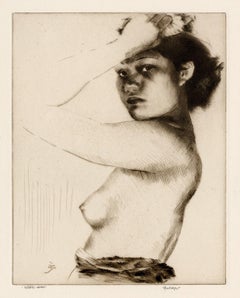
Standing Female Nude

Standing Female Nude

By Frederick Carl Frieseke

Located in Fairlawn, OH

Standing Female Nude Drypoint, c. 1910 Unsigned Estate authentication on verso (see photo) Estate authentication verso by Frances Frieseke Kilmer (Mrs. Kenton Kilmer, 1914-1998) (see photo) Probably depicts the artist's wife, the artist's favorite model Extremely rare original drypoint by Frieseke Printed with selective inking to highlight the figure Condition: excellent Image/Plate size: 10 x 6 5/8 inches Frame size: 19 1/4 x 15 3/4 inches Provenance: Estate of the Artist By descent to his daughter Frances Hirschl & Adler Gallery, Stock No. APG 1106.3D-B (see photo) Biography Frederick Carl Frieseke was born on April 7, 1874, in Owosso, Michigan. After studying for a short while at the Art Institute of Chicago and the Art Students League in New York, Frieseke left for France in 1898, and almost all of his career was spent as an expatriate, with ties to the United States maintained through his New York dealer, William MacBeth, and by occasional visits to America. Following the pattern of innumerable young Americans, he enrolled at the Academie Julian where he studied with Benjamin Constant (1845-1902) and Jean-Paul Laurens (1838-1921). He appears to have had at least brief contact with and to have been influenced by James McNeill Whistler, who had recently opened his Academie Carmen in Paris. By 1900 Frieseke was spending summers in the town of Giverny, made famous by the residence of Monet and subsequently by other artists, among them many Americans. In 1906, the year after his marriage to Sarah O'Bryan, he leased a house once occupied by the American Impressionist Theodore Robinson. Although the property was adjacent to Monet's, Frieseke had only limited contact with the French master. Instead he apparently found Pierre Auguste Renoir the most influential of all the Impressionists. Frieseke's Giverny house and garden, as settings for a series of female models, provided nearly all of his subject matter for the next thirty years, although in 1930 he made a series of watercolors of Florida scenes remembered from his childhood and painted some Swiss landscapes. After World War I, the artist and his family settled in Normandy. Frieseke's career falls roughly into three stages. In the first, figures most clearly show his academic training and draughtsmanship. Gradually these evolve into the most common images of the next decade, comprised of loosely-applied blotches of bright color. The vast majority of these show their subjects in the garden, standing among the flowers, taking tea, or just basking in the sun. Others include models in colorful, light-filled interiors. In Frieseke's latest paintings, the figures very often appear indoors, their forms are given greater solidity, and the brushwork is less broken. At the height of his career, in the 1910s and early 1920s, Frieseke was perhaps the most popular of all living American artists. He received numerous awards and medals and saw his work purchased by private collectors and major museums. Decades after the initial introduction of Impressionism by Monet and his contemporaries, Frieseke assumed this style for his work, choosing to ignore the newer artistic movements of the early twentieth century. Nevertheless, his paintings were acclaimed in both the United States and in Europe. In 1904 he won a silver medal at the St. Louis Universal Exposition and a gold medal at Munich. He was elected a member of the Société National des Beaux Arts in 1908 and the National Academy of Design in 1912. Seventeen of his canvases were featured at the Venice Biennale in 1909 and he won the Grand Prize at the Panama-Pacific International Exposition in 1915. He was commissioned to execute several murals, including one for the New York store of John Wanamaker, one of his most loyal patrons. He died on August 28, 1939, at his home in Normandy, in the town of Le Mesnil sur Blangy. In the decades following his death, however, after artistic tastes had changed considerably, his work was nearly forgotten until it received renewed attention as interest in American Impressionism grew in the 1960s Courtesy National Gallery of Art, Washington Etchings by Frederick Carl Frieseke include The Balcony and Standing Female Nude. Frieseke was an American Impressionist painter who was popular in the 1910s and 1920s. Etchings by Frederick Carl Frieseke: The Balcony: An etching by Frieseke from 1904 Standing Female Nude Other paintings by Frederick Carl Frieseke: The Garden Parasol...

Category

1910s American Impressionist Alessandro Mastro-Valerio Art

Materials

Drypoint

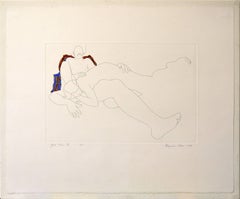
1970 EROTIC Original Pencil Signed ‘Erotic #5’ ‘Erotic Threesome’ Bag One Series

1970 EROTIC Original Pencil Signed ‘Erotic #5’ ‘Erotic Threesome’ Bag One Series

By John Lennon

Located in New York, NY

JOHN LENNON & YOKO ONO (1940-1980) 1970 “EroticNumber #5” Pencil Signed John Lennon Lower right Numbered H.C. XXXV1/VL 23 x 30 inches Image size 33x40 inches with frame Original COA ...

Category

1970s American Modern Alessandro Mastro-Valerio Art
Materials

Lithograph

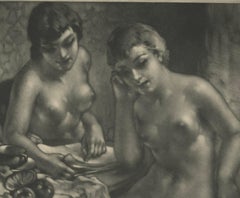
Reclining Nude

Reclining Nude

By Irene Zevon

Located in Buffalo, NY

An original linocut print by American artist Irene Zevon. The reclining nude is one of Zevon's most coveted subject matters. This 1959 print is one of a series of ten prints.

Category

1950s American Modern Alessandro Mastro-Valerio Art
Materials

Linocut, Paper

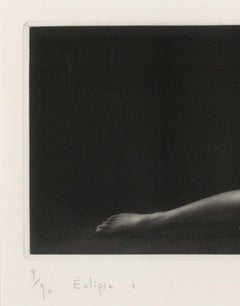
Le Voil, I Drypoint Print, Nude Style, Circa 1930, Signed, 4.75x3.63"

Le Voil, I Drypoint Print, Nude Style, Circa 1930, Signed, 4.75x3.63"

By Pablo Picasso

Located in Fairlawn, OH

Provenance: Marina Picasso Estate, her number verso Purchased from Jan Krugier Gallery, NY References And Exhibitions: Georges Bloch, Picasso: Catalogue de l'oeuvre grave et lith...

Category

1930s Alessandro Mastro-Valerio Art
Materials

Drypoint

Alessandro Mastro-valerio art for sale on 1stDibs.

Find a wide variety of authentic Alessandro Mastro-Valerio art available for sale on 1stDibs. You can also browse by medium to find art by Alessandro Mastro-Valerio in engraving, mezzotint and more. Much of the original work by this artist or collective was created during the 1940s and is mostly associated with the modern style. Not every interior allows for large Alessandro Mastro-Valerio art, so small editions measuring 3 inches across are available. Customers who are interested in this artist might also find the work of Cecil Crosley Bell, Frank Wootton, and Charles Quest. Alessandro Mastro-Valerio art prices can differ depending upon medium, time period and other attributes. On 1stDibs, the price for these items starts at $650 and tops out at $950, while the average work can sell for $720.

Artists Similar to Alessandro Mastro-Valerio