Alexander Runciman Prints and Multiples

British, 1736-1785

Alexander Runciman, born on August 15, 1736, in Edinburgh, was a Scottish painter of historical and mythological subjects. He was the elder brother of John Runciman, also a painter. He studied at the Foulis Academy, Glasgow and from 1750–62, he was apprenticed to the landscape painter Robert Norie, later becoming a partner in the Norie family firm. He also worked as a stage painter for the Theatre Royal, Edinburgh. In 1767, he went to Rome, where he spent five years. His brother John accompanied him but died in Naples in the winter of 1768–69. During Runciman's stay in Italy, he became acquainted with other artists such as Henry Fuseli and the sculptor Johan Tobias Sergel. Runciman's earliest efforts had been in the landscape and he turned to historical and imaginative subjects, exhibiting his Nausicaä at Play with her Maidens in 1767 at the Free Society of British Artists, Edinburgh. On his return from Italy after a brief time in London, he exhibited in the Royal Scottish Academy in 1772. He settled in Edinburgh and was appointed master of the Trustees Drawing Academy. He was patronized by Sir James Clerk, whose hall at Penicuik House he decorated with a series of subjects from Ossian. He also created various religious paintings and an altar-piece in the Scottish Episcopal Church, Edinburgh and easel pictures of Cymon and Iphigenia, Sigismunda Weeping over the Heart of Tancred and Agrippina with the Ashes of Germanicus. In 1773, he was listed as sharing a studio with Mr. McLarin at the foot of Old Assembly Close, Royal Mile. He enjoyed a strong reputation as a landscape painter in his lifetime. Some of his works, due to their spontaneity, the vigor of style, color and unorthodox composition, place him as an early exponent of modern art. Keith Ralph studied under Alexander Runciman. Runciman died on October 4, 1785, in Edinburgh and is buried in Canongate Churchyard. The grave is unmarked but a stone plaque was erected by the RSA in 1866 on the west-facing wall of the church to honor his memory and also commemorating his brother John who died in Naples.

to
2
1
Overall Width
to
Overall Height
to
1
3
1,255
976
906
868
3
3
3
2
2
2
1
1
3
1
1
3
Artist: Alexander Runciman
18th century etching figurative neoclassical mythology scene dynamic

18th century etching figurative neoclassical mythology scene dynamic

By Alexander Runciman

Located in Milwaukee, WI

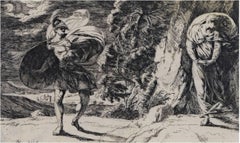
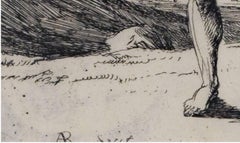
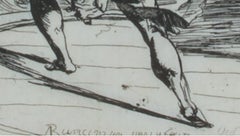
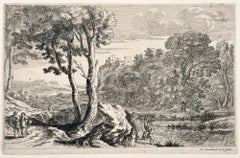
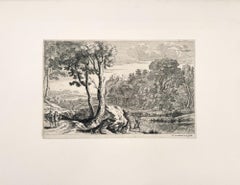
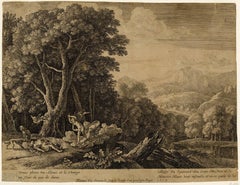
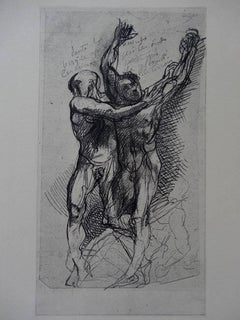
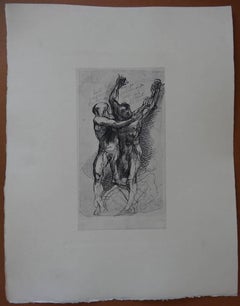
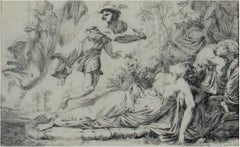
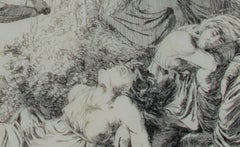
"Cormar Attacking a Spirit on the Waters" is an etching by eighteenth-century Scottish artist Alexander Runciman, signed in plate on the lower edge of the etching, "ARunciman inv. & ...

Category

1770s Academic Alexander Runciman Prints and Multiples

Materials

Etching, Paper, Ink

18th century etching figurative royalty wedding scene print black and white

18th century etching figurative royalty wedding scene print black and white

By Alexander Runciman

Located in Milwaukee, WI

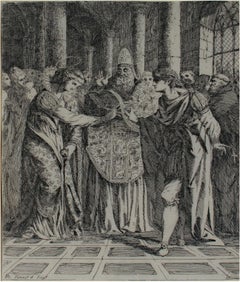
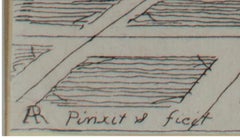
"The Marriage of Saint Margaret and King Malcolm" is an etching by Scottish artist Alexander Runciman. There is an engraved signature with the artist's monogram followed by "pinxit et fecit," indicating that Runciman both designed the original drawing and likely executed the etching on the metal plate. On the left, a young woman with a halo in fine dress stoops slightly and gathers her skirts as she leans over to accept the ring that the man on the right is reaching to place upon her finger. He is also young, dressed finely, and wearing a crown. Between them, a church official with a pointed hat and a long flowing beard recites the appropriate prayers for the occasion, while onlookers crowd in the background. The tiled floor demonstrates the use of one-point perspective, and the church appears to be in the Gothic style. Art size: 8 3/4" x 7 1/4" Frame size: 26 1/2" x 22 3/8" Alexander Runciman (Edinburgh 15 August 1736 – 4 October 1785 Edinburgh) was a Scottish painter of historical and mythological subjects. He was the elder brother of John Runciman, also a painter. He was born in Edinburgh, and studied at the Foulis Academy, Glasgow, and from 1750 to 1762 he was apprenticed to the landscape painter Robert Norie, later becoming a partner in the Norie family firm. He also worked as a stage painter for the Theatre Royal in Edinburgh. In 1767, he went to Rome, where he spent five years. His brother John accompanied him, but died in Naples in the winter of 1768–69. During Runciman's stay in Italy he became acquainted with other artists such as Henry Fuseli and the sculptor Johan Tobias Sergel...

Category

1770s Academic Alexander Runciman Prints and Multiples

Materials

Etching

Related Items
Chamomile & Safflower: A 17th-18th C. Besler Hand-colored Botanical Engraving

Chamomile & Safflower: A 17th-18th C. Besler Hand-colored Botanical Engraving

Located in Alamo, CA

This is a hand-colored copper plate engraving entitled "Chamemelum Romanum flore simplici (Chamomile), Cincus Sativus (False saffron, Safflower), Chamaemelum Romanum Flore (Roman Chamomile)", depicting flowering Chamomile, Safflower and Roman Chamomile plants respectively from Basilius Besler's landmark work, Hortus Eystettensis (Garden at Eichstatt), first published in 1613 in Eichstatt, Germany near Nuremberg and later in 1640 and 1713. This beautiful colorful engraving is printed on thin laid chain-linked paper with wide margins. There are a few small spots and some irregularity of the lower edge. There is some bleed-through of text from the verso. The print is otherwise in excellent condition with striking hand-coloring. The sheet measures 22.25" high and 17.38" wide. Basilius Besler (1561–1629) was an apothecary and botanist. He was curator of the Willibaldsburg Castle garden of Johann Konrad von Gemmingen, prince bishop...

Category

Early 18th Century Academic Alexander Runciman Prints and Multiples

Materials

Engraving

The Crucifixion (Christ on the Cross) /// Jesus after Albrecht Dürer Old Masters

The Crucifixion (Christ on the Cross) /// Jesus after Albrecht Dürer Old Masters

Located in Saint Augustine, FL

Artist: Lambrecht Hopfer (German, Active c. 1525-1550) Title: "The Crucifixion (Christ on the Cross)" Portfolio: (after) The Engraved Passion *Issued unsigned, though monogram signed by Hopfer in the plate (printed signature) lower right Circa: 1530, (published c. 1690, second state of three) Medium: Original Etching on laid paper Limited edition: Unknown Printer: The Hopfer family, Augsburg, Germany; (David Funck, Nuremberg, Germany) Publisher: The Hopfer family, Augsburg, Germany; (David Funck, Nuremberg, Germany) Framing: Recently framed, the sheet is floated over, and top-matted with a 100% cotton fabric rag mat from Holland in a wood moulding and Museum glass Framed size: 14.88" x 13.88" Sheet size: 5.5" x 3.63" Reference: Bartsch No. VIII.527.12; Hollstein No. 12.II Condition: Trimmed to platemark. A few tiny professional repairs: at elbow of Jesus's right arm and the inside thigh of Jesus. Some light skinning upper right corner and lower right area. It is otherwise a strong impression in good condition Very rare Notes: Provenance: private collection - Green Bay, WI; acquired from Sotheby's, New York, NY in c. 2015. The artist Lambrecht Hopfer's printed monogram signature "LH" lower right. The printer/publisher David Funck's (plate) number "182" lower right. This etching is after Albrecht Dürer’s 1511 engraving "The Crucifixion (Christ on the Cross)", ("Dürer-Katalog" - Meder No. 13, page 73). Printed in black from an iron plate. The image depicts Christ on the cross at center, the Virgin at left, two Maries behind her, St. John standing at right, a Roman solider behind him. It is after the eleventh plate of Dürer's sixteen plates from his 1507-1513 "The Engraved Passion" series, ("Dürer-Katalog" - Meder No. 3-18, page 70-74). "The print was originally designed without the number engraved in the lower margin (First state: Lambrecht Hopfer, c. 1530). The Hopfers' descendant David Funck (Nuremberg, 1642–1705) acquired over two hundred of their original iron plates, engraved numbers into them, and re-printed them around 1686-1700. The "182" indicates that "The Crucifixion" was the 182nd print in Funck’s series (Second state: David Funck, c. 1686-1700). About a century later, 92 of these plates were acquired by Carl Wilhelm Silberberg in Frankfurt and printed for the third and final time in the book "Opera Hopferiana", of which "The Crucifixion" was the 90th print (Third state: Carl Wilhelm Silberberg for "Opera Hopferiana", 1802)". - Elizabeth Upper, Cambridge University Library, University of Cambridge, Cambridge, UK Biography: Lambrecht (Lambert) Hopfer (Active c. 1525-1550) was a German Old Masters printmaker. He was the brother of Hieronymus Hopfer (Active c. 1520-1530) and son of Daniel Hopfer...

Category

16th Century Old Masters Alexander Runciman Prints and Multiples

Materials

Etching, Laid Paper

Vespera; Der Abend (Evening; The Evening) /// Johann Daniel Preissler Old Master

Vespera; Der Abend (Evening; The Evening) /// Johann Daniel Preissler Old Master

Located in Saint Augustine, FL

Artist: (after) Johann Daniel Preissler (German, 1666-1737) Title: "Vespera; Der Abend (Evening; The Evening)" Portfolio: Die Vier Tageszeiten (The Four Times of Day) Year: 1723 Medium: Original Etching and Engraving on laid paper Limited edition: Unknown Printer: likely Johann Balthasar Probst, Augsburg, Germany Publisher: Jeremias Wolff (Erben), Augsburg, Germany Sheet size: 22.5" x 16.63" Image size: 17.38" x 13.63" Reference: Le Blanc No. 255, 38; Nagler No. 23 Condition: Soft handling creases and folds to sheet. Some scattered foxmarks in left margin. Two small tears skillfully repaired from verso in margins. Has been professionally stored away for decades. It is otherwise a strong impression in good condition with full margins Extremely rare Notes: Provenance: private collection - Aspen, CO. Engraved by German artist Johann Balthasar Probst (1673-1750) after a drawing by German artist Johann Daniel Preissler (1666-1737). Comes from Preissler's 1723 "Die Vier Tageszeiten (The Four Times of Day)" portfolio of four etchings and engravings. Printed from one copper plate in one color: black. Descriptions of the portrayed image are printed in Latin and German. Biography: Johann Daniel Preissler, or Preisler (1666–1737) was a German painter and director of Nuremberg's Academy of Fine Arts. He was a notable member of a German artistic family, originating in Bohemia. His children included Johann Justin Preissler (1698–1771), Georg Martin Preisler (1700–1754), Barbara Helena Preisler (1707–1758; married to Oeding), Johan Martin Preisler (1715–1794), and Valentin Daniel Preisler (1717–1765), all in their time renowned artists. Most notable for his portraits, nudes and history paintings, Johann Daniel Preissler also produced drawings and frescoes. He was particularly known beyond his native Nuremberg for his "Die durch Theorie erfundene Practic", a sequence of works on art theory – the individual works were translated into several other languages and served as textbooks for students such as the Swiss Salomon Gessner...

Category

1720s Old Masters Alexander Runciman Prints and Multiples

Materials

Laid Paper, Engraving, Etching

Aurora sive Tempus Matutinum; Der Wohl und Übel angewandte Morgen /// Old Master

Aurora sive Tempus Matutinum; Der Wohl und Übel angewandte Morgen /// Old Master

Located in Saint Augustine, FL

Artist: (after) Johann Daniel Preissler (German, 1666-1737) Title: "Aurora sive Tempus Matutinum; Der Wohl und Übel angewandte Morgen (Dawn or Morning Time; The Morning Used for Better or For Worse)" Portfolio: Die Vier Tageszeiten (The Four Times of Day) Year: 1723 Medium: Original Etching and Engraving on laid paper Limited edition: Unknown Printer: likely Johann Balthasar Probst, Augsburg, Germany Publisher: Jeremias Wolff (Erben), Augsburg, Germany Sheet size: 22.57" x 16.38" Image size: 17.75" x 14" Reference: Le Blanc No. 255, 38; Nagler No. 23 Condition: Soft handling creases, folds, and scattered faint areas of discoloration to sheet. Three tears skillfully repaired from verso. Has been professionally stored away for decades. It is otherwise a strong impression in good condition with full margins Extremely rare Notes: Provenance: private collection - Aspen, CO. Engraved by German artist Johann Balthasar Probst (1673-1750) after a drawing by German artist Johann Daniel Preissler (1666-1737). Comes from Preissler's 1723 "Die Vier Tageszeiten (The Four Times of Day)" portfolio of four etchings and engravings. Printed from one copper plate in one color: black. Descriptions of the portrayed image are printed in Latin and German. Biography: Johann Daniel Preissler, or Preisler (1666–1737) was a German painter and director of Nuremberg's Academy of Fine Arts. He was a notable member of a German artistic family, originating in Bohemia. His children included Johann Justin Preissler (1698–1771), Georg Martin Preisler (1700–1754), Barbara Helena Preisler (1707–1758; married to Oeding), Johan Martin Preisler (1715–1794), and Valentin Daniel Preisler (1717–1765), all in their time renowned artists. Most notable for his portraits, nudes and history paintings, Johann Daniel Preissler also produced drawings and frescoes. He was particularly known beyond his native Nuremberg for his "Die durch Theorie erfundene Practic", a sequence of works on art theory – the individual works were translated into several other languages and served as textbooks for students such as the Swiss Salomon Gessner...

Category

1720s Old Masters Alexander Runciman Prints and Multiples

Materials

Laid Paper, Engraving, Etching

Meridies; Der Mittag (Noon; The Midday) /// Johann Daniel Preissler Old Master

Meridies; Der Mittag (Noon; The Midday) /// Johann Daniel Preissler Old Master

Located in Saint Augustine, FL

Artist: (after) Johann Daniel Preissler (German, 1666-1737) Title: "Meridies; Der Mittag (Noon; The Midday)" Portfolio: Die Vier Tageszeiten (The Four Times of Day) Year: 1723 Medium: Original Etching and Engraving on laid paper Limited edition: Unknown Printer: likely Johann Balthasar Probst, Augsburg, Germany Publisher: Jeremias Wolff (Erben), Augsburg, Germany Sheet size: 22.5" x 16.32" Image size: 18.13" x 14.32" Reference: Le Blanc No. 255, 38; Nagler No. 23 Condition: Soft handling creases and folds to sheet. A few light areas of staining and scattered small areas of discoloration in margins. Two small tears skillfully repaired from verso in margins. Has been professionally stored away for decades. It is otherwise a strong impression in good condition with full margins Extremely rare Notes: Provenance: private collection - Aspen, CO. Engraved by German artist Johann Balthasar Probst (1673-1750) after a drawing by German artist Johann Daniel Preissler (1666-1737). Comes from Preissler's 1723 "Die Vier Tageszeiten (The Four Times of Day)" portfolio of four etchings and engravings. Printed from one copper plate in one color: black. Descriptions of the portrayed image are printed in Latin and German. Biography: Johann Daniel Preissler, or Preisler (1666–1737) was a German painter and director of Nuremberg's Academy of Fine Arts. He was a notable member of a German artistic family, originating in Bohemia. His children included Johann Justin Preissler (1698–1771), Georg Martin Preisler (1700–1754), Barbara Helena Preisler (1707–1758; married to Oeding), Johan Martin Preisler (1715–1794), and Valentin Daniel Preisler (1717–1765), all in their time renowned artists. Most notable for his portraits, nudes and history paintings, Johann Daniel Preissler also produced drawings and frescoes. He was particularly known beyond his native Nuremberg for his "Die durch Theorie erfundene Practic", a sequence of works on art theory – the individual works were translated into several other languages and served as textbooks for students such as the Swiss Salomon Gessner...

Category

1720s Old Masters Alexander Runciman Prints and Multiples

Materials

Laid Paper, Engraving, Etching

Sneezewort, Poppy, Strawflower: 17th C. Besler Hand-colored Botanical Engraving

Sneezewort, Poppy, Strawflower: 17th C. Besler Hand-colored Botanical Engraving

Located in Alamo, CA

This is a hand-colored copper plate engraving entitled "Ptarmica Vulgaris (Sneezewort), Papaver Spinosum (Mexican Poppy), Chrysocame Peregrina (Seaside Strawflower)", depicting flowering Sneezewort, Mexican Poppy and Seaside Strawberry plants respectively from Basilius Besler's landmark work, Hortus Eystettensis (Garden at Eichstatt), first published in 1613 in Eichstatt, Germany near Nuremberg and later in 1640 and 1713. This beautiful colorful engraving is printed on thin laid chain-linked paper. The left margin is thinner than the others and the left edge is somewhat irregular where the engraving was previously bound in the original publication. The print is otherwise in excellent condition with striking hand-coloring. The sheet measures 20" high and 16.38" wide. Basilius Besler (1561–1629) was an apothecary and botanist. He was curator of the Willibaldsburg Castle garden of Johann Konrad von Gemmingen, prince bishop...

Category

1640s Academic Alexander Runciman Prints and Multiples

Materials

Engraving

The Bathers ("De Zwemmertjes")

The Bathers ("De Zwemmertjes")

By Rembrandt van Rijn

Located in New York, NY

Etching and drypoint on laid paper, 1651. New Hollstein's third, and final, state. Full sheet size 5.38 x6.5 inches. Frame size 14.25 x 16.75 inches. Catalogue raisonné references...

Category

1650s Old Masters Alexander Runciman Prints and Multiples

Materials

Drypoint, Etching

Grand Prix De Rome Submission Circa 1906 Académie D’Homme Nude With Arrow

Grand Prix De Rome Submission Circa 1906 Académie D’Homme Nude With Arrow

Located in Sutton Poyntz, Dorset

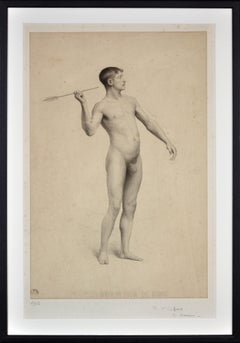
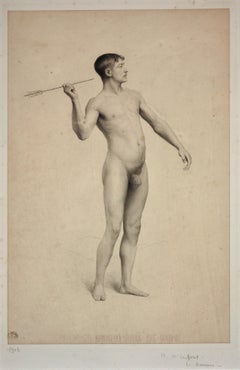
A Grand Prix De Rome Submission Circa 1906. “Académie D’Homme” Nude Throwing An Arrow. Period Print (Lithograph or Heliogravure). Image size 19 inches x 12.2 inches ( 48cm x 31cm ). Frame size 22 inches x 15.4 inches ( 56cm x 39cm ). Available for sale; this antique reproductive plate (usually a lithograph or heliogravure) after the original competition drawing is annotated Premier Grand Prix De Rome and is dated in the margin 1906. The print is presented and supplied in a sympathetic contemporary wooden frame (which is shown in these photographs) and behind glass. This antique print is in good material condition with age toning to the paper along with a scattering of aged blemishes. It is supplied ready to hang and display. The print carries a dedication lower right in the margin. An incomplete (partial) ink stamp in the lower left hand corner makes reference to an Anvers (Antwerp) institution. This finely executed early 20th-century figure print of a drawing is of the Académie d’Homme genre (traditional academic nude study). It depicts a nude male figure in dynamic contrapposto, shown mid-action as he prepares to throw an arrow. The pose combines classical balance with controlled movement, reflecting the rigorous standards of French academic training at the turn of the century. The image is a period print, likely produced as a lithograph or heliogravure, after an original competition drawing. It is annotated “Premier Grand Prix de Rome” and dated 1906 in the margin, indicating that the original of this work was a submission to the prestigious Prix de Rome competition, the highest accolade for academic artists in France. Such works were commonly reproduced for study, reference and institutional circulation and it is likely that this reproduction was made in the same year, or shortly afterwards. Rendered with careful anatomical precision, the figure demonstrates a deep understanding of musculature, proportion and weight distribution, hallmarks of École des Beaux-Arts instruction. The neutral background focuses attention entirely on the human form, emphasising clarity of line and sculptural modelling. This circa 1906 academic male nude print...

Category

Early 20th Century Academic Alexander Runciman Prints and Multiples

Materials

Paper, Lithograph

Besler Hand-colored Botanical Engraving of Flowering Tulip & Wild Garlic Plants

Besler Hand-colored Botanical Engraving of Flowering Tulip & Wild Garlic Plants

Located in Alamo, CA

This is a hand-colored copperplate engraving entitled "Tulipa viridiscoloris, Fritillaria iuncifolns, Allium Vrsinum" depicting flowering tulip, fritillary and wild garlic plants fro...

Category

Early 18th Century Academic Alexander Runciman Prints and Multiples

Materials

Engraving

The Roman Colosseum: A Framed 18th Century Etching of the Interior by Piranesi

The Roman Colosseum: A Framed 18th Century Etching of the Interior by Piranesi

By Giovanni Battista Piranesi

Located in Alamo, CA

This large framed 18th century etching by Giovanni Battista Piranesi entitled "Veduta dell'interno dell'Anfiteatro Flavio detto il Colosseo" (View of the interior of the Flavian Amph...

Category

1760s Old Masters Alexander Runciman Prints and Multiples

Materials

Etching

Ancient Roman Architecture: Original Framed 18th C. Etching by G. Piranesi

Ancient Roman Architecture: Original Framed 18th C. Etching by G. Piranesi

By Giovanni Battista Piranesi

Located in Alamo, CA

"Veduta del Sepolcro della Famiglia Plauzia per la Strada Che Conduce da Roma a Tivoli vicino a Ponte Lugano" from "Le Antichità Romane" (Roman Antiquities), one of the most famous works by Piranesi. "Antichita" illustrates the tombs along the Appian Way...

Category

Early 18th Century Old Masters Alexander Runciman Prints and Multiples

Materials

Etching, Engraving, Drypoint

Previously Available Items

Alexander Runciman prints and multiples for sale on 1stDibs.

Find a wide variety of authentic Alexander Runciman prints and multiples available for sale on 1stDibs. You can also browse by medium to find art by Alexander Runciman in etching, ink, paper and more. Much of the original work by this artist or collective was created during the 18th century and is mostly associated with the Old Masters style. Not every interior allows for large Alexander Runciman prints and multiples, so small editions measuring 20 inches across are available. Customers who are interested in this artist might also find the work of Giovanni Benedetto Castiglione, George Edwards, and Crispin de Passe II. Alexander Runciman prints and multiples prices can differ depending upon medium, time period and other attributes. On 1stDibs, the price for these items starts at $1,500 and tops out at $3,300, while the average work can sell for $1,900.