Chaïm Goldberg Prints and Multiples

to
1
Overall Width
to
Overall Height
to
1
10
1,322
1,024
922
889
1
1
1
1
1
1
1
1
1
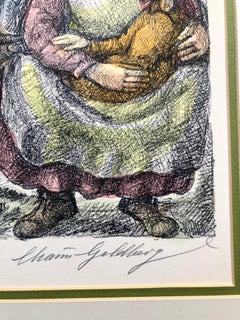
Artist: Chaïm Goldberg
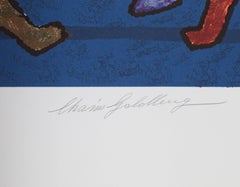
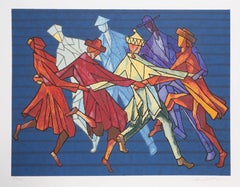
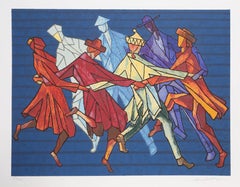
Horah Dance, Lithograph by Chaim Goldberg

Horah Dance, Lithograph by Chaim Goldberg

By Chaïm Goldberg

Located in Long Island City, NY

Artist: Chaim Goldberg, Israeli (1917 - 2004) Title: The Horah Dance Year: Circa 1980 Medium: Lithograph on Arches Paper, signed and numbered in pencil ...

Category

1970s American Modern Chaïm Goldberg Prints and Multiples

Materials

Lithograph

Related Items
"Labor in a Diesel Plant" Machine Age American Scene Industrial Mid 20th Century

"Labor in a Diesel Plant" Machine Age American Scene Industrial Mid 20th Century

By Letterio Calapai

Located in New York, NY

"Labor in a Diesel Plant" Machine Age American Scene Industrial Mid 20th Century Letterio Calapai (American 1902-1993) ''Labor in A Diesel Plant'' Wood engraving, 1940 17 x 10 1/2...

Category

1940s American Modern Chaïm Goldberg Prints and Multiples

Materials

Lithograph

1970 EROTIC Original Pencil Signed ‘Erotic #5’ ‘Erotic Threesome’ Bag One Series

1970 EROTIC Original Pencil Signed ‘Erotic #5’ ‘Erotic Threesome’ Bag One Series

By John Lennon

Located in New York, NY

JOHN LENNON & YOKO ONO (1940-1980) 1970 “EroticNumber #5” Pencil Signed John Lennon Lower right Numbered H.C. XXXV1/VL 23 x 30 inches Image size 33x40 inches with frame Original COA ...

Category

1970s American Modern Chaïm Goldberg Prints and Multiples

Materials

Lithograph

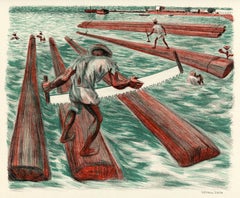
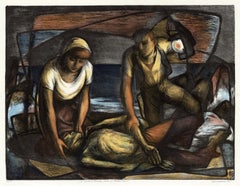
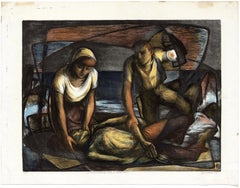
Lumber Workers (Cuidad del Carmen, State of Campeche)

Lumber Workers (Cuidad del Carmen, State of Campeche)

By Alfredo Zalce

Located in Fairlawn, OH

Lumber Workers (Cuidad del Carmen, State of Campeche) Color lithograph on wove paper, c. 1945 Signed lower right in pencil From: Mexican Art - A Portfolio of Mexican People and Places Edition: 250 Published by Associated American Artist and Taller Grafica de Popular (TGP) This print is one of two supplemental color lithographs from a portfolio of ten black-and-white lithographs showing images of Mexican people engaged in daily activities, primarily labor and crafting, by ten different mid-century Mexican political printmakers and members of the Taller de Gráfica Popular print collective, printed on cream wove paper, each signed in pencil at lower right. This image depicts the lumber industry in Campeche, one of the 31 states, located in Southeast Mexico, it is bordered by the states of Tabasco to the south west, Yucatán to the north east, and Quintana Roo to the east, and to the southeast by the Orange Walk district of Belize. Campeche was part of the province of Yucatán but split off in the mid-19th century, mostly due to political friction with city of Mérida. Today, much of the state’s economic comeback is due to the finding of petroleum offshore in the 1970s, which has made the coastal cities of Campeche and Ciudad del Carmen important economic centers. The state has important Mayan and colonial sites but they are not as well known or visited as others in the Yucatán. (Courtesy Annex Galleries) Condition: Excellent Slight toning around the sheet edges Image size: 11 3/8 x 14 1/8 inches Sheet size: 15 x 17 3/4 inches Reference: AAA Index 928 Alfredo Zalce Torres (12 January 1908 – 19 January 2003) was a Mexican artist and contemporary of Diego Rivera, David Siqueiros and other better-known muralists. He worked principally as a painter, sculptor, and engraver, also taught, and was involved in the foundation of a number of institutions of culture and education. He is perhaps best known for his mural painting, typically imbued with ”fervent social criticism”. He is acclaimed as the first artist to borrow the traditional material of coloured cement as the medium for a ”modern work of art”. Publicity-shy, he is said to have turned down Mexico's Premio Nacional de Ciencias y Artes before finally accepting it in 2001. Before his death, Sotheby's described him as ”the most important living Mexican artist up to date”. Early life A number of episodes from his childhood have been used to cast light on his future artistic career. Born in Pátzcuaro, Michoacán in 1908, as an infant he lived in Tacubaya during the Mexican Revolution; his school was near where the rival forces of Victoriano Huerta and Emiliano Zapata met in battle. One day he saw a dead body; he says that instead of fear his attitude was that of contemplation. According to a friend and prominent collector of his works, the young Alfredo began to draw aged six or seven, but chose to do so upon the linoleum floor of his home; nevertheless both his parents praised him. While at primary school, he regularly drew on the blackboard to accompany his teachers and illustrate their lessons, as encouragement to his fellow pupils. Between 1924 and 1927 he studied at the Escuela Nacional de Artes Plásticas in Mexico City, where formative influences included Mateo Saldaña, Germán Gedovius and Diego Rivera.[3] He was soon on friendly terms with Diego Rivera as well as Rufino Tamayo, David Siqueiros, José Clemente Orozco and Frida Kahlo. As the oldest of three children, he took responsibility for the family after the death of his father; while a student, he studied in the mornings and worked in the afternoons so as to be able to provide financial support. He undertook further studies at the Escuela de Talla Directa and the Taller de Litografía of Emilio Amero. Career Much of Zalce's career was spent in teaching and cultural activities. He first went to Zacatecas to teach art but, since the Cristero War had ended only shortly before, the school was not permitted to operate owing to lingering political tensions. He taught drawing at various primary schools for the Secretariat of Education from 1932 to 1935. In 1944, he became a teacher at the La Esmeralda and Escuela Nacional de Artes Plásticas. He moved to Morelia in 1950 and became the director of the Escuela de Pintura y Escultura. He also worked as a professor at the Universidad Autónoma de Nuevo León and the Escuela Popular de Bellas Artes.[3] Besides teaching, he illustrated books with academic and social themes. He was a founder or cofounder of the Escuela de Pintura of Tabasco, the Taller de Gráfica Popular, the Escuela de Pintura of Taxco in Guerrero, the Taller de Artes Plásticas in Uruapan and the Escuela de Pintura y Artesanías in Morelia. He was also a founder of the Liga de Escritores y Artistas Revolucionarios in 1933; one of its first missions was to oppose the favourable attitude at the time of many in Mexico towards Adolf Hitler. In 1930, he created a mural for the primary school in Ayotla, State of Mexico. In 1932, he worked in ”fresco” at the Escuela para Mujeres in Mexico City. He painted murals in the former Talleres Gráficos de la Nación in 1936; again in collaboration with Leopoldo Méndez at the Escuela Normal de Puebla in 1938; and at the Palacio de Gobierno and the Cámera de Diputados in Michoacán with Ángel Bracho...

Category

1940s American Modern Chaïm Goldberg Prints and Multiples

Materials

Lithograph

Mayan Trio
Mayan Trio

Mayan Trio

By Francisco Dosamantes

Located in Fairlawn, OH

Mayan Trio Lithograph, 1950 Signed in pencil lower right (see photo) Edition 250 for Associated American Artists Publsihed 1950 Reference: AAA Cat.: 1950‑05; 1958‑01 AAA Index 1087 Condition: Excellent Image size: 13 x 9 1/2 inches Francisco Dosamantes (b. October 4, 1911 - d. July 18.1986) was a Mexican artist and educator who is best known for is educational illustrations and graphic work against fascism. He was a founding member of the Taller de Gráfica Popular and the Salón de la Plástica Mexicana. Life Francisco Dosamantes was born in Mexico City on October 4, 1911. His father was Daniel Dosamantes who was a builder, interior decorator and painter. He was not registered into the civil registry until he was about twenty years old on March 6, 1939. His mother’s name is not listed on the certificate. As a child, he demonstrated a strong interest in drawing and color, influenced by his father and his uncle Juan. The Mexican Revolution occurred while he was a young child and he stated that he remembered events such as soldiers on horses charging as well as the execution of rural farm workers. He attended primary and high school in Mexico City but stated that his education was irregular and deficient. He then entered the Escuela Nacional de Artes Plásticas, where he studied for five years. Initially, however, he was disappointed with the inexperience of the young professors and he left for a short time to study on his own. During this time, some of the dissatisfied professors organized the 30 30 group against the academic system of the school and which whom he sympathized. The effort gained the attention of established artists such as Diego Rivera who intervened. He died on Mexico City on July 18, 1986 Career After he graduated, he worked with the cultural missions of the Secretaría de Educación Pública in Oaxaca, Michoacán, Guerrero, Colima, Coahuila and Chihuahua (state) from 1932 to 1937 then again from 1941 to 1945. He stated that this experience was vital to his conscience as he worked with rural farm workers and others he stated were worthy of dignity and respect, but victims of deceit and exploitation. When he returned to Mexico City, he gave classes in high schools from 1937 to 1941. In 1945 he founded and directed the Taller Escuela de Dibujo y Pintura “Joaquín Claussell” in Campeche, Campeche. Dosamantes was a politically and culturally active artist with most of his work and affiliations related to such. He was a member of the Liga de Escritores y Artistas Revolucionarios from 1934 to 1938. He was a founding member of the Taller de Gráfica Popular, serving as administrator in 1940 and remaining a member until his death except for one short hiatus. He created posters for conferences about fascism and Nazism such as Alemania bajo bayonetas (Germany under bayonets) in 1938. In 1940 he became the secretary general of the Sindicato de Maestros de Artes Plásticas. He was also a member of the Sociedad para el Impulso de las Artes Plásticas en 1948, a founding member of the Salón de la Plástica Mexicana in 1949 and a member of the Frente Nacional de Artes Plásticas from 1952. He painted a number of murals in rural areas of Mexico generally when he was there on cultural missions. His main mural is at the former home of José María Morelos in Carácuaro, Michoacán, but there are a number at various rural schools. These were all painted between 1941 and 1946. As a book illustrator he mostly worked for the Secretaría de Educación Pública working on books for literacy campaigns. He exhibited his works, which included engravings, oils, tempuras and lithographs in Mexico and abroad. His first individual exhibition was in 1930 at the Galeria de Arte Moderno in Mexico City. His major exhibitions include the Excelsior Gallery in Mexico City in 1932, various exhibitions in New York, Washington, Philadelphia and Los Angeles in 1937; the Nelson Gallery of Art in Kansas City, Missouri in late 1947, and the Gallery of Mexican Art in...

Category

1950s American Modern Chaïm Goldberg Prints and Multiples

Materials

Lithograph

Feast of Lights: Hanukkah

Feast of Lights: Hanukkah

By Abraham Rattner

Located in Fairlawn, OH

Feast of Lights (Poster) Signed in the stone 17 color lithograph Published by Kennedy Galleries Edition: Unknown edition, signed in the stone There was also a pencil signed edition o...

Category

1970s American Modern Chaïm Goldberg Prints and Multiples

Materials

Lithograph

Adolf Dehn, Curtain (aka Flora Dora Girls), 1932, burlesque lithograph

Adolf Dehn, Curtain (aka Flora Dora Girls), 1932, burlesque lithograph

By Adolf Dehn

Located in New York, NY

Adolf Dehn's, lithograph on chine collé, Curtain or The Flora Dora Girls, is an ode to burlesque with dancing girls and fabulous costumes. It comes on the heals of a 1930 pre-code mo...

Category

1940s American Modern Chaïm Goldberg Prints and Multiples

Materials

Lithograph

Turn-about
Turn-about

Rudy O. PozzattiTurn-about, 1972

$750

H 18.75 in W 23.25 in

Turn-about

By Rudy O. Pozzatti

Located in Fairlawn, OH

Turn- about Color Aluminum plate lithograph from three plates Signed, titled, and numbered in pencil by the artist "Bon-a-tirer" impression (BAT) This is the finished example that the artist approved as the model for the edition. Published at Lakeside Studio with the master printer Jack Lemon. Condition: Very good, one ink stain in the large margin, from printing Image size: 18 3 /4 x 23 1/4" 47.63 x 59.06cm Sheet size: 22 x 29 7/8" "Painter and printmaker Rudolph Otto "Rudy" Pozzatti was born in Telluride, Colorado, on January 14, 1925. Upon graduation from high school, he received a scholarship to attend the University of Colorado in Boulder where he enrolled as an art major. In 1943, his studies were interrupted by his induction into the U. S. Army. After his discharge in 1946, he re-enrolled in the University of Colorado where he studied under Wendell Black...

Category

1970s American Modern Chaïm Goldberg Prints and Multiples

Materials

Lithograph

Black Passion
Black Passion

Black Passion

By Rudy O. Pozzatti

Located in Fairlawn, OH

Black Passion Aluminum plate lithograph from two plates, 1975 Signed, titled and numbered in pencil by the artist Edition 50 Published at Lakeside Studio with the Master printer Jack Lemon Imagery depicts the Seven deadly Sins three Roman soldiers and Simon of Cyrene, who was forced to help Christ carry the cross One of Pozzatti's favorite works Condition: Otherwise very good condition Soft rippling bottom margin Image size: 20 x 28 inches (50.80 x 71.12cm) Sheet size: 24 x 32 inches "Painter and printmaker Rudolph Otto "Rudy" Pozzatti was born in Telluride, Colorado, on January 14, 1925. Upon graduation from high school, he received a scholarship to attend the University of Colorado in Boulder where he enrolled as an art major. In 1943, his studies were interrupted by his induction into the U. S. Army. After his discharge in 1946, he re-enrolled in the University of Colorado where he studied under Wendell...

Category

1970s American Modern Chaïm Goldberg Prints and Multiples

Materials

Lithograph

Charles Locke, McCosh Walk, Princeton University

Charles Locke, McCosh Walk, Princeton University

By Charles Locke

Located in New York, NY

This lithograph is signed in pencil under the image at the lower right. Just above that, in the image, are the artist's initials and the date, 1942. This well-known walkway on the P...

Category

1940s American Modern Chaïm Goldberg Prints and Multiples

Materials

Lithograph

Jon Corbino, Montana Earthquake, 1936, lithograph

Jon Corbino, Montana Earthquake, 1936, lithograph

By Jon Corbino

Located in New York, NY

Works by Jon Corbino (1905-1964) feature drama. Here he's showing us the chaos produced by a major earthquake in rural Montana in 1936 -- an actual historical event. The horses (ear...

Category

1930s American Modern Chaïm Goldberg Prints and Multiples

Materials

Lithograph

Adolf Dehn, The Big-Hearted Girls (The Last Veil), 1932, burlesque lithograph

Adolf Dehn, The Big-Hearted Girls (The Last Veil), 1932, burlesque lithograph

By Adolf Dehn

Located in New York, NY

Adolf Dehn's, lithograph about burlesque, The Big Hearted Girls #2 (also known as The Last Veil), is filled with dancing girls and fabulous costumes. That central figure is a marvel!...

Category

1940s American Modern Chaïm Goldberg Prints and Multiples

Materials

Lithograph

Previously Available Items
Horah Dance, Lithograph by Chaim Goldberg

Horah Dance, Lithograph by Chaim Goldberg

By Chaïm Goldberg

Located in Long Island City, NY

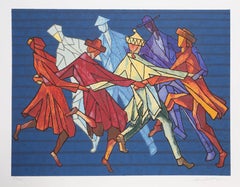
Artist: Chaim Goldberg, Israeli (1917 - 2004) Title: The Horah Dance Year: Circa 1980 Medium: Lithograph on Arches Paper, signed and numbered in pencil ...

Category

1970s American Modern Chaïm Goldberg Prints and Multiples

Materials

Lithograph

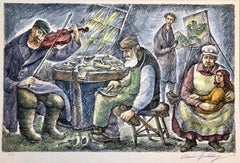
Judaica Lithograph Shtetl Interior Scene Etching Jewish Fiddler and Cobbler

Judaica Lithograph Shtetl Interior Scene Etching Jewish Fiddler and Cobbler

By Chaïm Goldberg

Located in Surfside, FL

Beautiful poignant lyrical piece. I am not sure if it is a lithograph or an etching with hand painted watercolor. it depicts a beautiful shtetl interior scene. Chaim Goldberg -- bo...

Category

20th Century Post-Impressionist Chaïm Goldberg Prints and Multiples

Materials

Etching, Lithograph

Horah Dance, Lithograph by Chaim Goldberg

Horah Dance, Lithograph by Chaim Goldberg

By Chaïm Goldberg

Located in Long Island City, NY

Artist: Chaim Goldberg, Israeli (1917 - 2004) Title: The Horah Dance Year: Circa 1980 Medium: Lithograph on Arches Paper, signed and numbered in pencil ...

Category

1970s American Modern Chaïm Goldberg Prints and Multiples

Materials

Lithograph

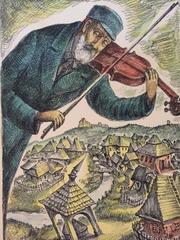
Chassidic Klezmer Fiddler

Chassidic Klezmer Fiddler

By Chaïm Goldberg

Located in Surfside, FL

Chaim Goldberg (March 20, 1917 – June 26, 2004) was a Polish-Jewish artist, painter, sculptor, and engraver. He is known for being a chronicler of Jewish life in the small Polish village (or Shtetl) where he was born, Kazimierz Dolny in eastern Poland; and as a painter of Holocaust era art, which to the artist was seen as an obligation and art with a sense of profound mission. Chaim Goldberg was born in a wooden clapboard house built by his father, a village cobbler. As a young boy of 6 he gravitated to creating little figurines carved from stones. Later he took up drawing and painting with basic shoemaker paints that he found at his father's workbench. He was the ninth child and the first boy after eight girls. He grew up in a religious home in Kazimierz Dolny. He would observe and draw the beggars and klezmers who frequented his home as guests. His father would encourage their stays by letting it be known that the humble Goldberg home was open for those who could not pay for their night stay at any of the inns. They were surely welcome there. These characters became Chaim's early models. On a crisp day in the fall of 1931, Dr. Saul Silberstein, a student of Sigmund Freud who was doing post doctorate work on his book, Jewish Village Mannerisms came into the Goldberg cobbler workshop to have his shoes repaired. As he waited for his shoes, he noticed the numerous art works that were attached to the wall with shoe nails and inquired who the artist was. Silberstein spent the entire night reviewing the young artist’s work. In the morning they went by foot to Lublin, a distance of 26 miles and Dr. Silberstein obtained the opinions of several respected individuals of the work by Chaim Goldberg. He then got him several small scholarships based on these letters of recommendation. This helped finance his early education at the "Józef Mehoffer School for Fine Arts", in Kraków, from which he graduated in 1934. Dr. Silberstein was able to interest several other wealthy sponsors, such as the honorable Felix Kronstein, a judge, and a newspaper publisher who supported the artist through his graduation from the Academy of Fine Arts in Warsaw. At 17, he was the youngest to be admitted and studied under the Rector of the Academy and Professor Tadeusz Pruszkowski, Kowarski, Władysław Skoczylas and Jan Gotard (pl). The beauty of Kazimierz Dolny had long ago been discovered by artists who had flocked there in large numbers over the years. Between the First World War and the Second World War, Kazimierz Dolny became known as an Art Colony as well. Professor Tadeusz Pruszkowski had built a summer studio in the mountains and attracted his students to come down and paint outdoors. many of these artists as well as older ones painted the life they saw and the landscape. Chaim Goldberg became stimulated by this traffic of artists and began to do art as well. When he was discovered he had not attended any school or private lessons. He watched what the other artists did and was encouraged to do the same; set himself up with a home-made easel and paint outdoors. When he was discovered at the age of 14, his collection included landscapes as well as paintings of the vagabond types that frequented his home as guests. Once ensconced in his large studio, Chaim Goldberg began to create large paintings that depicted Jewish life he remembered in his Shtetl of Kazimierz Dolny. During this period, of 1960-1966 he created some of his best known paintings, such as The Wedding (in the collection of the Spertus Museum, Chicago); The Shtetl (in the collection of the Metropolitan Museum of Art, NY);, Simchat Torah (in a private collection, NY); and Don't Forget. Chaim Goldberg began to experiment with new shapes and mediums, such as wood carving and stone chiseling in Israel, in the year 1964. He began with abstract drawings of three-dimensional shapes floating and shooting into space. These darting and frequently marching shapes were influenced by the space race between the United States and Russia. He continued to develop his modernist side, despite his commitment to memorialize the life of the Shtetl. It is a very rate to see this dichotomy between realism and making art for art sake in abstract forms with any artist. He continued this dichotomy throughout the rest of his life by dividing his day into sessions in different parts of his studios. In 1970, after arriving in the United States, his drive to create art-for-art-sake turned to creating drawing, watercolors, oil paintings and sculptures based on his impressions of daily life. His response to the modern dwelling and to the masks people use when communicating with one another began to form a viable collections of an artist's inner thoughts and feelings. He foresaw the demise of the Soviet Union in 1973 and created a series of large drawings that depict the Soviet 'empire' as a clawed monster hanging on by the extreme ends of its fangs to a network of spider web-like formations meant to depict their deceptions and lies. His drawings of the modern ways are a documentation of how the artist felt, and saw in his dreams the errors we humans commit towards one another. They are a great window into the feelings of a modern artist caught in the complicated city dwelling and sees no hope for escape from the noise and pollution. Exhibitions: 1931 - "Polish Landscapes," Group Show, Kazimierz-Dolny, Poland 1934 - Studio Show, Kazmierz-Dolny, Poland 1936 - National Group Show, Warsaw, Poland 1937 - National Group Show, Warsaw, Poland (the artist, his future wife and her family were refugees in Siberia) 1946 - "Poland After World War II" solo show, Shtczechin, Poland 1947 - National Group Show, Warsaw, Poland 1949 - National Group Show, Warsaw, Poland 1950 - National Group Show, Warsaw, Poland 1951 - National Group Show, Warsaw, Poland 1952 - National Group Show, Warsaw, Poland 1965 - One Man Show, Pioneer House, Giv'atayim, Israel 1966 - Retrospective Show, Museum Yad Labanim, Petach Tikvah, Israel (attended by Mrs. Golda Meir - Prime Minister; and Kadish Luz - Speaker of the House (Knesset) 1967 - One Man Show, LYS Gallery, New York 1968 - One Man Show, Theodor Hertzl Institute, New York City, New York 1968 - One Man Show, Mixed Media Art Center, Syracuse, New York 1969 - One Man Show, Paul Kessler Art Gallery, Provincetown, Massachusetts 1970 - One Man Show, Paul Kessler Art Gallery, Provincetown, Massachusetts 1971 - Large Retrospective Exhibit at the DeAndries Gallery, St' John's University, Queens, New York 1972 - One Man Show, Mixed Media, Lincoln Mall Art Center, Miami, Florida 1972 - Group Show, Mixed Media, American Congress, Washington, D.C. 1973 - One Man Show, "Chaim Goldberg's Shtetl" (drawings, watercolors, sculptures, oil paintings and line engravings) Smithsonian Institution, Hall of Graphic Arts, Washington, D. C. 1973 - Group Exhibit, "Jewish Motifs and Culture of the 20th Century," Klingspor Museum, Offenbach, Germany 1974 - One Man Show, The Avila Art Center, Jewish Synagogue, Caracas, Venezuela 1977 - Group Show with the Texas Society of Sculptors, Houston Public Library, Main Branch, Houston, Texas 1979 - One Man Show, Museum of Printing History, Houston, Texas 1982 - Group Exhibit, "Art of the Twentieth Century - A Revelation," Congregation Beth Israel, Houston, Texas 1985 - Group Exhibit, "Twenty-Sixth Invitational," Longview Museum of Art, Longview, Texas 1994 - Group Exhibit, "Shtetl Life," the Nathan and Faye Hurvitz Collection, the Magnes Collection of Jewish Art and Life, Berkeley, California Goldberg's "Marketplace", a hand-colored litho was on the cover of the exhibit catalog. 1997 - One Man Exhibit, "Chaim Goldberg at 80," Nathan B...

Category

20th Century Chaïm Goldberg Prints and Multiples
Materials

Lithograph

Chaïm Goldberg prints and multiples for sale on 1stDibs.
Find a wide variety of authentic Chaïm Goldberg prints and multiples available for sale on 1stDibs. You can also browse by medium to find art by Chaïm Goldberg in lithograph, etching, paint and more. Much of the original work by this artist or collective was created during the 20th century and is mostly associated with the Post-Impressionist style. Not every interior allows for large Chaïm Goldberg prints and multiples, so small editions measuring 24 inches across are available. Customers who are interested in this artist might also find the work of Roman Cieslewicz, Fritz Eichenberg., and Bernard Brussel-Smith. Chaïm Goldberg prints and multiples prices can differ depending upon medium, time period and other attributes. On 1stDibs, the price for these items starts at $495 and tops out at $750, while the average work can sell for $623.