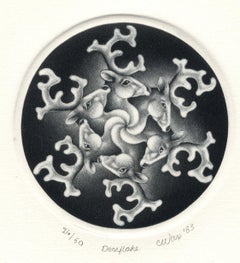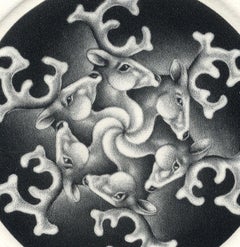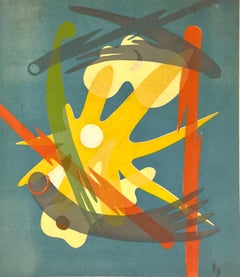
Charles Quest Prints and Multiples

1904-1993

Charles Quest, a successful artist, and fine art instructor, worked in a variety of mediums including mosaic, stained glass, mural painting, and sculpture, but remains best known as a printmaker. Quest grew up in St. Louis, his talent evident as a teenager when he began copying the works of masters such as Michelangelo on his bedroom walls. He studied at the Sam Fox School of Design & Visual Arts at Washington University where he later taught from 1944–71. He traveled to Europe after his graduation in 1929, and studied at the Académie de la Grande Chaumière and Académie Colarossi, Paris, continuing to draw inspiration from the works of the Old Masters. After returning to St. Louis, Quest received several commissions to paint murals in public buildings, schools, and churches, including one from Joseph Cardinal Ritter to paint a replica of Velázquez's Crucifixion over the main altar of the Old Cathedral in St. Louis.

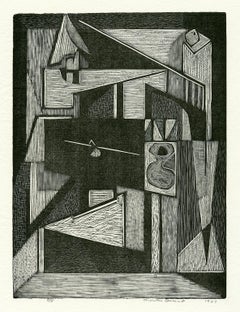
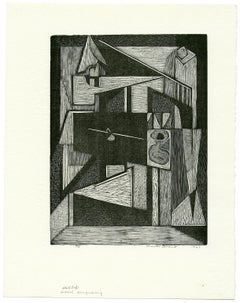
Quest soon became interested in the woodcut medium which he apparently learned through his study of J. J. Lankes' A Woodcut Manual (1932) and Paul Landacre's articles in the American Artist magazine since no artists in St. Louis were working in wood at that time. Quest also revealed that for him, woodcutting and engraving were ‘more enjoyable than any other means of expression.’ In the late 1940s, his graphic works began attracting a lot of critical attention — several of his woodcuts won prizes and were acquired by major American and European museums. His wood engraving entitled Lovers was included in the American Federation of Art's traveling print exhibition in 1947. Two years later Quest's two prize-winning prints, Still Life with Grindstone and Break Forth into Singing were exhibited in major American museums in a traveling show organized by the Philadelphia Print Club. His work was included in the Chicago Art Institute's exhibition, Woodcut Through Six Centuries and the print Still Life with Vise, which was purchased by the Museum of Modern Art in New York. In 1951, he was invited by artist-curator Jacob Kainen to exhibit 30 wood engravings and color woodcuts in the Graphic Arts Division of the Smithsonian's National Museum (now known as the American History Museum). This one-man exhibition was a remarkable achievement for Quest, who had been working in the medium for only about 10 years.

In the press release for the show, Kainen praised the ‘technical refinement’ of Quest's work. “He obtains a great variety of textural effects through the use of the graver, and these dense or transparent grays are set off against whites or blacks to achieve sparkling results. His work has the handsome qualities characteristic of the craftsman and designer,” noted Kainen. At the time of the Smithsonian exhibition, Quest's work was represented by three New York galleries in addition to one in his hometown. He had also won 38 prizes, and his prints were in the collections of the Library of Congress, the Art Institute of Chicago, the Metropolitan Museum and the Philadelphia Museum of Art. In cooperation with the Art in Embassies program, his color woodcuts were displayed at the American Embassy in Paris in 1951. Recognition at home came in 1955 with his first solo exhibition in St. Louis. Press coverage of the show heralded the growth of graphic arts toward rivaling painting and sculpture as a major independent medium.

Quest retired from teaching in 1971 and made relatively few prints in his later years, as the rigors of the medium were too demanding. He moved to Tryon, North Carolina, with his wife Dorothy, an artist and portrait painter, and remained active as a painter until he died in 1993. An exhibition of his prints at the Bethesda Art Gallery in 1983 attracted the interest of Curator Emeritus Joseph A. Haller, S. J., who began purchasing his work for the University's collection. In 1990, Georgetown University Library's Special Collections Division became the grateful recipient of a large body of Quest's work including prints, drawings, paintings, sculpture, and stained glass, as well as his archive of correspondence and professional memorabilia. These extensive holdings, including some 260 of his fine prints, provide a rich opportunity for further study and appreciation of this versatile and not-to-be-forgotten mid-Western American artist of the 20th century.

to
2
Overall Width
to
Overall Height
to
2
3
1,439
1,042
915
903
2
2
1
1
2
2
Artist: Charles Quest
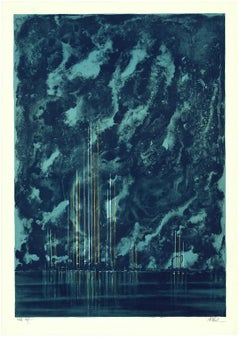
Underwater — Mid-century Modern

Underwater — Mid-century Modern

By Charles Quest

Located in Myrtle Beach, SC

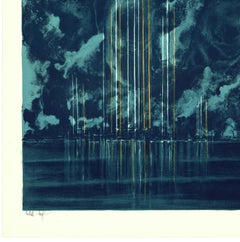
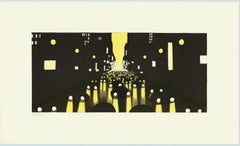
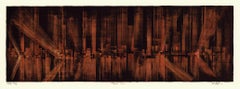
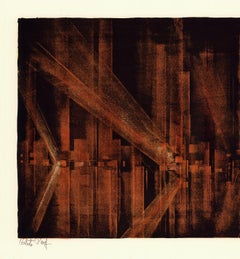
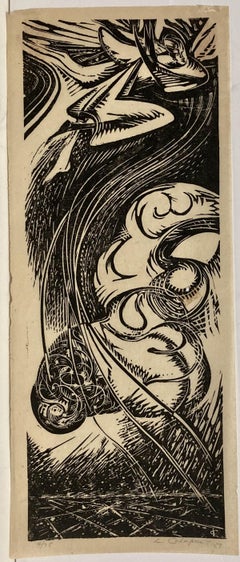
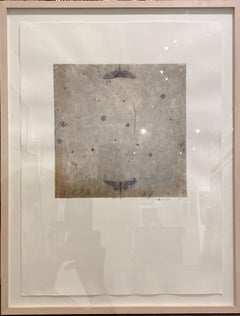
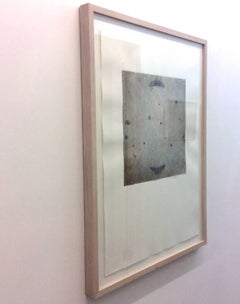
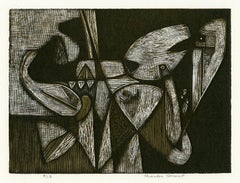
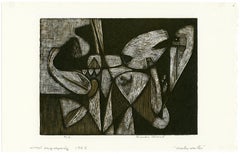
Charles Quest, 'Underwater', 1948, chiaroscuro wood engraving, edition 12. Signed, titled, dated and numbered '3/12' in pencil. A fine, richly-inked impression, in dark brown and warm black, on off-white wove paper, with full margins (5/8 to 1 1/2 inch), in excellent condition. Scarce. ABOUT THE ARTIST Charles Quest, painter, printmaker, and fine art instructor, worked in various mediums, including mosaic, stained glass, mural painting, and sculpture. Quest grew up in St. Louis, his talent evident as a teenager when he began copying the works of masters such as Michelangelo on his bedroom walls. He studied at the Washington University School of Fine Arts, where he later taught from 1944 to 1971. He traveled to Europe after his graduation in 1929 and studied at La Grande Chaumière and Academie Colarossi, Paris, continuing to draw inspiration from the works of the Old Masters. After returning to St. Louis, Quest received several commissions to paint murals in public buildings, schools, and churches, including one from Joseph Cardinal Ritter, to paint a replica of Velasquez's Crucifixion over the main altar of the Old Cathedral in St. Louis. Quest soon became interested in the woodcut medium, which he learned through his study of J. J. Lankes' A Woodcut Manual (1932) and Paul Landacre's articles in American Artist magazine ‘since no artists in St. Louis were working in wood’ at that time. Quest also revealed that for him, wood cutting and engraving were ‘more enjoyable than any other means of expression.’ In the late 1940s, his graphic works began attracting critical attention—several of his woodcuts won prizes and were acquired by major American and European museums. His wood engraving entitled ‘Lovers’ was included in the American Federation of Art's traveling print exhibition in 1947. Two years later, Quest's two prize-winning prints, ‘Still Life with Grindstone’ and ‘Break Forth into Singing’, were exhibited in major American museums in a traveling show organized by the Philadelphia Print Club. His work was included in the Chicago Art Institute's exhibition, ‘Woodcut Through Six Centuries’, and the print ‘Still Life with Vise’ was purchased by the Museum of Modern Art in New York. In 1951 he was invited by artist-Curator Jacob Kainen to exhibit thirty wood engravings and color woodcuts in a one-person show at the Smithsonian's National Museum (now known as the American History Museum). Kainen's press release praised the ‘technical refinement’ of Quest's work: ‘He obtains a great variety of textural effects through the use of the graver, and these dense or transparent grays are set off against whites or blacks to achieve sparkling results. His work has the handsome qualities characteristic of the craftsman and designer.’ At the time of the Smithsonian exhibition, Quest's work was represented by three New York galleries in addition to one in his home town. He had won 38 prizes, and his prints were in the collections of the Library of Congress, the Chicago Art Institute, the Metropolitan Museum, and the Philadelphia Museum of Art. In cooperation with the Art in Embassies program, his color woodcuts were displayed at the American Embassy in Paris in 1951. Recognition at home came in 1955 with his first solo exhibition in St. Louis. Press coverage of the show heralded the ‘growth of graphic arts toward rivaling painting and sculpture as a major independent medium’. An exhibition of his prints at the Bethesda Art Gallery in 1983 attracted Curator Emeritus Joseph A. Haller, S.J., who began purchasing his work for Georgetown University's collection. In 1990 Georgetown University Library's Special Collections Division was the recipient of a large body of Quest's work, including prints, drawings, paintings, sculpture, stained glass, and his archive of correspondence and professional memorabilia. These extensive holdings, including some 260 of his fine prints, provide a rich opportunity for further study and appreciation of this versatile and not-to-be-forgotten mid-Western American artist...

Category

1940s American Modern Charles Quest Prints and Multiples

Materials

Woodcut

Still Life — Mid-century Modern

Still Life — Mid-century Modern

By Charles Quest

Located in Myrtle Beach, SC

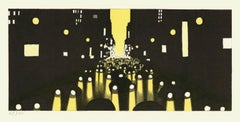
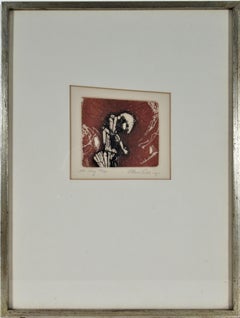
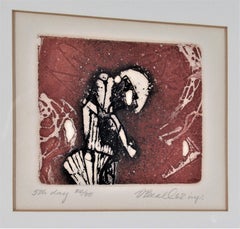
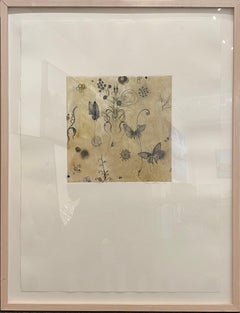
Charles Quest, 'Still Life', 1947, wood engraving, edition 8. Signed, dated, and numbered '3/8' in pencil. Titled and annotated 'wood engraving' in the bottom left margin. A fine impression, on off-white wove paper, with full margins (1 to 2 inches), in excellent condition. Scarce. Matted to museum standards, unframed. ABOUT THE ARTIST Charles Quest, painter, printmaker, and fine art instructor, worked in various mediums, including mosaic, stained glass, mural painting, and sculpture. Quest grew up in St. Louis, his talent evident as a teenager when he began copying the works of masters such as Michelangelo on his bedroom walls. He studied at the Washington University School of Fine Arts, where he later taught from 1944 to 1971. He traveled to Europe after his graduation in 1929 and studied at La Grande Chaumière and Academie Colarossi, Paris, continuing to draw inspiration from the works of the Old Masters. After returning to St. Louis, Quest received several commissions to paint murals in public buildings, schools, and churches, including one from Joseph Cardinal Ritter, to paint a replica of Velasquez's Crucifixion over the main altar of the Old Cathedral in St. Louis. Quest soon became interested in the woodcut medium, which he learned through his study of J. J. Lankes' A Woodcut Manual (1932) and Paul Landacre's articles in American Artist magazine ‘since no artists in St. Louis were working in wood’ at that time. Quest also revealed that for him, wood cutting and engraving were ‘more enjoyable than any other means of expression.’ In the late 1940s, his graphic works began attracting critical attention—several of his woodcuts won prizes and were acquired by major American and European museums. His wood engraving entitled ‘Lovers’ was included in the American Federation of Art's traveling print exhibition in 1947. Two years later, Quest's two prize-winning prints, ‘Still Life with Grindstone’ and ‘Break Forth into Singing’, were exhibited in major American museums in a traveling show organized by the Philadelphia Print Club. His work was included in the Chicago Art Institute's exhibition, ‘Woodcut Through Six Centuries’, and the print ‘Still Life with Vise’ was purchased by the Museum of Modern Art in New York. In 1951 he was invited by artist-Curator Jacob Kainen to exhibit thirty wood engravings and color woodcuts in a one-person show at the Smithsonian's National Museum (now known as the American History Museum). Kainen's press release praised the ‘technical refinement’ of Quest's work: ‘He obtains a great variety of textural effects through the use of the graver, and these dense or transparent grays are set off against whites or blacks to achieve sparkling results. His work has the handsome qualities characteristic of the craftsman and designer.’ At the time of the Smithsonian exhibition, Quest's work was represented by three New York galleries in addition to one in his home town. He had won 38 prizes, and his prints were in the collections of the Library of Congress, the Chicago Art Institute, the Metropolitan Museum, and the Philadelphia Museum of Art. In cooperation with the Art in Embassies program, his color woodcuts were displayed at the American Embassy in Paris in 1951. Recognition at home came in 1955 with his first solo exhibition in St. Louis. Press coverage of the show heralded the ‘growth of graphic arts toward rivaling painting and sculpture as a major independent medium’. An exhibition of his prints at the Bethesda Art Gallery in 1983 attracted Curator Emeritus Joseph A. Haller, S.J., who began purchasing his work for Georgetown University's collection. In 1990 Georgetown University Library's Special Collections Division was the recipient of a large body of Quest's work, including prints, drawings, paintings, sculpture, stained glass, and his archive of correspondence and professional memorabilia. These extensive holdings, including some 260 of his fine prints, provide a rich opportunity for further study and appreciation of this versatile and not-to-be-forgotten mid-Western American artist...

Category

1940s American Modern Charles Quest Prints and Multiples

Materials

Woodcut

Related Items
He Repeated the Letters of the Alphabet

He Repeated the Letters of the Alphabet

By Corita Kent

Located in Missouri, MO

Sister Mary Corita Kent (American, 1918-1986) He Repeated the Letters of the Alphabet... Color Screenprint 22.5 x 38.75 inches Signed Lower Right Sister Mary Corita Kent, once the n...

Category

Mid-20th Century American Modern Charles Quest Prints and Multiples

Materials

Color, Screen

Olivetti

Giovanni PintoriOlivetti, 1967

$2,800

H 37.38 in W 26.25 in

Olivetti

By Giovanni Pintori

Located in New York, NY

Pintori, Giovanni. Olivetti. 1967. 2nd printing. 1st Printing 1946. Offset Lithograph. Rare Giovanni Pintori (1912 – 1999) was an Italian graphic designer and painter. His most famous works are the advertisement posters for Olivetti typewriters...

Category

1960s American Modern Charles Quest Prints and Multiples

Materials

Offset

Late 20th century color lithograph prairie style Frank Lloyd Wright architecture

Late 20th century color lithograph prairie style Frank Lloyd Wright architecture

By Frank Lloyd Wright

Located in Milwaukee, WI

"The Prairie School Collection - Rug" is an offset lithograph poster with gold foil. This piece advertises an exhibition of Frank Lloyd Wright's designs. Unsigned. 34 7/8" x 22" art...

Category

1980s American Modern Charles Quest Prints and Multiples

Materials

Offset

Hilaire Hiler WPA Era Native American Fox Costume Color Serigraph 1934 Print

Hilaire Hiler WPA Era Native American Fox Costume Color Serigraph 1934 Print

By Hilaire Hiler

Located in Denver, CO

An important 1934 WPA-era color serigraph by American modernist Hilaire Hiler (1898–1966), this dynamic work titled Native American Fox Costume exemplifies the artist’s bold synthesis of modernist abstraction, cultural symbolism, and avant-garde color theory. The composition depicts a stylized figure in ceremonial fox costume, poised with a bow and adorned with an elaborate feathered headdress, rendered in striking contrasts of black, red, and white. The result is a powerful visual rhythm that reflects both the graphic experimentation and cultural fascination characteristic of early twentieth-century American Modernism. Executed during the WPA period, this original serigraph demonstrates Hiler’s distinctive semi-abstract style, in which figuration is reduced to geometric structure and symbolic form. The flattened composition, bold outlines, and saturated palette create a sense of movement and ritual energy, reinforcing the work’s connection to mythic narrative and Native American-inspired themes common in WPA-era printmaking. The artist’s engagement with color theory and structural design is evident throughout, making this an especially strong example of his print oeuvre. Hilaire Hiler was a key figure in American modernism, known not only as a painter and printmaker but also as a color theorist and educator associated with WPA mural projects, including work for the Aquatic Park...

Category

1930s American Modern Charles Quest Prints and Multiples

Materials

Screen

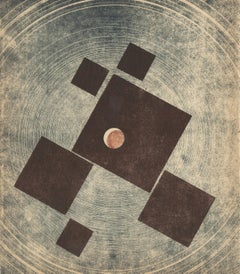
Untitled
Untitled

Untitled

By Charles William Smith

Located in Fairlawn, OH

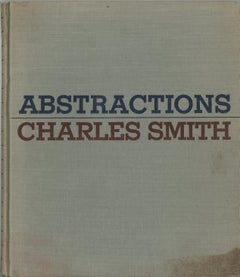
Untitled Color woodcut, 1939 Unsigned as issued Signed and dedicated by the artist on the justification page (see photo) From: Abstractions By Charles Smith Forward by Carl O. Schnie...

Category

1930s American Modern Charles Quest Prints and Multiples

Materials

Woodcut

Genesis 7th Day
Genesis 7th Day

Dennis Ray BeallGenesis 7th Day, 1962

$425

H 16.35 in W 12.35 in D 0.65 in

Genesis 7th Day

By Dennis Ray Beall

Located in San Francisco, CA

This artwork titled "Genesis 7th Day" 1962 is a n original colors etching, with embossing by noted American artist Dennis Ray Beall, b.1929. It is hand signed, titled, dated and numb...

Category

Mid-20th Century American Modern Charles Quest Prints and Multiples

Materials

Etching

Exhibition of Designs by Frank Lloyd Wright at Unity Temple. Lake St. Kenilworth

Exhibition of Designs by Frank Lloyd Wright at Unity Temple. Lake St. Kenilworth

By Alfonso Iannelli

Located in New York, NY

i Exhibition of Designs by Frank Lloyd Wright at Unity Temple. Lake St. Kenilworth, Oak Park. (Published by the Chicago Heritage Committee with the Cooperation of the Unitarian Unive...

Category

1960s American Modern Charles Quest Prints and Multiples

Materials

Offset

Night Light Signed Aquatint Etching California Modernist Woman Artist Susan Hall

Night Light Signed Aquatint Etching California Modernist Woman Artist Susan Hall

By Susan Hall

Located in Surfside, FL

Susan Hall Hand signed and numbered Aquatint Etching This piece has a Memphis Milano sort of vibe to it. Susan Hall lives and works in Point Reyes Station, California, a town in the heart of the Point Reyes National Seashore. This pristine wilderness area is dominated by a mosaic of bays and ocean, rolling grass lands and forests. It is inhabited by a diversity of wildlife, including over 450 species of birds, mountains lions, deer, bobcats, foxes, and elk. Ms. Hall who is a native of this area returned after spending twenty years in New York City. In her book, “Painting Point Reyes”, Hall says, “Point Reyes is the center of my painting life. Point Reyes has been my life and when I haven’t lived here, it has been an underground stream that spoke to me in dreams and visions.” While living and painting in New York City, Ms. Hall exhibited her work widely in museums and galleries. Among them are the Whitney Museum of Art; San Francisco Museum of Art; Nancy Hoffman Gallery, Trabia MacAfee Gallery, Phyllis Kind Gallery, Chicago; Ovsey Gallery, Los Angeles. In addition, her work has been featured in group exhibitions throughout the United States and abroad, including in 2020 Bud Shark's Ink: The California Crew at BMoCA, Boulder Museum of Contemporary Art Colorado USA representing the panoply of aesthetics, cultural backgrounds, viewpoints, and talent held within the bounty of art “made in California.” This remarkable grouping of artists, Brad Brown, Enrique Chagoya, Roy De Forest, Amy Ellingson, Susan Hall, Don Ed Hardy, Mildred Howard, Robert Hudson, Hung Liu, Kara Maria, Rex Ray, Alison Saar, Italo Scanga, and William T. Wiley. Women to the Fore, Hudson River Museum Yonkers 2021 A group of women artists working in oil painting and drawing, lithograph prints and photograph, collage and sculpture. Many icons of feminist art history. Judy Chicago, Judy Giera, Marisol, and Shanequa Benitez, Ann McCoy...

Category

1970s American Modern Charles Quest Prints and Multiples

Materials

Etching, Aquatint

(Abstraction) by DD
(Abstraction) by DD

(Abstraction) by DD, 1940

$750

H 15.25 in W 13.25 in

(Abstraction) by DD

Located in New York, NY

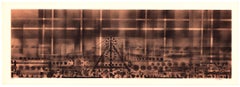
This image is an extravaganza of modernist motifs. The monogram 'D.D.' is at the lower right.

Category

Mid-20th Century American Modern Charles Quest Prints and Multiples

Materials

Woodcut

Urban Walls: Cincinnati, Abstract Geometric Screenprint by Bill Sontag

Urban Walls: Cincinnati, Abstract Geometric Screenprint by Bill Sontag

By Bill Sontag

Located in Long Island City, NY

Artist: Bill Sontag, American (b. 1932) Title: Urban Walls: Cincinnati Year: 1971 Edition: 85/150 Medium: Screenprint, signed and numbered in pencil Image Size: 24 x 32 inches Size: ...

Category

1970s American Modern Charles Quest Prints and Multiples

Materials

Screen

Letterio Calapai, (Sky Abstraction), 1957, mid-century wood engraving

Letterio Calapai, (Sky Abstraction), 1957, mid-century wood engraving

By Letterio Calapai

Located in New York, NY

Letterio Calapai is widely recognized as a major American artist of the twentieth century. He is widely respected as a printmaker, especially for engravings and wood engravings, and ...

Category

1950s American Modern Charles Quest Prints and Multiples

Materials

Woodcut

"Untitled" Paul Resika, Modernist, Black and White, Abstracted Composition

"Untitled" Paul Resika, Modernist, Black and White, Abstracted Composition

By Paul Resika

Located in New York, NY

Paul Resika Untitled Signed lower right Etching on wove paper 10 1/2 x 6 inches Paul Resika (born 1928, New York, New York) is primarily recognized for his artwork featuring the di...

Category

1990s American Modern Charles Quest Prints and Multiples

Materials

Paper, Etching

Previously Available Items
Work Bench — Mid-century Modern

Work Bench — Mid-century Modern

By Charles Quest

Located in Myrtle Beach, SC

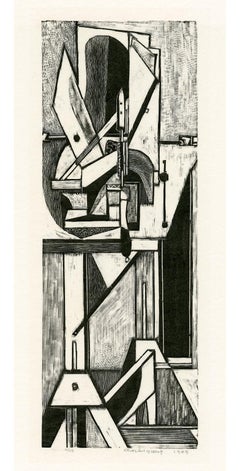
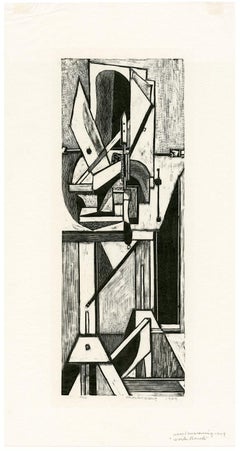
Charles Quest, 'Work Bench', 1949, wood engraving, edition 40. Signed, dated and numbered 9/40 in pencil. Titled and annotated 'wood engraving 1949' in pencil, in the artist’s hand, lower right margin. A fine, richly-inked impression, on off-white wove Japan, with full margins (1 3/4 to 2 inches), in excellent condition. Matted to museum standards, unframed. ABOUT THE ARTIST Charles Quest, a successful artist, and fine art instructor, worked in a variety of mediums including mosaic, stained glass, mural painting, and sculpture, but remains best known as a printmaker. Quest grew up in St. Louis, his talent evident as a teenager when he began copying the works of masters such as Michelangelo on his bedroom walls. He studied at the Washington University School of Fine Arts where he later taught from 1944 to 1971. He traveled to Europe after his graduation in 1929, and studied at La Grande Chaumière and Academie Colarossi, Paris, continuing to draw inspiration from the works of the Old Masters. After returning to St. Louis, Quest received several commissions to paint murals in public buildings, schools, and churches, including one from Joseph Cardinal Ritter to paint a replica of Velasquez's Crucifixion over the main altar of the Old Cathedral in St. Louis. Quest soon became interested in the woodcut medium which he apparently learned through his study of J. J. Lankes' A Woodcut Manual (1932) and Paul Landacre's articles in American Artist magazine ‘since no artists in St. Louis were working in wood’ at that time. Quest also revealed that for him, wood cutting and engraving were ‘more enjoyable than any other means of expression.’ In the late 1940s, his graphic works began attracting a lot of critical attention—several of his woodcuts won prizes and were acquired by major American and European museums. His wood engraving entitled ‘Lovers’ was included in the American Federation of Art's traveling print exhibition in 1947. Two years later Quest's two prize-winning prints, ‘Still Life with Grindstone’ and ‘Break Forth into Singing’ were exhibited in major American museums in a traveling show organized by the Philadelphia Print Club. His work was included in the Chicago Art Institute's exhibition, ‘Woodcut Through Six Centuries’ and the print ‘Still Life with Vise’, was purchased by the Museum of Modern Art in New York. In 1951 he was invited by artist-Curator Jacob Kainen to exhibit thirty wood engravings and color woodcuts in the Graphic Arts Division of the Smithsonian's National Museum (now known as the American History Museum). This one-man exhibition was a remarkable achievement for Quest, who had been working in the medium for only about ten years. In the press release for the show, Kainen praised the ‘technical refinement’ of Quest's work: ‘He obtains a great variety of textural effects through the use of the graver, and these dense or transparent grays are set off against whites or blacks to achieve sparkling results. His work has the handsome qualities characteristic of the craftsman and designer.’ At the time of the Smithsonian exhibition, Quest's work was represented by three New York galleries in addition to one in his home town. He had also won 38 prizes, and his prints were in the collections of the Library of Congress, the Chicago Art Institute, the Metropolitan Museum and the Philadelphia Museum of Art. In cooperation with the Art in Embassies program, his color woodcuts were displayed at the American Embassy in Paris in 1951. Recognition at home came in 1955 with his first solo exhibition in St. Louis. Press coverage of the show heralded the ‘growth of graphic arts toward rivaling painting and sculpture as a major independent medium’. Charles Quest retired from teaching in 1971 and made relatively few prints in his later years, as the rigors of the medium were too demanding. He moved to Tryon, North Carolina, with his wife Dorothy, an artist and portrait painter, and remained active as a painter until his death in 1993. An exhibition of his prints at the Bethesda Art Gallery in 1983 attracted the interest of Curator Emeritus Joseph A. Haller, S.J., who began purchasing his work for the University's collection. In 1990 Georgetown University Library's Special Collections Division became the grateful recipient of a large body of Quest's work including prints, drawings, paintings, sculpture, and stained glass, as well as his archive of correspondence and professional memorabilia. These extensive holdings, including some 260 of his fine prints, provide a rich opportunity for further study and appreciation of this versatile and not-to-be-forgotten mid-Western American artist...

Category

1940s American Modern Charles Quest Prints and Multiples

Materials

Woodcut

Charles Quest prints and multiples for sale on 1stDibs.

Find a wide variety of authentic Charles Quest prints and multiples available for sale on 1stDibs. You can also browse by medium to find art by Charles Quest in woodcut print and more. Much of the original work by this artist or collective was created during the 1940s and is mostly associated with the modern style. Not every interior allows for large Charles Quest prints and multiples, so small editions measuring 5 inches across are available. Customers who are interested in this artist might also find the work of Giovanni Pintori, Caroline Durieux, and Louis Schanker. Charles Quest prints and multiples prices can differ depending upon medium, time period and other attributes. On 1stDibs, the price for these items starts at $750 and tops out at $1,500, while the average work can sell for $875.