Edouard Manet Art

French, 1832-1883
Edouard Manet (1832 – 1883) was a French painter. He was one of the first 19th-century artists to paint modern life, and a pivotal figure in the transition from Realism to Impressionism. Born into an upper-class household with strong political connections, Manet rejected the future originally envisioned for him, and became engrossed in the world of painting. His early masterworks, The Luncheon on the Grass (Le déjeuner sur l'herbe) and Olympia, both 1863, caused great controversy and served as rallying points for the young painters who would create Impressionism. Today, these are considered watershed paintings that mark the start of modern art. The last 20 years of Manet's life saw him form bonds with other great artists of the time, and develop his own style that would be heralded as innovative and serve as a major influence for future painters. Although harshly condemned by critics who decried its lack of conventional finish, Manet's work had admirers from the beginning. One was Emile Zola, who wrote in 1867: "We are not accustomed to seeing such simple and direct translations of reality. Then, as I said, there is such a surprisingly elegant awkwardness ... it is a truly charming experience to contemplate this luminous and serious painting which interprets nature with a gentle brutality."
to
11
3
2
Overall Width
to
Overall Height
to
14
2
1
1
11
1
1
16
8
5
4
3
3
2
2
1
1
1
1
1
1
1
1
1
14
2
2
1
17
11,084
2,853
2,494
1,436
2
5
9
7
Artist: Edouard Manet
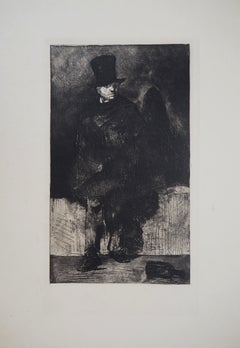
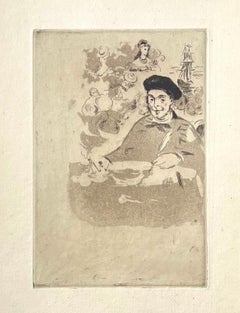
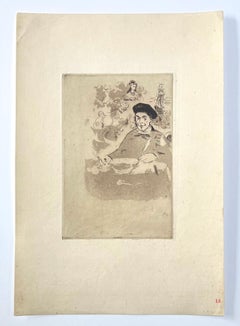
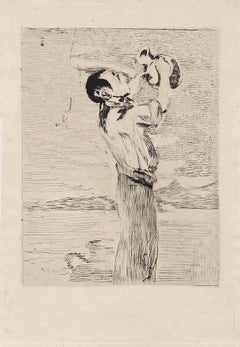
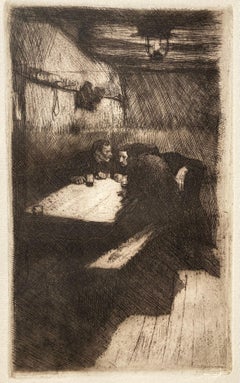
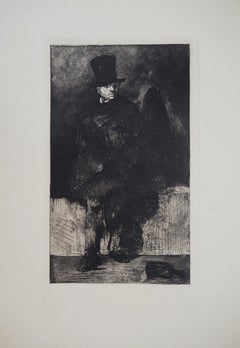
The Absinthe Drinker - Original Etching (Guerin #9 Fisher #9)

The Absinthe Drinker - Original Etching (Guerin #9 Fisher #9)

By Édouard Manet

Located in Paris, IDF

Edouard MANET The Absinthe Drinker, 1860 Original etching Printed signature in the plate On Japan paper 45 x 40 cm (c. 18 x 16 inch) REFERENCES : Catalog raisonnes Guerin n°9 and F...

Category

1860s Impressionist Edouard Manet Art

Materials

Etching

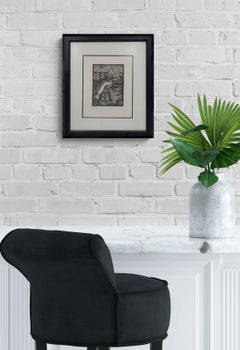
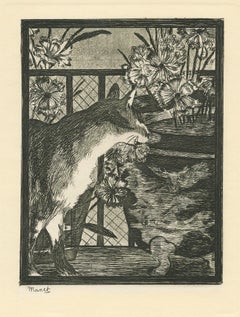
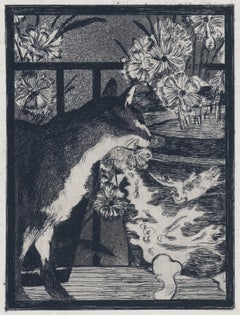
Le Chat et Les Fleurs

Le Chat et Les Fleurs

By Édouard Manet

Located in Middletown, NY

Etching and aquatint on cream laid, watermarked Rives paper. 6 5/8 x 5 inches (167 x 126 mm). Sixth and final state, a posthumous impression. A fine, inky impression with full margin...

Category

1860s Realist Edouard Manet Art

Materials

Etching, Aquatint

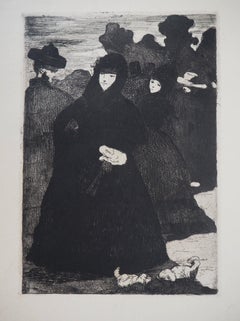
Spain : Women at Prado - Original Etching (Guerin #46 & Fisher #47)

Spain : Women at Prado - Original Etching (Guerin #46 & Fisher #47)

By Édouard Manet

Located in Paris, IDF

Edouard MANET Spain : Women at Prado, 1865 Original etching Printed signature in the plate On Japan paper 45 x 40 cm (c. 18 x 16 inch) REFERENCES : - Catalog raisonne Guerin #46 ...

Category

1860s Impressionist Edouard Manet Art

Materials

Etching

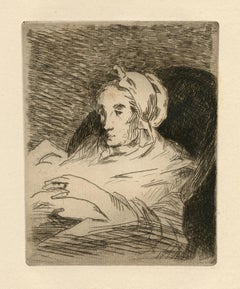
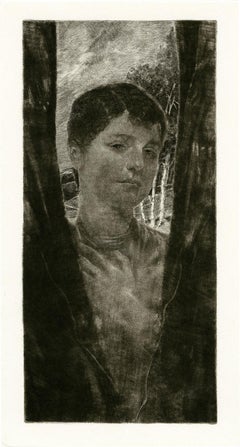
"La Convalescente" original etching

"La Convalescente" original etching

By Édouard Manet

Located in Henderson, NV

Medium: original etching and aquatint. Catalogue reference: Harris 85 iii/iii. This is a fine impression from the 1884 Bazire edition, printed on laid paper. Plate size: 5 x 4 inches...

Category

1880s Post-Impressionist Edouard Manet Art

Materials

Etching

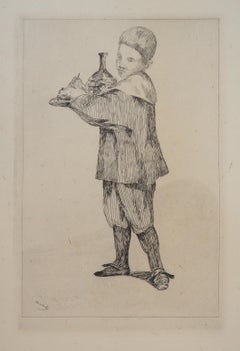
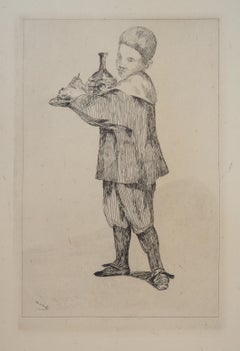
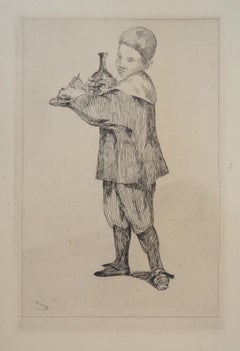
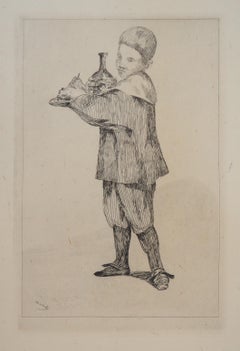
Child with a Tray (Pear and Bottle) - Original Etching (Guerin #15)

Child with a Tray (Pear and Bottle) - Original Etching (Guerin #15)

By Édouard Manet

Located in Paris, IDF

Edouard MANET Child with a Tray (Pear and Bottle), 1861 Original etching Printed signature in the plate On Japan paper 36 x 24 cm (c. 12 x 10 inch) REFERENCES : Catalog raisonne Gu...

Category

1860s Impressionist Edouard Manet Art

Materials

Etching

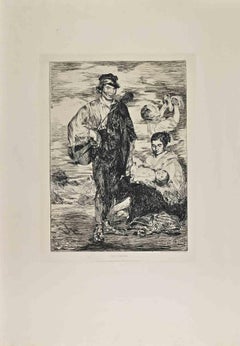
Les Gitanos Etching, Impressionist Style, Circa 1862, Unframed

Les Gitanos Etching, Impressionist Style, Circa 1862, Unframed

By Édouard Manet

Located in Roma, IT

Les Gitanos is a black and White etching realized by Edouard Manet in 1862.  Titled in the lower. Second state and lifetime impression realized by Société des Aquafortistes, with f...

Category

1860s Impressionist Edouard Manet Art

Materials

Etching

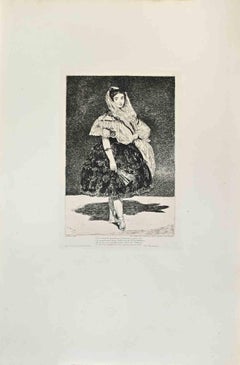
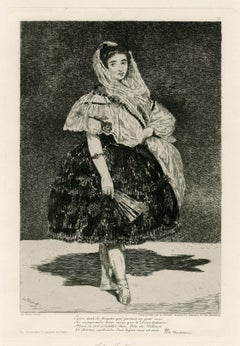
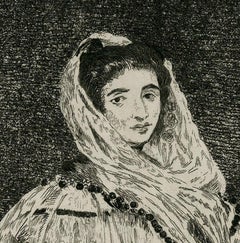
Lola De Valence Etching, Impressionist, Signed, 1862, Unframed

Lola De Valence Etching, Impressionist, Signed, 1862, Unframed

By Édouard Manet

Located in Roma, IT

Lola De Valence is a black and white etching realized by Edouard Manet (1832-1883) in 1862. Image dimensions: 18x26 cm. Etching and aquatint, 6th state, the first to be published, ...

Category

1870s Impressionist Edouard Manet Art

Materials

Etching

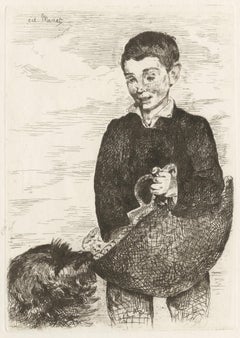
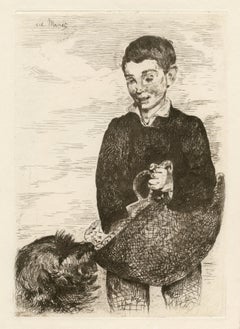
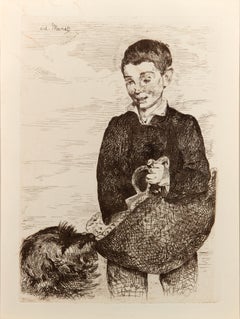
Le Gamin (The Kid)
Le Gamin (The Kid)

Le Gamin (The Kid)

By Édouard Manet

Located in Fairlawn, OH

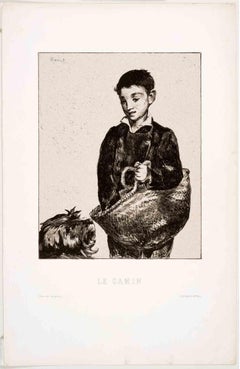
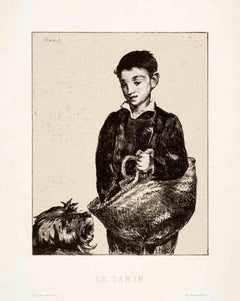
Le Gamin (The Kid) Etching on laid paper, 1862 Signed in the plate upper left (see photo) As published in Theodore Duret, L'Histoire d'Edouard Manet et de Son Ouvre, 1902 (The first ...

Category

1860s Impressionist Edouard Manet Art

Materials

Etching

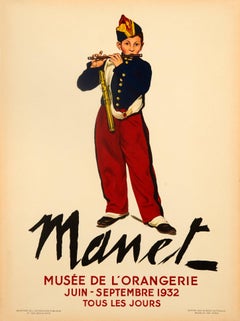
Le Fifre - Musée De L'Orangerie (after) Edouard Manet, 1932

Le Fifre - Musée De L'Orangerie (after) Edouard Manet, 1932

By Édouard Manet

Located in New York, NY

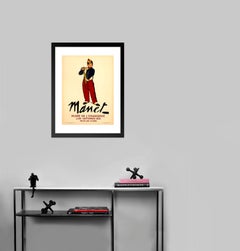
Artist: Edouard Manet Medium: Lithographic Poster, 1932 Dimensions: 29.5 x 22 in, 75 x 55.9 cm Classic Poster Paper - Excellent Condition A This 1932 very rare lithographic poster reproduces an amazing painting by Edouard Manet entitled "Le Fifre" (the fifer), from 1866. It was displayed at the Louvre from 1914 until 1947, when it was relocated to the Musée du Jeu de Paume. In 1986, it was moved to its current home in the Musée d'Orsay, the national museum of 19th-century art. (it is now on loan to the Louvre in Abu Dhabi.) On a trip to Spain in 1865, Édouard Manet visited the Prado, where the art of Diego Velasquez...

Category

1930s Edouard Manet Art

Materials

Lithograph

"Théodore de Banville tourné à gauche" original etching

"Théodore de Banville tourné à gauche" original etching

By Édouard Manet

Located in Henderson, NV

Medium: original etching and aquatint. Executed in 1874, this impression on laid paper is presumed to be from the 1905 Strölin edition. Plate size: 9 3/8 x 6 1/4 inches (238 x 160 mm...

Category

Early 1900s Edouard Manet Art

Materials

Etching

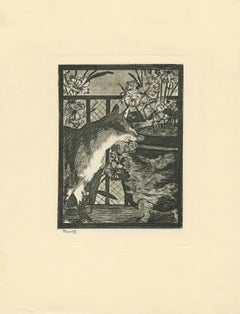
Le Chat et les Fleurs (from "Les Chats par Champfleury")

Le Chat et les Fleurs (from "Les Chats par Champfleury")

By Édouard Manet

Located in Kansas City, MO

Edouard Manet Le Chat et les Fleurs (from "Les Chats par Champfleury") 1869 Etching and aquatint on Rives paper Image: 6.25 x 5.125 (17.3 × 13 cm) Plate: 8 x 6 inches (20.3 x 15.2 c...

Category

1860s Impressionist Edouard Manet Art

Materials

Etching, Aquatint

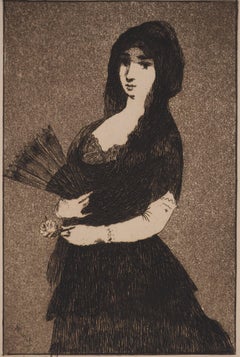
Woman with Mantilla - Original Etching (Guerin #51 Fisher #46)

Woman with Mantilla - Original Etching (Guerin #51 Fisher #46)

By Édouard Manet

Located in Paris, IDF

Edouard MANET (1832-1883) Exotic flower (or Woman with a Mantilla) 1869 Original etching Signed in the plate On vellum 36 x 26 cm REFERENCES: - Catalogue raisonné Guérin #51 - Cata...

Category

1860s Impressionist Edouard Manet Art

Materials

Etching

Le Gamin Etching, Impressionist Style, Circa 1862, Unframed

Le Gamin Etching, Impressionist Style, Circa 1862, Unframed

By Édouard Manet

Located in Roma, IT

Lithograph on chine collée on firm white paper. Image dimension (chine collée) 28.7x22.7; Sheet size 50.4x32.6. Not signed, as issued. Lower inscribed and titled in typographic sc...

Category

1860s Impressionist Edouard Manet Art

Materials

Etching

Le Buveur d'Eau (The Water Drinker) - Etching by Edouard Manet - 1870s

Le Buveur d'Eau (The Water Drinker) - Etching by Edouard Manet - 1870s

By Édouard Manet

Located in Roma, IT

Realized by Manet in 1870/1874, this famous subject was printed in an apparently unique lifetime proof, as stated in Harris' Catalog. It was then printed in two posthumous edition, ...

Category

1860s Impressionist Edouard Manet Art

Materials

Etching

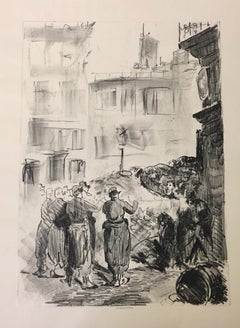
La Barricade -  Lithograph by Edouard Manet - 1871

La Barricade - Lithograph by Edouard Manet - 1871

By Édouard Manet

Located in Roma, IT

Rare and beautiful lithograph by Edouard Manet . "La Barricade " illustrates a group of soldiers executing a band of rebels on a street corner. This artwork deals with a subject in...

Category

1870s Impressionist Edouard Manet Art

Materials

Paper, Lithograph

Related Items
Arch Beach, California

Arch Beach, California

Located in San Francisco, CA

This artwork titled "Arch Beach, California" c.1910 is an original etching on Wove paper by American artist Harley DeWitt Nichols, 1859-1939. It is hand signed and titled in pencil by the artist. The plate mark (image) size is 6.5 x 9.5 inches, framed size is 13 x 17 inches. it is custom framed in a wooden silver frame, with off white matting. It is in excellent condition, especially considering the age. About the artist: Born in the small rural Wisconsin town of Barton, Harley lived a peripatetic life. As a young child, he accompanied his family to Lincoln, Nebraska where he found great excitement in the roaming herds of buffalo and Native Americans. It was in these years that a talent for drawing was discovered. In 1870, after several years of hardship, his father moved the family back to Wisconsin. At the age of 11 he became a water boy...

Category

Early 20th Century American Impressionist Edouard Manet Art

Materials

Etching

"King of the Friendly Islands" (Tonga); Engraving from Captain Cook's 3rd Voyage

"King of the Friendly Islands" (Tonga); Engraving from Captain Cook's 3rd Voyage

By John Webber

Located in Alamo, CA

"Poulaho, King of the Friendly Islands, Drinking Kava" is an engraving created by William Sharp (1749-1824), from a drawing by John Webber (1752-1793), who was the artist on Captain James Cook's 3rd and final voyage of discovery. It was published in the atlas of "A Voyage to the Pacific Ocean Undertaken by the Command of His Majesty, for Making Discoveries in the Northern Hemisphere", the official British Admirality sanctioned journal published upon completion of the voyage in London in 1784 by Strahan & Cadell. Captain Cook visited Tonga on his 3rd voyage, which he named The Friendly Islands because of the warm welcome he and his crew received, unlike some of the other more hostile Pacific islands. The engraving depicts Cook and his men observed a kava ceremony at the village of Mu’a on Tongatapu. King Paulaho sits in the centre foreground, his back to the spectator with a man kneeling before him. The ceremonial mat depicted behind Paulaho indicates that nobody was allowed to sit behind him. The figure in the centre holds a single cup, referring to the Tongan custom of offering the cup to the king first. Kava is native to the islands of the South Pacific and was first described for English readers in 1768 by Captain James Cook. The kava root has been used for centuries as a central feature of ceremonies and celebrations because it was able to bring about a calming and pleasant social atmosphere. The root was crushed and processed into coconut milk to become the focal ceremonial beverage, simply referred to as kava. This engraving is presented in a Koa wood frame and a white mat. Koa wood is legendary in Hawaii. There are occasional faint spots, but the print is otherwise in very good condition. This amazing Koa wood is native to Hawaii and it is known for the deep rich colors and varied grain pattern. Koa has an honored heritage in Hawaii and is highly revered and sacred. The word “koa” means “warrior” in Hawaiian. The warriors of King Kamehameha the Great, created canoes and weapons from a wood plentiful on the Big Island of Hawaii. This wood became synonymous with the warriors themselves, and it became known as koa. There are three other engravings listed from the official journal of Captain Cook's 3rd voyage available that are presented in identical Koa wood frames and mats (LU117324682422, LU117324684052, LU117324684032). They would make a wonderful grouping for a display of 2, 3 or 4 prints. A discount is available for a grouping depending on the number of items included. Captain Cook is remembered as one of the greatest explorers and navigators in history. His explorations included Australia, New Zealand and islands of the South Pacific and the northwest coast of North America. Hawaii was discovered by Captain Cook during this voyage. Hawaii was originally called The Sandwich Islands in honor of The Earl of Sandwich...

Category

1780s Realist Edouard Manet Art

Materials

Engraving

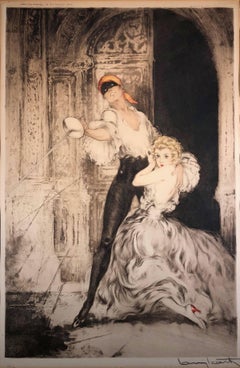
Don Juan
Don Juan

Louis IcartDon Juan, 1928

$2,800Sale Price|20% Off

H 28 in W 20.5 in

Don Juan

By Louis Icart

Located in Missouri, MO

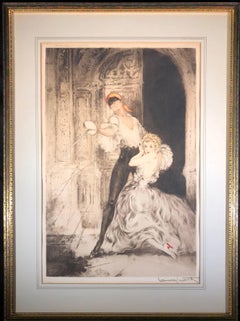
Aquating Engraving Image Size: approx. 20 1/4 x 13 3/8 Framed Size: 28 x 20.5 inches Pencil Signed Lower Right Louis Justin Laurent Icart was born in Toulouse in 1890 and died in Paris in 1950. He lived in New York City in the 1920s, where he became known for his Art-Deco color etchings of glamourous women. He was first son of Jean and Elisabeth Icart and was officially named Louis Justin Laurent Icart. The use of his initials L.I. would be sufficient in this household. Therefore, from the moment of his birth he was dubbed 'Helli'. The Icart family lived modestly in a small brick home on rue Traversière-de-la-balance, in the culturally rich Southern French city of Toulouse, which was the home of many prominent writers and artists, the most famous being Henri de Toulouse-Lautrec. Icart entered the l'Ecole Superieure de Commerce de Toulouse in order to continue his studies for a career in business, particularly banking (his father's profession). However, he soon discovered the play writings of Victor Hugo (1802-1885), which were to change the course of his life. Icart borrowed whatever books he could find by Hugo at the Toulouse library, devouring the tales, rich in both romantic imagery and the dilemmas of the human condition. It was through Icart's love of the theater that he developed a taste for all the arts, though the urge to paint was not as yet as strong for him as the urge to act. It was not until his move to Paris in 1907 that Icart would concentrate on painting, drawing and the production of countless beautiful etchings, which have served (more than the other mediums) to indelibly preserve his name in twentieth century art history. Art Deco, a term coined at the 1925 Paris Exposition des Arts Decoratifs, had taken its grip on the Paris of the 1920s. By the late 1920s Icart, working for both publications and major fashion and design studios, had become very successful, both artistically and financially. His etchings reached their height of brilliance in this era of Art Deco, and Icart had become the symbol of the epoch. Yet, although Icart has created for us a picture of Paris and New York life in the 1920s and 1930s, he worked in his own style, derived principally from the study of eighteenth-century French masters such as Jean Antoine Watteau, François Boucher and Jean Honoré Fragonard. In Icart's drawings, one sees the Impressionists Degas...

Category

1920s Art Deco Edouard Manet Art

Materials

Engraving, Aquatint

Londres (London)

Maximilien LuceLondres (London), 1929

$3,900

H 14.25 in W 20.25 in

Londres (London)

By Maximilien Luce

Located in New York, NY

Pencil signed by both Luce and Jacques Villon (Villon etched the image) and numbered 120/200 in pencil, lower margin. Published by Galerie Bernheim-Jeune, Paris. Catalogue Raisonne:...

Category

1920s Pointillist Edouard Manet Art

Materials

Etching, Aquatint, Color

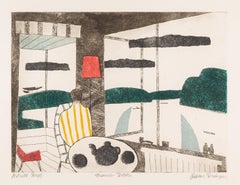
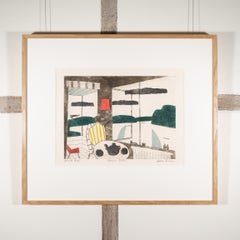
Thames Ditton - Contemporary Interior 20th Century Print

Thames Ditton - Contemporary Interior 20th Century Print

By Julian Trevelyan

Located in Kingsclere, GB

Julian Trevelyan 1910-1988 Thames Ditton, 1969 etching and aquatint 41 x 55 cm 16 1/8 x 21 5/8 in signed, titled and inscribed in pencil, aside from the edition of 75 Julian Trevely...

Category

20th Century Edouard Manet Art

Materials

Etching, Aquatint

La Boullie (The Porridge), Old Masters Drypoint Etching by Jean Francois Millet

La Boullie (The Porridge), Old Masters Drypoint Etching by Jean Francois Millet

By Jean François Millet

Located in Long Island City, NY

Etching printed in brownish black on light tan Chine collé, 1861. Image measures 6 x 5 inches, displayed in a 15.5 x 12.5 inch frame. Etched signature and date lower left. A very goo...

Category

1860s Impressionist Edouard Manet Art

Materials

Drypoint, Etching, Intaglio

Paysanne au Puits (Peasant Woman at the Well)

Paysanne au Puits (Peasant Woman at the Well)

By Camille Pissarro

Located in New York, NY

Camille Pissarro (1830-1903), Paysanne au Puits (Peasant Woman at the Well), etching and aquatint, 1891, signed, titled and numbered (3 etat no 2). Refer...

Category

1890s Impressionist Edouard Manet Art

Materials

Etching, Aquatint

Keying Up - The Court Jester

Keying Up - The Court Jester

By William Merritt Chase

Located in Fairlawn, OH

Keying Up - The Court Jester Etching with drypoint, 1879 Signed in the plate lower left corner (see photos) Proof before engraved title and engraved names Printed on thin light golden Japanese tissue paper In the final state, with engraved titled and typeface engraved artist’s signature below the image Condition: excellent Plate size: 6-5/8 x 4-1/4" According to Pisano, this image was very popular during Chase’s life. It is based on his famous painting, Keying Up-The Court Jester, in the collection of the Pennsylvania Academy of Fine Arts. The painting was created in Munich during the artist’s studies there. It was exhibited in the 1876 Centennial Exhibition in Philadelphia where it won a Medal of Honor and helped establish the artist’s reputation as a leading American painter. Chase, always conscious of self promotion, created the etching and had numerous impressions printed. He sold them for a modest price to increase his fame. The etching was later published in Sylvester R. Koehler, American Art Review, September 1878. It was for this American Art Review printing that the engraved titled and type face signature below the image were added to the plate. This example was part of a group of impressions that came down in the Chase family via his daughter Dorothy Bremond Chase, his third daughter. They were acquired at auction in a single auction lot, housed in a paper board folder. The consignor was Associated American Artist’s as they were liquidating their stock prior to closing the gallery. Dorothy was the subject of Chase’s painting, My Little Daughter Dorothy. C. 1894, in the collection of the Detroit Institute of Arts as well as numerous other portraits of her. Reference: Pisano/Bake, Volume 1, Pr. 3, illustrates the rare 1st state, this being a 2nd state before any other the engraved title and Chase's name in the bottom margin which are found in the third state. Artist bio in file (Chase) In 1883 Chase was involved in the organization of an exhibition to help raise funds for a pedestal for the Statute of Liberty. The exhibition featured loans of three works by Manet and urban scenes by the Italian Impressionist Giuseppe de Nittis. Both artists influenced Chase's Impressionistic style that gave rise to a series of New York park scenes. It is also thought that he was influenced by John Singer Sargent's In the Luxembourg Gardens (1879) which was exhibited in New York at this time. Indeed, Chase had met Sargent in Europe in 1881, the two men becoming lifelong friends with Sargent painting Chase's portrait in 1902. On another European trip in 1885, Chase met James McNeill Whistler in London. While Whistler had a reputation for being difficult, the two artists got along famously and agreed to paint one another's portrait. Eventually, however, Whistler's moods began to grate with Chase who wrote home stating "I really begin to feel that I never will get away from here". For his part, Whistler criticized Chase's finished portrait and, according to Hirshler, "complained about Chase for the rest of his life". While no record exists of Whistler's portrait of Chase; Chase's portrait of Whistler remains a well-known piece in his oeuvre. In 1887 Chase married Alice Gerson, the daughter of the manager of a lithography company. Though some fifteen years his junior (Chase was 37), he had known Alice for some time through her family's devotion to the arts. The pair, who would enjoy a happy marriage with Alice in full support of her husband's career, settled initially in Brooklyn where their first child was born. The couple would parent six daughters and two sons and it was only his family that could rival his devotion to his art. Indeed, Chase often combined his two loves by painting several portraits of his wife and children in Brooklyn parks before the couple relocated to Manhattan. Later Period Between 1891 and 1902, Chase and his family spent their summers at a purpose-built home and studio in Shinnecock Hills, a close suburb of the upmarket town of Southampton on the south shore of Long Island (roughly 100 miles east of New York). Chase set up, and taught two days a week, at the nearby Shinnecock Hills Summer School of Art which benefitted from the financial backing of local art collectors. It was at Shinnecock that Chase, taken in by the region's striking natural surroundings, painted several Impressionistic landscapes. As Bettis put it, "There, among the dunes, in the bright sunlight and sea air his painterly impulse was given free sway, and he produced some of his freest and loveliest work". His passion for the area was so felt he even gave his daughter Hazel the middle name of Neamaug, in honor of the rich Native American history of Shinnecock. Chase was equally focused on the students that came to the School and who he encouraged to paint in the modern plein air style favored by the French Impressionists. Although Chase was making a name for himself as an Impressionist, he never abandoned his commitment to the sombre tones and academic tropes he had learned in Munich, though these he reserved for his portraits, and for his series of striking still lifes featuring dead fish. Chase was in fact a successful society portraitist - he painted fashionable women for a fee of $2,000 - and would paint his students as "samples" which he then donated to leading art institutions (such as Lady in Black (1888) which he donated to the Metropolitan Museum in 1891). In 1896, facing financial difficulties, Chase flirted with the idea of giving up his teaching in New York and traveled with his family to Madrid where he developed a passion for bullfighting. Chase returned however to Shinnecock in June to teach his yearly summer art class, and in the fall of that year, established his own art school in Manhattan: the Chase School which was modelled on the Académie Julian in Paris. Chase lacked business savvy, however, and the Chase School lasted only two years before it was placed under new management. It continued as the New York School of Art (changed to Parsons School of Design starting 1941) with Chase as head the School for eleven more years. Chase also taught during this period at the Pennsylvania Academy of Fine Arts. In 1902, following the premature death of his friend John Twachtman, Chase was invited to join the Ten American Painters group (who included amongst its members, Frank Weston Benson, Thomas Wilmer Dewing...

Category

1870s American Impressionist Edouard Manet Art

Materials

Etching

Church of San Pietro In Banchi, Italy - 1908 Original Etching

Church of San Pietro In Banchi, Italy - 1908 Original Etching

Located in Soquel, CA

Church of San Pietro In Banchi, Italy - 1908 Original Etching Original 1908 etching of the church of San Pietro Banchi in Genoa, Italy by George Walter Chandler (American, 1866-1928...

Category

Early 1900s Post-Impressionist Edouard Manet Art

Materials

Laid Paper, Etching

A la Corrida
A la Corrida

A la Corrida

Located in Fairlawn, OH

A la Corrida Color aquatint, c. 1900 Signed "Osterlind" lower right in red pencil Annotated: "No. 96" in pencil lower left Edition: about 100 Published by Sagot, Paris: their blindst...

Category

Early 1900s Impressionist Edouard Manet Art

Materials

Aquatint

Kabuki actor Nakamura Shikan II by Utagawa Kunisada Edo Japanese Woodblock Print

Kabuki actor Nakamura Shikan II by Utagawa Kunisada Edo Japanese Woodblock Print

By Utagawa Kunisada (Toyokuni III)

Located in Soquel, CA

Kabuki actor Nakamura Shikan II by Utagawa Kunisada Japanese Woodblock Print Wonderful portrait of Nakamura Shikan II, a prominent kabuki actor, in the role of Kisen Hoshi Toyokuni ...

Category

1820s Realist Edouard Manet Art

Materials

Printer's Ink, Rice Paper, Woodcut

Previously Available Items
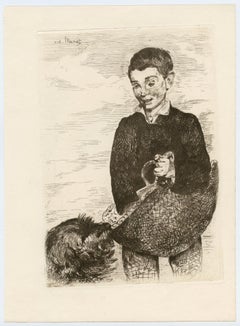
"Le Gamin" original etching - Boy with a Dog

"Le Gamin" original etching - Boy with a Dog

By Édouard Manet

Located in Henderson, NV

Medium: original etching. Catalogue reference: Guerin 27 and Harris 31. This charming etching is one of several compositions executed by Edouard Manet on the subject of a boy and his...

Category

Early 1900s Post-Impressionist Edouard Manet Art

Materials

Etching

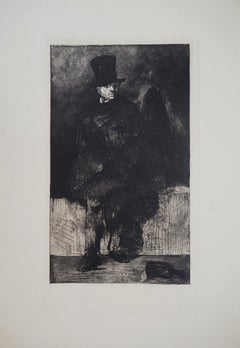
The Absinthe Drinker - Original Etching (Guerin #9 Fisher #9)

The Absinthe Drinker - Original Etching (Guerin #9 Fisher #9)

By Édouard Manet

Located in Paris, IDF

Edouard MANET The Absinthe Drinker, 1860 Original etching Printed signature in the plate On Japan paper 45 x 40 cm (c. 18 x 16 inch) REFERENCES : Catalog raisonnes Guerin n°9 and F...

Category

1860s Impressionist Edouard Manet Art

Materials

Etching

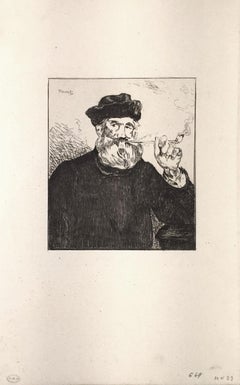
Le Fumeur - Etching by Edouard Manet - 1866

Le Fumeur - Etching by Edouard Manet - 1866

By Édouard Manet

Located in Roma, IT

Very Fine and Beautiful print on vergé ancien, belonging to the Strolin Edition of 1905 (100 specimen). Full margins. Ref. Cat. Guérin 49; Cat. Bareau-Berès 55; Cat. Fisher 40.

Category

1860s Impressionist Edouard Manet Art

Materials

Etching

Lola De Valence
Lola De Valence

Édouard ManetLola De Valence, 1862

Sold

H 10.89 in W 6.88 in

Lola De Valence

By Édouard Manet

Located in Fairlawn, OH

Lola De Valence Etching, 1862 Signed in the plate lower left: “Ed Manet” Printed on chine collee paper, without watermark From the first edition, published by Cadart and Luquet, Paris, before the removal of the inscription “ Ed. Manet sculpt” From the 1863 edition, before the 1874 Portfolio, 1890 Portolio. 1894 Dumont edition and the Strolin edition of 100 in 1905 Pencil inscription with title below the plate in the lower margin Conditiono: Excellent Image size: 10 7/8 x 6 7/8 inches Plate size: 18 3/4 x 13 inches Reference: Harris-Manet 33 iii/III Guerin-Manet 23 vi/VIII The painting that this etching is inspired by is in the collection of the Musee d'Orsay, Paris. "Lola de Valence is a painting by the painter Édouard Manet in 1862 . The canvas represents a dancer dressed intraditional Spanish clothes...

Category

1860s Impressionist Edouard Manet Art

Materials

Etching

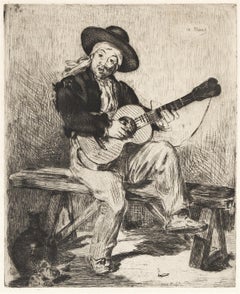
Le Guitarrero (ou Le Chanteur Espagnol)

Le Guitarrero (ou Le Chanteur Espagnol)

By Édouard Manet

Located in New York, NY

A superb, richly-inked impression of this etching and roulette on cream laid Japan paper. Fifth state (of 6). Edition of 50. Published by Cadart, Paris. From "Édouard Manet: Eaux-for...

Category

1860s Impressionist Edouard Manet Art

Materials

Etching, Laid Paper

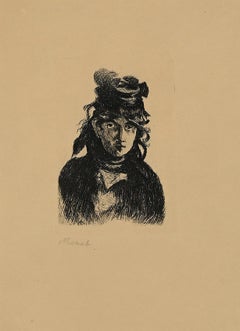
"Berthe Morisot" original etching

"Berthe Morisot" original etching

By Édouard Manet

Located in Henderson, NV

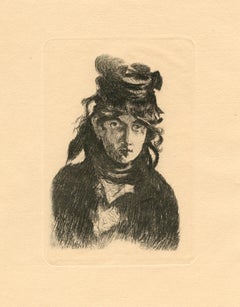
Medium: original etching and drypoint. Catalogue reference: Harris 75. This etching was executed by Manet in 1872, but only a few were printed before the copper plate was cancelled w...

Category

1920s Edouard Manet Art

Materials

Etching

Child with a Tray (Pear and Bottle) - Original Etching (Guerin #15)

Child with a Tray (Pear and Bottle) - Original Etching (Guerin #15)

By Édouard Manet

Located in Paris, IDF

Edouard MANET Child with a Tray (Pear and Bottle), 1861 Original etching Printed signature in the plate On Japan paper 36 x 24 cm (c. 12 x 10 inch) REFERENCES : Catalog raisonnes G...

Category

1860s Impressionist Edouard Manet Art

Materials

Etching

Child with a Tray (Pear and Bottle) - Original Etching (Guerin #15)

Child with a Tray (Pear and Bottle) - Original Etching (Guerin #15)

By Édouard Manet

Located in Paris, IDF

Edouard MANET Child with a Tray (Pear and Bottle), 1861 Original etching Printed signature in the plate On Japan paper 36 x 24 cm (c. 12 x 10 inch) REFERENCES : Catalog raisonnes G...

Category

1860s Impressionist Edouard Manet Art

Materials

Etching

Child with a Tray (Pear and Bottle) - Original Etching (Guerin #15)

Child with a Tray (Pear and Bottle) - Original Etching (Guerin #15)

By Édouard Manet

Located in Paris, IDF

Edouard MANET Child with a Tray (Pear and Bottle), 1861 Original etching Printed signature in the plate On Japan paper 36 x 24 cm (c. 12 x 10 inch) REFERENCES : Catalog raisonnes G...

Category

1860s Impressionist Edouard Manet Art

Materials

Etching

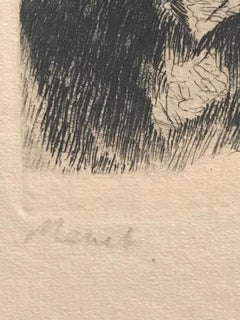
Berthe Morisot - Etching by Edouard Manet - 1872 (printed in 1910/12)

Berthe Morisot - Etching by Edouard Manet - 1872 (printed in 1910/12)

By Édouard Manet

Located in Roma, IT

Not numbered. Note in pencil lower left with the Artist's name (not his signature). 3rd and finale State: Following Strölin's cancellation, with a small hole at top and bottom. Pr...

Category

1910s Modern Edouard Manet Art

Materials

Etching

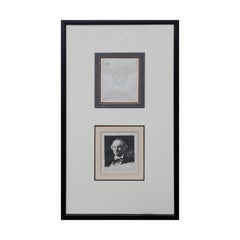
Pair of Portrait Etchings of Charles Baudelaire

Pair of Portrait Etchings of Charles Baudelaire

By Édouard Manet

Located in Houston, TX

Edouard Manet (1832-1883) (2) etchings printed by A. Salmon: At top, Charles Baudelaire de Profile 1862 etching is monogrammed “M” in the plate upper right and marked “Imp. A. Salmon” to the lower right. Below, Portrait of Charles Baudelaire de Face 1865 etching is signed “Manet” in the plate lower right. Both Marked “Paint et Grave par Manet to the lower left and marked “Imp. A. Salmon” to the lower right. Top Etching Dimensions: H 4.5 in. x W 3.75 in. Bottom Etching Dimensions: H 4.25 in. x W 3.75 in. Artist Biography: Edouard Manet was born in Paris on January 23, 1832, to an affluent and well connected family. His mother, Eugenie-Desiree Fournier, was the goddaughter of the Swedish crown prince, Charles Bernadotte, from whom the current Swedish monarchs are descended. His father, Auguste Manet, was a French judge who expected Edouard to pursue a career in law. His uncle, Charles Fournier, encouraged him to pursue painting and often took young Manet to the Louvre. In 1845, following the advice of his uncle, Manet enrolled in a special course of drawing where he met Antonin Proust, future Minister of Fine Arts, and a subsequent life-long friend. At his father's suggestion, in 1848 he sailed on a training vessel to Rio de Janeiro. After twice failing the examination to join the navy, the elder Manet relented to his son's wishes to pursue an art education. From 1850 to 1856, Manet studied under the academic painter Thomas Couture, a painter of large historical paintings. In his spare time he copied the old masters in the Louvre. From 1853 to 1856 he visited Germany, Italy, and the Netherlands, during which time he absorbed the influences of the Dutch painter Frans Hals, and the Spanish artists Diego Velazquez and Francisco Jose de Goya. In 1856, he opened his own studio. His style in this period was characterized by loose brush strokes, simplification of details, and the suppression of transitional tones. Adopting the current style of realism initiated by Gustave Courbet, he painted The Absinthe Drinker...

Category

19th Century Abstract Edouard Manet Art
Materials

Paper, Etching

Portrait of Charles Baudelaire with Hat II -  Etching by E. Manet - 1869

Portrait of Charles Baudelaire with Hat II - Etching by E. Manet - 1869

By Édouard Manet

Located in Roma, IT

Portrait of Charles Baudelaire with Hat II (Original Title: Baudelaire de Profilings en Chapeau II) is an original etching realized by Edouard Manet in 1862. Manet's monogram on up...

Category

1860s Edouard Manet Art

Materials

Etching

Edouard Manet art for sale on 1stDibs.

Find a wide variety of authentic Edouard Manet art available for sale on 1stDibs. If you’re browsing the collection of art to introduce a pop of color in a neutral corner of your living room or bedroom, you can find work that includes elements of orange and other colors. You can also browse by medium to find art by Edouard Manet in etching, paper, lithograph and more. Much of the original work by this artist or collective was created during the 19th century and is mostly associated with the Impressionist style. Not every interior allows for large Edouard Manet art, so small editions measuring 4 inches across are available. Customers who are interested in this artist might also find the work of Jean Louis Forain, Félix Bracquemond, and Philippe Henri Noyer. Edouard Manet art prices can differ depending upon medium, time period and other attributes. On 1stDibs, the price for these items starts at $750 and tops out at $66,843, while the average work can sell for $1,822.

Artists Similar to Edouard Manet

Questions About Edouard Manet Art
  • 1stDibs ExpertMarch 22, 2022
    The Luncheon on the Grass and Olympia are the two paintings Édouard Manet was best known for. He produced the paintings in 1862 and 1863, respectively. Both works marked the beginning of the shift from Realism to Impressionism. On 1stDibs, find a variety of Édouard Manet art.
  • 1stDibs ExpertApril 5, 2022
    Édouard Manet was famed for his textured paintings which used bold contrasting colors that focused on figures and still life elements. On 1stDibs, you can shop a collection of expertly vetted Édouard Manet pieces from some of the world’s top art dealers.
  • 1stDibs ExpertJanuary 19, 2025
    Edouard Manet was famous for his work as a painter during the 19th century. He was one of the first artists of his time to paint modern life and a pivotal figure in the transition from Realism to Impressionism. Born into an upper-class household with strong political connections, the French artist rejected the future originally envisioned for him and became engrossed in the world of painting. His early masterworks, The Luncheon on the Grass and Olympia, both made in 1863, caused great controversy and served as rallying points for the young painters who would establish Impressionism. Today, these are considered watershed paintings that mark the start of modern art. On 1stDibs, shop a selection of Edouard Manet art.