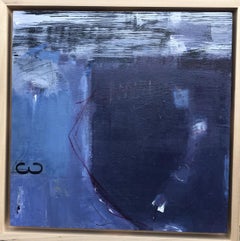
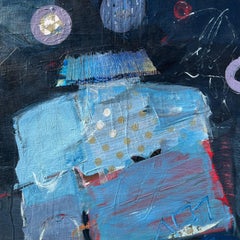
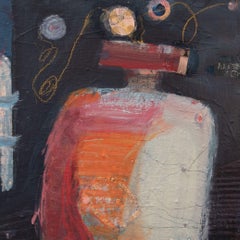
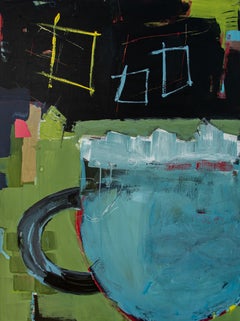
By Ellen Brooks
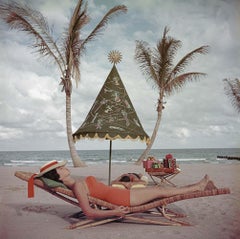
Located in Surfside, FL
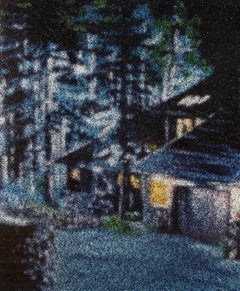
Ellen Brooks (born February 3, 1946) is an American photographer. She began her career on the West Coast, and is associated with the Los Angeles-based art community of the late 1960s and ‘70s. In 1982 she moved to New York, where her practice has since been based. Her work is known for its boundary-pushing forays into sculpture, and for her use of screens and image altering pro-filmic photographic processes. She has shown at the Museum of Modern Art (MOMA), the Whitney Museum of American Art, the Los Angeles Museum of Contemporary Art, and the Centre Pompidou, and has worked in the permanent collections of the MOMA, the Whitney, the National Museum of American Art, the Getty Museum, and others.
Biography
Ellen Brooks was born in Los Angeles, California. She received both her Bachelor’s degree and her Master’s degree in Fine Arts from the University of California, Los Angeles, in 1968 and 1971 respectively. Her early works dealt primarily with human figures, notably Beach Piece, an early work in which she employed the photographic medium to address issues of alienation versus bodily presence in space. The work, which featured larger-than-lifesize nude figures in various poses of recline, was installed on Venice Beach, from which the figures appeared to half-emerge from the sand. During her graduate studies she constructed a series of flats [Flats 1–5] which were shown at the Museum of Modern Art in the 1970 exhibition Photography Into Sculpture. The flats addressed similar issues of scale to Beach Piece from the opposite direction, incorporating the viewer’s vantage point from above to obfuscate the objects’ situation in space.
Following her MFA she moved to San Francisco, where her use of the photograph continued a progression of investigations of scale and installation. Her next major work, Adolescent Piece, also used nude bodies. The work would subsequently be refabricated and reinstalled in several different forms at different scales over the next four decades, at University of Las Vegas, San Francisco Art Institute, and at the Los Angeles Institute of Contemporary Art. Its most recent iteration, at MOCA in 2011, employed the original process of 1976, using Xerox transfers from photographic contact sheets. This installation “constituted a ‘fourth generation’ of the photographs,” according to the artist. “The first generation was the negative; the second, the eight-by-10-inch contact sheet, the third, the machine copy of the contact sheet onto wax paper, and the fourth, the images glued onto the gallery walls.” The work garnered significant attention during several of its stagings, due to the relative unguardedness of its young, unclothed subjects, all between the ages of ten and fifteen.
Tableaux
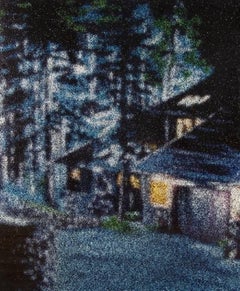
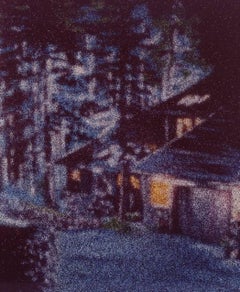
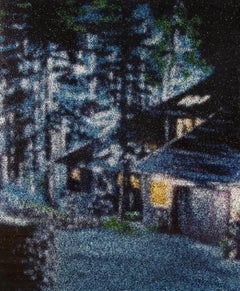
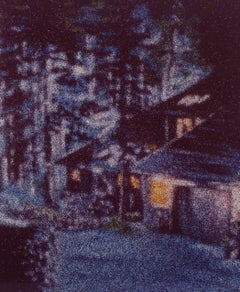
In the late ‘70s and into the 1980s, Brooks worked on an extended series called Tableaux. Like the earlier flats, the Tableaux used the reduced scale of maquettes to stage film still-esque scenes of domestic interiors and dilemmas, often incorporating disarray or ambiguous circumstances within their three walls. Created using miniature...
Category
Late 20th Century Modern Ellen Brooks Art