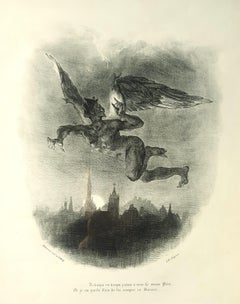
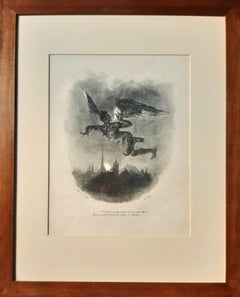
Eugene Delacroix Prints and Multiples

French, 1798-1863
Ferdinand Victor Eugène Delacroix (French: 26 April 1798 – 13 August 1863) was a French Romantic artist regarded from the outset of his career as the leader of the French Romantic school. In contrast to the Neoclassical perfectionism of his chief rival Ingres, Delacroix took for his inspiration the art of Rubens and painters of the Venetian Renaissance, with an attendant emphasis on colour and movement rather than clarity of outline and carefully modelled form. Dramatic and romantic content characterized the central themes of his maturity, and led him not to the classical models of Greek and Roman art, but to travel in North Africa, in search of the exotic. Friend and spiritual heir to Théodore Géricault, Delacroix was also inspired by Lord Byron, with whom he shared a strong identification with the "forces of the sublime", of nature in often violent action. However, Delacroix was given to neither sentimentality nor bombast, and his Romanticism was that of an individualist. In the words of Baudelaire, "Delacroix was passionately in love with passion, but coldly determined to express passion as clearly as possible."Together with Ingres, Delacroix is considered one of the last old Masters of painting and is one of the few who was ever photographed. As a painter and muralist, Delacroix's use of expressive brushstrokes and his study of the optical effects of colour profoundly shaped the work of the Impressionists, while his passion for the exotic inspired the artists of the Symbolist movement. A fine lithographer, Delacroix illustrated various works of William Shakespeare, the Scottish author Walter Scott, and the German author Johann Wolfgang von Goethe.
to
5
3
Overall Width
to
Overall Height
to
3
2
10
1,258
991
901
868
6
2
1
5
3
7
4
4
2
2
1
1
1
1
1
1
1
5
3
2
1
1
4
3
Artist: Eugene Delacroix
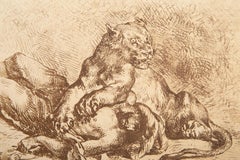
Lionne Dechirant la Poitrine d'un Arabe, Modern Etching by Eugene Delacroix

Lionne Dechirant la Poitrine d'un Arabe, Modern Etching by Eugene Delacroix

By Eugène Delacroix

Located in Long Island City, NY

Eugene Delacroix, French (1798 - 1863) - Lionne Dechirant la Poitrine d'un Arabe, Year: 1849, Medium: Soft Ground Etching, signed and dated in the plate, Image Size: 8 x 10.75 inch...

Category

1840s Old Masters Eugene Delacroix Prints and Multiples

Materials

Etching

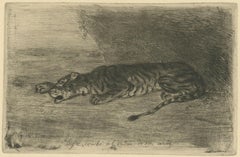
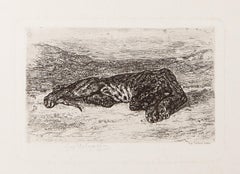
Tigre couché à l'entrée de son antre  (Tiger Lying at the Entrance to its Lair)

Tigre couché à l'entrée de son antre (Tiger Lying at the Entrance to its Lair)

By Eugène Delacroix

Located in Middletown, NY

Etching, drypoint, and roulette on watermarked Hallines cream laid paper, 3 3/4 x 5 7/8 inches (95 x 148 mm), full margins. A very good impression of this charming image, with all of...

Category

Early 19th Century Realist Eugene Delacroix Prints and Multiples

Materials

Laid Paper, Drypoint, Etching

La Delivrance De La Princesse Olga - Etching by M.Roux after E. Delacroix - 1911

La Delivrance De La Princesse Olga - Etching by M.Roux after E. Delacroix - 1911

By Eugène Delacroix

Located in Roma, IT

Image dimensions: 24 x 28 cm. La Delivrance De La Princesse Olga is an original print in etching technique on ivory-colored paper, realized by M. Roux after Eugène Delacroix . In v...

Category

1910s Romantic Eugene Delacroix Prints and Multiples

Materials

Lithograph

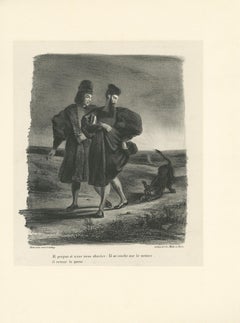
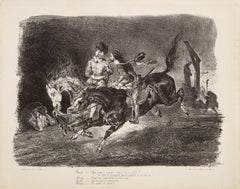
Faust, Méphistophélès et le Barbet / Faust, Méphistophélès and the Water Spaniel

Faust, Méphistophélès et le Barbet / Faust, Méphistophélès and the Water Spaniel

By Eugène Delacroix

Located in Middletown, NY

Lithograph on Chine appliqué, 9 1/4 x 8 1/8 inches (235 x 206 mm), full margins. First state (of 4). Extremely minor uniform age tone, otherwise in good condition. A superb, richly-inked impression. [Delteil 61.1] ______ At an early age Delacroix became a lover of music and literature and had been drawing from the time he entered school.  He expected painting would be a hobby, but on the death of his father he found he had to make his own way in life.  In 1817 he entered the studio of Pierre-Narcisse Guerin; amongst his fellow pupils was Gericault.  His first exhibited work was Dante and Virgil...

Category

Early 19th Century Barbizon School Eugene Delacroix Prints and Multiples

Materials

Handmade Paper, Lithograph

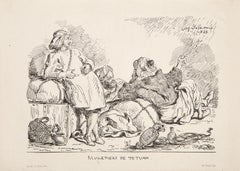
Muletiers de Tetuan, Modern Lithograph by Eugene Delacroix

Muletiers de Tetuan, Modern Lithograph by Eugene Delacroix

By Eugène Delacroix

Located in Long Island City, NY

Eugene Delacroix, French (1798 - 1863) - Muletiers de Tetuan, Year: 1833, Medium: Lithograph on Japon, Image Size: 8 x 10.5 inches, Size: 9.5 x 14 in. (24.13 x 35.56 cm), Publisher...

Category

1830s Old Masters Eugene Delacroix Prints and Multiples

Materials

Lithograph

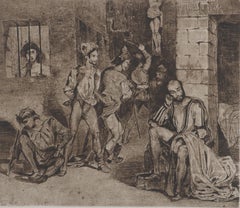
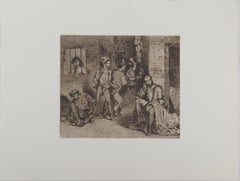
The Italian Poet Tasso in the Madhouse - Etching

The Italian Poet Tasso in the Madhouse - Etching

By Eugène Delacroix

Located in Paris, IDF

Eugène DELACROIX (1798-1863) Tasso in the Madhouse Engraving after a drawing Signed on the plate On vellum 38 x 50 cm INFORMATION: In 1839, Delacroix painted his famous painting "T...

Category

Early 20th Century Modern Eugene Delacroix Prints and Multiples

Materials

Etching

Un Forgeron - Etching by Eugène Delacroix - 1870s

Un Forgeron - Etching by Eugène Delacroix - 1870s

By Eugène Delacroix

Located in Roma, IT

Un Forgeron is an artwork realized by Eugène Delacroix in the 1870s. Etching. Good conditions. Realized for the "Société des Aquafortistes. Born on the initiative of the publisher...

Category

1870s Modern Eugene Delacroix Prints and Multiples

Materials

Etching

Surprise - Etching by François Chifflart - 1860s

Surprise - Etching by François Chifflart - 1860s

By Eugène Delacroix

Located in Roma, IT

Surprise is a black and White etching realized by François Chifflart in the 1860s.  Titled in the lower. Image size: 24x32. Very good impression with wide margins and a very fresh...

Category

1860s Modern Eugene Delacroix Prints and Multiples

Materials

Etching

Related Items
18th C. Portrait of Edward Stanley from Henry VIII's Court after Holbein Drawing

18th C. Portrait of Edward Stanley from Henry VIII's Court after Holbein Drawing

By Hans Holbein

Located in Alamo, CA

This is an 18th century engraved portrait of "Edward Stanley" created by Francesco Bartolozzi (1728–1815), after a drawing by Hans Holbein the Younger (1497- 1543) in the 16th century. Holbein was the official artist in the court of King Henry VIII. Bartolozzi used both etching and stipple engraving techniques to create the work which was published by John Chamberlaine in London in 1793 in "The Book of Imitations of Original Drawings by Hans Holbein in the Collection of His Majesty". Edward Stanley, 3rd Earl of Derby...

Category

Late 18th Century Old Masters Eugene Delacroix Prints and Multiples

Materials

Engraving, Etching

Meridies; Der Mittag (Noon; The Midday) /// Johann Daniel Preissler Old Master

Meridies; Der Mittag (Noon; The Midday) /// Johann Daniel Preissler Old Master

Located in Saint Augustine, FL

Artist: (after) Johann Daniel Preissler (German, 1666-1737) Title: "Meridies; Der Mittag (Noon; The Midday)" Portfolio: Die Vier Tageszeiten (The Four Times of Day) Year: 1723 Medium: Original Etching and Engraving on laid paper Limited edition: Unknown Printer: likely Johann Balthasar Probst, Augsburg, Germany Publisher: Jeremias Wolff (Erben), Augsburg, Germany Sheet size: 22.5" x 16.32" Image size: 18.13" x 14.32" Reference: Le Blanc No. 255, 38; Nagler No. 23 Condition: Soft handling creases and folds to sheet. A few light areas of staining and scattered small areas of discoloration in margins. Two small tears skillfully repaired from verso in margins. Has been professionally stored away for decades. It is otherwise a strong impression in good condition with full margins Extremely rare Notes: Provenance: private collection - Aspen, CO. Engraved by German artist Johann Balthasar Probst (1673-1750) after a drawing by German artist Johann Daniel Preissler (1666-1737). Comes from Preissler's 1723 "Die Vier Tageszeiten (The Four Times of Day)" portfolio of four etchings and engravings. Printed from one copper plate in one color: black. Descriptions of the portrayed image are printed in Latin and German. Biography: Johann Daniel Preissler, or Preisler (1666–1737) was a German painter and director of Nuremberg's Academy of Fine Arts. He was a notable member of a German artistic family, originating in Bohemia. His children included Johann Justin Preissler (1698–1771), Georg Martin Preisler (1700–1754), Barbara Helena Preisler (1707–1758; married to Oeding), Johan Martin Preisler (1715–1794), and Valentin Daniel Preisler (1717–1765), all in their time renowned artists. Most notable for his portraits, nudes and history paintings, Johann Daniel Preissler also produced drawings and frescoes. He was particularly known beyond his native Nuremberg for his "Die durch Theorie erfundene Practic", a sequence of works on art theory – the individual works were translated into several other languages and served as textbooks for students such as the Swiss Salomon Gessner...

Category

1720s Old Masters Eugene Delacroix Prints and Multiples

Materials

Laid Paper, Engraving, Etching

Daniel Marot's The Siege of the Dutch Fortified City of Ypres by Louis XIV

Daniel Marot's The Siege of the Dutch Fortified City of Ypres by Louis XIV

By Daniel Marot

Located in Alamo, CA

"Ypres, Grand Ville Riche & Marchande" is an engraving and etching by Daniel Marot (le Vieux) (1661–1752). It depicts a view of the siege of the city of Ypres and its citadel on the left in the Spanish Netherlands by Louis XIV's troops. This battle took place between March 18 and March 25, 1678, as part of the Franco-Dutch War. Marot illustrated in great detail (best appreciated with magnification) the French attack on the strong pentagonal citadel on the extreme left, which had been built recently in anticipation of a French attack. The trenches built by the French approaching the town are seen on the right. King Louis XIV can be seen in the foreground surveying the battle mounted on his white horse, surrounded by his officers and troops. The print is presented in an attractive ornate black wood frame with a cream-colored double mat with a black inner trim. It is glazed with plexiglas. The frame measures 25.38" x 22.63" x .88". The engraving, frame, mat and glazing are in excellent condition. Artist: Daniel Marot (1661–1752) was also called "Le Vieux". He was the son of the famous architect, Jean Marot. Marot had diverse interests and talents. In addition to his art, he designed garden projects, architectural ornaments, furniture, and even upholstery. Marot as a Huguenot protestant was forced to leave France in 1685 following the revocation of the Edict of Nantes. He emigrated to Holland, where he worked for William of Orange (an arch enemy of his former employer Louis XIV). Marot was largely responsible for the interiors of Williams palace at the Loo. In 1694 he went Britain as William had married Queen Mary and he had become King William III of England. He later returned to Holland in about 1698 and died in the Hague in 1752. He left a lasting legacy on the decorative arts in the Netherlands, where his grand version of the Louis XIV style remained popular into the 1730s. Historical Background: In October 1677, Mary Stuart, niece and possible successor of Charles II of England, married Louis XIV's arch enemy William III of Orange...

Category

Late 17th Century Old Masters Eugene Delacroix Prints and Multiples

Materials

Engraving, Etching

The Fisher-Bird - Original Lithograph by J.J Grandville - 1852

The Fisher-Bird - Original Lithograph by J.J Grandville - 1852

By J. J. Grandville

Located in Roma, IT

The Fisher-Bird is an original lithograph on ivory-colored paper realized by J.J. Grandville from Scènes de la vie privée et publique des animaux, 1852. Published by Manesq & Harvard...

Category

1850s Modern Eugene Delacroix Prints and Multiples

Materials

Paper, Lithograph

Savoy Coat of Arms - Lithograph - 19th Century

Savoy Coat of Arms - Lithograph - 19th Century

Located in Roma, IT

Savoy Coat of Arms is a lithograph print on paper, realized in the 19th Century. Good conditions with diffused foxing. The coat of arms, is made up of a cross surmounted by a crown...

Category

19th Century Old Masters Eugene Delacroix Prints and Multiples

Materials

Lithograph

19th century color lithograph watercolor landscape figurative animal print

19th century color lithograph watercolor landscape figurative animal print

By Nathaniel Currier

Located in Milwaukee, WI

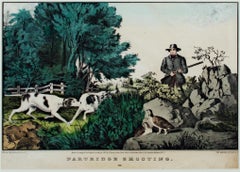
The present hand-colored lithograph presents the viewer with a hunting scene in a picturesque landscape. In the foreground, a man approaches two partridges as his two pointers prepare to flush them out. Beyond, a white fence draws our eyes to the homestead in the distance. Images like this one show how people in the United States were trying to identify themselves as a new nation in the North American landscape - as separate from their European counterparts but with similar similar and specific wildlife and magesties of nature. It also identifies hunting in this landscape as an American pastime. 9.25 x 12.5 inches, artwork 18.38 x 22 inches, frame Entitled bottom center "Partridge Shooting...

Category

Mid-19th Century Romantic Eugene Delacroix Prints and Multiples

Materials

Watercolor, Lithograph

19th century color lithograph figures cemetery willow tree memorial headstone

19th century color lithograph figures cemetery willow tree memorial headstone

By Nathaniel Currier

Located in Milwaukee, WI

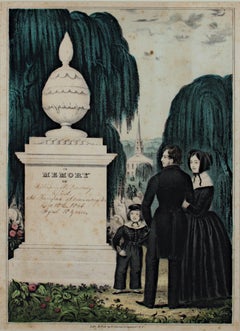
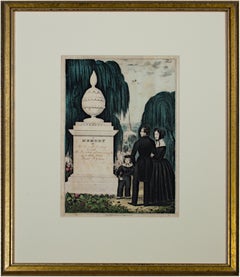
The present hand-colored lithograph was produced as part of the funeral and mourning culture in the United States during the 19th century. Images like this were popular as ways of remembering loved ones, an alternative to portraiture of the deceased. This lithograph shows a man, woman and child in morning clothes next to an urn-topped stone monument. Behind are additional putto-topped headstones beneath weeping willows, with a steepled church beyond. The monument contains a space where a family could inscribe the name and death dates of a deceased loved one. In this case, it has been inscribed to a young Civil War soldier: William W. Peabody Died at Fairfax Seminary, VA December 18th, 1864 Aged 18 years The young Mr. Peabody probably died in service for the Union during the American Civil War. Farifax Seminary was a Union hospital and military headquarters in Alexandria, Virginia. The hospital served nearly two thousand soldiers during the war time. Five hundred were also buried on the Seminary's grounds. 13.75 x 9.5 inches, artwork 23 x 19 inches, frame Published before 1864 Inscribed bottom center "Lith. & Pub. by N. Currier. 2 Spruce St. N.Y." Framed to conservation standards using 100 percent rag matting and TruVue Conservation Clear glass, housed in a gold gilded moulding. Nathaniel Currier was a tall introspective man with a melancholy nature. He could captivate people with his piercing stare or charm them with his sparkling blue eyes. Nathaniel was born in Roxbury, Massachusetts on March 27th, 1813, the second of four children. His parents, Nathaniel and Hannah Currier, were distant cousins who lived a humble yet spartan life. When Nathaniel was eight years old, tragedy struck. Nathaniel’s father unexpectedly passed away leaving Nathaniel and his eleven-year-old brother Lorenzo to provide for the family. In addition to their mother, Nathaniel and Lorenzo had to care for six-year-old sister Elizabeth and two-year-old brother Charles. Nathaniel worked a series of odd jobs to support the family, and at fifteen, he started what would become a life-long career when he apprenticed in the Boston lithography shop of William and John Pendleton. A Bavarian gentleman named Alois Senefelder invented lithography just 30 years prior to young Nat Currier’s apprenticeship. While under the employ of the brothers Pendleton, Nat was taught the art of lithography by the firm’s chief printer, a French national named Dubois, who brought the lithography trade to America. Lithography involves grinding a piece of limestone flat and smooth then drawing in mirror image on the stone with a special grease pencil. After the image is completed, the stone is etched with a solution of aqua fortis leaving the greased areas in slight relief. Water is then used to wet the stone and greased-ink is rolled onto the raised areas. Since grease and water do not mix, the greased-ink is repelled by the moisture on the stone and clings to the original grease pencil lines. The stone is then placed in a press and used as a printing block to impart black on white images to paper. In 1833, now twenty-years old and an accomplished lithographer, Nat Currier left Boston and moved to Philadelphia to do contract work for M.E.D. Brown, a noted engraver and printer. With the promise of good money, Currier hired on to help Brown prepare lithographic stones of scientific images for the American Journal of Sciences and Arts. When Nat completed the contract work in 1834, he traveled to New York City to work once again for his mentor John Pendleton, who was now operating his own shop located at 137 Broadway. Soon after the reunion, Pendleton expressed an interest in returning to Boston and offered to sell his print shop to Currier. Young Nat did not have the financial resources to buy the shop, but being the resourceful type he found another local printer by the name of Stodart. Together they bought Pendleton’s business. The firm ‘Currier & Stodart’ specialized in "job" printing. They produced many different types of printed items, most notably music manuscripts for local publishers. By 1835, Stodart was frustrated that the business was not making enough money and he ended the partnership, taking his investment with him. With little more than some lithographic stones, and a talent for his trade, twenty-two year old Nat Currier set up shop in a temporary office at 1 Wall Street in New York City. He named his new enterprise ‘N. Currier, Lithographer’ Nathaniel continued as a job printer and duplicated everything from music sheets to architectural plans. He experimented with portraits, disaster scenes and memorial prints, and any thing that he could sell to the public from tables in front of his shop. During 1835 he produced a disaster print Ruins of the Planter's Hotel, New Orleans, which fell at two O’clock on the Morning of the 15th of May 1835, burying 50 persons, 40 of whom Escaped with their Lives. The public had a thirst for newsworthy events, and newspapers of the day did not include pictures. By producing this print, Nat gave the public a new way to “see” the news. The print sold reasonably well, an important fact that was not lost on Currier. Nat met and married Eliza Farnsworth in 1840. He also produced a print that same year titled Awful Conflagration of the Steamboat Lexington in Long Island Sound on Monday Evening, January 18, 1840, by which melancholy occurrence over One Hundred Persons Perished. This print sold out very quickly, and Currier was approached by an enterprising publication who contracted him to print a single sheet addition of their paper, the New York Sun. This single page paper is presumed to be the first illustrated newspaper ever published. The success of the Lexington print launched his career nationally and put him in a position to finally lift his family up. In 1841, Nat and Eliza had their first child, a son they named Edward West Currier. That same year Nat hired his twenty-one year old brother Charles and taught him the lithography trade, he also hired his artistically inclined brother Lorenzo to travel out west and make sketches of the new frontier as material for future prints. Charles worked for the firm on and off over the years, and invented a new type of lithographic crayon which he patented and named the Crayola. Lorenzo continued selling sketches to Nat for the next few years. In 1843, Nat and Eliza had a daughter, Eliza West Currier, but tragedy struck in early 1847 when their young daughter died from a prolonged illness. Nat and Eliza were grief stricken, and Eliza, driven by despair, gave up on life and passed away just four months after her daughter’s death. The subject of Nat Currier’s artwork changed following the death of his wife and daughter, and he produced many memorial prints and sentimental prints during the late 1840s. The memorial prints generally depicted grief stricken families posed by gravestones (the stones were left blank so the purchasers could fill in the names of the dearly departed). The sentimental prints usually depicted idealized portraits of women and children, titled with popular Christian names of the day. Late in 1847, Nat Currier married Lura Ormsbee, a friend of the family. Lura was a self-sufficient woman, and she immediately set out to help Nat raise six-year-old Edward and get their house in order. In 1849, Lura delivered a son, Walter Black Currier, but fate dealt them a blow when young Walter died one year later. While Nat and Lura were grieving the loss of their new son, word came from San Francisco that Nat’s brother Lorenzo had also passed away from a brief illness. Nat sank deeper into his natural quiet melancholy. Friends stopped by to console the couple, and Lura began to set an extra place at their table for these unexpected guests. She continued this tradition throughout their lives. In 1852, Charles introduced a friend, James Merritt Ives, to Nat and suggested he hire him as a bookkeeper. Jim Ives was a native New Yorker born in 1824 and raised on the grounds of Bellevue Hospital where his father was employed as superintendent. Jim was a self-trained artist and professional bookkeeper. He was also a plump and jovial man, presenting the exact opposite image of his new boss. Jim Ives met Charles Currier through Caroline Clark, the object of Jim’s affection. Caroline’s sister Elizabeth was married to Charles, and Caroline was a close friend of the Currier family. Jim eventually proposed marriage to Caroline and solicited an introduction to Nat Currier, through Charles, in hopes of securing a more stable income to support his future wife. Ives quickly set out to improve and modernize his new employer’s bookkeeping methods. He reorganized the firm’s sizable inventory, and used his artistic skills to streamline the firm’s production methods. By 1857, Nathaniel had become so dependent on Jims’ skills and initiative that he offered him a full partnership in the firm and appointed him general manager. The two men chose the name ‘Currier & Ives’ for the new partnership, and became close friends. Currier & Ives produced their prints in a building at 33 Spruce Street where they occupied the third, fourth and fifth floors. The third floor was devoted to the hand operated printing presses that were built by Nat's cousin, Cyrus Currier, at his shop Cyrus Currier & Sons in Newark, NJ. The fourth floor found the artists, lithographers and the stone grinders at work. The fifth floor housed the coloring department, and was one of the earliest production lines in the country. The colorists were generally immigrant girls, mostly German, who came to America with some formal artistic training. Each colorist was responsible for adding a single color to a print. As a colorist finished applying their color, the print was passed down the line to the next colorist to add their color. The colorists worked from a master print displayed above their table, which showed where the proper colors were to be placed. At the end of the table was a touch up artist who checked the prints for quality, touching-in areas that may have been missed as it passed down the line. During the Civil War, demand for prints became so great that coloring stencils were developed to speed up production. Although most Currier & Ives prints were colored in house, some were sent out to contract artists. The rate Currier & Ives paid these artists for coloring work was one dollar per one hundred small folios (a penny a print) and one dollar per one dozen large folios. Currier & Ives also offered uncolored prints to dealers, with instructions (included on the price list) on how to 'prepare the prints for coloring.' In addition, schools could order uncolored prints from the firm’s catalogue to use in their painting classes. Nathaniel Currier and James Merritt Ives attracted a wide circle of friends during their years in business. Some of their more famous acquaintances included Horace Greeley, Phineas T. Barnum, and the outspoken abolitionists Rev. Henry Ward, and John Greenleaf Whittier (the latter being a cousin of Mr. Currier). Nat Currier and Jim Ives described their business as "Publishers of Cheap and Popular Pictures" and produced many categories of prints. These included Disaster Scenes, Sentimental Images, Sports, Humor, Hunting Scenes, Politics, Religion, City and Rural Scenes, Trains, Ships, Fire Fighters, Famous Race Horses, Historical Portraits, and just about any other topic that satisfied the general public's taste. In all, the firm produced in excess of 7500 different titles, totaling over one million prints produced from 1835 to 1907. Nat Currier retired in 1880, and signed over his share of the firm to his son Edward. Nat died eight years later at his summer home 'Lion’s Gate' in Amesbury, Massachusetts. Jim Ives remained active in the firm until his death in 1895, when his share of the firm passed to his eldest son, Chauncey. In 1902, faced will failing health from the ravages of Tuberculosis, Edward Currier sold his share of the firm to Chauncey Ives...

Category

Mid-19th Century Romantic Eugene Delacroix Prints and Multiples

Materials

Watercolor, Lithograph
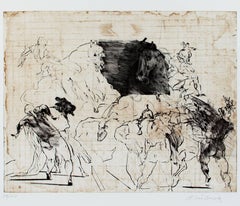
20th century drypoint etching figurative animal print horses sketch signed

20th century drypoint etching figurative animal print horses sketch signed

By Claude Weisbuch

Located in Milwaukee, WI

"Combat Equestre" is an original lithograph by Claude Weisbuch. The artist signed the piece lower right and wrote the edition number (24/100) in the lower left. This piece depicts mu...

Category

1970s Modern Eugene Delacroix Prints and Multiples

Materials

Drypoint, Etching

The glass mountain shattered David Hockney Fairy Tales from the Brothers Grimm

The glass mountain shattered David Hockney Fairy Tales from the Brothers Grimm

By David Hockney

Located in New York, NY

This etching from David Hockney’s celebrated Six Fairy Tales from the Brothers Grimm portfolio depicts the somewhat obscure story Old Rinkrank, which Hockney chose to illustrate beca...

Category

1960s Modern Eugene Delacroix Prints and Multiples

Materials

Etching, Aquatint

Girafe - Lithograph by Alberto Mastroianni - 1970s

Girafe - Lithograph by Alberto Mastroianni - 1970s

By Alberto Mastroianni

Located in Roma, IT

Lithograph on paper realized by Alberto Mastroianni in 1970s. Hand signed and numbered in pencil. Edition of 150. Good condition.

Category

1970s Contemporary Eugene Delacroix Prints and Multiples

Materials

Paper, Lithograph
Four Figures and a Head, on Giant Phallus by Claes Oldenburg erotic nude scene

Four Figures and a Head, on Giant Phallus by Claes Oldenburg erotic nude scene

By Claes Oldenburg

Located in New York, NY

This sensuous and playful scene is characteristic of Oldenburg’s printmaking ouevre: a veritable heap of women displaying various expressions of joy and come-hither coquettishness. T...

Category

1970s Modern Eugene Delacroix Prints and Multiples

Materials

Etching

Previously Available Items
Lion - Etching by Eugène Delacroix - Late 19th Century

Lion - Etching by Eugène Delacroix - Late 19th Century

By Eugène Delacroix

Located in Roma, IT

Engraving by H. Toussaint, after the painting by Eugène Delacroix.  Black and white etching on wove paper. Plate mark visible.  Image size: 16.5 × 23.5 cm (approx.) This dramatic e...

Category

Late 19th Century Modern Eugene Delacroix Prints and Multiples

Materials

Etching

Arabes d'Oran - Etching by Eugene Delacroix - 1860s

Arabes d'Oran - Etching by Eugene Delacroix - 1860s

By Eugène Delacroix

Located in Roma, IT

Arabes d'Oran is a black and White etching realized by E. Delacroix in the 1860s.  Titled in the lower. Image size: 17x21. Very good impression with wide margins and a very fresh ...

Category

1860s Modern Eugene Delacroix Prints and Multiples

Materials

Etching

Tiger Sleeping in the Desert, Impressionist Etching by Eugene Delacroix

Tiger Sleeping in the Desert, Impressionist Etching by Eugene Delacroix

By Eugène Delacroix

Located in Long Island City, NY

Eugene Delacroix, French (1798 - 1863) - Tiger Sleeping in the Desert, Year: 1846, Medium: Etching, signed in the plate, Image Size: 3 x 4.75 inches, Size: 12.5 x 17.75 in. (31.75 ...

Category

1840s Impressionist Eugene Delacroix Prints and Multiples

Materials

Etching

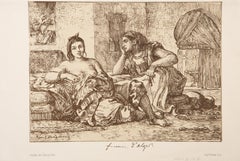
Women of Algiers (B&W), Modern Lithograph by Eugene Delacroix

Women of Algiers (B&W), Modern Lithograph by Eugene Delacroix

By Eugène Delacroix

Located in Long Island City, NY

Eugene Delacroix, French (1798 - 1863) - Women of Algiers (B&W), Year: 1838, Medium: Lithograph on Japon, Image Size: 6.25 x 8.75 inches, Size: 9.5 x 14 in. (24.13 x 35.56 cm), Pub...

Category

1830s Old Masters Eugene Delacroix Prints and Multiples

Materials

Lithograph

Women of Algiers (color), Modern Lithograph by Eugene Delacroix

Women of Algiers (color), Modern Lithograph by Eugene Delacroix

By Eugène Delacroix

Located in Long Island City, NY

Eugene Delacroix, French (1798 - 1863) - Women of Algiers (color), Year: 1838, Medium: Lithograph, Image Size: 6.25 x 8.75 inches, Size: 7.25 x 10.75 in. (18.42 x 27.31 cm), Publis...

Category

1830s Old Masters Eugene Delacroix Prints and Multiples

Materials

Lithograph

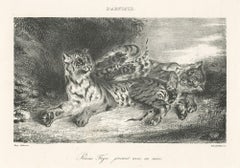
Jeune Tigre jouant avec sa mère (Young Tiger playing with its mother)

Jeune Tigre jouant avec sa mère (Young Tiger playing with its mother)

By Eugène Delacroix

Located in Middletown, NY

Lithograph on on white wove paper, 4 1/2 x 7 3/8 inches (112 x 187 mm), wide margins. First state (of 6). A very good impression with minor scattered spots of very light discoloration. [Delteil 91.1] __________ At an early age Delacroix became a lover of music and literature and had been drawing from the time he entered school.  He expected painting would be a hobby, but on the death of his father he found he had to make his own way in life.  In 1817 he entered the studio of Pierre-Narcisse Guerin; amongst his fellow pupils was Gericault.  His first exhibited work was Dante and Virgil...

Category

Mid-19th Century Barbizon School Eugene Delacroix Prints and Multiples

Materials

Handmade Paper, Lithograph
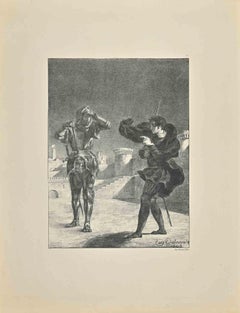
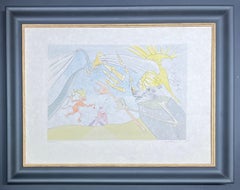
Theatrical Scene - Lithograph by Eugène Delacroix - 1843
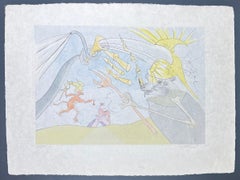
Theatrical Scene - Lithograph by Eugène Delacroix - 1843
By Eugène Delacroix

Located in Roma, IT

Theatrical Scene is an Lithograph realized after Eugène Delacroix in 1843. Good condition on a yellowed paper. Signed and dated on the lower right corner. Ferdinand Victor Eugène Delacroix French: 26 April 1798 – 13 August 1863) was a French Romantic artist regarded from the outset of his career as the leader of the French Romantic school. As a painter and muralist, Delacroix's use of expressive brushstrokes and his study of the optical effects of colour profoundly shaped the work of the Impressionists, while his passion for the exotic inspired the artists of the Symbolist movement. A fine lithographer, Delacroix illustrated various works of William Shakespeare, the Scottish author Walter Scott and the German author Johann Wolfgang von Goethe.
Category

1840s Romantic Eugene Delacroix Prints and Multiples

Materials

Lithograph

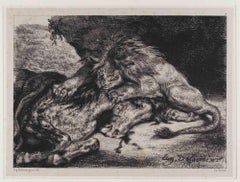
Lion Dévorant un Cheval - Original Lithograph by E. Delacroix - 1844
Lion Dévorant un Cheval - Original Lithograph by E. Delacroix - 1844
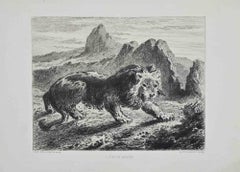
By Eugène Delacroix

Located in Roma, IT

Lion dévorant un cheval is an original modern artwork realized by Eugène Delacroix (1798 - 1863) in 1844. Original limited edition lithograph signed on plate. Dimensions: 16.9 x 23.6 cm. Very fine print on applied china, from the 4th state (out of 5), the title and date erased, before the Bertauts address and number erased. Tiny redness and dirt on the support. Full margins. Dry stamp: Contemporary Artists (Lugt 36b). Very good conditions. Eugène Delacroix (Charenton-Saint-Maurice, 1798 - 1863) was one of the leading artists of the French Romantic period in the 19th century. He received his artistic training in Paris and became known as a leading figure of the French Romantic era of the 19th century. Inspired by history, literature, and exotic locales, Delacroix painted such famous works as the "Liberty Leading the People...
Category

1840s Romantic Eugene Delacroix Prints and Multiples

Materials

Lithograph
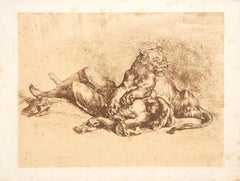
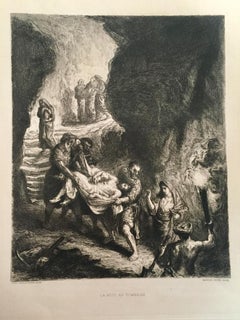
Le Mise au Tombeau - Etching by E. Delacroix - 1859

Le Mise au Tombeau - Etching by E. Delacroix - 1859

By Eugène Delacroix

Located in Roma, IT

Image dimensions: 30x24 cm. This splendid etching Le mise au tombeau was realized by Eugène Delacroix in 1859. The state of preservation of the artwork is excellent. The artwork is handsigned on the lower left. At the bottom, just below the image, the inscriptions “Le mise au tombeau” in the center, "Marcel Roux...

Category

1850s Romantic Eugene Delacroix Prints and Multiples

Materials

Lithograph
Méphistophélès Dans les Airs - Lithograph by E. Delacroix - 1828
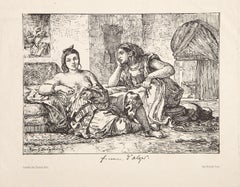
Méphistophélès Dans les Airs - Lithograph by E. Delacroix - 1828

By Eugène Delacroix

Located in Roma, IT

Méphistophélès Dans les Airs " Mephistopheles in the Air", is an original lithograph, realized by Eugène Delacroix in 1828, table 1 by Goethe's Faust illustrated by Delacroix, Editor...

Category

1820s Romantic Eugene Delacroix Prints and Multiples

Materials

Lithograph

Herminie Et Les Bergers

Herminie Et Les Bergers

By Eugène Delacroix

Located in Roma, IT

Original etching and aquatint by Eugène Delacroix named Herminie et Les Bergers. Perfect conditions. Printed by P. Fritel. It represents an episode of Torqua...

Category

1830s Modern Eugene Delacroix Prints and Multiples

Materials

Etching

Eugene Delacroix prints and multiples for sale on 1stDibs.

Find a wide variety of authentic Eugene Delacroix prints and multiples available for sale on 1stDibs. You can also browse by medium to find art by Eugene Delacroix in lithograph, paper, etching and more. Not every interior allows for large Eugene Delacroix prints and multiples, so small editions measuring 6 inches across are available. Customers who are interested in this artist might also find the work of Charles François Daubigny, Theophile Narcisse Chauvel, and Hippolyte Bellangé. Eugene Delacroix prints and multiples prices can differ depending upon medium, time period and other attributes. On 1stDibs, the price for these items starts at $133 and tops out at $10,000, while the average work can sell for $675.