Frederick Alexander Duncan Art

to
1
1
Overall Width
to
Overall Height
to
2
1
2
2
2
2
1
1
1
1
2
1
1
1
1
2
10,634
2,826
2,495
1,410
2
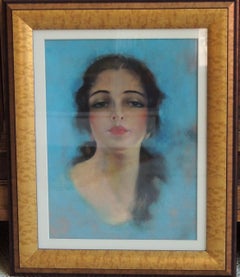
Artist: Frederick Alexander Duncan
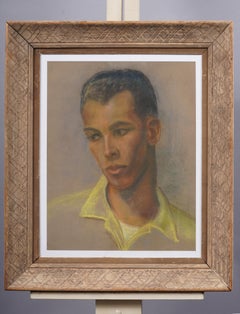
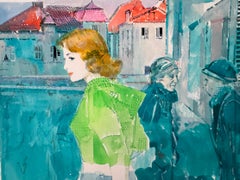
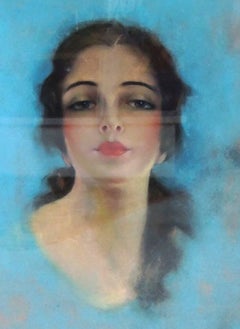
Dreaming Eyes

Dreaming Eyes

By Frederick Alexander Duncan

Located in Fort Washington, PA

Medium: Oil on Board Signature: Unsigned Calendar Illustration

Category

20th Century Frederick Alexander Duncan Art

Materials

Oil, Board

Related Items
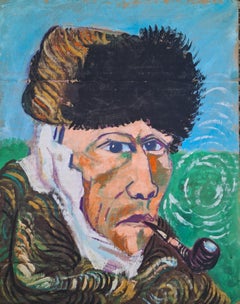
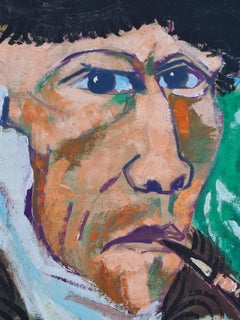
Portrait of Vincent Van Gogh with Bandaged Ear and Pipe.

Portrait of Vincent Van Gogh with Bandaged Ear and Pipe.

By (After) Vincent van Gogh

Located in Cotignac, FR

Gouache and watercolour on corrugated cardboard after the famous self portrait by Vincent van Gogh with his fur hat, bandaged ear and pipe. This painting is by Jean Ducel who has pla...

Category

Late 20th Century Frederick Alexander Duncan Art

Materials

Watercolor, Gouache, Cardboard

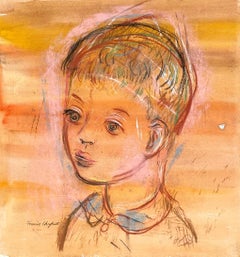
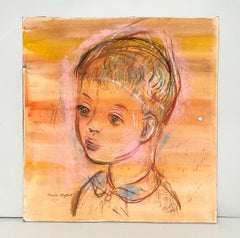
An Introspective, 1950s Mid-Century Modern Pastel Drawing of a Young Boy

An Introspective, 1950s Mid-Century Modern Pastel Drawing of a Young Boy

By Francis Chapin

Located in Chicago, IL

An introspective, 1950s Mid-Century Modern pastel drawing of a young boy by notable Chicago artist Francis Chapin. Pastel on artist board. Image size: 16 x 15 inches. (Artwork is...

Category

1950s American Modern Frederick Alexander Duncan Art

Materials

Pastel, Board

Cuban Artist  - Caricature of Adolphe Menjou Debonair Devil

Cuban Artist - Caricature of Adolphe Menjou Debonair Devil

Located in Miami, FL

Framed Cuban Artist/Caricaturist Conrado Walter Massaguer presents Hollywood star Adolphe Menjou in a satirical dual portrait. In the foreground, the subject is seen in a dapper top hat, tux, fashionable cigarette and boutonnière, and is shown as being the epitome of being stylishly debonair. To make a larger point about this subject, Massaguer paints a cast shadow of Menjou as a burning red devil who studies his alter ego from above. Keeping with the artist's sarcasm, we see the good and bad in one image. Works by Massaguer are rare and this work is in keeping with his signature style. This work was most likely done on assignment for Life Magazine, Cosmopolitan, The New Yorker or Vanity Fair. Signed upper right. Inscribe lower right. Titled on verso. Unframed, Slight bend to board; toning to board; scattered faint foxing; pin point abrasions to margins, not affecting image. 19-1/2 x 15-1/8 inches board size. Conrado Walter Massaguer y Diaz was a Cuban artist, political satirist, and magazine publisher. He is considered a student of the Art Nouveau. He was the first caricaturist in the world to broadcast his art on television.He was first caricaturist to exhibit on Fifth Avenue. He was the first caricaturist in the world to exhibit his caricatures on wood. He, and his brother Oscar, were the first magazine publishers in the world to use photolithographic printing. Self portrait of Conrado Walter Massaguer, depicted on a carrousel ride, with the devil over his left shoulder and an angel over his right. (1945) He created the magazine Social with his brother Oscar to showcase Cuban artistic talent. The duo later created the magazine Carteles, which became for a period the most popular magazine in Cuba, which was purchased by Miguel Ángel Quevedo in 1953. In his life, he met and drew caricatures of Franklin D. Roosevelt, Walt Disney, Albert Einstein, the King of Spain, and many others.[ In sum total, he was the author of more than 28 thousand caricatures and drawings.Ernest Hemingway once had to refrain himself from punching Massaguer in the face after the artist drew an unflattering caricature of him. The dictator Gerardo Machado, however, did not punch Massaguer for his own unflattering caricature - he had the artist deported. He was one of the most internationally renowned Cuban artists of his day, and his art is still regularly featured in galleries across the Western Hemisphere and Europe. Early life Massaguer was born on October 18, 1889, in Cárdenas, Cuba.[In 1892, his family moved to Havana. When the Cuban War of Independence broke out, Massaguer's family escaped the country. From 1896 to 1908, he lived in Mérida, Mexico. However, during this time, his parents enrolled him in the New York Military Academy, where he stayed during school years. In 1905, after graduating the military academy, he briefly attended the San Fernando school in Havana, where he was tutored by Ricardo de la Torriente and Leopoldo Romañach. In 1906, less than a year later, he returned to the family home in Mexico. Career as artist Early career While living in Yucatán, Mexico, Massaguer published his first caricatures in local newspapers and magazines. These included La Campana, La Arcadia, and the Diario Yucateco. In 1908, he moved back to Havana. After returning to the island in 1908, Massaguer began mingling with Havana's aristocratic circles, forming close friendships with some of the city's most powerful and influential men, as well as winning the favor of many women who were quickly charmed by him. Massaguer, largely self-taught, honed his style using the avant-garde techniques he studied from the European and American magazines that were widely available in Cuba at the time. Cover of the immensely popular Cuban magazine El Figaro, drawn by Massaguer in 1909. This cover depicts two bumbling, incompetent American tourists to the island. He started drawing for El Fígaro, and was featured prominently on the cover in 1909. After two years of refining his craft, Havana announced a poster contest aimed at attracting North American tourists to stay in the city during the winter months. Notable figures like Leopoldo Romañach, Armando Menocal, Rodríguez Morey, Jaime Valls, and others also entered the competition. The jury was particularly impressed by the modern execution and creative solution of one piece, signed by Massaguer, who was relatively unknown at the time. The jury deliberations caused a great controversy.[5] The prize was ultimately awarded to the Galician painter Mariano Miguel, who had recently married the daughter of Nicolás Rivero, the wealthy owner of the conservative newspaper Diario de la Marina. Although Massaguer received only an honorable mention, the fraud scandal caused such an uproar that his name quickly entered the public spotlight, and he became an overnight sensation. In 1910, he became co-owner of the advertising agency Mercurio, with Laureano Rodríguez Castells. At Mercurio, he led the Susini cigar campaign, and earned substantial wealth. Massaguer has been described as a restless man, in both mind and body.After earning enough money from his art to begin traveling, he was almost always doing so. He constantly traveled between New York City and Havana, Mexico and France, Europe and the Americas. In 1911, his reputation among the Havana socialites solidified when he organized his own first public caricature exhibit, and also the first Caricature Salon ever held in the Americas, hosted at Athenaeum of Havana (the Ateneo), and the Círculo de La Habana. Other exhibitors here included Maribona, Riverón, Portell Vilá, Valer, Botet, Barsó, García Cabrera, Carlos Fernández, Rafael Blanco, and Hamilton de Grau. "Messaguer Visits Broadway." Caricatures of theatrical and literary figures. Elsie Janis, Raymond Hitchcock, S. Jay Kaufman (columnist), Ibanez, author of The Four Horsemen, and Frances White In 1912, in the New York American Journal, he published his first Broadway drawings. From 1913 to 1918, he was an editor for Gráfico. Social Main article: Social (magazine) Cover of the magazine Social, July 7, 1923 In 1916, he created the magazine Social with his brother, Oscar H. Massaguer. Social's contributors included Guillén Carpentier, Chacón y Calvo, Enrique José Varona and others.Social has been described as Massaguer's great love in the magazine industry, and was the property that historians say he cared the most about. Social was an innovative magazine, being the first magazine in the world to use a modern printing process called photolithographic printing. Social set cultural trends, not only in the fashion of Cuba, but in art, politics, and Cuban identity.[11] Social catered to a certain aesthetic in Cuba - that of the sophisticated elite socialite - but Massaguer would also use this magazine to ridicule and jibe against that same class of society when he found their personalities worthy of his contempt. In Social, readers could find a variety of content, including short stories, avant-garde poetry, art reviews, philosophical essays, and serialized novels, as well as articles on interior design, haute couture, and fashion. Occasionally, the magazine also featured reports on sports such as motor racing, rowing, tennis, and horse riding.The cultural promotion efforts of both Massaguer and Emilio Roig de Leuchsenring are evident in the magazine. Notably, this period overlaps with their involvement in the Minorista Group, which was then at the forefront of the country's intellectual life.[5] Many contributors were devoted members of the group, leading some experts to consider Social as the cultural voice of the Minoristas. One of the features of Social magazine was its section called "Massa Girls," which was a play on his own name, and pronounced with a glottal 'g' in a similar fashion to the letter in Massaguer.[12] Massaguer drew women as independent and free-thinking, and never drew the woman celebrity as a caricature of herself, but as a free agent surrounded by caricatures.[11] However, Massaguer himself has been described as a womanizer in his personal life, and hesitant to fully embrace every facet of women's liberation. In 1916, he also established la Unión de Artes Gráficas and the advertising agency Kesevén Anuncios.[9] The art critic Bernardo González Barroa wrote: “Massaguer has solved the problem of working hard, living comfortably off what his art produces and not missing any artistic, sporting or social event. His broad, childish laugh, of a carefree individual who carries his luck hidden in a pocket, appears everywhere for the moment, disguising the pranks of pupils that lurk, mock and, finally, flash with satisfaction at finding the characteristic point after having analyzed a soul... Massaguer's personality is beginning to solidify now. He has been the best-known and most popular caricaturist for a long time, but his technique had not reached the security, the mastery of values that he presents in his latest works, which is very natural and explainable”[5] Carteles Main article: Carteles Cover of the magazine Carteles, November 29, 1931 In 1919, Massaguer and his brother created the magazine Carteles.[9] Carteles gained the widest circulation of any magazine in Latin America, and the most popular magazine in Cuba for a time, until that title was claimed by Revista Bohemia. Carteles remained in print until July 1960.This magazine showcased Cuban commerce, art, sports, and social life before the revolution. In 1924, Carteles took a more political turn, with articles criticizing Gerardo Machado's government. it became a prime example of the humor and graphic design employed by artists like Horacio Rodríguez Suria and Andrés García...

Category

1930s Art Nouveau Frederick Alexander Duncan Art

Materials

Ink, Watercolor, Illustration Board

Rosalee Sondheimer I

Rosalee Sondheimer I

By Winold Reiss

Located in New York, NY

Winold Reiss (1886-1953), who scholars increasingly recognize as a pivotal figure in early 20th-century American art, is known for his evocative portraits that capture the spirit and...

Category

20th Century American Modern Frederick Alexander Duncan Art

Materials

Pastel, Board

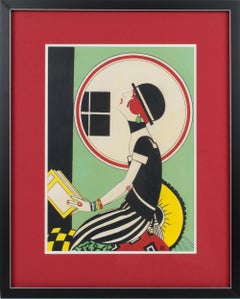
Harper's Bazaar Mid Century Fashion Illustration, Watercolor on Board

Harper's Bazaar Mid Century Fashion Illustration, Watercolor on Board

Located in Miami, FL

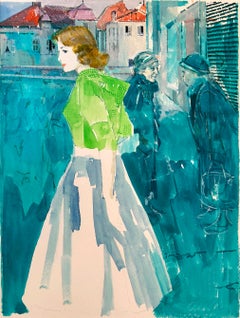
The present work, Harper's Bazaar Mid Century Fashion Illustration, was done on assignment, most likely for a major women's magazine, such as Harper's Bazaar, Vogue, or Cosmopolitan ...

Category

1950s Impressionist Frederick Alexander Duncan Art

Materials

Watercolor, Illustration Board, Pencil

“Listen to Time”
“Listen to Time”

Iryna Rets“Listen to Time”, 2025

$346

H 16.34 in W 9.65 in D 0.2 in

“Listen to Time”

Located in Zofingen, AG

A monochrome minimalist portrait in a restrained palette. The white face, resembling a mask, is immersed in music, dissolving into time. Simple yet expressive brushstrokes create a s...

Category

2010s Abstract Frederick Alexander Duncan Art

Materials

Acrylic, Cardboard

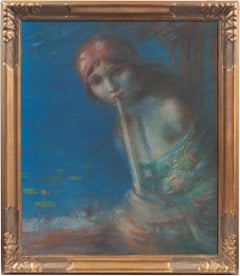
'Gypsy Flute Player', Royal Academy, NY World's Fair, Pasadena, GGIE, Romany

'Gypsy Flute Player', Royal Academy, NY World's Fair, Pasadena, GGIE, Romany

By Aage Christian Wiboltt

Located in Santa Cruz, CA

Signed lower left, 'A. C. Wiboltt' for Aage Christian (Jack) Wiboltt (Danish-American, 1894-1952) and created circa 1925. Framed dimensions: 33.25 x 1.5 x 28 inches A substantial, e...

Category

1920s Frederick Alexander Duncan Art

Materials

Pastel, Cardboard

Portrait - Original Mixed Media Artwork by Maurice Lourday - 1927

Portrait - Original Mixed Media Artwork by Maurice Lourday - 1927

Located in Roma, IT

Portrait is an original pencil, pastel and watercolor drawing on creamy cardboard, realized in 1927 by Maurice Lourday (1860-1934). Titled on the lower. In very good conditions, ex...

Category

1920s Contemporary Frederick Alexander Duncan Art

Materials

Pencil, Pastel, Watercolor, Cardboard

Frederick Alexander Duncan art for sale on 1stDibs.

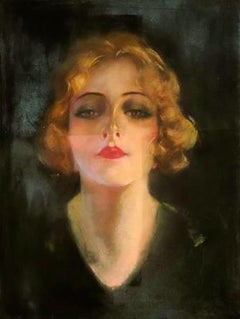
Find a wide variety of authentic Frederick Alexander Duncan art available for sale on 1stDibs. If you’re browsing the collection of art to introduce a pop of color in a neutral corner of your living room or bedroom, you can find work that includes elements of blue and other colors. You can also browse by medium to find art by Frederick Alexander Duncan in board, crayon, oil paint and more. Not every interior allows for large Frederick Alexander Duncan art, so small editions measuring 14 inches across are available. Customers who are interested in this artist might also find the work of Robert Philipp, Robert Hallowell, and Thelma Terrell. Frederick Alexander Duncan art prices can differ depending upon medium, time period and other attributes. On 1stDibs, the price for these items starts at $2,400 and tops out at $2,400, while the average work can sell for $2,400.
Artists Similar to Frederick Alexander Duncan