Jean Leon Gerome Ferris Art

American, 1863-1930

Jean Leon Gerome Ferris was an American painter best known for his series of 78 scenes from American history, entitled The Pageant of a Nation, the largest series of American historical paintings by a single artist. He was born in Philadelphia, Pennsylvania, on August 18, 1863, as the son of Stephen James Ferris, a portrait painter who was a devotee of Jean-Léon Gérôme (after whom he was named) and also an admirer of Mariano Fortuny. He grew up around art, having been trained by his father and having two acclaimed painters, Edward Moran and Thomas Moran, as uncles. Ferris enrolled in the Pennsylvania Academy of the Fine Arts in 1879 and trained further at the Académie Julian beginning in 1883 under William-Adolphe Bouguereau. He also met his namesake Jean-Léon Gérôme, who greatly influenced Ferris's decision to paint scenes from American history. As Ferris wrote in his unpublished autobiography, “Gérôme's axiom was that one would paint best that with which he is most familiar." His early subjects were Orientalist in nature, that movement having been in vogue when he was young. Some of his material was original, some of it took after Fortuny, but he was skilled enough, despite never having had any experience with art. In 1882, he exhibited a painting entitled Feeding the Ibis, which was valued at $600. By 1895, Ferris had gained a reputation as a historical painter and he embarked on his dream of creating a series of paintings that told a historical narrative. In 1898, he sold one of these, General Howe's Levee, 1777, but he later regretted it, realizing that such a series could not be complete if the separate paintings could not be kept together. Ferris, who had married Annette Amelia Ryder in 1894 and with whom he had a daughter named Elizabeth Mary, died in Philadelphia on March 18, 1930.

to
1
1
1
Overall Width
to
Overall Height
to
2
2
2
2
2
1
1
1
1
1
1
1
2
11,049
2,853
2,494
1,431
1
2
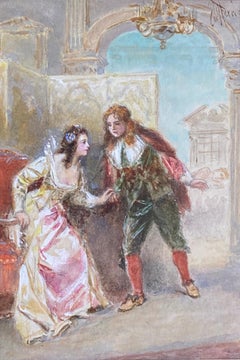
Artist: Jean Leon Gerome Ferris
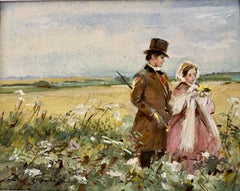
“A Page of Love”
“A Page of Love”

“A Page of Love”

By Jean Leon Gerome Ferris

Located in Southampton, NY

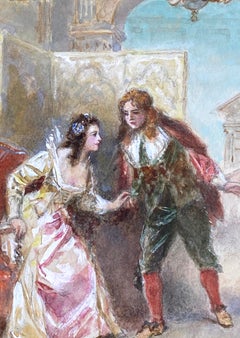
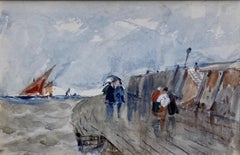
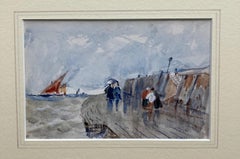
Here is a wonderful original watercolor and gouache depicting a scene from Emile Zola book “A Page of Love” by the American artist, Jean Leon Gerome Ferris....

Category

1890s Victorian Jean Leon Gerome Ferris Art

Materials

Watercolor, Gouache, Archival Paper

Related Items
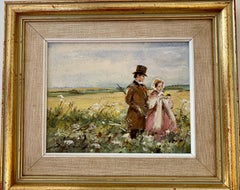
Courtship,  British Couple walking in a landscape in Edwardian dress

Courtship, British Couple walking in a landscape in Edwardian dress

By John Strickland Goodall

Located in Woodbury, CT

John Strickland Goodall John Strickland Goodall was born in Heacham, Norfolk on 7 June 1908. He was the son of a famous heart specialist whose boasted seven generations of medics, a...

Category

1980s Victorian Jean Leon Gerome Ferris Art

Materials

Paper, Gouache

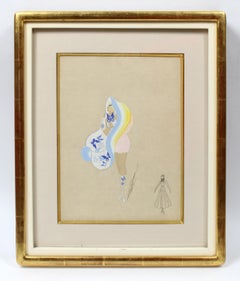
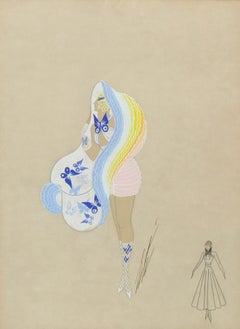
1910's Art Deco Erte Gouache Painting Original Hand Signed Rare French Costume

1910's Art Deco Erte Gouache Painting Original Hand Signed Rare French Costume

By Erté

Located in Buffalo, NY

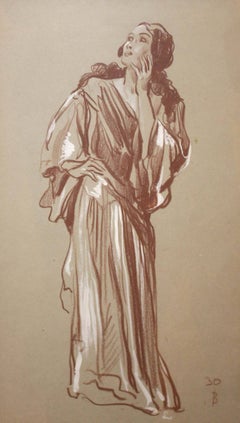
A rare original signed Art Deco gouache on paper by Erte (Romain de Tirtoff) . This stunning theatrical costume design is signed Erte at the lower right. The piece is 20 by 18 fram...

Category

1910s Art Deco Jean Leon Gerome Ferris Art

Materials

Gouache, Archival Paper, Pencil

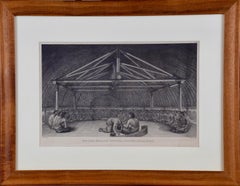
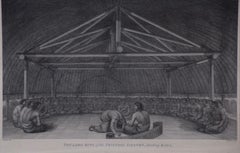
"King of the Friendly Islands" (Tonga); Engraving from Captain Cook's 3rd Voyage

"King of the Friendly Islands" (Tonga); Engraving from Captain Cook's 3rd Voyage

By John Webber

Located in Alamo, CA

"Poulaho, King of the Friendly Islands, Drinking Kava" is an engraving created by William Sharp (1749-1824), from a drawing by John Webber (1752-1793), who was the artist on Captain James Cook's 3rd and final voyage of discovery. It was published in the atlas of "A Voyage to the Pacific Ocean Undertaken by the Command of His Majesty, for Making Discoveries in the Northern Hemisphere", the official British Admirality sanctioned journal published upon completion of the voyage in London in 1784 by Strahan & Cadell. Captain Cook visited Tonga on his 3rd voyage, which he named The Friendly Islands because of the warm welcome he and his crew received, unlike some of the other more hostile Pacific islands. The engraving depicts Cook and his men observed a kava ceremony at the village of Mu’a on Tongatapu. King Paulaho sits in the centre foreground, his back to the spectator with a man kneeling before him. The ceremonial mat depicted behind Paulaho indicates that nobody was allowed to sit behind him. The figure in the centre holds a single cup, referring to the Tongan custom of offering the cup to the king first. Kava is native to the islands of the South Pacific and was first described for English readers in 1768 by Captain James Cook. The kava root has been used for centuries as a central feature of ceremonies and celebrations because it was able to bring about a calming and pleasant social atmosphere. The root was crushed and processed into coconut milk to become the focal ceremonial beverage, simply referred to as kava. This engraving is presented in a Koa wood frame and a white mat. Koa wood is legendary in Hawaii. There are occasional faint spots, but the print is otherwise in very good condition. This amazing Koa wood is native to Hawaii and it is known for the deep rich colors and varied grain pattern. Koa has an honored heritage in Hawaii and is highly revered and sacred. The word “koa” means “warrior” in Hawaiian. The warriors of King Kamehameha the Great, created canoes and weapons from a wood plentiful on the Big Island of Hawaii. This wood became synonymous with the warriors themselves, and it became known as koa. There are three other engravings listed from the official journal of Captain Cook's 3rd voyage available that are presented in identical Koa wood frames and mats (LU117324682422, LU117324684052, LU117324684032). They would make a wonderful grouping for a display of 2, 3 or 4 prints. A discount is available for a grouping depending on the number of items included. Captain Cook is remembered as one of the greatest explorers and navigators in history. His explorations included Australia, New Zealand and islands of the South Pacific and the northwest coast of North America. Hawaii was discovered by Captain Cook during this voyage. Hawaii was originally called The Sandwich Islands in honor of The Earl of Sandwich...

Category

1780s Realist Jean Leon Gerome Ferris Art

Materials

Engraving

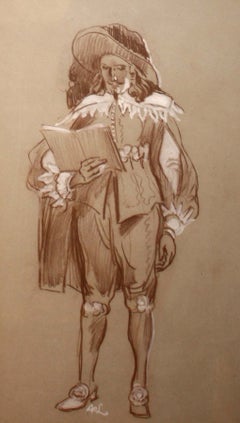
Theater Sketch 2

Theater Sketch 2

By Alexander Oscar Levy

Located in Buffalo, NY

Alexander O. Levy was a painter, illustrator, printmaker and designer who was born in 1881 in Bonn, Germany. He died in 1946 in Buffalo, New York. At age three, he was brought to ...

Category

1930s Art Deco Jean Leon Gerome Ferris Art

Materials

Archival Paper, Charcoal, Gouache

"Waiting for Rehearsal"

"Waiting for Rehearsal"

By Paul Cadmus

Located in Astoria, NY

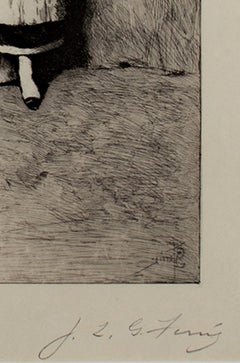
Paul Cadmus (American, 1904-1999), "Waiting for Rehearsal", Etching, 1984, signed in pencil lower right, titled and numbered edition "140/175" lower left, and blind stamped "Pelavin ...

Category

1980s Modern Jean Leon Gerome Ferris Art

Materials

Etching

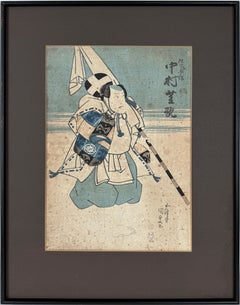
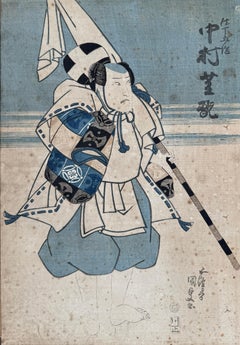
Kabuki actor Nakamura Shikan II by Utagawa Kunisada Edo Japanese Woodblock Print

Kabuki actor Nakamura Shikan II by Utagawa Kunisada Edo Japanese Woodblock Print

By Utagawa Kunisada (Toyokuni III)

Located in Soquel, CA

Kabuki actor Nakamura Shikan II by Utagawa Kunisada Japanese Woodblock Print Wonderful portrait of Nakamura Shikan II, a prominent kabuki actor, in the role of Kisen Hoshi Toyokuni ...

Category

1820s Realist Jean Leon Gerome Ferris Art

Materials

Printer's Ink, Rice Paper, Woodcut

G. Paterson "Dinner Party at a Mandarin's House" Engraving After T. Allom c.1840

G. Paterson "Dinner Party at a Mandarin's House" Engraving After T. Allom c.1840

Located in San Francisco, CA

G. Paterson "Dinner Party at a Mandarin's House" Original Engraving After T. Allom C.1840 Original engraving Dimensions 8" wide x 5" high The frame measures 20.5" wide x 18.5" hig...

Category

Mid-19th Century Realist Jean Leon Gerome Ferris Art

Materials

Engraving

Two 1890s Young Women Wading at the Beach

Two 1890s Young Women Wading at the Beach

Located in San Francisco, CA

A woman must remain fashionable, even when at the beach. This late 19th-century gouache and watercolor piece, likely created between 1885 and 1900, depicts two lively young women in ...

Category

Late 19th Century Victorian Jean Leon Gerome Ferris Art

Materials

Wood, Paint, Paper, Gouache

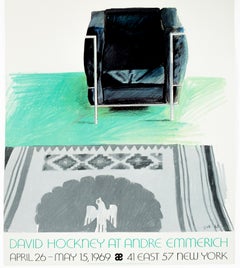
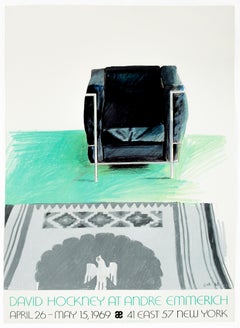
Vintage Le Corbusier '69 David Hockney Exhibition Poster Kilim southwest rug

Vintage Le Corbusier '69 David Hockney Exhibition Poster Kilim southwest rug

By David Hockney

Located in New York, NY

Shading in bright turquoise above a Southwestern style thunderbird Kilim rug adorns this original exhibition poster for David Hockney's 1969 show at Andre Emmerich, New York. This po...

Category

1960s Realist Jean Leon Gerome Ferris Art

Materials

Lithograph

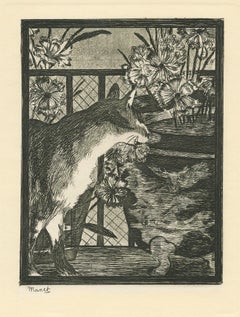
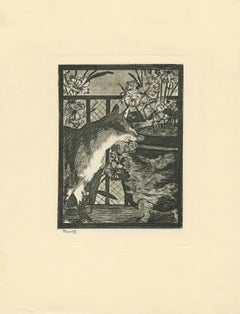
Le Chat et Les Fleurs

Le Chat et Les Fleurs

By Édouard Manet

Located in Middletown, NY

Etching and aquatint on cream laid, watermarked Rives paper. 6 5/8 x 5 inches (167 x 126 mm). Sixth and final state, a posthumous impression. A fine, inky impression with full margin...

Category

1860s Realist Jean Leon Gerome Ferris Art

Materials

Etching, Aquatint

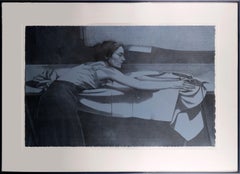
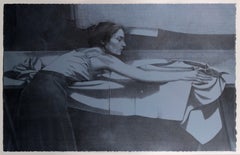
Interiors VII: The Train from Munich

Interiors VII: The Train from Munich

By Peter Milton

Located in Middletown, NY

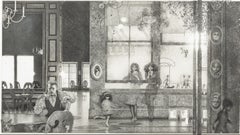
Interiors VII: The Train from Munich Robert E. Townsend, 1991. Resist ground etching and engraving with hand refinement in charcoal, pencil, stabilo, and eraser on BFK Rives white wove paper, 20 x 36 inches (507 x 914 mm), full margins. Signed, titled, dated and numbered 51/175 by the artist in pencil, lower margin. A brilliant, inky impression with luminous light and gradient tones. In excellent condition with one extremely minor and superficial spot of light tan adhesive residue on the verso, unobtrusive and not visible on the recto, with no other visible defects. With the blind stamp of the printer, Robert E. Townsend in the lower left margin. An especially fine impression in superb condition. [Milton 113]. When asked about this work in particular, Milton expressed that his favorite images were his darkest images, in theme, mood, and in ink. Milton, who has said that his work is infused with a postmodern awareness of the past, has focused here in a deeply personal way on a segment of history that continues to haunt us all. The work, published in 1991, evokes one of the darkest periods of European history, the eroding and erasing of European culture under fascism, and the eventual total loss of humanity. The Train from Munich is an especially relevant and emotional work for Milton, who created the piece for his wife, Edith, who escaped Munich in 1939 as a child on the fabled Kinderstransport. The Kinderstransport was a desperate rescue effort on the part of the British government to save as many Jewish children as possible by railway before borders closed on the precipice of the Second World War. Children left their parents behind, and boarded the trains alone, leaving the impending doom of Nazi Germany, they arrived in Great Britain as refugees. More than 10,000 children escaped the holocaust via the Kinderstransport. In Train from Munich, the image itself holds an almost immeasurable amount of symbolism; each inch of the matrix is a successful effort to confront this history in a way that is poignant through a series of motifs. We see the Café disappearing into a ghostlike memory of the past, an allegory to the disintegration of culture, while through the windows we can see a rampant, snarling dog; a portrait of Hitler's shepherd, Blondi. Blondi isn't the only notable figure in the composition. Milton has pointed out that the fading figure of the doorman at the Hotel Metropole is modeled after the artist and intellectual Marcel Duchamp, and the face of the young girl peering...

Category

1990s American Modern Jean Leon Gerome Ferris Art

Materials

Charcoal, ABS, Engraving, Etching
Jan Oytenbogaert
Jan Oytenbogaert

Rembrandt van RijnJan Oytenbogaert, 1639

$950

H 25.25 in W 24 in D 1 in

Jan Oytenbogaert

By Rembrandt van Rijn

Located in San Francisco, CA

This artwork titled Jan Uytenbogaert" 1639 is an etching on paper After Rembrandt Van Rijn, 1606-1669, plate engraved By French renown engraver Charles Armand Durand, 1831-1905. Sign...

Category

17th Century Realist Jean Leon Gerome Ferris Art

Materials

Etching

Jean Leon Gerome Ferris art for sale on 1stDibs.

Find a wide variety of authentic Jean Leon Gerome Ferris art available for sale on 1stDibs. You can also browse by medium to find art by Jean Leon Gerome Ferris in archival paper, etching, gouache and more. Not every interior allows for large Jean Leon Gerome Ferris art, so small editions measuring 4 inches across are available. Customers who are interested in this artist might also find the work of Antoine Calbet, Margaret Sweet Johnson, and Anne Muntges. Jean Leon Gerome Ferris art prices can differ depending upon medium, time period and other attributes. On 1stDibs, the price for these items starts at $1,050 and tops out at $1,250, while the average work can sell for $1,150.

Artists Similar to Jean Leon Gerome Ferris