Marcel Gaillard Prints and Multiples

to
2
Overall Width
to
Overall Height
to
1
2
1,257
977
904
868
2
1
1
1
1
1
1
1
1
1
1
1
Artist: Marcel Gaillard
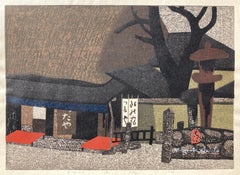
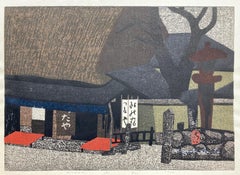
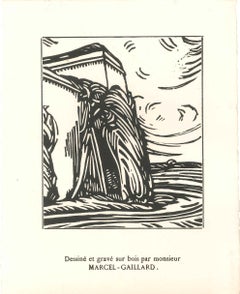
Desert - Original Woodcut by Marcel Gaillard - 1918

Desert - Original Woodcut by Marcel Gaillard - 1918

By Marcel Gaillard

Located in Roma, IT

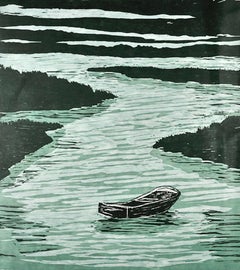
Desert is a beautiful black and white xylograph on ivory colored paper, by the French landscapist Marcel Gaillard (1886 -1947). This original print, representing an oriental buildin...

Category

1910s Modern Marcel Gaillard Prints and Multiples

Materials

Woodcut
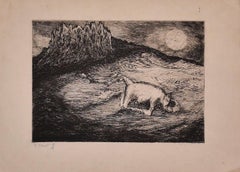
Frog - Original Etching on Paper by Marcel Gaillard - 1950s

Frog - Original Etching on Paper by Marcel Gaillard - 1950s

By Marcel Gaillard

Located in Roma, IT

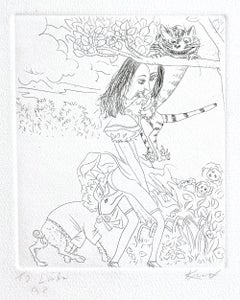
Frog is an original etching on paper by Marcel Gaillard. The state of preservation of the artwork is good. Numbered on the lower left 1/1. Sheet dimension : 28 x 38 cm. The artwo...

Category

1950s Marcel Gaillard Prints and Multiples

Materials

Etching

Related Items
Leda and the Swan

Leda and the Swan

By Albert Decaris

Located in West Hollywood, CA

Presenting a monumental original etching by French artist Albert Decaris. Decaris won many honors in France during his extensive career. "Leda and the Swan", depicts the mythologi...

Category

1920s Marcel Gaillard Prints and Multiples

Materials

Etching

Wassily Kandinsky - Horse Knight - Original Etching

Wassily Kandinsky - Horse Knight - Original Etching

By Wassily Kandinsky

Located in Collonge Bellerive, Geneve, CH

Wassily Kandinsky - Horse Knight - Original Etching 32 x 24 cm 1966 From the art review XXe siècle, San Lazzaro Unsigned and unumbered as issued

Category

1960s Abstract Geometric Marcel Gaillard Prints and Multiples

Materials

Etching

Leonor Fini - Cats - Original Etching

Leonor FiniLeonor Fini - Cats - Original Etching, 1985

$1,435

H 17.33 in W 11.03 in D 0.04 in

Leonor Fini - Cats - Original Etching

By Leonor Fini

Located in Collonge Bellerive, Geneve, CH

Leonor Fini - Cats - Original Engraving Mme.Helvetius' Cats Original etching created in 1985, Printed Signature (LF). Conditions: excellent Edition: 100 Support: Arches paper. Dimensions: Paper dimensions: 44 x 28 cm Editions: Moret, Paris. Leonor Fini is considered one of the most important women artists of the mid-twentieth century, along with Leonora Carrington, Frida Kahlo, Meret Oppenheim, Remedios Varo, and Dorothea Tanning – most of whom Fini knew well. Her career, which spanned some six decades, included painting, graphic design, book illustration, product design (the renowned torso-shaped perfume bottle for Schiaparelli’s Shocking), and set and costume design for theatre, ballet, opera, and film. In this compellingly readable, exhaustively researched account, author Peter Webb brings Fini’s provocative art and unconventional personal life, as well as the vibrant avant-garde world in which she revolved, vividly in life. Born in Buenos Aires in 1907 (August 30 – January 18, 1996, Paris) to Italian and Argentine parents, Leonor grew up in Trieste, Italy, raised by her strong-willed, independent mother, Malvina. She was a virtually self-taught artist, learing anatomy directly from studying cadavers in the local morgue and absorbing composition and technique from the Old Masters through books and visits to museums. Fini’s fledging attempts at painting in Trieste let her to Milan, where she participated in her first group exhibition in 1929, and then to Paris in 1931. Her vivacious personality and flamboyant attire instantly garnered her a spotlight in the Parisian art world and she soon developed close relationships with the leading surrealist writers and painters, including Paul Eluard, Salvador Dali, Man Ray, and Max Ernst, who became her lover for a time. The only surrealist she could not abide because of his misogyny was André Breton. Although she repeatedly exhibited with them, she never considered herself a surrealist. The American dealer Julien Levy, very much impressed by Fini’s painting and smitten by her eccentric charms, invited her to New York in 1936, where she took part in a joint gallery exhibition with Max Ernst and met many American surrealists, including Joseph Cornell and Pavel Tchelitchew. Her work was included in MoMA’s pivotal Fantastic Art, Dada and Surrealism exhibition, along with De Chirico, Dali, Ernst, and Yves Tanguy. In 1939 in Paris she curated an exhibition of surrealist furniture for her childhood friend Leo Castelli for the opening of his first gallery. Introductions to her exhibition catalogues were written by De Chirico, Ernst, and Jean Cocteau. A predominant theme of Fini’s art is the complex relationship between the sexes, primarily the interplay between the dominant female and the passive, androgynous male. In many of her most powerful works, the female takes the form of a sphinx, often with the face of the artist. Fini was also an accomplished portraitist; among her subjects were Stanislao Lepri...

Category

1980s Modern Marcel Gaillard Prints and Multiples

Materials

Etching

Salvador Dali - Corrida - Vintage Poster with Etching

Salvador Dali - Corrida - Vintage Poster with Etching

By Salvador Dalí­

Located in Collonge Bellerive, Geneve, CH

Salvador Dali - Corrida - Vintage Poster with Etching Etching made behind a menu in Restautant Duran as a tribute dinner to Salvador Dali and his wife Ga...

Category

1960s Surrealist Marcel Gaillard Prints and Multiples

Materials

Etching

'Taos Placita' — American Southwest Regionalist Masterwork

'Taos Placita' — American Southwest Regionalist Masterwork

By Gustave Baumann

Located in Myrtle Beach, SC

Gustave Baumann, 'Taos Placita', color woodcut, 1947, edition 125. Baumann 132. Signed, titled, and numbered '20-125' in pencil; with the artist’s Hand-in-Heart chop. A superb, richly-inked impression, with fresh colors, on fibrous oatmeal wove paper; the full sheet with margins (2 to 3 1/8 inches); slight rippling at the left sheet edge, in excellent condition. Matted to museum standards, unframed. Image size 9 5/8 x 11 1/4 inches (244 x 286 mm); sheet size 13 1/4 x 17 inches (337 x 432 mm). Collections: Harwood Museum of Art, New Mexico Museum of Art, Phoenix Art Museum, Scottsdale Art Museum, Wichita Art Museum. ABOUT THE ARTIST Gustave Baumann (1881-1971) was a renowned printmaker and a leading figure of the American color woodcut revival whose exquisite craftsmanship and vibrant imagery captured the essence of the Southwest. "A brilliant printmaker, Baumann brought to the medium a full mastery of the craft of woodworking that he acquired from his father, a German cabinetmaker. This craftsmanship was coupled with a strong artistic training that resulted in the handsome objects we see in the exhibition today. After discovering New Mexico in 1918, Baumann began to explore in his woodblock prints of this period the light. color, and architectural forms of that landscape. His prints of this period are among the most beautiful and poetic images of the American West." —Lewis I. Sharp, Director, Denver Art Museum Baumann, the son of a craftsman, immigrated to the United States from Germany with his family when he was ten, settling in Chicago. From 1897 to 1904, he studied in the evenings at the Art Institute of Chicago, working in a commercial printmaking shop during the day. In 1905, he returned to Germany to attend the Kunstwerbe Schule in Munich, where he decided on a career in printmaking. He returned to Chicago in 1906 and worked for a few years as a graphic designer of labels. Baumann made his first prints in 1909 and exhibited them at the Art Institute of Chicago the following year. In 1910, he moved to the artists’ colony in Nashville, Indiana, where he explored the creative and commercial possibilities of a career as a printmaker. In 1915, he exhibited his color woodcuts at the Panama-Pacific International Exposition in San Francisco, winning the gold medal. Among Baumann’s ongoing commercial activities was his work for the Packard Motor Car Company from 1914 to 1920 where he produced designs, illustrations, and color woodcuts until 1923. In 1919, Baumann’s printmaking work dominated the important exhibition of American color woodcuts at the Detroit Institute of Arts. Twenty-six of his prints were included, far more than the works of any other artist. A set of his blocks, a preparatory drawing, and seven progressive proofs complemented the exhibition. That same year, Baumann worked in New York and, over the summer, in Provincetown, Massachusetts. His airy images of Cape Cod employed soft, pastel colors and occasionally showed the influence of the white-line woodcut technique. Many of his Chicago artist friends had traveled to the southwest, and Baumann became intrigued by their paintings, souvenirs, and stories of an exotic place named Taos, New Mexico. In the summer of 1918, he spent the summer in Taos sketching and painting before visiting Santa Fe. Paul Walter, the director of the Museum of New Mexico, offered him a studio in the museum's basement. Inspired by the rugged beauty of the Southwest—the vibrant colors and dramatic landscapes of the region became a central theme in his work, influencing his artistic style and subject matter for the remainder of his career. Later in the decade, he traveled to the West Coast and made prints of California landscape. Baumann's prints became synonymous with the Southwest, capturing the spirit of its place in America's identity with a unique sense of authenticity and reverence. His iconic images of desert vistas, pueblo villages, and indigenous cultures served as visual tributes to the region's rich cultural heritage, earning him a dedicated following among collectors and curators alike. A true craftsman and artist, Baumann completed every step of the printmaking process himself, cutting each block, mixing the inks, and printing every impression on the handmade paper he selected. His dedication to true craftsmanship and his commitment to preserving the integrity of his artistic vision earned him widespread acclaim and recognition within the art world. About the vibrant colors he produced, Baumann stated, “A knowledge of color needs to be acquired since they don’t all behave the same way when ground or mixed...careful chemistry goes into the making of colors, with meticulous testing for permanence. While complicated formulae evolve new colors, those derived from Earth and metal bases are still the most reliable.” In the 1930s, Baumann became interested in puppet theater. He designed and carved his own marionettes and established a little traveling company. From 1943 to 1945, the artist carved an altarpiece for the Episcopal Church of the Holy Faith in Santa Fe. In 1952, a retrospective exhibition of his prints was mounted at the New Mexico Museum of Fine Arts. Throughout his prolific career, Baumann executed nearly four hundred color woodcuts. Baumann’s woodcuts...

Category

1940s American Modern Marcel Gaillard Prints and Multiples

Materials

Woodcut
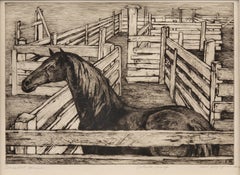
Three leaves (taro) - Landscape Print - Woodcut Print By Marc Zimmerman

Three leaves (taro) - Landscape Print - Woodcut Print By Marc Zimmerman

By Marc Zimmerman

Located in Carmel, CA

Minimal image in black ink on buff rice paper. Taro leaves are a simple form inspiring this woodcut print. Three leaves (taro) - Landscape Print - Woodcut Print By Marc Zimmerman T...

Category

2010s American Modern Marcel Gaillard Prints and Multiples

Materials

Woodcut
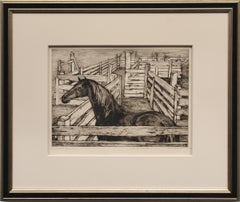
Stevan Dohanos, Backyard

Stevan Dohanos, Backyard

By Stevan Dohanos

Located in New York, NY

Stevan Dohanos was an accomplished draftsman who work was widely known through the Saturday Evening Post. This print 'Backyard,' however, leaves aside the illustrative magazine work ...

Category

1930s American Modern Marcel Gaillard Prints and Multiples

Materials

Woodcut
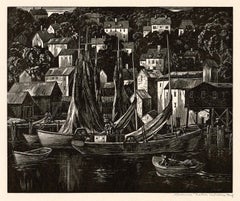
Werner Drewes, Winter, 1933, modernist woodcut

Werner Drewes, Winter, 1933, modernist woodcut

By Werner Drewes

Located in New York, NY

A modernist fantasy winter scene created by Werner Drewes, this print brings key aspects of the period together. His cubist-inspired woodcut technique is utilized here to bring the s...

Category

1930s American Modern Marcel Gaillard Prints and Multiples

Materials

Woodcut
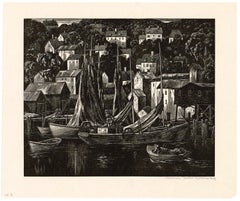
'Hill' — American Modernism, California

'Hill' — American Modernism, California

By Paul Landacre

Located in Myrtle Beach, SC

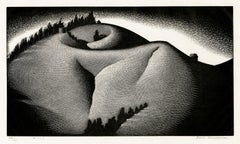
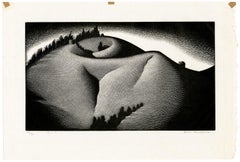
Paul Landacre, 'Hill', wood engraving, 1936, edition 60 (only 54 printed); only 2 impressions printed in a second edition of 150. Signed, titled, and numbered '49/60' in pencil. Wien...

Category

1930s American Modern Marcel Gaillard Prints and Multiples

Materials

Woodcut
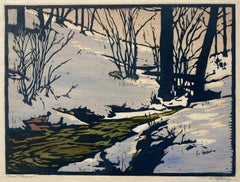
Modern American Industrial Landscape

Modern American Industrial Landscape

Located in Buffalo, NY

An original woodblock print dated 1965, titled "Our Town" but signed illegibly.

Category

1960s American Modern Marcel Gaillard Prints and Multiples

Materials

Paper, Woodcut

Marcel Gaillard prints and multiples for sale on 1stDibs.

Find a wide variety of authentic Marcel Gaillard prints and multiples available for sale on 1stDibs. You can also browse by medium to find art by Marcel Gaillard in etching, woodcut print and more. Much of the original work by this artist or collective was created during the 20th century and is mostly associated with the modern style. Not every interior allows for large Marcel Gaillard prints and multiples, so small editions measuring 7 inches across are available. Customers who are interested in this artist might also find the work of Léopold Lévy, Giselle Halff, and Claude Hemeret. Marcel Gaillard prints and multiples prices can differ depending upon medium, time period and other attributes. On 1stDibs, the price for these items starts at $178 and tops out at $223, while the average work can sell for $201.