Mark Catesby Prints and Multiples

English, 1682-1749
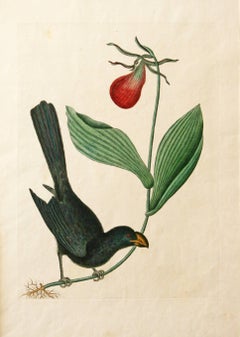
Mark Catesby (24 March 1683 – 23 December 1749) was an English naturalist. Between 1729 and 1747 Catesby published his Natural History of Carolina, Florida and the Bahama Islands, the first published account of the flora and fauna of North America. It included 220 plates of birds, reptiles, amphibians, fish, insects, mammals and plants. Mark Catesby's The Natural History of Carolina, Florida and the Bahama Islands is generally credited as the first published work to provide illustrations and descriptions of North American flora and fauna. From 1722-1726 Catesby, an English naturalist, ranged over South Carolina, Georgia and the Bahamas sketching and collecting specimens of native plants and animals. Little is known of Catesby's early life. He was born in eastern England in 1683. Although Catesby does not appear to have attended university or studied for the Bar, he was sufficiently educated to write clear English and Latin. His interest in and knowledge of plants may have derived from his uncle, who maintained a botanical garden. Catesby also appears to have benefited from an acquaintance with John Ray, a leading English naturalist of the 17th century and the co-author of an early classic study of birds. It is unclear when or how Catesby developed his skills as an artist. Catesby's first visit to North America occurred in 1712 when he traveled to Williamsburg, Virginia, to live with his sister and her husband, who had settled there. During his seven-year stay, he explored the length of the James River sketching plants and collecting botanical samples. Upon Catesby's return to England in 1719, his work in Virginia drew the attention of several influential members of the Royal Society. And with their financial backing, Catesby returned to North America three years later, arriving in Charleston in May 1722. During his four-year stay, he traveled throughout South Carolina, coastal Georgia and to the Bahamas. The sketches and specimens Catesby gathered during his second North American trip formed the basis for The Natural History of Carolina, Florida and the Bahama Islands. Although most often found as a two-volume set, Catesby's Natural History was published in 11 discrete sections from 1734-1747 and sold by subscription. Although Catesby died in 1749, his work was republished in 1754 and again in 1771. Catesby's work predated the classification system developed by Swedish botanist Carl Linneaus. However, the 1771 edition, featured here, includes a catalog of the Linnean names for the plants and animals Catesby featured in Natural History.
to
1
1
Overall Width
to
Overall Height
to
1
5
1,324
1,036
942
896
2
2
1
1
2
1
1
1
1
1
1
1
1
1
1
2
Artist: Mark Catesby
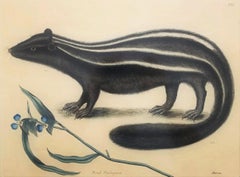
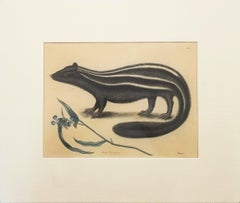
Putorius & Pseudo Phalangium (The Pole-Cat) (Skunk) /// Mark Catesby Animal Art

Putorius & Pseudo Phalangium (The Pole-Cat) (Skunk) /// Mark Catesby Animal Art

By Mark Catesby

Located in Saint Augustine, FL

Artist: Mark Catesby (English, 1638-1749) Title: "Putorius & Pseudo Phalangium (The Pole-Cat) (Skunk)" (Plate/Tab 62) Portfolio: Natural History of Carolina, Florida & the Bahama Isl...

Category

1770s Old Masters Mark Catesby Prints and Multiples

Materials

Watercolor, Handmade Paper, Etching, Intaglio

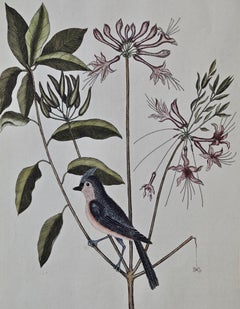
18th Century Catesby Hand-colored Bird & Plant Engraving "The Crested Titmous"

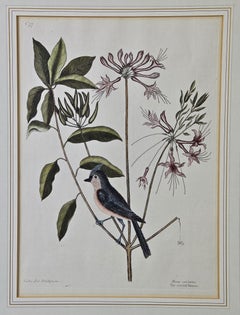
18th Century Catesby Hand-colored Bird & Plant Engraving "The Crested Titmous"

By Mark Catesby

Located in Alamo, CA

A hand-colored copperplate engraving of a bird and plants by Mark Catesby (1683-1749) entitled "The Crested Titmous" from "The Natural History of Carolina, Georgia, Florida and the Bahama Islands", published in 1731. It depicts a small Crested Titmous bird, facing left, perched on the stem of a plant with clusters of mauve colored star-like flowers. This original Catesby hand-colored engraving, on laid paper with a large central Fleur-de-Lys watermark, is presented in a cream color French mat. The mat measures 20" x 15.5" and the sheet measures 18.75" x 14.75". Mark Catesby was born in England to a prosperous family, but he traveled to America, first to visit his sister and her husband in 1712. From 1712 to 1719 he explored America observing its birds and plants, taking notes, creating drawings and collecting specimens. He returned to England with this material and created more detailed drawings. His next visit to America 1722-1726 allowed for more detailed research. Upon his return to England he created his monumental and beautiful work "The Natural History of Carolina, Florida, and Bahama Islands", which was published in London in two folio volumes of 11 parts each consisting of 20 plates...

Category

Mid-18th Century Naturalistic Mark Catesby Prints and Multiples
Materials

Engraving

Related Items
17th century etching animal print sketch ram sheep black and white signed

17th century etching animal print sketch ram sheep black and white signed

By Karel Dujardin

Located in Milwaukee, WI

"Two Rams Looking Down & To Their Left" is an original etching by Karel DuJardin. DuJardin completed many delicate etchings of rams. 3 3/4" x 7 3/4" art 16 3/8" x 19 1/2" frame Du Jardin was a master of various genres of painting, including refined and tranquil Italianising landscapes, monumental historical paintings and superb portraits of the aristocracy. Unlike the majority of his contemporaries, Karel du Jardin (b. Amsterdam 1626, d. Venice 1678) was a talented painter in not one, but many different genres. He is especially famous for his small-scale landscapes, such as the charming Italian landscape with a woman milking a goa" (1652) from the Rijksmuseum's collection. Du Jardin depicted both sun-filled Italianate scenes and Dutch farmyards with pigs and sheep. He also painted a range of elegant portraits of aristocrats and merchants. His self-portrait (1662) on copper is one of the most fascinating 17th-century portraits of a Dutch artist. Du Jardin's spectacular large-scale historical pieces, represented is the show by the impressive Conversion of Saint Pau" (1662) from the collection of the National Gallery of London, are among his most remarkable achievements; he often chose themes that were only rarely depicted by other Dutch painters of the period. During his own lifetime Du Jardin was praised by poets and writers, particularly for his attention to detail and elegant painting technique. As Cornelis de Bie, the artist’s biographer, wrote in 1661: "the surety of the brush at his finger and such sharpe clarity […] that the eye thereon doth linger." Du Jardin's valuable paintings were mainly purchased by rich individuals with an eye for elegance, but were also commissioned by prominent institutions such as the Amsterdam 'Spinhuis' (a women's prison), for whom he painted a vast group portrait of the prison-governors. Karel du Jardin was an artist who liked to travel. He lived for a time in Lyon and in Paris, and sailed with Joan Reynst, Heer van Drakestein, by ship via England, Portugal and Spain to Tangier and Algiers, where they met Michiel de Ruyter...

Category

17th Century Old Masters Mark Catesby Prints and Multiples

Materials

Etching

Tree with moth, caterpillar..., Plate 39, Metamorphosis Insectorum Surinamensium

Tree with moth, caterpillar..., Plate 39, Metamorphosis Insectorum Surinamensium

By Maria Sibylla Merian

Located in Middletown, NY

Metamorphosis Insectorum Surinamensium, Plate No. 39; Unidentified tree with moth, caterpillar and pupa. The Netherlands: 1705....

Category

Early 18th Century Naturalistic Mark Catesby Prints and Multiples
Materials

Watercolor, Engraving

Cocoa plant, caterpillar, ..., Plate 26, Metamorphosis Insectorum Surinamensium

Cocoa plant, caterpillar, ..., Plate 26, Metamorphosis Insectorum Surinamensium

By Maria Sibylla Merian

Located in Middletown, NY

Metamorphosis Insectorum Surinamensium, Plate No. 26; Cocoa plant, caterpillar, pupa, and butterflies. The Netherlands: 1705. En...

Category

Early 18th Century Naturalistic Mark Catesby Prints and Multiples
Materials

Watercolor, Engraving

The Monitory Lizard, Australia, engraving with original hand-colouring, 1790

The Monitory Lizard, Australia, engraving with original hand-colouring, 1790

By Frederick Polydore Nodder

Located in Melbourne, Victoria

'The Monitory Lizard' Copper-line engraving with original hand-colouring. 1790, by Frederick Polydore Nodder (fl.1770 – 1800). 120mm by 195mm (platemnark). Early engraving of an ...

Category

Late 18th Century Naturalistic Mark Catesby Prints and Multiples
Materials

Engraving

4 plates from The Wondrous Transformation of Caterpillars & their Strange Diet..

4 plates from The Wondrous Transformation of Caterpillars & their Strange Diet..

By Maria Sibylla Merian

Located in Middletown, NY

Four plates from The Wondrous Transformation of Caterpillars and their Strange Diet of Flowers. “Wolfsmelk Rupsen;" “Wolfsmilch, Raupe und Schmetterling" Amsterdam: J F Bernard, 1730. Each an engraving with hand coloring in watercolor and gouache printed on one sheet of watermarked Honig cream laid paper, each measures 6 1/4 x 5 inches (157 x 121 mm), sheet measures 20 5/8 x 14 inches (522 x 355 mm), full margins. With handling creases in the lower right sheet quadrant, as well as minor, loose cockling, otherwise in very good condition. The colors are superb with exceptionally fresh and bright saturation. Engraved between 1679 and 1683, printed 1730. Plates included: No.1:I; No. 2:1; II & III. MARIA SIBYLLA MERIAN was one of the most highly respected entomologists of the 17th century, and remains today one of the field's most significant figures. A German-born naturalist and scientific illustrator, she reared herself on the study of caterpillars, and made tremendous contributions to the knowledge of the life cycles of numerous species. Until her detailed and careful study of the process of metamorphosis it was thought that insects were "born of mud," through spontaneous generation. Trained as a miniature painter by her stepfather, she published her first book of illustrations in 1675, at the age of 28. In 1679, Merian published the first volume of the two-volume series on caterpillars, The Wondrous Transformation of Caterpillars and their Strange Diet of Flowers; the second volume followed in 1683. Each volume contained 50 plates that she engraved and etched. In 1699, Merian traveled to Dutch Guiana...

Category

Early 18th Century Naturalistic Mark Catesby Prints and Multiples
Materials

Watercolor, Engraving

Set of Four Hand Colored Monkey Prints

Set of Four Hand Colored Monkey Prints, 1812

$4,800

H 15.5 in W 12.5 in D 1 in

Set of Four Hand Colored Monkey Prints

Located in Palm Beach, FL

This set of four hand colored copper plate engravings are illustrations by early 19th century naturalist J. H. Jacob first published in Italy in 1812, and are referred to as "Jacob's...

Category

Early 19th Century Naturalistic Mark Catesby Prints and Multiples
Materials

Engraving

4 plates from The Wondrous Transformation of Caterpillars & their Strange Diet..

4 plates from The Wondrous Transformation of Caterpillars & their Strange Diet..

By Maria Sibylla Merian

Located in Middletown, NY

Four plates from The Wondrous Transformation of Caterpillars and their Strange Diet of Flowers. “Wolfsmelk Rupsen;" “Wolfsmilch, Raupe und Schmetterling" Amsterdam: J F Bernard, 1730. Each an engraving with hand coloring in watercolor and gouache printed on one sheet of watermarked Honig cream laid paper, each measures 6 1/4 x 5 inches (157 x 121 mm), sheet measures 20 5/8 x 14 inches (522 x 355 mm), full margins. With handling creases in the lower right sheet quadrant, as well as minor, loose cockling, otherwise in very good condition. The colors are superb with exceptionally fresh and bright saturation. Engraved between 1679 and 1683, printed 1730. Plates included: LIV, LV, LVI, & LVII. MARIA SIBYLLA MERIAN was one of the most highly respected entomologists of the 17th century, and remains today one of the field's most significant figures. A German-born naturalist and scientific illustrator, she reared herself on the study of caterpillars, and made tremendous contributions to the knowledge of the life cycles of numerous species. Until her detailed and careful study of the process of metamorphosis it was thought that insects were "born of mud," through spontaneous generation. Trained as a miniature painter by her stepfather, she published her first book of illustrations in 1675, at the age of 28. In 1679, Merian published the first volume of the two-volume series on caterpillars, The Wondrous Transformation of Caterpillars and their Strange Diet of Flowers; the second volume followed in 1683. Each volume contained 50 plates that she engraved and etched. In 1699, Merian traveled to Dutch Guiana...

Category

Early 18th Century Naturalistic Mark Catesby Prints and Multiples
Materials

Watercolor, Engraving

4 plates from The Wondrous Transformation of Caterpillars & their Strange Diet..

4 plates from The Wondrous Transformation of Caterpillars & their Strange Diet..

By Maria Sibylla Merian

Located in Middletown, NY

Four plates from The Wondrous Transformation of Caterpillars and their Strange Diet of Flowers. “Wolfsmelk Rupsen;" “Wolfsmilch, Raupe und Schmetterling" Amsterdam: JF Bernard, 1730. Each an engraving with hand coloring in watercolor and gouache printed on one sheet of watermarked Honig cream laid paper, each measures 6 1/4 x 5 inches (157 x 121 mm), sheet measures 20 5/8 x 14 inches (522 x 355 mm), full margins. With handling creases in the lower right sheet quadrant, as well as minor, loose cockling, otherwise in very good condition. The colors are superb with exceptionally fresh and bright saturation. Engraved between 1679 and 1683, printed 1730. Plates included: CXLI, CXLII, CXIII & CXLIV. MARIA SIBYLLA MERIAN was one of the most highly respected entomologists of the 17th century, and remains today one of the field's most significant figures. A German-born naturalist and scientific illustrator, she reared herself on the study of caterpillars, and made tremendous contributions to the knowledge of the life cycles of numerous species. Until her detailed and careful study of the process of metamorphosis it was thought that insects were "born of mud," through spontaneous generation. Trained as a miniature painter by her stepfather, she published her first book of illustrations in 1675, at the age of 28. In 1679, Merian published the first volume of the two-volume series on caterpillars, The Wondrous Transformation of Caterpillars and their Strange Diet of Flowers; the second volume followed in 1683. Each volume contained 50 plates that she engraved and etched. In 1699, Merian traveled to Dutch Guiana...

Category

Early 18th Century Naturalistic Mark Catesby Prints and Multiples
Materials

Watercolor, Engraving

Ancient Roman Statues - Original Etching by Giovanni Morghen - 18th Century

Ancient Roman Statues - Original Etching by Giovanni Morghen - 18th Century

Located in Roma, IT

Ancient Roman Statues from the series "Antiquities of Herculaneum", is an original etching on paper realized by Giovanni Morghen in the 18th century. Signed on the plate. Good cond...

Category

Late 18th Century Old Masters Mark Catesby Prints and Multiples
Materials

Etching

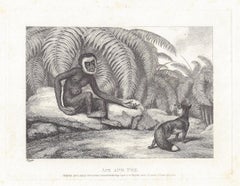
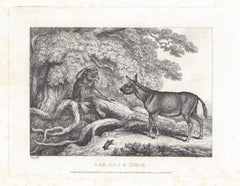
Ape and Fox, antique animal fable etching by Samuel Howitt

Ape and Fox, antique animal fable etching by Samuel Howitt

By Samuel Howitt

Located in Melbourne, Victoria

Original antique etching by Samuel Howitt (1756-1822) . C1810. Published by Edward Orme. An early 19th century etching by Howitt from a series depicting ...

Category

Early 19th Century Naturalistic Mark Catesby Prints and Multiples
Materials

Engraving, Etching

Previously Available Items
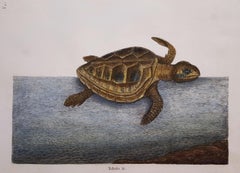
The Loggerhead Turtle

The Loggerhead Turtle

By Mark Catesby

Located in Saint Augustine, FL

An original hand-colored copper plate etching on handmade laid paper by English artist Mark Catesby (1638-1749) titled "The Loggerhead Turtle", (plat...

Category

1750s Baroque Mark Catesby Prints and Multiples
Materials

Watercolor, Etching

The Razor-billed Blackbird of Jamaica, hand-colored engraving, 1754

The Razor-billed Blackbird of Jamaica, hand-colored engraving, 1754

By Mark Catesby

Located in Paonia, CO

Mark Catesby ( 1683-1749 ) "The Natural History of Carolina, Florida and the Bahama Islands" The Razor-billed Blackbird of Jamaica hand-colored engraving, 1754 paper size...

Category

1750s Mark Catesby Prints and Multiples
Materials

Engraving

Mark Catesby prints and multiples for sale on 1stDibs.

Find a wide variety of authentic Mark Catesby prints and multiples available for sale on 1stDibs. If you’re browsing the collection of prints and multiples to introduce a pop of color in a neutral corner of your living room or bedroom, you can find work that includes elements of orange and other colors. You can also browse by medium to find art by Mark Catesby in etching, paint, watercolor and more. Not every interior allows for large Mark Catesby prints and multiples, so small editions measuring 16 inches across are available. Customers who are interested in this artist might also find the work of Samuel Sydney, Walter Crane, and Henry George Moon. Mark Catesby prints and multiples prices can differ depending upon medium, time period and other attributes. On 1stDibs, the price for these items starts at $750 and tops out at $2,950, while the average work can sell for $2,885.