Max Kuehne Art

American, 1880-1968
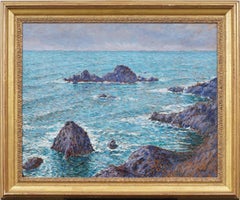
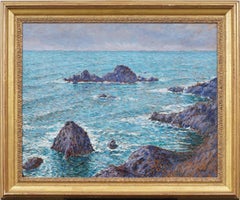
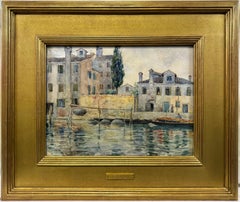
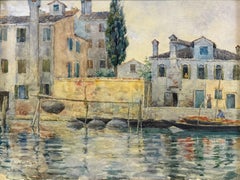
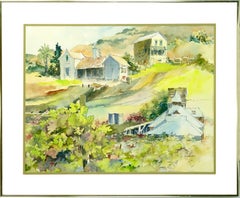
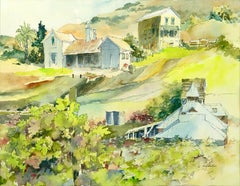
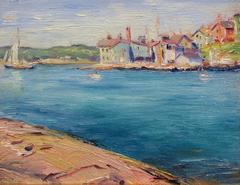
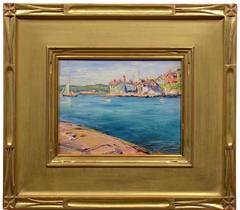
Born in Halle, Germany in 1880, Max Kuehne was a colorist who created cheerful landscapes that appear to be painted spontaneously and with freshness. He studied with William Merritt Chase and Kenneth Hayes at the Chase School in New York. In 1910, he embarked on a bicycling trip, traveling through England, France, Germany, Holland and Belgium. To support this trip he did portrait commissions along the way. When he returned to New York City, he set up a studio in Greenwich Village and was a student of Robert Henri from whom he learned a dark impressionist style. He also became close with such avant garde artists as Guy Pene du Bois, William Glackens, William Zorach and Maurice and Charles Prendergast, which also influenced his dark work including street scenes and docks in New York City. However, three years in Spain, and painting trips to Gloucester lightened his palette as did time in Paris where he was much influenced by the Fauves, Nabis, and decorative painters. By 1912 he was producing work that would make him known as a "colourist of great distinction" by producing "paintings full of sparkling sunlight." He became a member of the artistic community later in Rockport, Massachusetts, with Gifford Beal, Leon Kroll, Paul Manship, Edward Hopper and Jonas Lie. Many of his finest paintings done later in his career are of the busy harbors and piers of Gloucester and Rockport. His work was widely exhibited including the National Academy of Design, the Art Institute of Chicago, and the Carnegie Institute in Pittsburgh.
to
1
2
1
1
Overall Width
to
Overall Height
to
4
1
1
1
3
1
4
1
1
4
3
2
1
1
9
10,733
2,827
2,495
1,414
4
4
Artist: Max Kuehne
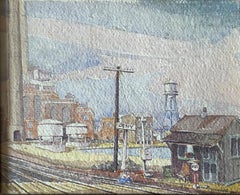
"Train Station, " Max Kuehne, Industrial City Scene, American Impressionism

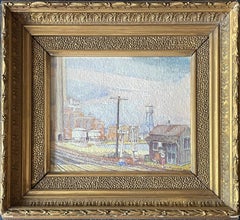
"Train Station, " Max Kuehne, Industrial City Scene, American Impressionism

By Max Kuehne

Located in New York, NY

Max Kuehne (1880 - 1968) Train Station, circa 1910 Watercolor on paper 8 1/4 x 10 1/4 inches Signed lower right Provenance: Private Collection, Illinois Max Kuehne was born in Halle, Germany on November 7, 1880. During his adolescence the family immigrated to America and settled in Flushing, New York. As a young man, Max was active in rowing events, bicycle racing, swimming and sailing. After experimenting with various occupations, Kuehne decided to study art, which led him to William Merritt Chase's famous school in New York; he was trained by Chase himself, then by Kenneth Hayes Miller. Chase was at the peak of his career, and his portraits were especially in demand. Kuehne would have profited from Chase's invaluable lessons in technique, as well as his inspirational personality. Miller, only four years older than Kuehne, was another of the many artists to benefit from Chase's teachings. Even though Miller still would have been under the spell of Chase upon Kuehne's arrival, he was already experimenting with an aestheticism that went beyond Chase's realism and virtuosity of the brush. Later Miller developed a style dependent upon volumetric figures that recall Italian Renaissance prototypes. Kuehne moved from Miller to Robert Henri in 1909. Rockwell Kent, who also studied under Chase, Miller, and Henri, expressed what he felt were their respective contributions: "As Chase had taught us to use our eyes, and Henri to enlist our hearts, Miller called on us to use our heads." (Rockwell Kent, It's Me O Lord: The Autobiography of Rockwell Kent. New York: Dodd, Mead and Co., 1955, p. 83). Henri prompted Kuehne to search out the unvarnished realities of urban living; a notable portion of Henri's stylistic formula was incorporated into his work. Having received such a thorough foundation in art, Kuehne spent a year in Europe's major art museums to study techniques of the old masters. His son Richard named Ernest Lawson as one of Max Kuehne's European traveling companions. In 1911 Kuehne moved to New York where he maintained a studio and painted everyday scenes around him, using the rather Manet-like, dark palette of Henri. A trip to Gloucester during the following summer engendered a brighter palette. In the words of Gallatin (1924, p. 60), during that summer Kuehne "executed some of his most successful pictures, paintings full of sunlight . . . revealing the fact that he was becoming a colorist of considerable distinction." Kuehne was away in England the year of the Armory Show (1913), where he worked on powerful, painterly seascapes on the rocky shores of Cornwall. Possibly inspired by Henri - who had discovered Madrid in 1900 then took classes there in 1906, 1908 and 1912 - Kuehne visited Spain in 1914; in all, he would spend three years there, maintaining a studio in Granada. He developed his own impressionism and a greater simplicity while in Spain, under the influence of the brilliant Mediterranean light. George Bellows convinced Kuehne to spend the summer of 1919 in Rockport, Maine (near Camden). The influence of Bellows was more than casual; he would have intensified Kuehne's commitment to paint life "in the raw" around him. After another brief trip to Spain in 1920, Kuehne went to the other Rockport (Cape Ann, Massachusetts) where he was accepted as a member of the vigorous art colony, spearheaded by Aldro T. Hibbard. Rockport's picturesque ambiance fulfilled the needs of an artist-sailor: as a writer in the Gloucester Daily Times explained, "Max Kuehne came to Rockport to paint, but he stayed to sail." The 1920s was a boom decade for Cape Ann, as it was for the rest of the nation. Kuehne's studio in Rockport was formerly occupied by Jonas Lie. Kuehne spent the summer of 1923 in Paris, where in July, André Breton started a brawl as the curtain went up on a play by his rival Tristan Tzara; the event signified the demise of the Dada movement. Kuehne could not relate to this avant-garde art but was apparently influenced by more traditional painters — the Fauves, Nabis, and painters such as Bonnard. Gallatin perceived a looser handling and more brilliant color in the pictures Kuehne brought back to the States in the fall. In 1926, Kuehne won the First Honorable Mention at the Carnegie Institute, and he re-exhibited there, for example, in 1937 (Before the Wind). Besides painting, Kuehne did sculpture, decorative screens, and furniture work with carved and gilded molding. In addition, he designed and carved his own frames, and John Taylor Adams encouraged Kuehne to execute etchings. Through his talents in all these media he was able to survive the Depression, and during the 1940s and 1950s these activities almost eclipsed his easel painting. In later years, Kuehne's landscapes and still-lifes show the influence of Cézanne and Bonnard, and his style changed radically. Max Kuehne died in 1968. He exhibited his work at the National Academy of Design, the Art Institute of Chicago, the Carnegie Institute in Pittsburgh, the Memorial Art Gallery of the University of Rochester, and in various New York City galleries. Kuehne's works are in the following public collections: the Detroit Institute of Arts (Marine Headland), the Whitney Museum (Diamond Hill...

Category

1910s American Impressionist Max Kuehne Art

Materials

Paper, Watercolor

“View of Lower New York from Brooklyn”

“View of Lower New York from Brooklyn”

By Max Kuehne

Located in Southampton, NY

Original oil on linen painting laid down to original fiberboard by the well know American artist, Max Kuehne. Signed in pencil verso upper left. Circa 1928. Condition is very good. ...

Category

1920s Abstract Impressionist Max Kuehne Art

Materials

Canvas, Oil, Fiberboard

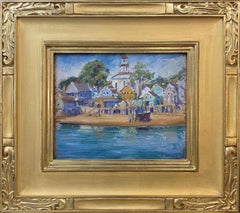
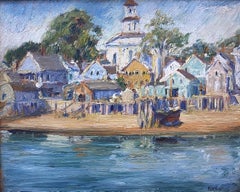
Provincetown
Provincetown

Provincetown

By Max Kuehne

Located in Milford, NH

A colorful impressionist coastal oil painting of Provincetown by German / American artist Max Kuehne (1880-1968). Kuehne was born in Halle, Germany, and emigrated to Flushing, New Y...

Category

Mid-20th Century American Impressionist Max Kuehne Art

Materials

Oil, Panel

Related Items
Mid-20th Century Oil on Board Abstract Impressionist Maritime Scene, René Genis

Mid-20th Century Oil on Board Abstract Impressionist Maritime Scene, René Genis

By René Genis

Located in Berlin, MD

Step into the bustling energy of a portside moment with René Genis’ “Les Grues” (The Cranes)”, a captivating oil-on-mat-board painting that transforms the in...

Category

Late 20th Century Abstract Impressionist Max Kuehne Art

Materials

Oil, Illustration Board

Ebbing Tide, Abstract Seascape, Original Landscape Painting, Framed Artwork

Ebbing Tide, Abstract Seascape, Original Landscape Painting, Framed Artwork

Located in Deddington, GB

Ebbing tide is an original landscape painting by Stephen KInder. This painting was completed on location in the late summer of 2019. The painting was completed on West Wittering...

Category

21st Century and Contemporary Abstract Impressionist Max Kuehne Art

Materials

Oil, Board

Stinchcombe Hill, Rupert Aker, Landscape Painting, Textured Art, Oil Painting

Stinchcombe Hill, Rupert Aker, Landscape Painting, Textured Art, Oil Painting

By Rupert Aker

Located in Deddington, GB

Stinchcombe Hill by Rupert Aker [2022] View along the Cotswold escarpment from Stinchcombe Hill Additional information: Original Oil on board Image size: H:30 cm x W:30 cm Complete...

Category

2010s Abstract Impressionist Max Kuehne Art

Materials

Oil, Board

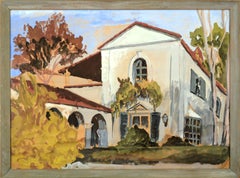
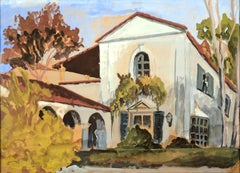
Mid Century California Mission Landscape

Mid Century California Mission Landscape

$600Sale Price|20% Off

H 18.5 in W 25 in D 1 in

Mid Century California Mission Landscape

Located in Soquel, CA

Beautiful mid century landscape of a historic California mission, highlighting its iconic architectural details such as a columned arches, white was...

Category

Mid-20th Century American Impressionist Max Kuehne Art

Materials

Paper, Gouache, Cardboard

"Eastern Plains of Colorado" By Sparky LeBold, Colorado Landscape Oil Painting

"Eastern Plains of Colorado" By Sparky LeBold, Colorado Landscape Oil Painting

Located in Denver, CO

"Eastern Plains of Colorado" by Sparky LeBold (US and Portugal based) is a beautiful handmade oil painting that depicts a view of the vast green plains of Colorado, with the famed su...

Category

2010s American Impressionist Max Kuehne Art

Materials

Oil, Panel

Mediterranean Fishing Boats Beach Catalonia Coastal Impressionist Oil Spanish

Mediterranean Fishing Boats Beach Catalonia Coastal Impressionist Oil Spanish

Located in Sitges, Barcelona

Mediterranean Fishing Boats Beach Catalonia Coastal Impressionist Oil Artist: J. Sureda Lloveras Title: Fishermen Boats on Mediterranean Beach Medium: Oil on panel Period: circa 1945 Movement: Spanish Impressionist School Support: Panel Signature: Signed lower left Condition: Very good condition Framed: No Dimensions: Height: 33 cm (13 in) Width: 41 cm (16.15 in) Origin: Catalonia, Spain Charming Mediterranean coastal scene depicting traditional fishing boats resting on a sunlit Catalonian beach, painted by J. Sureda Lloveras around 1945. The composition captures the quiet poetry of working maritime life along the Spanish coast, with anchored boats, suspended fishing nets and luminous white seaside architecture dissolving into a warm atmospheric horizon. The brushwork is spontaneous yet controlled, combining structural drawing with fresh plein-air sensitivity typical of mid-century Mediterranean impressionist painting. Scenes like this evoke the authentic coastal identity collectors associate with Sitges, Costa Brava and the wider Catalan shoreline during the golden era of Spanish figurative landscape painting. The painting balances decorative harmony with documentary charm, making it equally suitable for collectors of Spanish impressionism and for interiors seeking refined coastal European atmosphere. Small-scale original Mediterranean harbor paintings with strong light and architectural presence are particularly desirable in today’s international interior design market, especially in the United States. A refined and highly displayable example of postwar Catalan coastal painting. This work belongs to the tradition of Mediterranean plein-air painting developed across Catalonia and the Spanish Levante during the first half of the 20th century. Comparable stylistic affinities may be found in the coastal works of: Joaquín Sorolla Eliseu Meifrèn Santiago Rusiñol Hermen Anglada-Camarasa (coastal palette phase) and European maritime painters such as Eugène Boudin Raoul Dufy (coastal compositions) These references position the painting within a broader international impressionist coastal landscape tradition appreciated by collectors worldwide. Mediterranean painting Spanish coastal painting Fishing boats painting...

Category

1940s Impressionist Max Kuehne Art

Materials

Oil, Board

"Mt. Evans and Bierstadt, Colorado" Oil Painting

"Mt. Evans and Bierstadt, Colorado" Oil Painting

Located in Denver, CO

David Shingler's (NC based) "Mt. Evans and Bierstadt, Colorado" is an oil painting that depicts a green grassy plain dotted with Pine trees leading to the snow capped mountains in th...

Category

2010s American Impressionist Max Kuehne Art

Materials

Oil, Wood Panel

Charles Partridge Adams California Coastal Watercolor American Impressionist

Charles Partridge Adams California Coastal Watercolor American Impressionist

By Charles Partridge Adams

Located in Denver, CO

This original California coastal watercolor by American Impressionist Charles Partridge Adams captures the atmospheric beauty and shifting light of the Pacific shoreline with remarka...

Category

1920s American Impressionist Max Kuehne Art

Materials

Watercolor

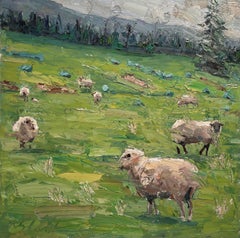
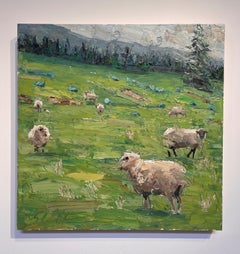
"Sheepish" Oil Painting

"Sheepish" Oil Painting

Located in Denver, CO

Clyde Steadman's "Sheepish" is an original, handmade oil painting that depicts an impasto painting of a sheep gathered on a green hillside.

Category

2010s American Impressionist Max Kuehne Art

Materials

Oil, Panel

“Venice, 1889” San Pietro di Castello Canals American Impressionist Watercolor

“Venice, 1889” San Pietro di Castello Canals American Impressionist Watercolor

Located in Yardley, PA

“Venice, 1889” by Louis Ritter (American, 1854-1892). A fantastic example of Ritter’s renowned European watercolors. This beautifully poised composition captures the sun-washed faça...

Category

1880s American Impressionist Max Kuehne Art

Materials

Paper, Watercolor

A Stone and Wood House in 19th-century Mamaroneck, New York

A Stone and Wood House in 19th-century Mamaroneck, New York

Located in San Francisco, CA

The painting may not illustrate your story, but it is universal—that desire to honor one’s forerunners and reflect on their daily lives. Consider the many opportunities, comforts and...

Category

1890s American Impressionist Max Kuehne Art

Materials

Board, Oil

Early Painting from Puerto Orotava (Puerto de la Cruz), Tenerife, 1894

Early Painting from Puerto Orotava (Puerto de la Cruz), Tenerife, 1894

Located in Stockholm, SE

This small oil painting on board (21.5 x 33 cm) is a rare early work by Swedish landscape painter Carl Johansson (1863–1944). Painted during the artist’s 1894 travels to the Canary I...

Category

1890s Impressionist Max Kuehne Art

Materials

Oil, Board

Previously Available Items
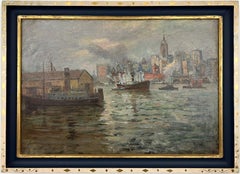
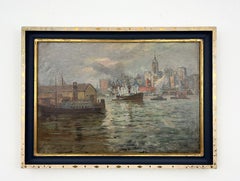
Brooklyn Bridge through the Clouds-Original New York 20th Century Oil Painting

Brooklyn Bridge through the Clouds-Original New York 20th Century Oil Painting

By Max Kuehne

Located in Marco Island, FL

An atmospheric and impressionistic view of New York City's towering skyline with ships in the harbour on a misty day. This lovely painting is housed in a beautifully detailed artist...

Category

Early 20th Century American Impressionist Max Kuehne Art

Materials

Oil, Canvas

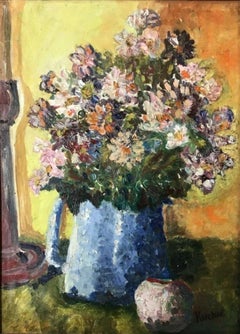
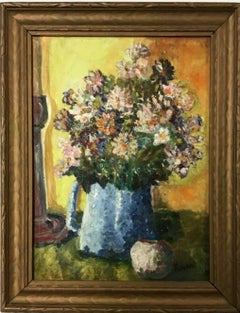
"Floral Still Life in a Blue Vase" American Impressionist

"Floral Still Life in a Blue Vase" American Impressionist

By Max Kuehne

Located in New York, NY

Max Kuehne (1880 - 1968) Floral Still Life Oil on board 16 x 12 inches Signed lower right: Kuehne Provenance: Wilma and Ronald J. Baird, Philadelphia Private Collection, Rhode Island Exhibited: Philadelphia, Mann Center for Older People, May 1968. Germantown, Pennsylvania, Young Women's Christian Association, May - June 1973. Max Kuehne was born in Halle, Germany on November 7, 1880. During his adolescence the family immigrated to America and settled in Flushing, New York. After experimenting with various occupations, Kuehne decided to study art, which led him to William Merritt Chase's famous school in New York; he was trained by Chase himself, then by Kenneth Hayes Miller. Chase was at the peak of his career, and his portraits were especially in demand. Kuehne would have profited from Chase's invaluable lessons in technique, as well as his inspirational personality. Miller, only four years older than Kuehne, was another of the many artists to benefit from Chase's teachings. Even though Miller still would have been under the spell of Chase upon Kuehne's arrival, he was already experimenting with an aestheticism that went beyond Chase's realism and virtuosity of the brush. Later Miller developed a style dependent upon volumetric figures that recall Italian Renaissance prototypes. Kuehne moved from Miller to Robert Henri in 1909. Rockwell Kent, who also studied under Chase, Miller, and Henri, expressed what he felt were their respective contributions: "As Chase had taught us to use our eyes, and Henri to enlist our hearts, Miller called on us to use our heads." Henri prompted Kuehne to search out the unvarnished realities of urban living; a notable portion of Henri's stylistic formula was incorporated into his work. Having received such a thorough foundation in art, Kuehne spent a year in Europe's major art museums to study techniques of the old masters. His son Richard named Ernest Lawson as one of Max Kuehne's European traveling companions. In 1911 Kuehne moved to New York where he maintained a studio and painted everyday scenes around him, using the rather Manet-like, dark palette of Henri. He also became close with such avant garde artists as Guy Pene du Bois, William Glackens, William Zorach and Maurice and Charles Prendergast, which also influenced his dark work including street scenes and docks in New York City. A trip to Gloucester during the following summer engendered a brighter palette. In the words of Gallatin, during that summer Kuehne "executed some of his most successful pictures, paintings full of sunlight . . . revealing the fact that he was becoming a colorist of considerable distinction." Kuehne was away in England the year of the Armory Show (1913), where he worked on powerful, painterly seascapes on the rocky shores of Cornwall. Possibly inspired by Henri - who had discovered Madrid in 1900 then took classes there in 1906, 1908 and 1912 - Kuehne visited Spain in 1914; in all, he would spend three years there, maintaining a studio in Granada. He developed his own impressionism and a greater simplicity while in Spain, under the influence of the brilliant Mediterranean light. George Bellows convinced Kuehne to spend the summer of 1919 in Rockport, Maine (near Camden). The influence of Bellows was more than casual; he would have intensified Kuehne's commitment to paint life "in the raw" around him. After another brief trip to Spain in 1920, Kuehne went to the other Rockport (Cape Ann, Massachusetts) where he was accepted as a member of the vigorous art colony, spearheaded by Aldro T. Hibbard. Rockport's picturesque ambiance fulfilled the needs of an artist-sailor: as a writer in the Gloucester Daily Times explained, "Max Kuehne came to Rockport to paint, but he stayed to sail." The 1920s was a boom decade for Cape Ann, as it was for the rest of the nation. Kuehne's studio in Rockport was formerly occupied by Jonas Lie. He became a member of the artistic community later in Rockport, Massachusetts, with Gifford Beal, Leon Kroll, Paul Manship, Edward Hopper and Jonas Lie. Many of his finest paintings done later in his career are of the busy harbors and piers of Gloucester and Rockport. Kuehne spent the summer of 1923 in Paris, where in July, André Breton started a brawl as the curtain went up on a play by his rival Tristan Tzara; the event signified the demise of the Dada movement. Kuehne could not relate to this avant-garde art but was apparently influenced by more traditional painters — the Fauves, Nabis, and painters such as Bonnard. Gallatin perceived a looser handling and more brilliant color in the pictures Kuehne brought back to the States in the fall. In 1926, Kuehne won the First Honorable Mention at the Carnegie Institute, and he re-exhibited there, for example, in 1937 (Before the Wind). Besides painting, Kuehne did sculpture, decorative screens, and furniture work with carved and gilded molding. In addition, he designed and carved his own frames, and John Taylor Adams encouraged Kuehne to execute etchings. Through his talents in all these media he was able to survive the Depression, and during the 1940s and 1950s these activities almost eclipsed his easel painting. In later years, Kuehne's landscapes and still-lifes show the influence of Cézanne and Bonnard, and his style changed radically. Max Kuehne died in 1968. He exhibited his work at the National Academy of Design, the Art Institute of Chicago, the Carnegie Institute in Pittsburgh, the Memorial Art Gallery of the University of Rochester, and in various New York City galleries. Kuehne's works are in the following public collections: the Detroit Institute of Arts (Marine Headland), the Whitney Museum (Diamond Hill...

Category

Mid-20th Century American Impressionist Max Kuehne Art

Materials

Paint, Oil, Board
Sailing Out of Harbor

Max KuehneSailing Out of Harbor

Sold

H 7.5 in W 9.38 in

Sailing Out of Harbor

By Max Kuehne

Located in Wiscasset, ME

Born in Halle, Germany in 1880, artist Max Kuehne studied at William Merritt Chase’s school in New York under Chase, then Kenneth Hayes Miller and in 1909, was a pupil of Robert Henr...

Category

1920s Impressionist Max Kuehne Art

Materials

Oil, Board
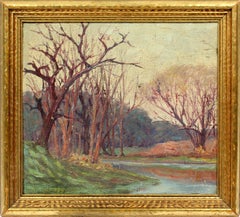
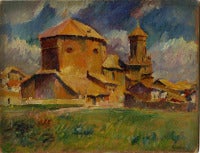
A Village Church Near Baya

A Village Church Near Baya

By Max Kuehne

Located in Fairlawn, OH

Signed by the artist lower right: Kuehne Signed, dated and titled "A Village Church near Baya (sic)" by the artist in pencil verso.

Category

1920s Max Kuehne Art

Max Kuehne art for sale on 1stDibs.

Find a wide variety of authentic Max Kuehne art available for sale on 1stDibs. You can also browse by medium to find art by Max Kuehne in paint, oil paint, canvas and more. Much of the original work by this artist or collective was created during the 20th century and is mostly associated with the Impressionist style. Not every interior allows for large Max Kuehne art, so small editions measuring 16 inches across are available. Customers who are interested in this artist might also find the work of Donald Teague, William Lester Stevens, and Gifford Beal. Max Kuehne art prices can differ depending upon medium, time period and other attributes. On 1stDibs, the price for these items starts at $2,800 and tops out at $65,000, while the average work can sell for $5,900.