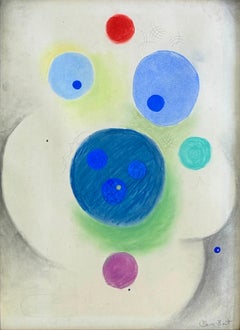
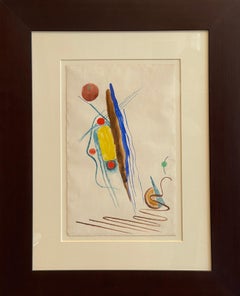
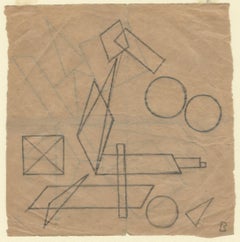
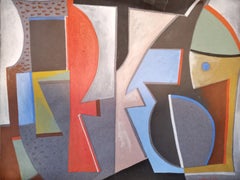
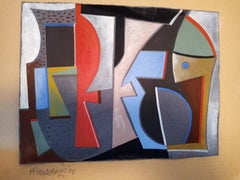
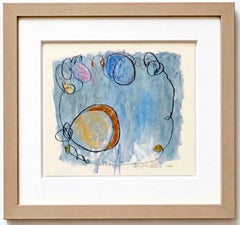
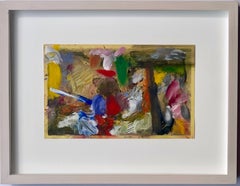
Untitled (Brown and Blue Shapes)
By Rudolf Bauer
Located in Columbia, MO
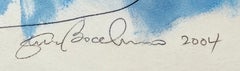
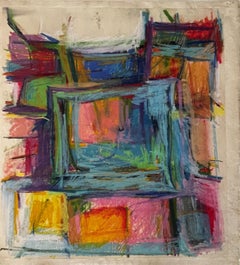
Untitled (Brown and Blue Shapes) Gouache and watercolor 18.25 x 11.62 inches Framed: 32.5 x 26 inches
Early 20th Century Abstract Rudolf Bauer Art
Watercolor, Gouache
Untitled (Brown and Blue Shapes)
By Rudolf Bauer
Located in Columbia, MO
Untitled (Brown and Blue Shapes) Gouache and watercolor 18.25 x 11.62 inches Framed: 32.5 x 26 inches
Watercolor, Gouache
untitled (Young Woman Washing)
By Rudolf Bauer
Located in Fairlawn, OH
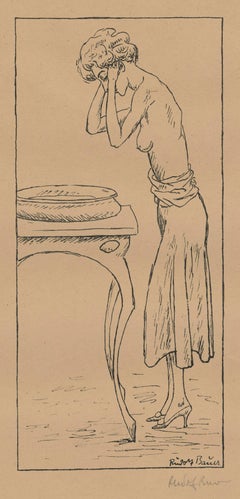
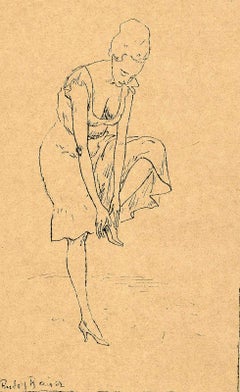
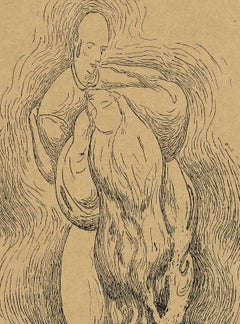
untitled (Young Woman Washing) Lithograph, c. 1910 Signed in pencil lower right; signed in the plate lower right (see photo) Image size: 11 x 5-1/8" Sheet size: 18 7/8 x 12 5/8 inches Condition: Very good Aging to the tan paper it is printed on Provenance: Estate of the Artist Borghi & Company, NYC Rudolph Bauer 1889-1953 Rudolf Bauer was born in Lindenwald near Bromberg, Silesia, in 1889 but his family moved only a few years later to Berlin. In 1905 Bauer began his studies at the Berlin Academy of Art but left the Academy only a few months later to educate himself. The upshot was paintings, caricatures and comical drawings which were published in 'Berliner Tageblatt', 'Ulk' and 'Le Figaro'. From 1912 Bauer contributed to the magazine and Gallery 'Der Sturm' founded by Herwarth Walden and pivotal to German Expressionism and the international avant-garde. In 1915 Rudolf Bauer participated for the first time in a group show at Walden's gallery. There he met Hilla von Rebay, with whom he began a relationship of many years that was crucial to Bauer's later work. By 1922 Bauer had shown work at about eight exhibitions mounted by 'Der Sturm'. From 1918 he also taught at the 'Der Sturm' art school, where Georg Muche was the director. After the war ended, Bauer was a founding member of the 'November Group' although he did not collaborate closely with the group. In 1919 Bauer joined forces with the painter and architect Otto Nebel and with Hilla von Rebay to found the artists' association 'Die Krater'. Impressionist at the outset, Bauer's early work reveals Cubist and Expressionist influences. By 1915/16 Bauer had switched to an abstract pictorial idiom, which is markedly influenced by Kandinsky. In the early 1920s Bauer was also preoccupied with Russian Constructivism as well as the Dutch de Stijl group. Bauer's decided preference for non-representational painting culminated in 1929 with the foundation of a private museum, 'Das Geistreich', which he directed as a salon for abstract art. Political developments in Germany forced Bauer to sell some of his work in America from 1932. His agent in America was Hilla von Rebay, who was by now director of the Guggenheim Collection. In 1936 she organized a touring exhibition of non-representational European art that included sixty Rudolf Bauer oil...
Lithograph
Non-Objective Drawing (Double sided composition)
By Rudolf Bauer
Located in Fairlawn, OH
Non-Objective Drawing (Double sided composition) Graphite on paper, 1938 Initialed "B" by the artist lower right corner Created while the artist was imprisoned in a Gestapo Prison fo...
Graphite
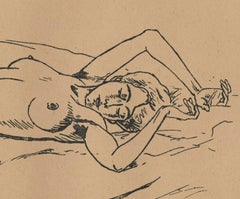
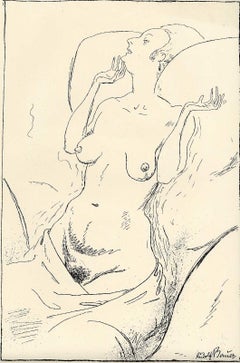
Reclining Nude on Bed
By Rudolf Bauer
Located in Fairlawn, OH
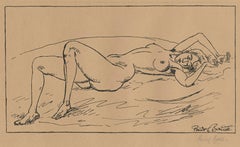
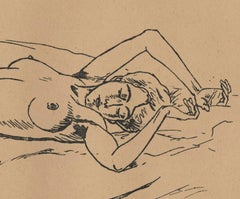
Reclining Nude on Bed Lithograph, c. 1910 Signed in pencil lower right and in the plate, lower right Image size: 7-1/4 x 13" Sheet size: 12 1/2 x 19 inches Condition: very good Some aging to the tan paper Provenance: Estate of the Artist Borghi & Company, New York Rudolph Bauer 1889-1953 Rudolf Bauer was born in Lindenwald near Bromberg, Silesia, in 1889 but his family moved only a few years later to Berlin. In 1905 Bauer began his studies at the Berlin Academy of Art but left the Academy only a few months later to educate himself. The upshot was paintings, caricatures and comical drawings which were published in 'Berliner Tageblatt', 'Ulk' and 'Le Figaro'. From 1912 Bauer contributed to the magazine and Gallery 'Der Sturm' founded by Herwarth Walden and pivotal to German Expressionism and the international avant-garde. In 1915 Rudolf Bauer participated for the first time in a group show at Walden's gallery. There he met Hilla von Rebay, with whom he began a relationship of many years that was crucial to Bauer's later work. By 1922 Bauer had shown work at about eight exhibitions mounted by 'Der Sturm'. From 1918 he also taught at the 'Der Sturm' art school, where Georg Muche was the director. After the war ended, Bauer was a founding member of the 'November Group' although he did not collaborate closely with the group. In 1919 Bauer joined forces with the painter and architect Otto Nebel and with Hilla von Rebay to found the artists' association 'Die Krater'. Impressionist at the outset, Bauer's early work reveals Cubist and Expressionist influences. By 1915/16 Bauer had switched to an abstract pictorial idiom, which is markedly influenced by Kandinsky. In the early 1920s Bauer was also preoccupied with Russian Constructivism as well as the Dutch de Stijl group. Bauer's decided preference for non-representational painting culminated in 1929 with the foundation of a private museum, 'Das Geistreich', which he directed as a salon for abstract art. Political developments in Germany forced Bauer to sell some of his work in America from 1932. His agent in America was Hilla von Rebay, who was by now director of the Guggenheim Collection. In 1936 she organized a touring exhibition of non-representational European art that included sixty Rudolf Bauer oil...
Lithograph
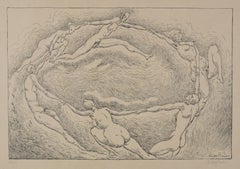
Circle of Life
By Rudolf Bauer
Located in Fairlawn, OH
Circle of Life Lithograph on tan paper, c. 1910's Signed in pencil lower right; signed in the plate lower right (see photo) Annotated "No. 50" in pencil lower left (see photo) ...
Lithograph
La Toilette No. 60.
By Rudolf Bauer
Located in New York, NY
Lithograph printed on tan wove newsprint-type paper. Signed in pencil and in the stone. 15 3/4 x 12 3/4". Sheet Size: Image Size 8 1/4 x 6 3/4". Rudolf Bauer (1889-1953) executed hi...
Lithograph
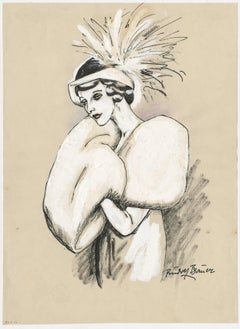
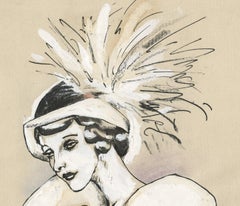
Woman in a Fur Wrap
By Rudolf Bauer
Located in Fairlawn, OH
Woman in a Fur Wrap Pen and ink heightened with white, c. 1920 Signed in ink lower right (see photo) Estate stamp verso (see photo) Provenance: estate of the artist ...
Ink
$12,500
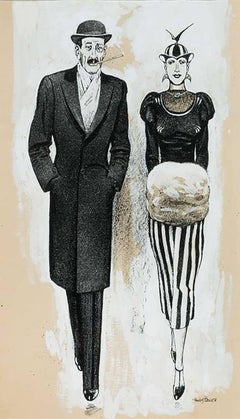
Fashion Couple
By Rudolf Bauer
Located in Fort Washington, PA
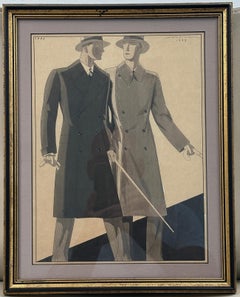
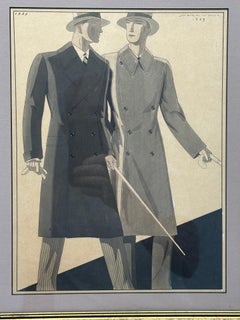
Medium: Gouache and Ink on Paper Dimensions: 17.50" x 10.75" Signature: Signed Lower Right
Paper, Ink, Gouache
$3,800
H 20.25 in W 15 in
ASU Portrait II /// Fritz Scholder Native American Indian Expressionist Surreal
By Fritz Scholder
Located in Saint Augustine, FL
Artist: Fritz Scholder (Native American, 1937-2005) Title: "ASU Portrait II" Portfolio: Arizona State University Centennial Portfolio *Signed by Scholder in pencil lower right Year: 1984 Medium: Original Lithograph on Arches Cover buff paper Limited edition: 49/100 Printer: Joseph M. Segura of the Print Research Facility, School of Art, Arizona State University, Tempe, AZ Publisher: the Print Research Facility, School of Art, Arizona State University, Tempe, AZ Sheet size: 20.25" x 15" Reference: "Collaborative Works: Recent Work and Catalogue Raisonné of the Visual Arts Research Institute" - ASU/VARI No. 121, page 98 Condition: Never framed, has been professionally stored away within its original portfolio case for decades. In mint condition Not a single example of this work has ever appeared at auction in over 40 years. Extremely rare Notes: Provenance: one owner ever - private collection - Scottsville, AZ; acquired directly from the publisher the Print Research Facility, School of Art, Arizona State University, Tempe, AZ upon its release in 1984. Numbered by Scholder in pencil lower left. Comes from the 1984 "Arizona State University Centennial Portfolio" of eighteen prints in various mediums by Daniel R Britton, R. E. (Ron) Gasowski, Arthur W. Hahn, James Hajicek, Jules Heller...
Lithograph
Les Quais a Venise
By Jean Jansem
Located in San Francisco, CA
Artist: Jean Jansem (French/Armenian, 1920-2013) Title: Les Quais a Venise Year: 1966 Medium: Color lithograph Edition: Numbered 127/160 in pencil Paper: Arches paper Image size: 18....
Lithograph
$1,200
H 26 in W 19 in
Nude on Bed, Art Nouveau Lithograph after Henri Toulouse-Lautrec
Located in Long Island City, NY
Laurent Marcel Salinas, After Toulouse-Lautrec, Egyptian/French (1913 - 2010) - Nude on Bed, Year: circa 1977, Medium: Lithograph on Arches, Museum Stamped and numbered in pencil, ...
Lithograph
$473
H 9.65 in W 13.98 in D 0.04 in
Shark - Original Offset and Lithograph by George Grosz - 1923
By George Grosz
Located in Roma, IT
Shark is an original offset and lithograph, realized by George Grosz. The artwork is the plate n. 66 from the porfolio Ecce Homo published between 1922/1923, edition of Der Malik-Ve...
Lithograph, Offset
$956Sale Price|20% Off
H 14 in W 10.25 in
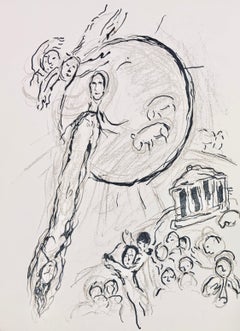
Marc Chagall, Paradise I, from Drawings for the Bible, 1960
By Marc Chagall
Located in Southampton, NY
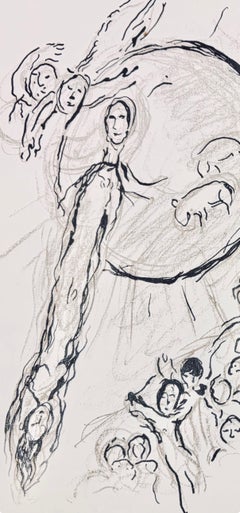
This exquisite lithograph by Marc Chagall (1887–1985), titled Paradise I (Paradise I), from Marc Chagall, Dessins Pour La Bible (Drawings for the Bible), Verve: Revue Artistique et Litteraire, Vol. X, No. 37-38, originates from the July 29, 1960 issue published by Editions de la revue Verve, Paris, under the direction of Teriade, Editeur, Paris, and printed by Mourlot Freres, Paris, 1960. This visionary composition reflects Chagall’s poetic interpretation of the biblical paradise, evoking a realm of harmony, innocence, and divine presence through his luminous color and dreamlike symbolism. The flowing forms and radiant imagery convey a sense of spiritual unity and transcendence, capturing the timeless serenity and mystical beauty of Eden within Chagall’s distinctive visual language. Infused with movement and lyricism, the work transforms sacred narrative into a meditative vision of paradise and the enduring connection between humanity and the divine. The piece forms part of Chagall’s celebrated series of lithographs and drawings created for Dessins Pour La Bible, a monumental project uniting art, scripture, and mysticism in one of the artist’s most important achievements. Executed as a lithograph on velin du Marais paper, this work measures 14 x 10.5 inches (35.56 x 26.67 cm). Unsigned and unnumbered as issued. The edition exemplifies the superb craftsmanship of the Mourlot Freres atelier, renowned for its collaborations with the greatest modern masters of the 20th century. Artwork Details: Artist: Marc Chagall (1887–1985) Title: Paradise I (Paradise I), from Marc Chagall, Dessins Pour La Bible (Drawings for the Bible), Verve: Revue Artistique et Litteraire, Vol. X, No. 37-38, July 29, 1960 Medium: Lithograph on velin du Marais paper Dimensions: 14 x 10.5 inches (35.56 x 26.67 cm) Inscription: Unsigned and unnumbered as issued Date: 1960 Publisher: Editions de la revue Verve, Paris, under the direction of Teriade, Editeur, Paris Printer: Mourlot Freres, Paris Catalogue raisonne references: Chagall, Marc, et al. Chagall Lithographe. Andre Sauret, 1960-1986, illustration 230-276. Cramer, Patrick, and Meret Meyer. Marc Chagall: Catalogue Raisonne des Livres Illustres. P. Cramer ed., 1995, illustration 42. Condition: Well preserved, consistent with age and medium Provenance: From Marc Chagall, Dessins Pour La Bible (Drawings for the Bible), Verve: Revue Artistique et Litteraire, Vol. X, No. 37-38, published by Editions de la revue Verve, Paris, 1960 Notes: Excerpted from the folio (translated from French), This double issue of Verve includes the drawings that Marc Chagall executed in 1958 and 1959 on biblical themes that he had not generally dealt with in his illustration for the Bible, engraved with etching and which were included in issue 33/34 of Verve. This album has 96 renderings in black and 24 color litbographies as well as the cover that were specially made for this album. It was completed printing on July 29, 1960 by Draeger Freres for black gravures and by Mourlot Freres for color lithography. About the Publication: Marc Chagall, Dessins Pour La Bible (Drawings for the Bible), published as Verve Vol. X, No. 37-38 on July 29, 1960, represents a significant continuation and expansion of Chagall’s profound engagement with biblical imagery and spiritual narrative. Conceived and directed by the visionary publisher Teriade, the publication builds upon the earlier Verve issue devoted to Chagall’s Bible illustrations by presenting a new body of work executed in 1958 and 1959, exploring themes and episodes that had not been fully addressed in the initial series. Printed in Paris by Draeger Freres for black gravures and Mourlot Freres for color lithography, the edition demonstrates an exceptional level of technical refinement and artistic collaboration. The publication includes an extensive suite of ninety six black reproductions and twenty four color lithographs, as well as specially created cover imagery, reflecting Chagall’s continued innovation in translating sacred themes into graphic form. As part of the broader tradition of Verve, one of the most important artistic and literary publications of the twentieth century, this issue exemplifies the fusion of text, image, and craftsmanship at the highest level. Today, Verve Vol. X, No. 37-38 stands as a major achievement within Chagall’s graphic oeuvre, reaffirming his role as one of the foremost interpreters of biblical narrative in modern art. About the Artist: Marc Chagall (1887–1985) was a Belarus-born French painter, printmaker, and designer whose visionary imagination, radiant color, and deeply poetic symbolism made him one of the most beloved and influential artists of the 20th century. Rooted in the imagery of his Jewish heritage and the memories of his childhood in Vitebsk, Chagall’s art wove together themes of faith, love, folklore, and fantasy with a dreamlike modern sensibility. His unique style merging elements of Cubism, Fauvism, Expressionism, and Surrealism defied categorization, transforming ordinary scenes into lyrical meditations on memory and emotion. Influenced by Russian icon painting, medieval religious art, and the modern innovations of artists such as Pablo Picasso, Henri Matisse, and Georges Braque, Chagall developed a profoundly personal visual language filled with floating figures, vibrant animals, musicians, and lovers that symbolized the transcendent power of imagination and love. During his early years in Paris, he became an integral part of the Ecole de Paris circle, forming friendships with Amedeo Modigliani, Fernand Leger, and Sonia Delaunay, and his creative spirit resonated with that of his peers and successors Alexander Calder, Alberto Giacometti, Salvador Dali, Joan Miro, Wassily Kandinsky, Marcel Duchamp, and Man Ray, artists who sought to push the boundaries of perception, emotion, and form. Over a prolific career that spanned painting, printmaking, stained glass, ceramics, and stage design, Chagall brought an unparalleled poetic sensibility to modern art, infusing even the most abstract subjects with human warmth and spiritual depth. His works are held in the most prestigious museums around the world, including the Museum of Modern Art, the Centre Pompidou, the Tate, and the Guggenheim, where they continue to inspire generations of artists and collectors. The highest price ever paid for a Marc Chagall artwork is approximately 28.5 million USD, achieved in 2017 at Sotheby’s New York for Les Amoureux (1928). Marc Chagall Paradise...
Lithograph
$13,500
H 17.25 in W 13.75 in
Gerlach's Allegorien Folio, plate #58: "Sculpture" Lithograph, Gustav Klimt.
By Gustav Klimt
Located in Palm Beach, FL
As an artist trained in the applied arts, Gustav Klimt valued all forms of art, including the graphic arts. This final design from 1896 for inclusion in Allegorien published by Gerlach & Schenk demonstrates respect for artistic precedent and for a wide range of media and technique. The publication was printed in an unknown number of copies. Klimt’s rendering in latin of the title, “SCVLPTVR.,” with three-dimensional effect on the wall, is a figurative allusion to this medium as well as a literal reference to Ancient Rome. By doing the same with his signature and date in roman numerals on the right hand side of the image, Klimt places himself, The Artist, firmly in this linear and legitimizing context of art history and as its modern standard-bearer. Playing on Classical mythology and the story of Pygmalion, in which a statue comes to life, Klimt presents his modern Venus holding an apple. Klimt’s Venus exhibits a curvilinear softness; there are no angles. Klimt deftly shows the possibilities in a graphic image to give life to dark, wavy hair and tenderness to swelling breasts and belly. To further emphasize the allegory of thriving modern art, he contrasts his Venus with the cold, hard ancient classical head whose eyes are vacuous and whose hair is but a stylized mass of curls. Klimt’s living Venus stands in front of the large bust and large classical pillar upon which is a sculpture of a Sphinx and a Greek Attic bust. As if a gallery to represent sculpture’s “best of” through the ages, the upper horizontal panel includes bust depictions in marble, cast metal and wood...
Lithograph
$18,500
H 17.25 in W 13.75 in
Gerlach's Allegorien, plate #46: "Love" Lithograph, Gustav Klimt.
By Gustav Klimt
Located in Palm Beach, FL
Klimt’s association with Martin Gerlach dates back to the early 1880s when Gerlach and Schenk published their first edition of Allegorien und Embleme. By the mid-1890s, they were pla...
Lithograph
$59,500
H 26.5 in W 25.5 in D 2 in
Charmion von Wiegand - Pillar of Zen #124, signed painting Andre Zarre Gallery
By Charmion von Wiegand
Located in New York, NY
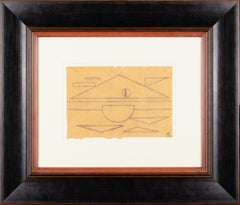
Charmion von Wiegand Pillar of Zen #124, 1959 Gouache on paper painting Hand signed, titled and dated on the front Unique Provenance: Andre Zarre Gallery, with label verso (Estate of renowned gallerist Andre Zarre, ne Andre Sowulewski) Measurements: Framed 26.5 inches vertical by 25.5 horizontal by 2 inches Artwork: 21 inches vertical by 22 inches horizontal Mid century modern, geometric, spiritual abstraction, mystical The Estate of the celebrated artist Charmion Von Wiegand has been represented exclusively by Michael Rosenfeld Gallery since 1998. From March 3 to August 13, 2023, Charmion Von Wiegand was the subject of an acclaimed retrospective at the Kunstmuseum Basel, and she has received major attention in the price, including a June, 2023 ArtNews feature entitled, "Who Was Charmion von Wiegand and Why Is She Important?". Her work was also featured in a solo presentation by Rosenfeld Gallery at the New York Art Show held at the Park Avenue Armory, which also received critical acclaim. Artists Biography - courtesy of Michael Rosenfeld Gallery: Known for her vibrant, geometric paintings that originate a deeply personal language of spiritual enlightenment expressed through a constructivist mode of abstraction, Charmion von Wiegand (1896–1983) was born in Chicago but spent much of her childhood traveling. The daughter of a journalist for Hearst, von Wiegand eventually settled in New York in 1915 to attend Barnard College and Columbia University, where she took classes at the School of Journalism while nurturing a growing interest in art history. In 1925, von Wiegand realized that she wanted to be an artist and set up a studio in Greenwich Village, teaching herself how to paint while pursuing a career as a journalist. In 1929, she secured a position in Moscow as a foreign correspondent for Hearst, the only woman at the desk at the time. In 1932, von Wiegand returned to New York and married Russian émigré Joseph Freeman, who co-founded and edited the leftist journal New Masses. Von Wiegand began writing art criticism for New Masses as well as for other publications, including New Theatre, ARTnews, and Arts Magazine. When the Abstract American Artists (AAA) held their inaugural exhibition, von Wiegand reviewed it. An early champion of abstract art, von Wiegand became close friends with AAA founder Carl Holty. In 1941, Holty introduced von Wiegand to Piet Mondrian, who would have a profound impact on her art. Fascinated by Mondrian’s artistic philosophy, von Wiegand played a key role in the introduction of his work to American audiences, translating many of the Dutch artist’s writings into English and assisting in the composition of his influential article “Toward the True Vision of Reality” (1941). Through her friendship with Mondrian, von Wiegand re-kindled her interest in Theosophy (a religion established in the late 19th century that combines aspects of Hinduism, Buddhism, occultism, and esotericism) and embarked on an extended study of neoplasticism. In her artwork, she incorporated Mondrian’s iconic grid but rejected the constraints of pure neoplasticism and embraced a wide range of influences including surrealism and German expressionism. In 1942, von Wiegand became a member of the AAA, exhibiting regularly with the group and eventually serving as its president from 1951 to 1953. In the late 1940s, sculptor and fellow AAA member Ibram Lassaw gave her a translation of The Secret of the Golden Flower: A Chinese Book of Life, which inspired von Wiegand to immerse herself in a study of Buddhist art. She began incorporating Buddhist motifs such as stupas and mandalas into her paintings, and her spiritual practice steadily intensified throughout the 1950s. In 1953, her husband gifted her a copy of the Taoist I Ching Book of Changes, a guide for divining meaning from randomly derived numbers arranged in a hexagram—a form the artist readily incorporated into her painting. Von Wiegand’s study of Theosophy also intensified over these years, bolstered by her increased access to the religion’s primary sources composed by the religion’s founders and their successors at the New York Theosophical Society’s library. Von Wiegand’s search for the sacred and transcendent ultimately led her to Tibetan Buddhism and, in 1967, von Wiegand met Khyongla Rato Rinpoche, a Gelugpa monk who had recently arrived in New York, who would mentor her spiritual study in the tradition of Mahayana Buddhism until her death. Her travels in the 1960s and 1970s took her to Tibet and India, where she had an audience with the Dalai Lama, who was living in exile in Dharamsala. Many works from these decades incorporate symbols and schematics drawn from Theosophical prismatic color charts, Chinese astrology and tantric yoga. In 1978, she was the subject of a PBS documentary titled The Circle of Charmion von Wiegand, which was scored by Philip Glass. In 1980, von Wiegand was elected to the American Academy of Arts and Letters and in 1982, the Bass Museum of Art in Miami Beach (FL) organized her first retrospective exhibition. She died the following year in New York, bequeathing her estate to Khyongla Rato and the Tibet Center of New York. In 1998, Michael Rosenfeld Gallery became the sole representative of her estate and has presented her work in four solo and multiple group exhibitions. Recent notable exhibitions that have included her work are The Third Mind: American Artists Contemplate Asia (Solomon R. Guggenheim Museum, New York, NY, 2009) and Constructive Spirit: Abstract Art in South and North America (Newark Museum, NJ, 2010). In March 2023, the Kunstmuseum Basel (Switzerland) opened the first comprehensive museum retrospective of von Wiegand’s work in Europe. Von Wiegand’s work is represented in numerous museum collections including the Addison Gallery of American Art, Phillips Academy (Andover, MA); Albright-Knox Art Gallery (Buffalo, NY); Arithmeum, University of Bonn (Germany); Birmingham Museum of Art (Alabama); Blanton Museum of Art, The University of Texas at Austin; Brooklyn Museum (NY); Carnegie Museum of Art (Pittsburgh, PA); The Cleveland Museum of Art (OH); Indianapolis Museum of Art (IN); Fondazione Marguerite Arp (Locarno, Switzerland); Museum of Fine Arts, Boston (Massachusetts); The Metropolitan Museum of Art (New York, NY); The Museum of Modern Art (New York, NY); Newark Museum of Art (New Jersey); Seattle Art Museum (WA); Smithsonian American Art Museum (Washington, DC); Walker Art Center (Minneapolis, MN); Weatherspoon Art Museum, The University of North Carolina at Greensboro; Wellin Museum of Art at Hamilton College (Clinton, NY); Whitney Museum of American Art (New York, NY); and Yale University Art Gallery (New Haven, CT). More about gallerist Andre Zarre A tribute in the New Criterion: Dispatch August 11, 2020 Andre Zarre, 1942–2020 by Dana Gordon On the late New York gallery pioneer. Art should never be aggressively explained; art should be felt. —Andre Zarre, 1977 Often, in the starlit New York cultural mecca, a longtime important figure fades away through the penumbra and dies without notice. Such was the fate of Andre Zarre, the contemporary art dealer, who passed away a few weeks ago. Andy, as he wanted friends to call him, opened his eponymous gallery in 1974 just off Madison Avenue on Sixty-ninth Street. He soon moved it to the omphalos of the art world in that era, 41 East Fifty-seventh Street, the Fuller Building. Over the years he moved to SoHo and then to Chelsea, as fashion and real estate prices pushed the art souk hither and thither. To understand his importance, all you need do is take a look at a list of artists who had solo shows at the Andre Zarre Gallery. This includes such names, from an early generation, as Sonia Delaunay, Nassos Daphnis, Sari Dienes, and Perle Fine. Among a subsequent generation are Pat Lipsky, Jay Milder, Thornton Willis, and Kes Zapkus.1 And this list does not include the many knowns and unknowns who were in his lively group shows. Zarre had a real “eye” and was a champion of abstract art from the moment he founded his gallery—even among the gathering storms of conceptual and political art, which he eschewed. He showed a good deal of figurative art as well. His galleries were always spacious and unpretentious, oriented simply to show the art. In the words of Dee Shapiro, who showed with the Zarre gallery many times, “He had a photographic memory and knew a lot about art and was always interested in the artist’s life.” Reliable biographical information on Zarre is scarce, but he said of his background that he was born in Poland in 1942 and that his parents were a diplomat and a socialite. He left home for the United States at the age of fifteen. During his decades as an art dealer in New York, Zarre did not appear to accumulate wealth, though he acquired a collection and lived on Park Avenue. “He was not personally aggressive in that way. People had to come to him,” Dee Shapiro said. He was honest in his financial dealings with artists, which not all art dealers are. For a long time while running the gallery he had a second job as a supervisor in an airline office and he kept little to no additional staff in the gallery. He supported a brother who remained in Poland. Among artists, Zarre was known to be quite ornery. After my show at his gallery in 1997, I refused to enter it for seventeen years. Then I ran into him in Chelsea and he offered me another show, an opportunity I gladly accepted, but he remained just as disagreeable. He showed the work of many women, probably more than any other gallery, save those devoted to showing only women. Collectors, curators, and writers found him mostly friendly. As Peter Reginato put it, Zarre was a “strange guy but I liked him. I think he was a dealer who was more interested in the art than in making money, but somehow he lasted forty-plus years.” Zarre is not known to have kept extensive or extant records of his gallery’s long history, though these may emerge in time. Scouring the Internet, one may compile a partial list of more than eighty artists who had solo shows at the Andre Zarre Gallery:Nancy Azara, Ellen Banks, Mary Barnes, Tony Bechara, Juan Bernal, Stephanie Bernheim, Randy Bloom, Elena Borstein, Michael Boyd, Fritz Bultman, Ed Buonagurio, Yoan Capote, Sonia Delaunay, Nassos Daphnis, Cathy Diamond, Sari Dienes, Joseph Dolinsky, Beata Drozd, Ronnie Elliot, William Fares, Perle Fine, Lynne Frehm, Ben Georgia, Mikel Glass, Dana Gordon, Juanita Guccione, Fred Gutzeit, Don Hazlitt, Amy Hill, Clinton Hill, Monroe Hodder, Budd Hopkins, Arlan Huang, Richard Hunt, Rhia Hurt, Buffie Johnson, Alexander Kaletski, Robert Kaupelis...
Paper, Gouache
$15,000
H 5.25 in W 8.25 in
Robert Natkin - unique early painting on historic Wells Street Gall. card Framed
By Robert Natkin
Located in New York, NY
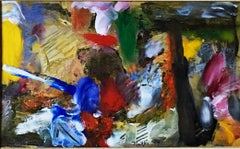
Unique historic work Hand signed and dated on the front An exceptionally early gouache from 1957, executed on the verso of a Wells Street Gallery invitation card - one of the first c...
Watercolor, Gouache
"Letter Q" From the suite "Alphabet"
By Erté
Located in San Francisco, CA
This artwork titled "Letter Q" from the suite "Alphabet" 1976, is an original colors lithograph and serigraph on Wove paper by renown Russian/French artist Erte, AKA Romain de Tirtof...
Screen, Lithograph
$24,500
H 17.25 in W 13.75 in
Gerlach's Allegorien, plate #66: "Tragedy" Lithograph, Gustav Klimt.
By Gustav Klimt
Located in Palm Beach, FL
Gustav Klimt created this image for inclusion in Gerlach & Schenk’s Allegorien the year before he formed the Vienna Secession. While this design is similar to his other inclusions, L...
Lithograph
$1,350
H 17 in W 15.5 in D 2 in
Morandi Bottle XX (Cubist Abstract Bottle Still life in Vintage Frame)
By David Dew Bruner
Located in Hudson, NY
Abstract modernist style still life graphite drawing inspired by Giorgio Morandi's bottle still life paintings "Morandi XX” by Hudson Valley artist, David Dew Bruner, made in 2025 G...
Paper, Graphite
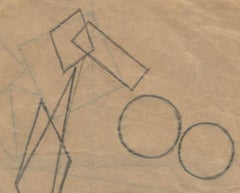
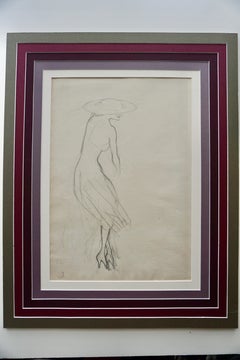
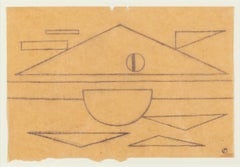
Untitled (Prison Drawing)
By Rudolf Bauer
Located in Columbia, MO
Original drawing by Rudolf Bauer, signed 'B' lower recto. Rudolf Bauer was born in 1889 into a comfortable, but not well-to-do, family on the border between Germany and Poland, and ...
Paper, Pencil
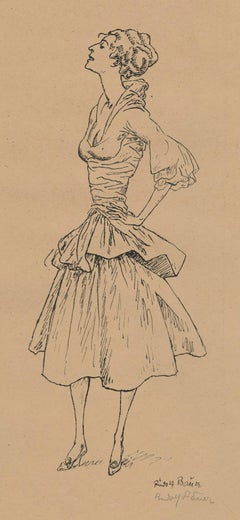
untitled (Woman with Hands on Hips)
By Rudolf Bauer
Located in Fairlawn, OH
untitled (Woman with Hands on Hips) Lithograph on tan wove paper, c. 1910's Signed in pencil lower right and in the plate, lower right (see photo) Edition: c. 100 Condition: Excellent Image size: 11-1/4 x 4-1/2 inches Sheet size: 18 1/8 x 11 3/8 inches Provenance: Estate of the Artist Borghi & Company, New York Herb Lerner, Boca Raton, FL Rudolph Bauer 1889-1953 Rudolf Bauer was born in Lindenwald near Bromberg, Silesia, in 1889 but his family moved only a few years later to Berlin. In 1905 Bauer began his studies at the Berlin Academy of Art but left the Academy only a few months later to educate himself. The upshot was paintings, caricatures and comical drawings which were published in 'Berliner Tageblatt', 'Ulk' and 'Le Figaro'. From 1912 Bauer contributed to the magazine and Gallery 'Der Sturm' founded by Herwarth Walden and pivotal to German Expressionism and the international avant-garde. In 1915 Rudolf Bauer participated for the first time in a group show at Walden's gallery. There he met Hilla von Rebay, with whom he began a relationship of many years that was crucial to Bauer's later work. By 1922 Bauer had shown work at about eight exhibitions mounted by 'Der Sturm'. From 1918 he also taught at the 'Der Sturm' art school, where Georg Muche was the director. After the war ended, Bauer was a founding member of the 'November Group' although he did not collaborate closely with the group. In 1919 Bauer joined forces with the painter and architect Otto Nebel...
Lithograph
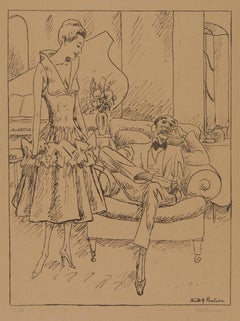
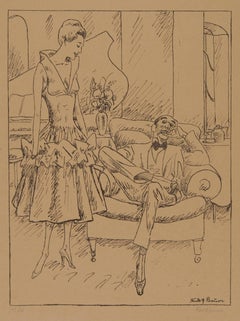
In the Salon
By Rudolf Bauer
Located in Fairlawn, OH
In the Salon Lithograph on tan wove paper, c. 1910 Signed in pencil lower right; signed in the plate lower right (see photo) Annotated "No. 20" in pencil lower left (see photo) Condition: Excellent Image size: 13-7/8 x 10-1/2 inches Sheet size: 19 x 14 1/4 inches Provenance: Estate of the Artist Borghi & Co., New York Herb Lerner, Boca Raton, FL Rudolph Bauer 1889-1953 Rudolf Bauer was born in Lindenwald near Bromberg, Silesia, in 1889 but his family moved only a few years later to Berlin. In 1905 Bauer began his studies at the Berlin Academy of Art but left the Academy only a few months later to educate himself. The upshot was paintings, caricatures and comical drawings which were published in 'Berliner Tageblatt', 'Ulk' and 'Le Figaro'. From 1912 Bauer contributed to the magazine and Gallery 'Der Sturm' founded by Herwarth Walden and pivotal to German Expressionism and the international avant-garde. In 1915 Rudolf Bauer participated for the first time in a group show at Walden's gallery. There he met Hilla von Rebay, with whom he began a relationship of many years that was crucial to Bauer's later work. By 1922 Bauer had shown work at about eight exhibitions mounted by 'Der Sturm'. From 1918 he also taught at the 'Der Sturm' art school, where Georg Muche was the director. After the war ended, Bauer was a founding member of the 'November Group' although he did not collaborate closely with the group. In 1919 Bauer joined forces with the painter and architect Otto Nebel...
Lithograph
Reclining Nude on Bed
By Rudolf Bauer
Located in Fairlawn, OH
Reclining Nude on Bed Lithograph, c. 1910 Signed in pencil lower right and in the plate, lower right Image size: 7-1/4 x 13" Sheet size: 12 1/2 x 19 inches Condition: very good Some aging to the tan paper Provenance: Estate of the Artist Borghi & Company, New York Rudolph Bauer 1889-1953 Rudolf Bauer was born in Lindenwald near Bromberg, Silesia, in 1889 but his family moved only a few years later to Berlin. In 1905 Bauer began his studies at the Berlin Academy of Art but left the Academy only a few months later to educate himself. The upshot was paintings, caricatures and comical drawings which were published in 'Berliner Tageblatt', 'Ulk' and 'Le Figaro'. From 1912 Bauer contributed to the magazine and Gallery 'Der Sturm' founded by Herwarth Walden and pivotal to German Expressionism and the international avant-garde. In 1915 Rudolf Bauer participated for the first time in a group show at Walden's gallery. There he met Hilla von Rebay...
Lithograph
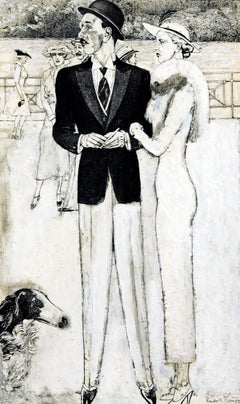
The Artist and His Wife
By Rudolf Bauer
Located in Fairlawn, OH
The Artist and His Wife Pen and ink heightened with white Signed in ink lower right Estate stamp verso Image size: 19 1/4 x 11 7/8 inches Provenance: Estate of the Artist Borghi & Company, New York Rudolph Bauer 1889-1953 "Rudolf Bauer was born in Lindenwald near Bromberg, Silesia, in 1889 but his family moved only a few years later to Berlin. In 1905 Bauer began his studies at the Berlin Academy of Art but left the Academy only a few months later to educate himself. The upshot was paintings, caricatures and comical drawings which were published in 'Berliner Tageblatt', 'Ulk' and 'Le Figaro'. From 1912 Bauer contributed to the magazine and Gallery 'Der Sturm' founded by Herwarth Walden and pivotal to German Expressionism and the international avant-garde. In 1915 Rudolf Bauer participated for the first time in a group show at Walden's gallery. There he met Hilla von Rebay...
Gouache
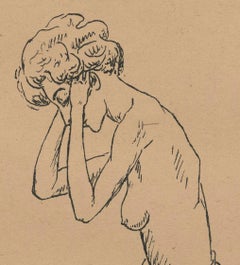
Profile of a Woman - Study
By Rudolf Bauer
Located in Berlin, MD
Rudolf Bauer (German, 1881 - 1953). "Profile of a Woman". Pencil drawing. c1905. A study work showing the artist attempting to find the right pose to enhance the figure: several diff...
Paper, Graphite
Sold
H 16.5 in W 11 in
Seated Nude / Arms Raised (Head reclines on back of chair)
By Rudolf Bauer
Located in New Orleans, LA
A full frontal nude sits in a chair with head resting and upraised arms. Her large breasts and pubic hair are both visible. It is signed and numbered No. 3 in pencil. It is also s...
Lithograph
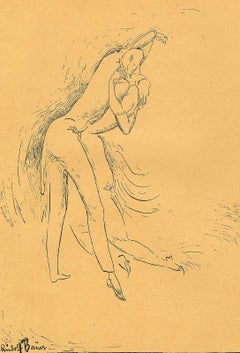
On the Dance Floor (a couple dances)
By Rudolf Bauer
Located in New Orleans, LA
Rudolf Bauer depicts a dancing couple in another vignette of German society in the early 20th Century. Rudolf Bauer was born in 1889, in Lindenwald, Germany-Poland. The son of a wea...
Lithograph
Sold
H 10.5 in W 10 in
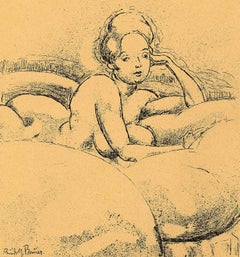
Woman Reclining on Pillows (Lady of leisure in German society of early 20th C)
By Rudolf Bauer
Located in New Orleans, LA
Rudolf Bauer depicts a nude woman reclining on pillows in another vignette of German society in early 20th Century. Rudolf Bauer was born in 1889, in Lindenwald, Germany-Poland. The...
Lithograph
A Woman and her shoe
By Rudolf Bauer
Located in New Orleans, LA
Rudolf Bauer depicts a woman adjusting one shoe in another vignette of German society in the early 20th Century. Rudolf Bauer was born in 1889, in Lindenwald, Germany-Poland. The so...
Lithograph
Seated Woman with Crossed Legs
By Rudolf Bauer
Located in New Orleans, LA
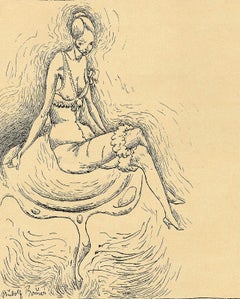
Rudolf Bauer depicts a confident young woman in a corset and garters seated with crossed legs in another vignette of German society in the early 20th Century...
Lithograph
Dancing (a couple dances)
By Rudolf Bauer
Located in New Orleans, LA
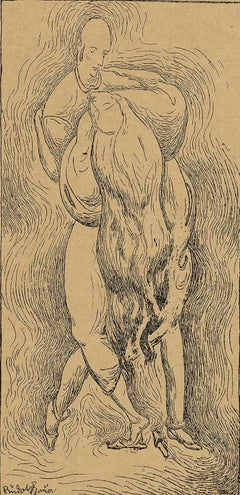
Rudolf Bauer depicts a dancing couple in another vignette of German society in the early 20th Century. Rudolf Bauer was born in 1889, in Lindenwald, Germany-Poland. The son of a wealthy engineer, Bauer became an essential part of the avant-garde movement and the birth of non-objective art in the early 1920's. Bauer began his studies at the Academy of Fine Arts in Berlin in 1905, where he learned the fundamentals and produced beautifully stylized figurative drawings. In 1912, Bauer met Herwarth Walden, a promoter of the avant-garde movement and founder of Der Sturm Art Gallery. Bauer became a member of Der Sturm, and was represented in group exhibitions along with Kandinsky, Picasso, Chagall, Klee et al. By 1922, Bauer had participated in 80 Der Sturm exhibitions in Belgium, Denmark, Great Britain, Italy, et al. In 1917, Bauer had his first one-man show at Der Sturm Gallery, exhibiting 120 works. By 1921, with his many one-man and group exhibitions, and his significant publications of his theories on art, Bauer became Germany's leading abstract expressionist painter. In 1929, Bauer founded his own private museum, Das Geistreich-Bauer (The Realm of the Spirit). In 1933, Hitler became Chancellor of the German Republic and with that modern art was branded as "sub-human". Walden closed Der Sturm and fled Germany. The purge of modern artists and curators began, but at the same time Bauer was having his work exhibited at the new Museum of Modern Art in New York City. Despite Hitler's proclamations of the "degeneracy" of modern art, Bauer continued his mission, the free expression in art, writing dictums and creating art. Meanwhile, Solomon R. Guggenheim, the famous American philanthropist, had been acquiring Bauer's work; so many pieces in fact that that he could no long fit his work within the confines of his residential suite at the Plaza Hotel in New York. In 1936, Guggenheim decided to exhibit his entire collection of Bauer's work in one venue, at the Gibbes Memorial Art Gallery in Charleston, SC. Later that year, the famous Jeu de Paume, a division of the Louvre, in Paris, honored Bauer with a one-man exhibition. As a result of the show, the Louvre purchased one of Bauer's oil paintings. Upon his return from the show at Jeu de Paume, and despite the fact he was not Jewish, Bauer was arrested and sent to a concentration camp. Filippo Marinetti...
Lithograph