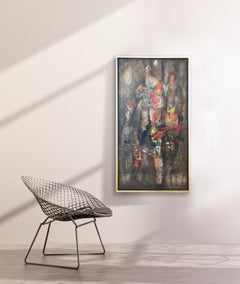
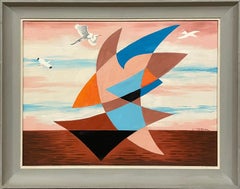
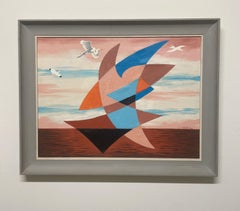
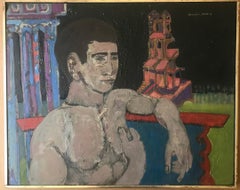
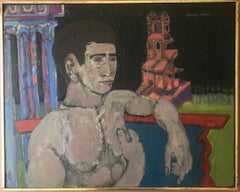
Sidney E. Zimmerman Paintings

American, 1926-2007

Sidney E. Zimmerman studied in Berlin during World War II and then at the School of the Brooklyn Museum of Art and the New York Art Students League under the influential Vaclav Vytlacil. He also spent time painting in Mexico City and Paris. Zimmerman exhibited in many group and one-man shows.

to
1
1
Overall Width
to
Overall Height
to
1
1
1
1
1
1
1
2
797
758
751
660
1
1
Artist: Sidney E. Zimmerman
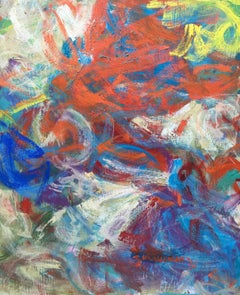
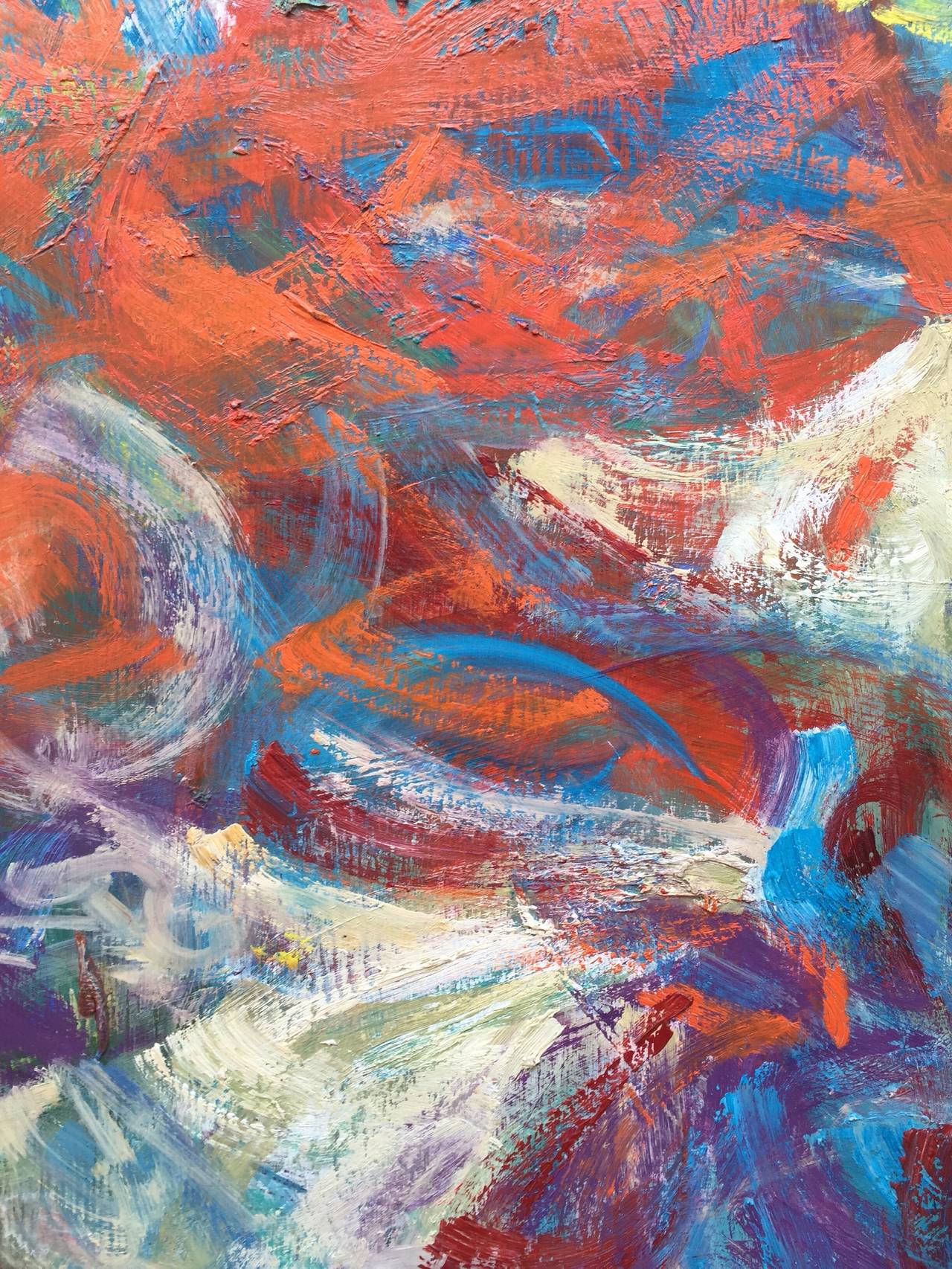
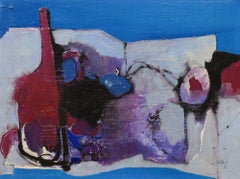
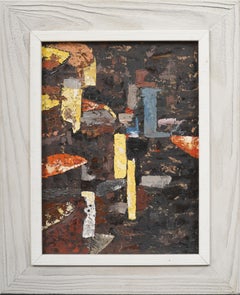
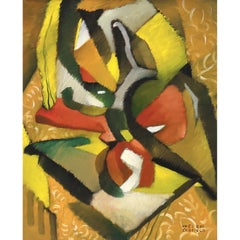
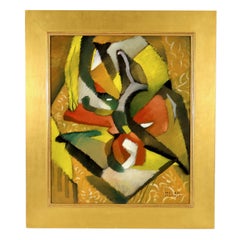
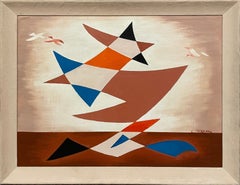
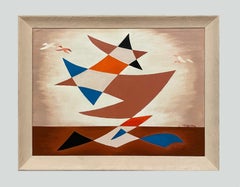
"Untitled"
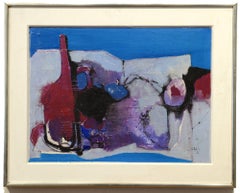
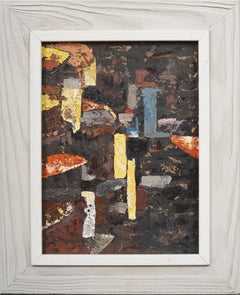
"Untitled"

Sidney E. Zimmerman"Untitled", 1961

$1,200Sale Price|46% Off

"Untitled"

By Sidney E. Zimmerman

Located in Southampton, NY

Sidney E.Zimmerman USA (1926-2007) studied at the Brooklyn a Museum of Art after returning from Europe during WWII. In 1950, he studied with Morris Kantor and Vaclav Vytlacil at the ...

Category

1960s Modern Sidney E. Zimmerman Paintings

Materials

Oil, Board

Related Items
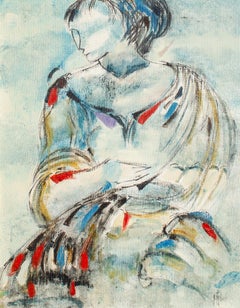
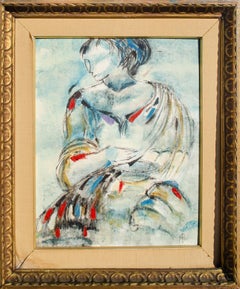
Original Style of Lazzaro Donati Painting of an Abstracted Woman

Original Style of Lazzaro Donati Painting of an Abstracted Woman

By Lazzaro Donati

Located in New York, NY

Style of Lazzaro Donati (Italian, 1926-1977) Untitled (Abstract Woman), Mid-20th Century Oil on board 20 x 16 in. Framed: 25 3/4 x 21 7/8 in. Signed lower right Lazzaro Donati (1926-1977) was born in Florence in 1926 and attended the Academy of Fine Arts. He began to paint in 1953, and in 1955 held his first exhibition at the Indiano Gallery in Florence. Within three years eleven exhibitions followed in Italy, and as his reputation grew he was invited to give major exhibitions in London, Paris, New York, Chicago, Rio de Janeiro and Montevideo. He is considered one of the foremost contemporary Italian painters and his paintings hang in museums and private collections throughout the Americas, Europe and Asia. Mr. Donati lived and worked at 24 Piazza Donatello in Florence, the square where generations of artists have created works worthy of the great Florentine tradition. As you entered the narrow hallway to his studio, a gilded life-size Venetian angel beckoned you to his door. Once inside, the present faded away and you found yourself in an atelier where early masters might have worked during the Renaissance. Within, luxurious Persian rugs set off the innumerable objects d'art and antique furnishings. Light poured in through the sloping glass wall on the north side. A dramatic stairway led to an overhanging balcony which served as a private gallery where the artist hung some of his favorite early works. To the left of the entrance was a smaller studio where Donati sculpted, with a window overlooking the famous old English cemetery where tourists laid flowers on the grave of Elizabeth Barrett Browning. In the main studio itself, where Donati received his clients in an atmosphere as polished as an office of a top executive, one hardly realized that it was here that the artist actually painted. His easel was covered with Persian blue velvet, the painting on the easel was already framed, his chair was upholstered in red velvet and on his palette the colors were arranged with the precision of a Byzantine mosaic. In a corner stand were his latest works, framed and ready to be sent off to his next exhibition in Europe or America. Donati was a born host with a warm welcome, an elegant man who possessed enormous charm a good nature and a keen sense of humor. Apparently shy, he preferred to speak on subjects extraneous to his art, purposely distracting you from his paintings, then leading you back to them, tactfully and without pretension. He spoke fluent French and English as well as some Spanish and German. "After all", he said, "you've got to know how to sell a painting to everyone." He had no sympathy for the "drip and splash" studios of his contemporaries, preferring to keep his studio tidy and spotless. "Painting is a matter of precision", he said, "If a painter can't put his paint where he wants it to go, I don't see how he can call himself a painter. For me it is absolutely necessary to control the paint." When asked to reveal the technique he used to achieve the enamel-like finish typical of his paintings he answered, "That is a secret between me and my butler. Actually, most of my paintings are done by him!" But in fact behind the façade, Donati was a serious craftsman who devoted to his painting as a way of life and means of expression. From the beginning of his career, his paintings revealed a striving for perfection and continual research in problems of style and technique. His early works indicated a momentary interest in surrealism and abstract art; they were predominantly two dimensional, depending on line and strong color. But by 1958, with his painting The Lady with a Fan...

Category

Mid-20th Century Modern Sidney E. Zimmerman Paintings

Materials

Oil, Board

Blue Still Life
Blue Still Life

Joel DurandBlue Still Life

$1,600

H 17 in W 23 in

Blue Still Life

Located in Wiscasset, ME

This vibrant work by noted 20th century American artist, Joel Durand, employs a bold palette and sophisticated approach in this dramatic and abstracted sti...

Category

1950s Modern Sidney E. Zimmerman Paintings

Materials

Oil, Board

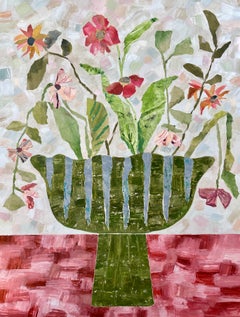
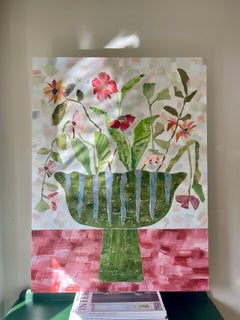
Studio Flowers, Dahlia, Clematis and Salvia, original painting, flowers

Studio Flowers, Dahlia, Clematis and Salvia, original painting, flowers

Located in Deddington, GB

An original still life from my Studio Flower series. A mixture of seasonal flowers in a decorated bowl, created in Oxfordshire. Each flower is hand crafted from Japanese paper and th...

Category

21st Century and Contemporary Modern Sidney E. Zimmerman Paintings

Materials

Oil, Board

Antique American School "City of Light" Abstract Architectural Framed Painting

Antique American School "City of Light" Abstract Architectural Framed Painting

Located in Buffalo, NY

Antique American modernist cityscape oil painting. Oil on canvasboard. Framed. Measuring: 21 by 17 inches overall, and 12 by 16 painting alone.. In excellent original condition. Han...

Category

1940s Modern Sidney E. Zimmerman Paintings

Materials

Oil, Board

Modern Abstract Earth Toned Cubist Inspired Figurative Harvest Scene Painting

Modern Abstract Earth Toned Cubist Inspired Figurative Harvest Scene Painting

Located in Houston, TX

Modern geometric figurative painting featuring Pablo Picasso inspired faces nestled amongst heavily abstracted harvest imagery. Reminiscent of a Cubist style of abstraction, the work...

Category

20th Century Modern Sidney E. Zimmerman Paintings

Materials

Oil, Board

"Abandoned Village, " 1960s Modern Abstract Painting

"Abandoned Village, " 1960s Modern Abstract Painting

By Stanley Bate

Located in Westport, CT

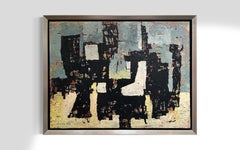
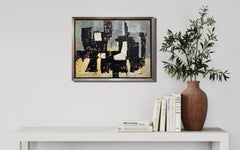
This Modern Abstract Expressionist painting by Stanley Bate is made with oil paint and and lacquer on board. It features light textured and a light blue-grey and yellow palette contrasted by the almost black focal point of the composition. The painting is 14.5" x 19" and measures 16.25" x 20.5" x 2" framed. Signed by the artist in the lower left-hand corner of the painting, it is framed in a floater frame with warm silver face and black sides and is ready to hang. Stanley Bate was born on March 26, 1903 in Nashville, Tennessee. The Bates were an established Tennessee family, in fact, Henry’s brother William Bate was the governor of Tennessee from 1883-1887 and a United States Senator from 1887-1905. Stanley studied art at the Watkins Institute in Nashville. In the 1920’s Bate moved to New York City to study at the Art Students League under Frederick Bridgman. He soon landed a job with Encyclopedia Britannica, and from 1927-1929 served as art editor. From 1929 until his death in 1972, Stanley was a self-employed artist. He taught art classes at both the Art Students League and the Albany Institute of History and Art and brought in extra income by making illustrations for magazines such as “Outdoor Life” and “Popular Science”. On January 27, 1934 Stanley married Emilie Rossel. Emilie had emigrated from Switzerland to New York in 1923. She found work as a governess to Alfred Vanderbilt and later as an executive secretary for Wall Street investment brokers Kahn, Loeb and Co. Emilie met Stanley in New York in the early 1930’s when she attended one of his art exhibitions with a friend. The couple, who had no children, lived on 34th Street in Manhattan. During this period, Bate was producing and exhibiting his art and joined several artists groups. Stanley and Emilie became part of the New York art scene, dining weekly at the Society of Illustrators Clubhouse. Stanley Bate’s time in New York was pivotal in the formation of his painting style. He lived in New York during the inception of one of the most important Modern Art movements, one that helped New York replace Paris as the center of avant-garde art. This movement, which was called the New York School of artists, was later known as Abstract Expressionism. It was comprised of a loosely associated group of vanguard artists working in New York City during the 1940s and 1950s. The New York School was not defined by a specific style, but instead reflected a fusion of European Modernism and American social relevancy that was depicted in many individual styles. Influences of Surrealism, Cubism, and Modernism can be found in their work, along with an interest in experimenting with non-traditional materials and methods. American art was in the forefront of international avant-garde for the first time. Stanley Bate was undoubtedly exposed to the varied styles and techniques that were emerging during the formative years of the New York School. Mark Rothko and Robert Motherwell were formulating their versions of color field paintings. Joseph Cornell was experimenting with assemblages, collage and the use of different types of textured paints. Jackson Pollock was adhering objects such as buttons and coins into his early works, while Louise Nevelson was using found objects. Helen Frankenthaler added sand to her early paintings. The New York School artists were undermining traditional fine art by using mixed media and non-traditional methods. Stanley Bate absorbed these varied influences and soon his early realistic landscapes and still-lifes were replaced with something entirely new. The influence of Cubism, notably the flat shallow space of the picture plane, is obvious in many of Bate’s paintings. Surrealism is evident in Bate’s use of subjects from myth, primitive art and antiquity, along with the Automatism-like line work in his more linear images. The unfettered experimentation of the New York School is everywhere in Stanley Bate’s work. We see nods to color field, collage, the mixing of textures into paint, mixed media, the inclusion of found objects and thick, luscious impasto. Bate was prolific and experimented in various media including oil, watercolor, lithography, silk screen, wood cut, drawing, collage, ceramics and sculpture. Bate is considered a true Modernist. His work is largely abstract, but sometimes figures and buildings are discernable. He frequently mixed paint, sand and glue together to achieve a textured surface, and then scraped and scratched through this layer to expose some of the underpainting below. His sculpture, which is often whimsical, also reflects the non-traditional methods of the New York School. Bate pioneered the use of enamel and copper in his work. The sculptures are not carved or modeled as was done in the past, but instead are built using mixed media and new materials. In addition to the New York School influence, many of Bate’s works exhibit a strong connection to the Spanish school, especially the work of Antonio Tapies and Modesto Cuixart. These artists were both part of an avant-garde group known as Art Informel, the Spanish equivalent of Abstract Expressionism. These artists likewise worked in mixed media and introduced objects and texture into their work. Many of Bate’s subjects and titles relate to Spanish locations and words. It is likely that Stanley spent time in Spain and found inspiration there. By the early 1940s, Stanley and Emilie had started spending weekends in a barn they purchased in Craryville, New York, a few hours north of Manhattan. The barn had no electricity or plumbing, but when the Bates eventually decided to leave New York and live full time in Craryville, they remodeled the barn, putting a gallery downstairs and a studio and living quarters upstairs. Although the Bates moved out of New York City, Stanley remained part of the New York art scene, exhibiting in New York and elsewhere throughout the 50s and 60s. During his lifetime he was represented by the New York galleries Knoedler and Company, Kennedy Galleries, Rose Fried Gallery and Key Gallery, along with Tyringham Gallery located in Tyringham, Massachusetts. Craryville was Stanley’s home until his death on August 21, 1972. Emilie died 1984...

Category

1960s Modern Sidney E. Zimmerman Paintings

Materials

Lacquer, Oil, Board
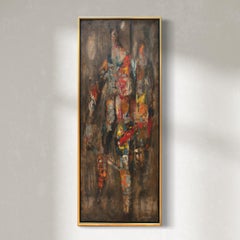
Exceptional 1930s abstract oil painting by woman artist Helen Clark Oldfield.

Exceptional 1930s abstract oil painting by woman artist Helen Clark Oldfield.

By Helen Clark Oldfield

Located in Colfax, CA

Exceptional early American abstract oil painting by California artist Helen Clark Oldfield. Helen Clark Oldfield, (1902–1981), was born in Santa Rosa, CA. She studied art and design...

Category

1930s American Modern Sidney E. Zimmerman Paintings

Materials

Oil, Board

wild flowers soho Dahlias, original painting, flower painting, contemporary

wild flowers soho Dahlias, original painting, flower painting, contemporary

Located in Deddington, GB

Original Still Life painting inspired by flowers arranged in my studio in Moroccan inspired ceramics. Additional information: Oil, Oil on Panel 83 H x 63 W x 5 D cm (32.68 x 24.80 x...

Category

2010s Modern Sidney E. Zimmerman Paintings

Materials

Oil, Board

"Centurion, " 1960s Modern Abstract Painting

"Centurion, " 1960s Modern Abstract Painting

By Stanley Bate

Located in Westport, CT

This vertical format abstract painting by Modernist artist Stanley Bate measures at 26" x 50" framed. The original gold-hued floater frame pulls out the vibrant and warm pops of yell...

Category

1960s Modern Sidney E. Zimmerman Paintings

Materials

Gold Leaf

Ron Gorchov Mid Century Modern Self Portrait Signed painting abstract figuration

Ron Gorchov Mid Century Modern Self Portrait Signed painting abstract figuration

By Ron Gorchov

Located in New York, NY

Ron Gorchov Historic Self Portrait, 1955-1959 Oil painting on board Hand signed in paint on the upper recto and dated 1955-9 Frame included: held in original vintage artist's frame T...

Category

Mid-20th Century Modern Sidney E. Zimmerman Paintings

Materials

Oil, Board

Sidney E. Zimmerman paintings for sale on 1stDibs.

Find a wide variety of authentic Sidney E. Zimmerman paintings available for sale on 1stDibs. If you’re browsing the collection of paintings to introduce a pop of color in a neutral corner of your living room or bedroom, you can find work that includes elements of green and other colors. You can also browse by medium to find art by Sidney E. Zimmerman in board, oil paint, paint and more. Much of the original work by this artist or collective was created during the 1960s and is mostly associated with the modern style. Not every interior allows for large Sidney E. Zimmerman paintings, so small editions measuring 24 inches across are available. Customers who are interested in this artist might also find the work of Donald Stacy, Louis Wolchonok, and Harold Haydon. Sidney E. Zimmerman paintings prices can differ depending upon medium, time period and other attributes. On 1stDibs, the price for these items starts at $1,200 and tops out at $1,200, while the average work can sell for $1,200.