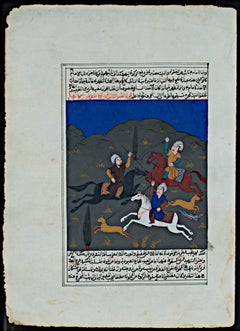
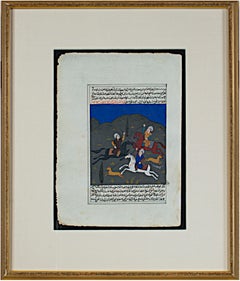
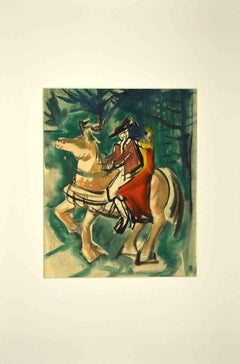
The present illuminated folio page contains a fine miniature depicting three figures hunting while on horseback, an image meant to accompany a historic epic. During the medieval period, hunting was an important pastime of male nobility throughout the Islamic world. The Quran itself explicitly endorses hunting and the use of animals to aid in capturing prey: "Lawful to you are foodstuffs that are good to eat and any game that, at your wish, is captured by beasts of prey which train as you do dogs, according to the method that Allah has taught you, after you have spoken the name of Allah over it." (Q 6:4) Muslim princes and nobles enjoyed the chase of the prey via horseback, using bow and arrow, crossbows, and blowpipes to capture their prey Horseback riding itself trained young men in the necessary skills for armed combat and warfare, developing their speed and strength.
12 x 8.25 inches, artwork
19.75 x 15.88 inches, frame
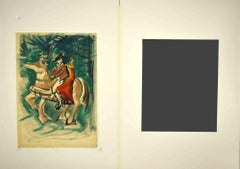
accompanied on the back with an image of the verso
framed to conservation standards with a 100% rag silk-lined mat in a gold gilded frame
A Persian miniature is a small Persian painting on paper, whether a book illustration or a separate work of art intended to be kept in an album of such works called a muraqqa. The techniques are broadly comparable to the Western and Byzantine traditions of miniatures in illuminated manuscripts. Although there is an equally well-established Persian tradition of wall-painting, the survival rate and state of preservation of miniatures is better, and miniatures are much the best-known form of Persian painting in the West, and many of the most important examples are in Western, or Turkish, museums. Miniature painting became a significant genre in Persian art in the 13th century, receiving Chinese influence after the Mongol conquests, and the highest point in the tradition was reached in the 15th and 16th centuries. The tradition continued, under some Western influence, after this, and has many modern exponents. The Persian miniature was the dominant influence on other Islamic miniature traditions, principally the Ottoman miniature...
Category
19th Century Other Art Style Unknown Mixed Media
MaterialsInk, Tempera, Laid Paper