Napoleon III Clocks

181 Results
NAPOLEON III STYLE

Under Napoleon III’s rule, Paris underwent a great rebuilding overseen by Baron Georges-Eugène Haussmann, which created grand avenues and lavish landmarks like the Paris Opera. Antique Napoleon III–style furniture was flamboyant and eclectic. It was also known as Second Empire style since it followed and referenced the Empire style of his uncle Napoleon I.

Developing from 1852–70, Napoleon III furniture was plush and ornate, matching the fashion for masked balls and socializing in salons. It borrowed freely from earlier French styles including Louis XIV, Louis XV and Louis XVI as well as aesthetics from around the world, from antiquity to Asian art. As writer Gustave Claudin remarked in 1867, the country’s architects worked in “a style which one would be tempted to call neo-Greco-Gothico-Pompadour-Pompeian.”

Napoleon III chairs were completely covered with velvet and lined with tassels; pouf footstools invited people to put up their feet. Sofas were upholstered with tapestries, and beds were adorned with gilt bronze and theatrical canopies. The addition of conservatories to homes led to new indoor-outdoor furniture, while the spirit of hygiene promoted by Baron Haussmann inspired bright, floral motifs.

Although the most ostentatious designs were for the elite, as seen in the Napoleon III apartments preserved in the Louvre, where red velvet, gilding and chandeliers create a cacophony of luxury, these trends influenced homes across classes as manufacturing made design increasingly accessible. Papier-mâché furniture allowed for elaborate shapes that would have been difficult to carve in wood. The malleable material was painted with chinoiserie patterns and decorative designs. It was mass-produced by factories such as Jennens and Bettridge with varnishing and mother-of-pearl inlays creating an effect reminiscent of Asian lacquer. (Surfaces that had been “japanned” — a specialty of Jennens and Bettridge — were intended to resemble lacquer work that was created in East Asia.)

Find a collection of antique Napoleon III decorative objects, tables, seating and other furniture on 1stDibs.

to
19
181
130
42

Use search to find more

434
344
329
283
257
231
230
196
179
115
104
78
47
40
38
37
21
7
1
169
11
2
4
4
1
1
3
4
160
116
49
42
41

Use search to find more

5
4
4
3
3

Use search to find more

Style: Napoleon III
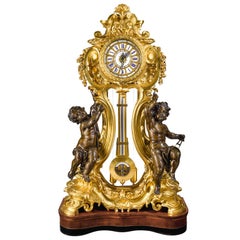
Palatial & Rare Napoleon III French Ormolu and Patinated Bronze Clock, Detouche

Palatial & Rare Napoleon III French Ormolu and Patinated Bronze Clock, Detouche

By C. Detouche

Located in Long Island City, NY, NY

A Palatial and Extremely Rare Napoleon III French Ormolu and Patinated Bronze Regulateur de Parquet Clock by Louis-Constantin Detouche, Paris, Circa 1850 An exceptional testament to the grandeur and technical mastery of 19th-century French horology, this palatial and extraordinarily rare Napoleon III ormolu and patinated bronze Regulateur de Parquet clock stands as a crowning achievement of the renowned Parisian horologist Louis-Constantin Detouche. Created circa 1850, this monumental timepiece exemplifies the perfect synthesis of artistic opulence and mechanical precision, distinguishing itself as one of the most impressive works from Detouche’s illustrious oeuvre. At over six feet tall, this clock’s imposing scale and decorative grandeur make it an object of immense historical and aesthetic significance. The case, crafted from the finest French ormolu, features two majestic patinated bronze seated putti, serving as allegorical figures and underscoring the artistic sophistication characteristic of the Second Empire style. The white enamel dial, elegantly signed "C. Detouche/Paris," affirms its prestigious maker, while the movement, meticulously numbered 7064 and bearing the stamps "C. Detouche RUE St. MARTIN" and "C. DETOUCHE 158 R. St MARTIN 160," speaks to the highest standards of 19th-century horological craftsmanship. Further distinguishing this piece is the medaille d’argent stamp, a testament to the numerous accolades and awards bestowed upon Detouche for his innovations in timekeeping. A Masterpiece of Horological Artistry: Louis-Constantin Detouche was not merely a clockmaker; he was a visionary whose contributions to horology redefined precision and complexity. This particular regulator clock...

Category

19th Century French Antique Napoleon III Clocks

Materials

Bronze, Ormolu

Napoleon Iii clocks for sale on 1stDibs.

Find a broad range of unique Napoleon III clocks for sale on 1stDibs. Many of these items were first offered in the Late 20th Century, but contemporary artisans have continued to produce works inspired by this style. If you’re looking to add vintage clocks created in this style to your space, the works available on 1stDibs include decorative objects, more furniture and collectibles, wall decorations and other home furnishings, frequently crafted with metal, bronze and other materials. If you’re shopping for used Napoleon III clocks made in a specific country, there are Europe, France, and Germany pieces for sale on 1stDibs. While there are many designers and brands associated with original clocks, popular names associated with this style include Europa Antiques, Raingo Frères, Ferdinand Barbedienne, and Henri Picard. It’s true that these talented designers have at times inspired knockoffs, but our experienced specialists have partnered with only top vetted sellers to offer authentic pieces that come with a buyer protection guarantee. Prices for clocks differ depending upon multiple factors, including designer, materials, construction methods, condition and provenance. On 1stDibs, the price for these items starts at $706 and tops out at $2,500,000 while the average work can sell for $8,006.