Carved Busts

414 Results
to
58
405
5
4
59
159
187
9
63
42
50
14
1
2
4
5
7
5
5
1
31
18
17
14
13
12
11
7
5
4
3
2
1
274
216
109
54
53
210
192
293
113
82
32
25
Height
to
Width
to
414
412
413
3
2
2
2
2
Technique: Carved
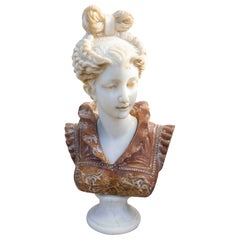
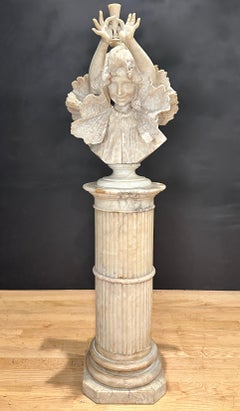
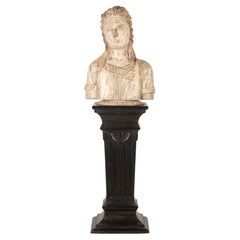
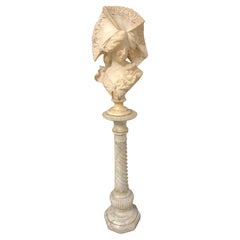
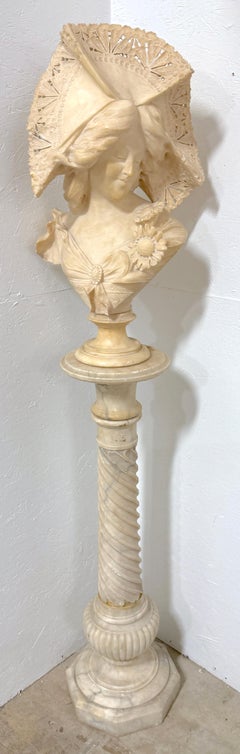
Monumental Italian Carved Alabaster Art Nouveau Bust, by A. Cipriani & Pedestal

Monumental Italian Carved Alabaster Art Nouveau Bust, by A. Cipriani & Pedestal

By Adolfo Cipriani

Located in West Palm Beach, FL

Monumental Signed Adolfo Cipriani Italian Carved Alabaster Bust with Pedestal, circa 1900 A monumental and exquisitely carved alabaster bust by Adolfo Cipriani (Italian, 1857–1941),...

Category

Early 20th Century Italian Romantic Carved Busts

Materials

Alabaster

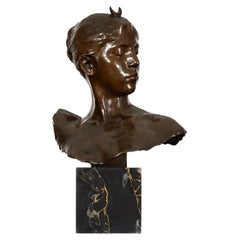
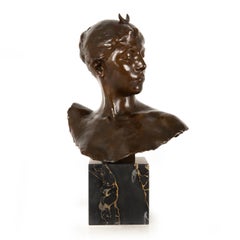
French Antique Bronze Sculpture Bust of Diana by Falguiere ca. 1880

French Antique Bronze Sculpture Bust of Diana by Falguiere ca. 1880

By Thiebaut Freres

Located in Shippensburg, PA

JEAN-JOSEPH-ALEXANDRE FALGUIÈRE French, 1831-1900 "Bust of Diana the Huntress" (1882) Patinated bronze over Nero Portero marble base Signed on shoulder "A. Falguiere", foundry cach...

Category

19th Century French Romantic Antique Carved Busts

Materials

Marble, Bronze

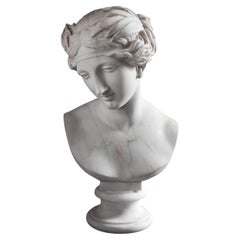
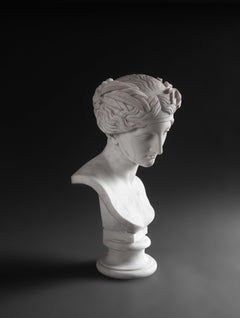
Bust of a Naiad, Attributed to John Gibson RA, Hand-Carved Carrara marble

Bust of a Naiad, Attributed to John Gibson RA, Hand-Carved Carrara marble

By John Gibson, R. A.

Located in York, GB

This finely executed bust of a Naiad is attributed to the neoclassical sculptor John Gibson (1790 – 1866). A Naiad was a type of mythological water nymph and is depicted here with her head bowed and cocked slightly to the side, displaying her strong neo-Hellenistic profile. In her hair, the nymph wears a headdress that is comprised of long and slender reed leaves, which not only identifies her iconographically as a water spirit, but draws a close comparison with those worn by the female figures in John Gibson’s Hylas Surprised by the Naiades (1827 - 1837) (fig.1). The downwards and off-centre orientation of our Naiad bust mirrors that of the taller figure on the left of the group, who rests her cheek on the head young Hylas (fig.2) Her facial physiognomy follows the neo-Hellenistic archetype established by Gibson and can be closely compared with his Tinted Venus – one of the most important statues of the Victorian era (1851–56, Walker Art Gallery, Liverpool) (fig.3). While Gibson’s Tinted Venus is known best for its controversial polychrome ‘tinting’, the essential structure of the face—broad brow, finely drawn nose, wide (and slightly drooping) almond-shaped eyes - provided a template that Gibson returned to repeatedly in his depiction of mythological maidens. Critics of the time noted the consistency of his female types, with some seeing their idealised severity as an antidote to the sentimentality of much mid-Victorian sculpture (fig.4 – 6). The facial physiognomy is also very similar to a drawing by Gibson at the Royal Academy that depicts Hero weeping over the dead body of Leander (fig.7). The socle style of the present work also finds comparisons with Gibsons busts of Cupid and Aurora. This was of course somewhat standardised, but it is interesting to note the extent of their similarity with our bust. John Gibson RA is considered by many to be the greatest British sculptor of the nineteenth century working in the Neoclassical style. It is hard to overestimate the impact Rome had on the life and art of the artist. He first arrived in the city around 1817, when he was just twenty-six, and remained a resident there until his death. Not only did Rome’s ancient sculptural treasures and architectural fragments offer Gibson a lifetime of inspiration, but the Grand Tourists who poured into Rome in the first half of the nineteenth century provided him with many commercial opportunities. These rich or aristocratic travellers sought out mythological sculptures for their grand, palatial residences. However, since the papal decrees of Doria Pamphilj and Pacca of 1803 banned the export of ancient Greek and Roman works of art from Rome, there was a large demand for modern idealised sculpture in the Neoclassical style (Frasca-Rath 2016, p. 10). During his early days in the city he had the great fortune to train under both Antonio Canova and Bertel Thorvaldsen (Roscoe and Hardy 2009, p. 522). He referred continuously to Canova as his “master”, particularly in his memoirs, which he dictated to Margarete Sandbach at the beginning of the 1850s; these were subsequently published by Lady Eastlake in 1870. Moreover, he claimed to be Canova’s last pupil in a letter to Antonio Gacini, Secretary of the Royal Academy in Milan in 1861, written to thank the Academy for accepting him as an Honorary Member: “The first instruction which I received in my art was from an Italian. It was Canova whose pupil I became in the year 1817 and studied under him for five years when he died. I was his last pupil” (Royal Academy Archive GI/1376). By 1821, Gibson had established his own studio in the via Fontanella, off the via Babuino. From here he aimed to produce sculpture of “the sublime and the purest beauty”, believing that the sculptor’s role was to select and combine the most beautiful parts of nature to create a harmonious whole, which would delight and elevate the viewer. By the mid nineteenth century he was one of the few remaining exponents of the so-called ‘pure’ and ‘neo Hellenistic’ style of sculpture, resolutely upholding the Neoclassical ideals established by Wincklemann, in a period when naturalism and modern subjects preoccupied the majority of artists in Europe (Turner, ed., 1996, p. 598). Gibson was convinced of the importance of disseminating artistic ideas through the younger generations, an ideal no doubt impressed upon him by Canova, and established ‘the British Academy of Arts in Rome’. His students included William Theed (1804–1891), Benjamin Spence (1822–1866), Harriet Hosmer...

Category

Mid-19th Century Italian Neoclassical Antique Carved Busts
Materials

Carrara Marble

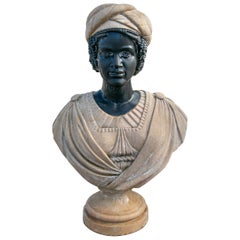
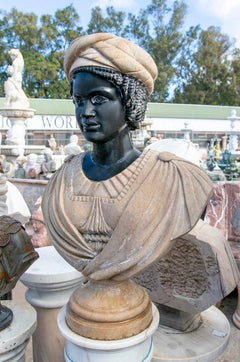
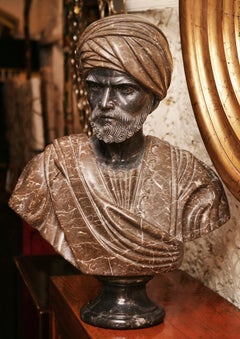
Classic Marble Bust in Two Tones with Black and Beige Contrast

Classic Marble Bust in Two Tones with Black and Beige Contrast

Located in Marbella, ES

An elegant, classically inspired sculptural bust carved from two-tone marble, highlighting the refined contrast between the polished black marble of the face and the veined beige mar...

Category

Late 20th Century Neoclassical Carved Busts

Materials

Marble

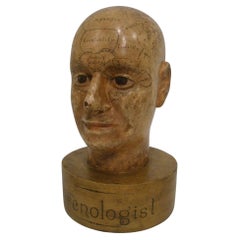
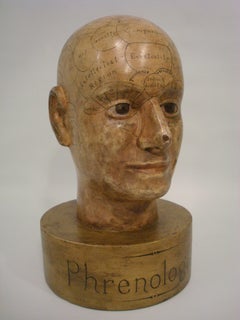
Wooden Phrenology Head Advertising Store Display Model Folk Art Americana

Wooden Phrenology Head Advertising Store Display Model Folk Art Americana

Located in Buenos Aires, Olivos

Carved and painted wooden phrenology head Store display advertising model. Phrenology bust by unknown wood carver, circa 1870. Perfect to decorate a Do...

Category

Late 19th Century American American Craftsman Antique Carved Busts

Materials

Wood

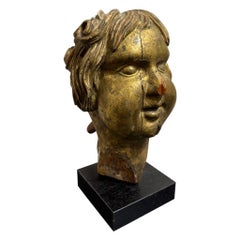
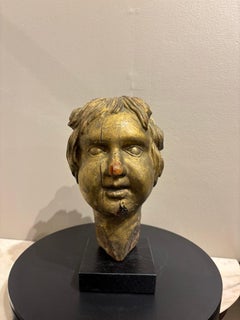
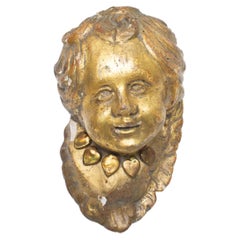
18th Century Italian Carved Gilt Wood Head of an Angel

18th Century Italian Carved Gilt Wood Head of an Angel

Located in Stamford, CT

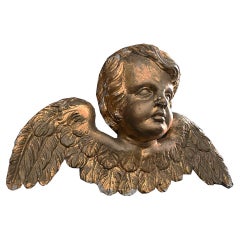
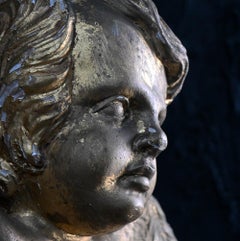
18th century Italian carved giltwood head of an angel. Hand carved with a vivid expression and just amazing hair. A peg on the reverse for attachment to a larger relief or group scul...

Category

Early 18th Century Italian Baroque Antique Carved Busts

Materials

Giltwood

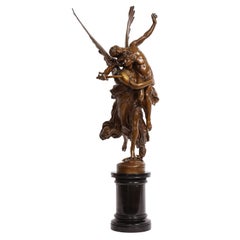
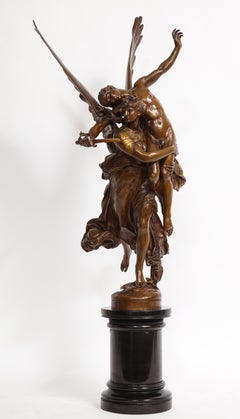
French 19th C Gilt and Patinated Bronze Group of Gloria Victis, by A. Mercie

French 19th C Gilt and Patinated Bronze Group of Gloria Victis, by A. Mercie

By Antonin Mercie, F. Barbedienne Foundry

Located in New York, NY

An Incredible and Large Gilt and Patinated Bronze Group of Gloria Victis, a Winged Figure of Victory with a Fallen Warrior. This incredible bronze piece was cast after a model by Maarius-Jean-Antonin Mercié, This model is signed 'F. BARBEDIENNE FONDEUR PARIS' demonstrating that it was cast by Ferdinand Barbedienne's foundry, the best bronzier of the 19th century. The base is further signed 'A. Mercie' and stamped 'Réduction Mécanique' with an inscription of '659'. The figure is mounted on a Belgian noir marble base with various stepped edges. Gloria Victis is one the most well-known and important bronze casts of the 19th Century. The quality of this particular model is absolutely incredible and all the marking indicate that this particular piece is one of the finest produced by the Foundry. A student of Jouffroy and de Falguière at the Ecole des Beaux-Arts, Marius-Jean-Antonin Mercié (1845-1916) won the Grand Prix de Rome at 23 years old with his work Thésée vainqueur du Minotaure. In 1872, he sent the plaster model of his work David vainqueur to the Salon, for which he won the first class medal. At the same time, he received La croix de la Légion d'honneur at the Villa Medici. His return to Paris, in 1874, issued in a long and brilliant career with numerous commissions, notably the monuments for Louis-Philippe and Queen Marie-Amélie for the Royal Chapel at Dreux (1886). By the age of 30 Mercié was already very well-known and his Gloria Victis received resounding success when it was exhibited at the Salon, in 1874 (in plaster) and in 1875 (in bronze). This work exalted the heroism and the patriotic sentiments aroused by the disasters of 1870. His predilection for patriotic subjects is shown in many of his works such as Quand même...

Category

19th Century French Louis XVI Antique Carved Busts

Materials

Belgian Black Marble, Bronze

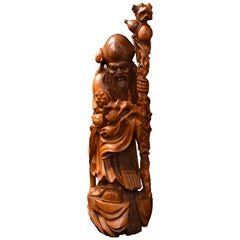
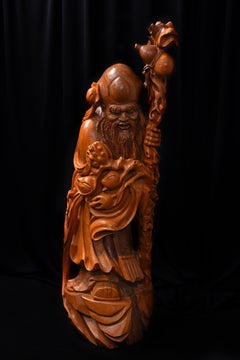
Large Chinese Carved Sculpture of Shou Xing God of Wisdom and Longevity

Large Chinese Carved Sculpture of Shou Xing God of Wisdom and Longevity

Located in San Diego, CA

Stunning Chinese sculpture of Shou Xing God of Wisdom and Longevity. Richly carved in organic burl wood. circa 1960s. Measure: 45.5" High. X.

Category

1960s Chinese Organic Modern Vintage Carved Busts

Materials

Burl

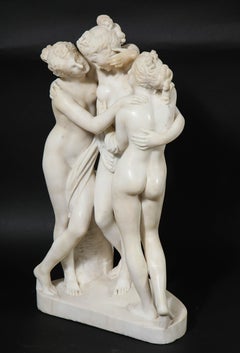
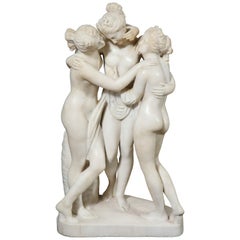
An Italian Carrara Marble Model of the Three Graces, after Antonio Canova

An Italian Carrara Marble Model of the Three Graces, after Antonio Canova

Located in New York, NY

An Impressive 19th Century Italian Hand-Carved Carrara Marble Model of The Three Graces, Originally by Antonio Canova. The carving on this piece is exceptionally well done. The faces, hair, hands and draped clothing...

Category

1850s Italian Louis XVI Antique Carved Busts

Materials

Carrara Marble

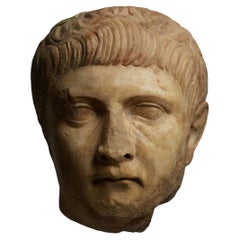
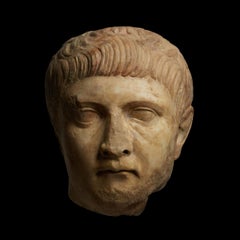
Ancient Roman Head of General Drusus the Younger in Marble

Ancient Roman Head of General Drusus the Younger in Marble

Located in BARCELONA, ES

42 cm with the stand. Provenance - Private collection, Paris, France. Nero Claudius Drusus, better known as Drusus the Younger or the Minor to distinguish him from his uncle, Drusu...

Category

15th Century and Earlier Greco Roman Antique Carved Busts

Materials

Marble

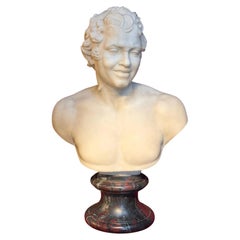
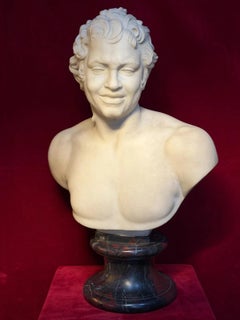
Italian Grand Tour Carrara Marble Bust of Satyr 19th Century

Italian Grand Tour Carrara Marble Bust of Satyr 19th Century

Located in Nottingham, GB

A striking late 19th-century Italian carved marble bust after the celebrated satyr faun (also known as the Laughing Faun), one of the most admired sculptures of classical antiquity. ...

Category

Late 19th Century Antique Carved Busts

Materials

Marble

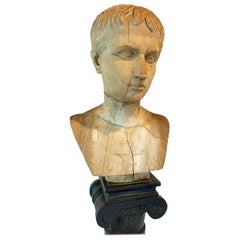
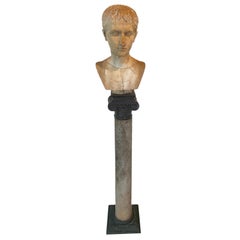
Antique Marble Bust of Young Caesar

Antique Marble Bust of Young Caesar

Located in New York, NY

An early 19th century Italian carved marble bust of a young Caesar, sitting on an antique marble and bronze column base. Measurements: Total height 51.5" Length 10" Depth 7" D...

Category

Mid-19th Century Italian Antique Carved Busts

Materials

Marble, Bronze

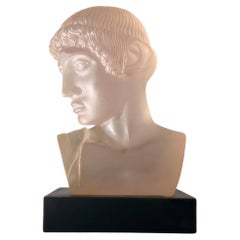
Neoclassical postmodern art glass bust of a Greek male, late 20th century

Neoclassical postmodern art glass bust of a Greek male, late 20th century

Located in View Park, CA

The neoclassical bust of a masculine Greek youth, late 20th century. Translucent resin - not dissimilar from alexandrite glass, which changes color depending on the light exposure - ...

Category

Late 20th Century Unknown Neoclassical Carved Busts

Materials

Resin, Wood

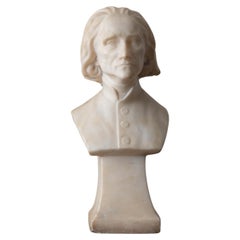
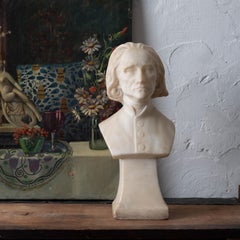
Franz Liszt Marble Bust, 19th Century

Franz Liszt Marble Bust, 19th Century

Located in Savannah, GA

Carved marble portrait bust depicting Franz Liszt (1811–1886), late 19th century. Classic Romantic era sculptural portrait of the Hungarian virtuoso pianist and composer, realized...

Category

19th Century Antique Carved Busts

Materials

Marble

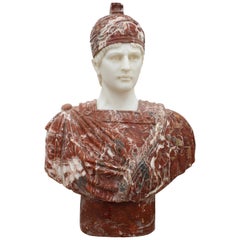
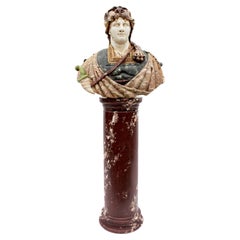
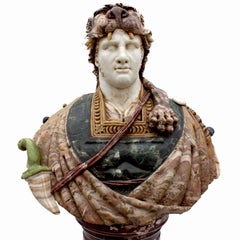
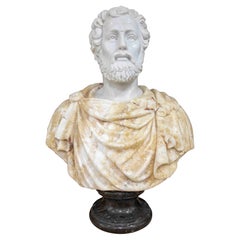
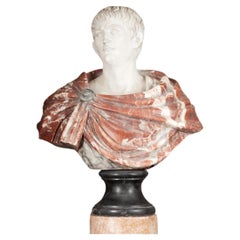
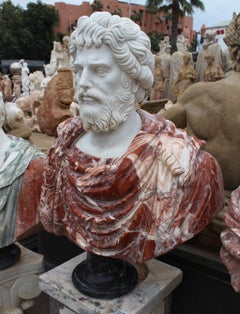
1990s Bust of Roman Hand Carved in Carrara White and Alicante Red Marble

1990s Bust of Roman Hand Carved in Carrara White and Alicante Red Marble

Located in Marbella, ES

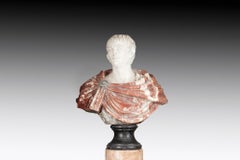
1990s bust of a Roman, hand carved by craftsmen using Carrara white marble for the head and Alicante red for the toga, where the white veins give movement and realism to the cloth.  

Category

Late 20th Century Italian Carved Busts

Materials

Marble

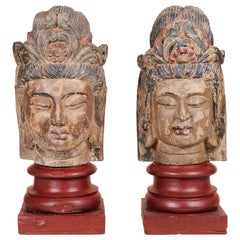
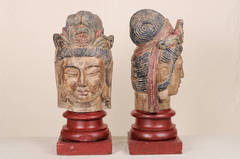
Antique Wooden Buddha Sculptures , Polychromy Finish, 59 cm"

Antique Wooden Buddha Sculptures , Polychromy Finish, 59 cm"

Located in Alessandria, Piemonte

Rare Buddha wooden heads sculptures , with polychrome traces - smiling and peaceful - Rested on a pair of wood capitals, same era. Suitable for the...

Category

Early 20th Century Chinese Chinoiserie Carved Busts

Materials

Wood

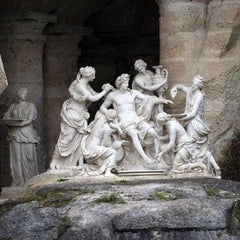
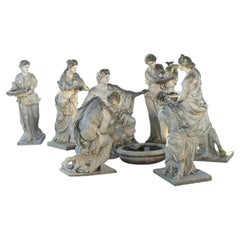
7 Stunning Italian Marble Sculptures Representing "The Baths of Apollo"

7 Stunning Italian Marble Sculptures Representing "The Baths of Apollo"

Located in Madrid, ES

7 Stunning Italian Marble Sculptures Representing "The Baths of Apollo" H: 220cm early 20th Century France. Versailles. Palace. Gardens. Grove of the Baths of Apollo. Hubert Robert....

Category

Early 20th Century Italian Modern Carved Busts

Materials

Marble

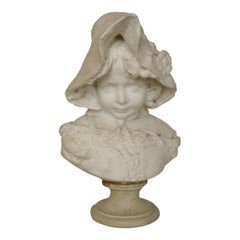
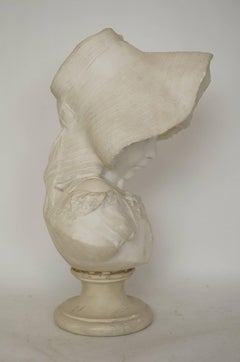
Italian 19th Century Marble Bust of a Girl by Pugi of Firenze

Italian 19th Century Marble Bust of a Girl by Pugi of Firenze

Located in New York, NY

Marble Bust of a Girl Signed F'lli Pugi, Firenze (Florence).

Category

Late 19th Century Italian Romantic Antique Carved Busts

Materials

Marble

Lifesize Italian 19th Century Specimen Marble Bust of a Greco-Roman Warrior

Lifesize Italian 19th Century Specimen Marble Bust of a Greco-Roman Warrior

Located in Los Angeles, CA

A very fine and mpressive life-size Italian, early 20th century marble bust of a Greco Roman Warrior, probably Hercules, after the antique. The large beautifully carved and decorated...

Category

Early 20th Century Italian Greco Roman Carved Busts

Materials

Marble, Agate, Lapis Lazuli

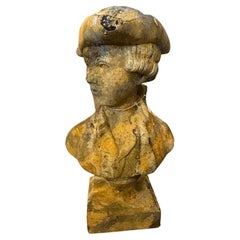
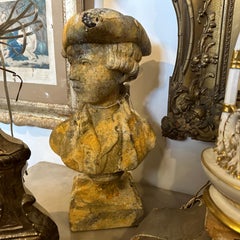
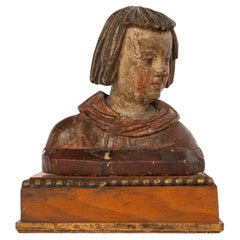
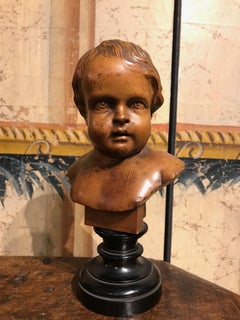
An Art Nouveau Hand-Carved Wood Italian Bust of a Young Boy

An Art Nouveau Hand-Carved Wood Italian Bust of a Young Boy

Located in Catania, Sicilia

This Art Nouveau Italian bust embodies the movement's hallmark features and also incorporating elements influenced by Italian art and culture. Their historical and artistic value mak...

Category

Early 20th Century Italian Art Nouveau Carved Busts

Materials

Fruitwood

Antique Catholic German Renaissance Carving Bust Stephan Rottaler Landshut 1500

Antique Catholic German Renaissance Carving Bust Stephan Rottaler Landshut 1500

Located in Portland, OR

An exceptionally rare antique German Renaissance carving by Stephan Rottaler (1581-1533), Bavaria circa 1500. The carving is by Stephan Rottaler, Landshut, Germany, an architect who ...

Category

16th Century German Renaissance Antique Carved Busts

Materials

Gesso, Wood

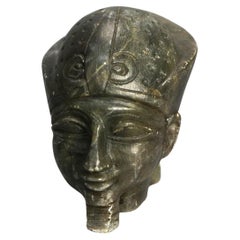
Antique Egyptian Revival Carved Hardstone Sculpture, Man with Headdress, 19thC

Antique Egyptian Revival Carved Hardstone Sculpture, Man with Headdress, 19thC

Located in Big Flats, NY

Antique Egyptian Revival Carved Hardstone Sculpture, Man with Headdress, 19thC Measures - 4"H x 3"W x 4.25"D A finely carved hardstone sculpture from the 19th century, reflecting the...

Category

19th Century Asian Egyptian Revival Antique Carved Busts

Materials

Stone

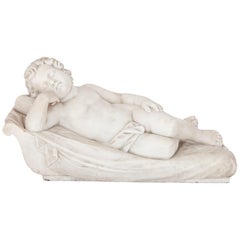
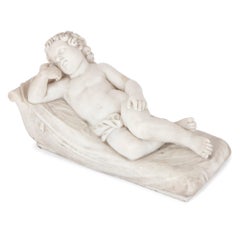
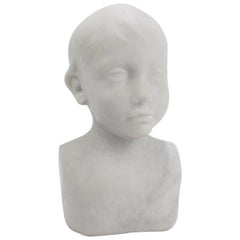
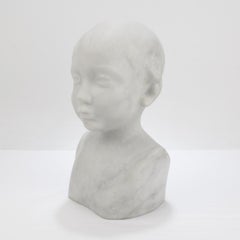
Renaissance Style Marble Figure of Sleeping Child

Renaissance Style Marble Figure of Sleeping Child

By François Duquesnoy

Located in London, GB

This marble figure of a sleeping child was crafted around 1800 in the style of François Duquesnoy, a sculptor active in Italy in the early 17th Century....

Category

Early 1800s Italian Renaissance Antique Carved Busts

Materials

Marble

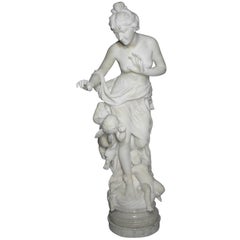
Italian 19th-20th Century Life-Size Marble Sculpture Titled "Searching for Love"

Italian 19th-20th Century Life-Size Marble Sculpture Titled "Searching for Love"

By Vito Pardo

Located in Los Angeles, CA

A very fine museum quality Italian 19th-20th century life-size marble sculpture titled "Searching for Love" by Vito Pardo (Italian, born in Venice in 1872) Depicting a semi-nude life...

Category

Early 1900s Italian Rococo Antique Carved Busts

Materials

Marble, Bronze

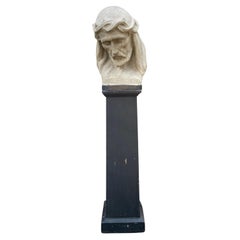
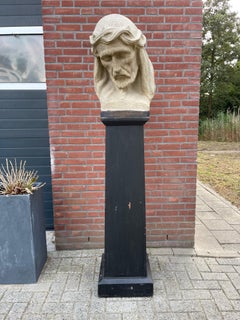
Large Antique Hand Carved Sandstone Sculpture, Bust of Christ with Display Stand

Large Antique Hand Carved Sandstone Sculpture, Bust of Christ with Display Stand

Located in Lisse, NL

Top quality and mint condition bust sculpture from the early 1900s with maker's name. This incredibly well carved bust of Jesus is impressive both for its quality and its large size. With His head bowed down like in His final hours on the cross this design is obviously perfect for displaying on a tall stand. In this case a tall and ebonized wooden pedestal was used and thanks to the contrasting colors of this bust and its pedestal they are like a match made in heaven. The master sculptor / artist could not have done a better job in hand carving the exhausted yet serene facial expression of Christ. The large size of this bust combined with the rare sandstone material makes this work of religious art look extra ancient. Because of its size this archetype of Christianity can also be seen and worshipped from further away. Unfortunately we cannot read the name of the skilled artisan who signed this unique sculpture. Thanks to its amazing quality, its excellent condition, its deeper meaning and its powerful presence this work of religious art will never fail to impress, no matter where you decide to have it on display. For it to have come our way felt like a blessing and to be able to offer it to the 1stdibs community in this amazing condition is an honour for us. Our fair price for this museum worthy sculpture again includes perfect packing and also worldwide delivery from our store to your door in just 4 to 6 days. Total height x width x depth: 74 x 17 x 16.5 inches. Christ bust...

Category

Early 20th Century European Arts and Crafts Carved Busts

Materials

Sandstone

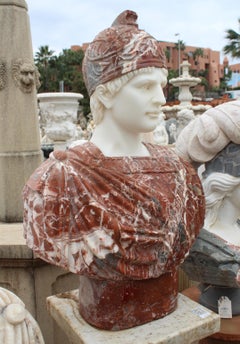
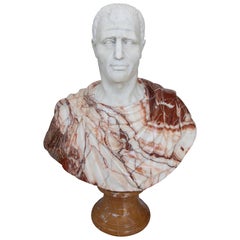
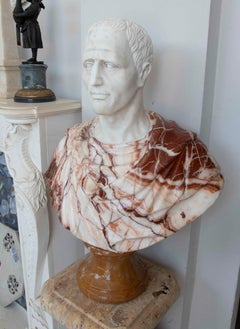
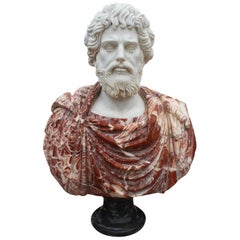
Classical Roman Bust in White Marble and Red Onyx – Imperial Style Sculpture

Classical Roman Bust in White Marble and Red Onyx – Imperial Style Sculpture

Located in Marbella, ES

This imposing sculpture represents a classical Roman bust, masterfully sculpted in polished white marble for the face and neck, and in a spectacular combination of red and white onyx...

Category

Late 20th Century European Carved Busts

Materials

Marble

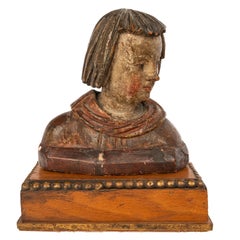
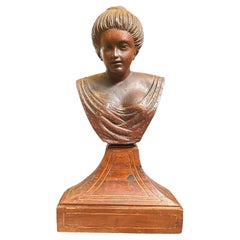
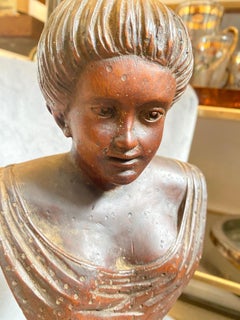
19th Century Italian Wooden Sculpture of Woman's Bust on a Base

19th Century Italian Wooden Sculpture of Woman's Bust on a Base

Located in Catania, Sicilia

Italian wooden sculpture of a mid 19th century woman's bust with purfled base. High quality hand-crafted item.

Category

Mid-19th Century Italian Charles X Antique Carved Busts

Materials

Wood

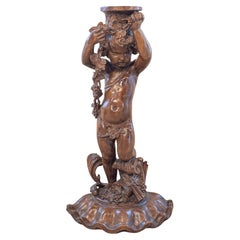
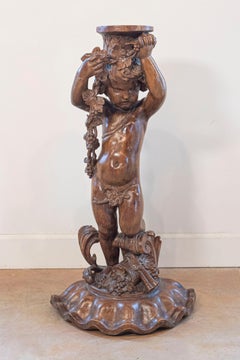
French Napoléon III 1860s Carved Walnut Sculpture of a Putto Carrying a Vessel

French Napoléon III 1860s Carved Walnut Sculpture of a Putto Carrying a Vessel

Located in Atlanta, GA

A French Napoléon III period walnut carved putto sculpture from the mid 19th century, with grapes, flowers and the double flute. Created in France during the third quarter of the 19t...

Category

Mid-19th Century French Napoleon III Antique Carved Busts

Materials

Walnut

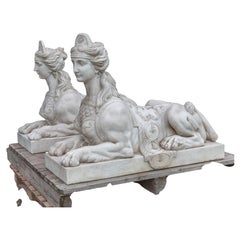
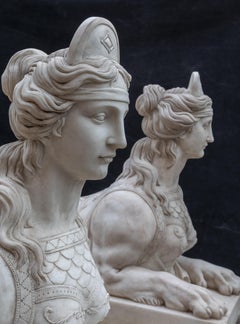
Pair of white marble sculptures depicting reclining sphinxes

Pair of white marble sculptures depicting reclining sphinxes

Located in Brussel, BE

An elegant pair of carved marble sphinx sculptures, each resting on a rectangular plinth. The figures combine classical female heads with reclining lion bodies, richly detailed with...

Category

Early 20th Century Egyptian Carved Busts

Materials

Carrara Marble

Neoclassical Female Bust in White Marble and Hand-Carved Red Jasper

Neoclassical Female Bust in White Marble and Hand-Carved Red Jasper

Located in Marbella, ES

A refined female bust in the Neoclassical style, carved from white marble with details in veined red jasper, which provides an elegant chromatic contrast and a strong decorative pres...

Category

Late 20th Century Neoclassical Carved Busts

Materials

Marble

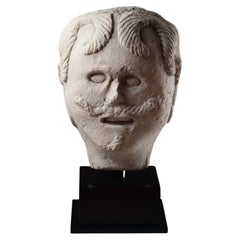
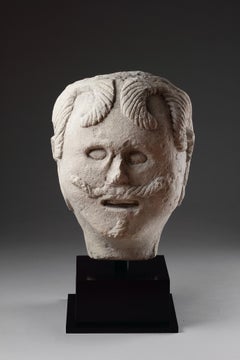
European Carved Limestone Celtic Votive Head of a Male Warrior

European Carved Limestone Celtic Votive Head of a Male Warrior

Located in London, GB

A Large European Carved Limestone Celtic Votive Head of a Male Warrior Wearing a Typical Flowing Moustache Small Beard and Curling Locks of Hair Stiffened with Lime Wash the Slit Mouth Open as if in Command Circa 1st Century BC - 1st Century AD Size: 31cm high, 22cm wide, 25cm deep - 12¼ ins high, 8¾ ins wide, 9¾ ins deep / 42cm high - 16½ ins high (with base) From about 500 BC, first Greek and later Roman historians mention peoples living in a large area of non-mediterranean Europe as Celts. These classical chroniclers seem to have recognised these communities as having sufficient shared cultural traditions to justify their being given a common name, ‘Keltoi’ by the Greeks, and ‘Celtae’ or ‘Galli’ by the Romans. The earliest allusions to Celts by such Greek historians as Herodotus (485 - 425 BC) were followed by Polybius (200 - 118 BC) and Livy (59 BC - AD 17) who discuss the expansion of the Celts from their central European homelands during the 4th and 3rd centuries BC. They document the presence of Celts in Spain, France, Italy, Greece and Asia Minor, specifically central Turkey. They testify to the successful Roman resistance to the Celts in Italy, after the ignominy of the sacking of Rome by them in 387 BC, and describe the huge defeat suffered by the Celts at the battle of Telemon in northern Italy in 225 BC. The Celts in Greece who sacked the sacred site of Delphi in 279 BC were defeated by King Antigonos Gonatas of Macedon in 278 - 277 BC and in Turkey by Altalus of Pergamon in 240 BC. The Celts in Spain fell under the shadow of Rome from 2nd Century BC and the Celtic heartland known by the Romans as ‘Gaul’ was conquered by the Romans under Julius Caesar in the mid 1st Century BC. Britain was not referred to as Celtic by the ancient historians, but Caesar recognised the close similarities between Britain and Gaul especially in their political organisation. Tacitus (55 - 120 AD) and others chronicled the conquest of Britain between 43 and 84 AD some mentioning the fierce nature of the Celts who went into battle naked. Celtic art therefore belongs to an artistic tradition in the early history of Europe which is no less important than that of the classical world. Art was central to Celtic identity and was closely related to the objects which it decorated. The Celts were used to seeing art as an integral part of their everyday lives. Provenance: Ex Finch and Co...

Category

15th Century and Earlier European Antique Carved Busts

Materials

Limestone

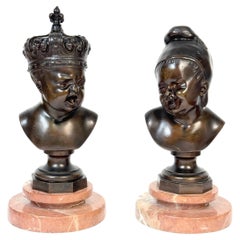
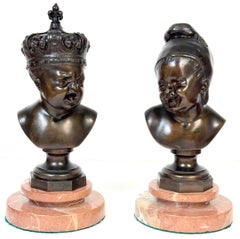
Pair Bronze Busts: "The Fallen King & Laughing Revolutionary, After Carpeaux

Pair Bronze Busts: "The Fallen King & Laughing Revolutionary, After Carpeaux

Located in West Palm Beach, FL

Pair of Allegorical Bronze Busts: "The Fallen King and the Laughing Revolutionary," After Jean-Baptiste Carpeaux, France, Late 19th–Early 20th Century A profoundly expressive and allegorically charged pair of patinated bronze busts, each mounted on veined pink marble plinths...

Category

Late 19th Century French Napoleon III Antique Carved Busts

Materials

Bronze

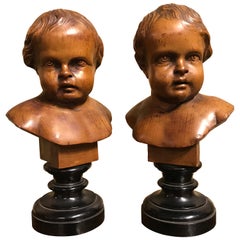
Pair 19th Century Baroque Style German Carved Wood Busts of Putti

Pair 19th Century Baroque Style German Carved Wood Busts of Putti

Located in Stamford, CT

A fine pair of carved fruit wood busts of young boys, or putti, South Germany, late 19th century. The realistically carved faces showing distinct personalities and intense gazes. Mou...

Category

Late 19th Century German Neoclassical Antique Carved Busts

Materials

Fruitwood

Hand-Carved Marble Classical Bust in Roman Style

Hand-Carved Marble Classical Bust in Roman Style

Located in Marbella, ES

Impressive classical marble bust, hand-carved with exceptional detail. The piece depicts a bearded male figure with a serene and majestic expression, dressed in a Roman tunic richly ...

Category

Late 20th Century Asian Carved Busts

Materials

Onyx, Marble

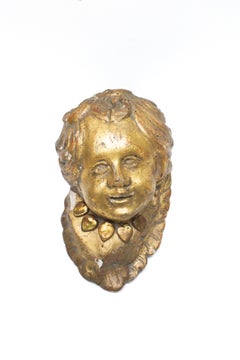
18th Century Italian Gilded Angel Head with Baroque Pearls

18th Century Italian Gilded Angel Head with Baroque Pearls

By Interi

Located in Columbia, SC

18th century Italian gold leaf angel head or "putto" adorned with baroque pearls. A putto is a cherub figure frequently appearing in both mythological and religious paintings and scu...

Category

18th Century Italian Baroque Antique Carved Busts

Materials

Gold Leaf

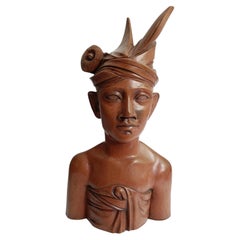
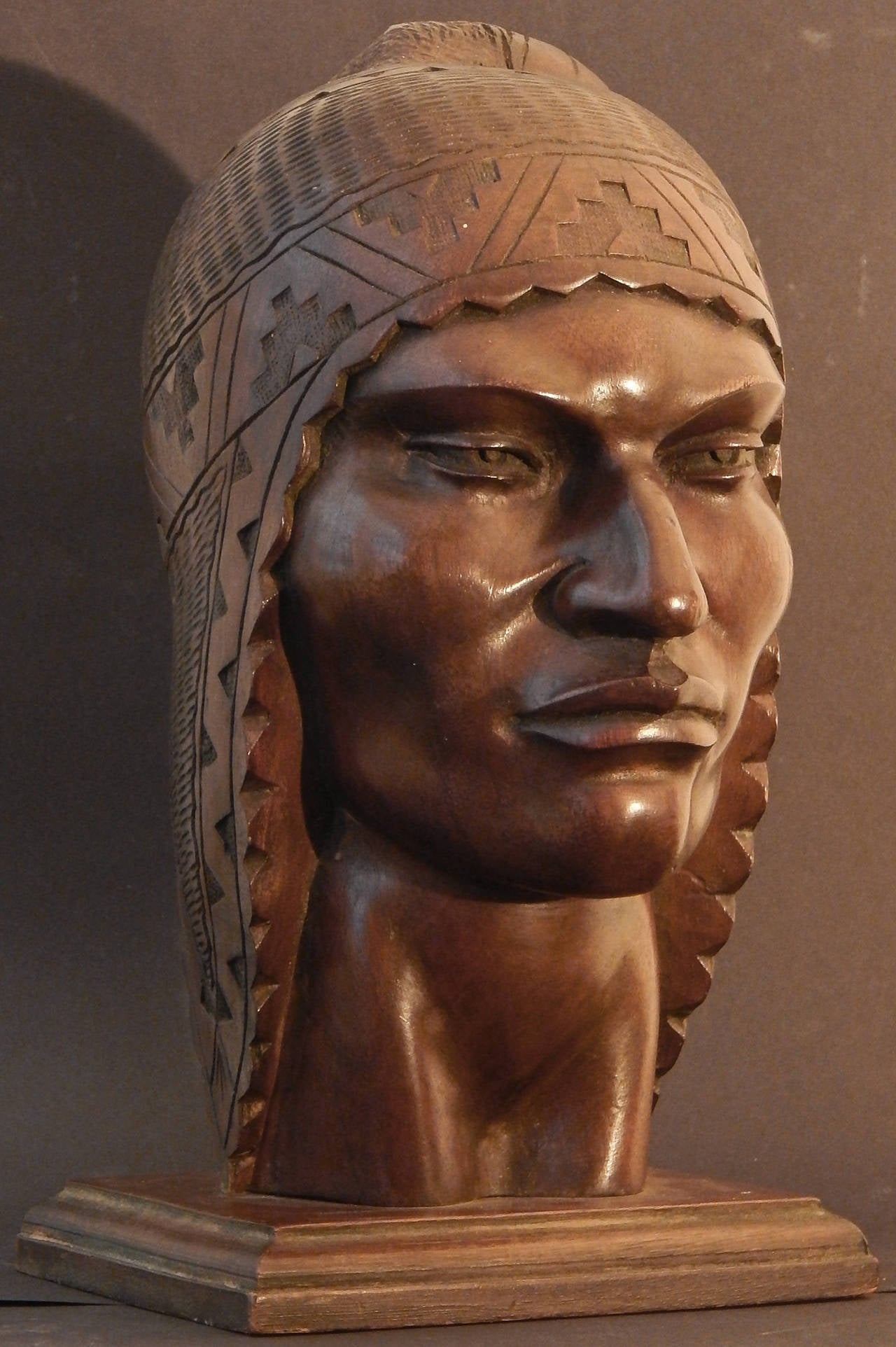
"Peruvian Male in Traditional Headdress, " Art Deco Sculpture

"Peruvian Male in Traditional Headdress, " Art Deco Sculpture

Located in Philadelphia, PA

Superbly carved and visually striking, this life-size depiction of a Peruvian man in a traditional knitted headdress is a superb example of stylized Art Deco sculpture, as well as th...

Category

1930s American Art Deco Vintage Carved Busts

Materials

Mahogany

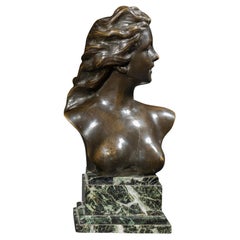
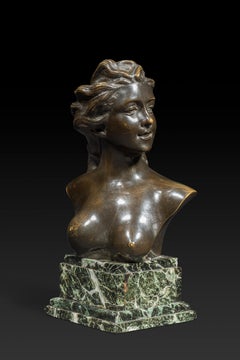
JEF LAMBEAUX (1852-1908) "Bust of a Young Woman" in bronze

JEF LAMBEAUX (1852-1908) "Bust of a Young Woman" in bronze

By Jef Lambeaux

Located in Ixelles, BE

JEF LAMBEAUX (1852-1908) "Bust of a Young Woman" in bronze. Jef Lambeaux's "Bust of a Young Woman" with bared breasts is a striking work of art that embodies both beauty and controversy. Created by the eminent Belgian sculptor Jef Lambeaux (1852-1908), this bronze sculpture reveals exceptional technical mastery and extraordinary artistic sensitivity. The young woman depicted, with her hair flowing freely and her face imbued with serenity, embodies the quintessence of feminine beauty. This work is part of the Romantic Realism...

Category

Late 19th Century Belgian Art Nouveau Antique Carved Busts

Materials

Bronze

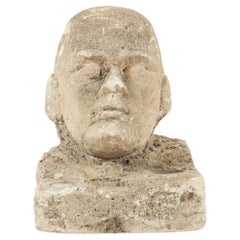
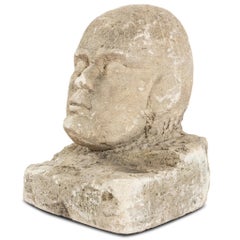
Monumental Carved Stone Head Sculpture - Belgium

Monumental Carved Stone Head Sculpture - Belgium

Located in Pittsburgh, PA

This monumental stone bust, hand-carved from granite, is a decorative sculpture featuring a closed-eye portrait. Its organic texture and tonal variation add depth and visual interest...

Category

1950s Belgian Vintage Carved Busts

Materials

Stone

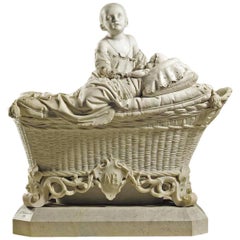
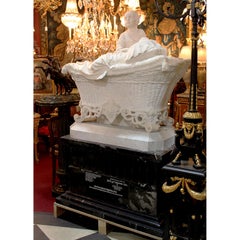
A Life-Size Italian 19th C. Marble Sculpture Children in a Crib by A. Tantardini

A Life-Size Italian 19th C. Marble Sculpture Children in a Crib by A. Tantardini

By Antonio Tantardini 1

Located in Los Angeles, CA

Antonio Tantardini (Italian, 1829-1879) An extraordinary Italian 19th century life-size carved Carrara white marble sculpture of "A Young Child and a baby in a wicker crib...

Category

1860s Italian Beaux Arts Antique Carved Busts

Materials

Carrara Marble

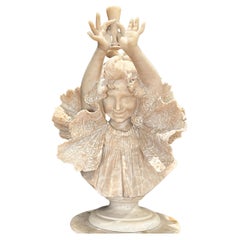
Italian Carved Alabaster And Marble Bust Of Young Girl By Antonio Frilli

Italian Carved Alabaster And Marble Bust Of Young Girl By Antonio Frilli

By Antonio Frilli

Located in Norwood, NJ

Masterfully carved and sculpted alabaster bust of a young girl with outstretched arms holding up a cup by Antonio Frilli. Smiling faced young girl, wearing lace and ruffled clothing,...

Category

Late 19th Century Italian Belle Époque Antique Carved Busts

Materials

Alabaster, Marble

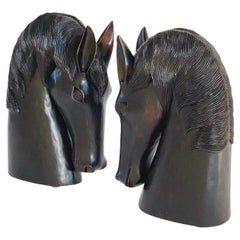
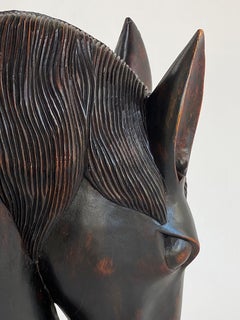
Pair Carved Wood Horse Busts--Vintage Equestrian Decor 16.5" High

Pair Carved Wood Horse Busts--Vintage Equestrian Decor 16.5" High

Located in Minneapolis, MN

Here is a wonderful pair of carved horse busts/heads dating from the mid-century and measuring an impressive 16.5" high and 12" wide. Although the country of origin and wood species ...

Category

Mid-20th Century Mid-Century Modern Carved Busts

Materials

Wood

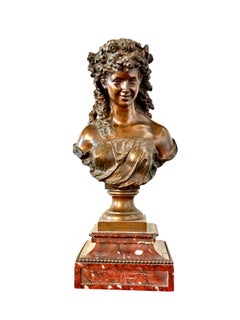
19th Century Bronze Bust Signed by Mathurin Moreau on Griotte Marble Base

19th Century Bronze Bust Signed by Mathurin Moreau on Griotte Marble Base

By Mathurin Moreau

Located in LA CIOTAT, FR

This exquisite bronze bust, signed by the renowned French sculptor Mathurin Moreau (1822–1912), is a captivating example of 19th century French decorative art. Cast with exceptional ...

Category

Late 19th Century French Antique Carved Busts

Materials

Griotte Marble, Bronze

Bust Roman Sculpture in Solid Marble

Bust Roman Sculpture in Solid Marble

Located in Paris, FR

Sculpture Bust Roman in solid hand carved marble lightly red tinted and grey tinted. Exceptional piece. Available now on stock.

Category

21st Century and Contemporary Italian Carved Busts

Materials

Marble

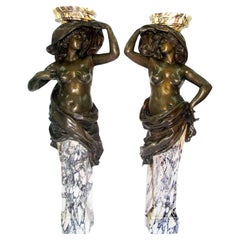
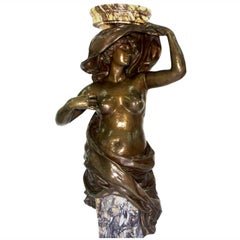
A Pair French 19th Century Bronze Nude Maidens Torchere, Carrier-Belleuse Attr.

A Pair French 19th Century Bronze Nude Maidens Torchere, Carrier-Belleuse Attr.

By Albert-Ernest Carrier-Belleuse

Located in Los Angeles, CA

A very fine and monumental pair of French 19th century patinated bronze figural torchere sculptures titled "La Nuit" (The Night) attributed to Albert Carrier-Belleuse (French, 1824-1...

Category

Late 19th Century French Beaux Arts Antique Carved Busts

Materials

Marble, Bronze

18th Century Large Italian Marble Bust of Caesar Augustus

18th Century Large Italian Marble Bust of Caesar Augustus

Located in Dublin 8, IE

18th Century Italian Marble Bust of Caesar Augustus. His draped robe is hand-carved in red rosso levanto marble with the face modelled in contrasting white Carrara marble. The piece ...

Category

18th Century Italian Neoclassical Antique Carved Busts
Materials

Marble, Carrara Marble

19th Century Hand Carved Gold Gilt Cherub/Putti Fragment

19th Century Hand Carved Gold Gilt Cherub/Putti Fragment

Located in London, GB

19th century hand carved gold gilt cherub/putti fragment A high-quality hand carved 19th century gold gilt paint over sectioned pine example. This wonderful piece details realistic human features, which suggests it was carved for a special interior section of sorts. Likely to have been part of a larger collective at some point. It would look delightful and highly decorative positioned over a doorway entrance. Size in inches: H 10” x W 15” x D 5” Origin: France Material: Pine Date: 1850 - 1880 Completely solid in structure and form without any breaks. Detail loss across the painted surface as shown. We sell antique...

Category

1850s French Early Victorian Antique Carved Busts

Materials

Pine

Pair of 17th Century Spanish Tall Ebonized Hand-Carved Wood Sculptures

Pair of 17th Century Spanish Tall Ebonized Hand-Carved Wood Sculptures

Located in North Miami, FL

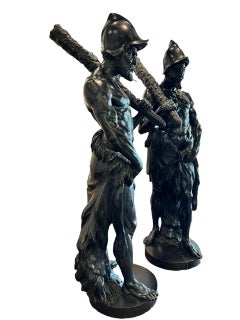
Behold an extraordinary pair of 17th Century Spanish ebonized wood sculptures that stand as a mesmerizing fusion of cultures and artistic mastery. These striking sculptures depict Eu...

Category

17th Century Spanish Antique Carved Busts

Materials

Wood

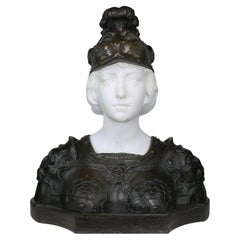
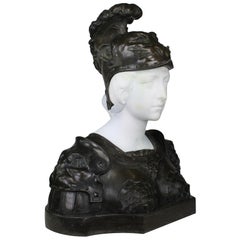
French 19th Century Bronze and White Marble Bust of Marianne in Full Armor

French 19th Century Bronze and White Marble Bust of Marianne in Full Armor

Located in Los Angeles, CA

A French 19th century bronze and marble bust of Marianne in full armor. The nicely cast Baroque Revival brown patinated bronze and carved white marble figure of Marianne, the allegorical personification of the French Republic, presented in her militaristic guise, reminiscent of Minerva, wearing a Phrygian helmet and armored breastplate centered by winged male mask and with lion shoulder armor pads, all raised on a conforming black marble base. Circa: 1890-1900. Marianne has been the national personification of the French Republic since the French Revolution, as a personification of liberty, equality, fraternity and reason, as well as a portrayal of the Goddess of Liberty. Marianne is displayed in many places in France and holds a place of honor in town halls and law courts. She is depicted in the Triumph of the Republic, a bronze sculpture overlooking the Place de la Nation in Paris, as well as represented with another Parisian statue on the Place de la République. Her profile stands out on the official government logo of the country, appears on French euro coins and on French postage stamps. She was also featured on the former franc currency and is officially used on most government documents. Marianne is a significant republican symbol; her French monarchist equivalent is often Joan of Arc. As a national icon Marianne represents opposition to monarchy and the championship of freedom and democracy against all forms of oppression. Other national symbols of Republican France include the tricolor flag, the national motto Liberté, Égalité, Fraternité, the national anthem "La Marseillaise", the coat of arms, and the official Great Seal of France. Marianne also wore a Cockade and a red Phrygian cap symbolizing Liberty. Minerva and its pendant bust of Mars evoke the classicizing subjects, bust-length formats, and style that originated in France during the reign of Louis XIV (1643–1715) and that concurrently was popularized across Europe. The busts' simple forms, stiff poses, and solemn facial types are consistent with the late Baroque sculptures that were carved in Flanders during this period. In Flanders, especially in Antwerp and Brussels, sculpture and architectural decoration traditionally was carved using combinations of native black marble (noir belge), mottled red marble (rouge belge), and white marble or alabaster. The use of these stones in colorful counterpoint speaks most strongly to the busts’ Flemish origins. The veneration of ideal heroes and heroines in ancient costume and arms took on extravagant form in the 17th century, with countless variations. Within this imaginative tradition, the identification of the pair as Minerva and Mars cannot be certain. The female bust, for example, could be identified as Bellona, Roman goddess of war, who is depicted in 17th and 18th century French paintings wearing flamboyantly plumed helmets and low-cut cuirasses that expose her breasts. Whatever their identities, the female and male warriors are portrayed as calm rather than bellicose beings. The sovereign pair does...

Category

19th Century French Baroque Revival Antique Carved Busts

Materials

Marble, Bronze

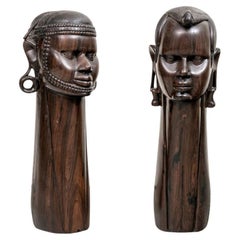
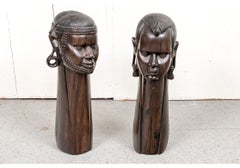
Pair Of Large Scale Heavy Nzambu East African Carved Exotic Wood African Busts

Pair Of Large Scale Heavy Nzambu East African Carved Exotic Wood African Busts

Located in Bridgeport, CT

A compatible pair of superbly crafted African busts in an extraordinary exotic hardwood. Nzambu East African sculptures, hand carved, solid and heavy depicting the busts of two tribe...

Category

20th Century African Tribal Carved Busts

Materials

Wood

Large Late 18th Century French Ship Figurehead

Large Late 18th Century French Ship Figurehead

Located in Gloucestershire, GB

Large late 18th Century French hand carved ships figurehead. A rare survivor, this figurehead would most likely have come from a Southern Frenc...

Category

Late 18th Century French Antique Carved Busts

Materials

Wood

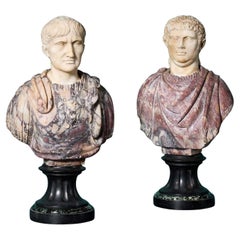
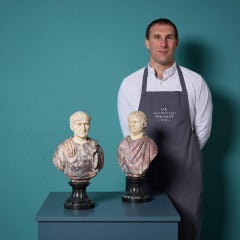
Two 18th Century Italian Marble Emperor Busts

Two 18th Century Italian Marble Emperor Busts

Located in Wormelow, Herefordshire

A pair of mid 18th century Italian marble busts depicting the Roman Emperors Augustus and Nero. Also known as Octavian, Augustus was the first Roman Emperor and founder of the Roman...

Category

Mid-18th Century Italian Neoclassical Antique Carved Busts
Materials

Marble

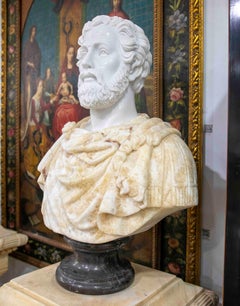
1990s Bust of Roman Hand Carved in Carrara White and Alicante Red Marble

1990s Bust of Roman Hand Carved in Carrara White and Alicante Red Marble

Located in Marbella, ES

1990s bust of a Roman, hand carved by craftsmen using Carrara white marble for the head and Alicante red for the toga, where the white veins give movement and realism to the cloth. S...

Category

Late 20th Century Italian Classical Roman Carved Busts

Materials

Marble

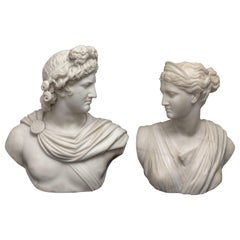
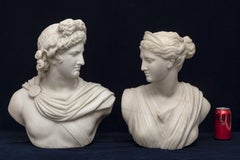
A Pair 19th Century Italian Hand-Carved Carrara Marble Busts of Apollo & Artemis

A Pair 19th Century Italian Hand-Carved Carrara Marble Busts of Apollo & Artemis

By Ferdinando Vichi

Located in New York, NY

An Outstanding Pair 19th Century Italian Hand-Carved Carrara Marble Busts of Apollo & Artemis, One Bust is Signed on the Back, "F Vichi". This pair of stunning marble busts, hand-car...

Category

1860s Italian Neoclassical Antique Carved Busts
Materials

Carrara Marble

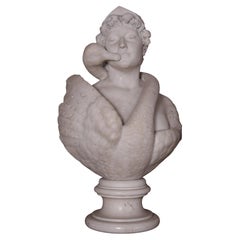
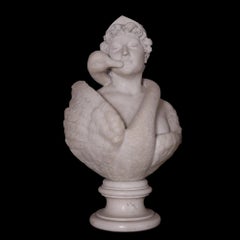
Leda and The Swan Marble Bust

Leda and The Swan Marble Bust

Located in London, by appointment only

Leda and the swan carved in white marble, Italian, Risorgimento, late 19th century. Stock Number: 33150 Leda and the Swan: A Mythological Tale Immortalised in Marble The mythology ...

Category

Late 19th Century French Belle Époque Antique Carved Busts
Materials
Carrara Marble