By Minton
Located in Cincinnati, OH
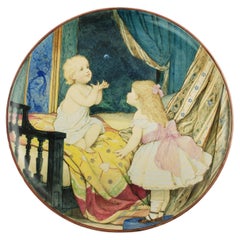
This large hand-painted charger was made by Mintons Art Pottery Studio of Kensington Gore, London. The studio traces its origins to the renowned earthenware and fine bone china factory Minton, located in Stoke-on-Trent, Staffordshire England. Colin Minton Campbell, descendant of founder Thomas Minton, took over company management in 1858 and went on to establish Mintons Art Pottery Studio in 1871 for the purpose of hand decorating pottery and tiles. The studio initially operated under the direction of painter and book illustrator William Stephen Coleman and drew upon the talents of artists studying at the Kensington's National Art Training School, now known as the Royal College of Art, as well as those of well-regarded Continental artists. The company was short lived as it was destroyed by an accidental fire in 1875 and was not rebuilt.
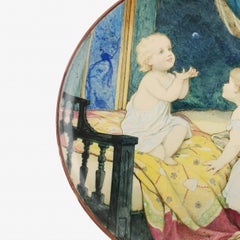
This large earthenware charger has been hand-painted in polychrome enamel and depicts two young children at play in the nursery. The scene includes multiple colors and textures and features a cherubic toddler seated upon a bed alongside a young girl standing on a blue footstool...
Category
1870s Great Britain (UK) Aesthetic Movement Antique Pottery Dinner Plates