Francesco Aviani (Italy - Venice, 25-11-1662 / 1715) att.
Couple of paintings depicting Capricci
Oil on canvas, 135 x 183 cm, without frame
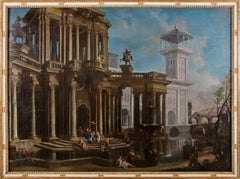
The two large and fine paintings depict two illusionistic architectural renderings, with views of colonnades and arched buildings, animated by figures. The compositions are characterized by the harmony with which the painter introduces the sumptuous architectural monuments, the mirrors of water, the buildings in the distance and the views of the landscape. Dominates with a color on the tones of brown and ochre that stands out on the blue sky, marked by some cloud of steam. The insertion of the figures to enliven the architectural views also balances with the set.
The Capriccio, an artistic genre that has made its way into Italian painting since the 17th Century, is characterized by the representation of fantastic architectures or prospective inventions, sometimes combined with elements drawn freely from reality. The two paintings are an example of this type and they are a very interesting and Fine artwork.
The remarkable pictorial quality emerges both from the composition of the ensemble and from the way in which the artist describes the views with great attention to detail, highlights and refined, perfectly realistic, chiaroscuro.
The same must be recognized for the figures: these are described with a wise brushstroke, quick and quick touches give the dynamism of the moment that is captured, as if time had stopped to show and narrate what is happening.
The painting on the right represents a large Baroque building in stone and paved with marbles, two floors, with moving façade, large columns with corinthian columns, a large portal with a staircase with large footsteps, a balustrade with string, from which some figures appear, and two equestrian monuments in bronze. The sumptuous building overlooks a large POOL of water, with a gushing fountain, around which some characters sit. In the second floor is described a white palace from which rises a tower crowned by a structure with wrought iron loggia. In addition there is a bridge and some architectural ruins behind which some mountainous reliefs fade towards the horizon.
On the staircase is described a particular scene. The people seem to be part of a very precise story. A woman, in the shadow of a parasol supported by a servant, would seem to drive out of the palace a man, who, taken under his arm by two maidens with a determined attitude, is led to a boat.
The scene could be identified with the biblical episode of the parable of the prodigal son (Luke 15,11-32), at the moment when the prodigal son is robbed and driven away by the harlots.
The episode tells of a man with two children. The youngest said to his father: “Father, give me the part of my inheritance”. And the father divided the substances. After not many days, the youngest son, collected his things, left for a far country and there he lost his substances with prostitutes and living as a debaucher. When he had spent everything, there came a great famine in that country and he began to find himself in need. Reduced to hunger, he was forced to be a pig herder to survive. He therefore meditated in his heart to go to his father and ask for his forgiveness and to be welcomed anew, even as a servant.
While still on the road, however, the father saw him and ran towards him, receiving him with open arms. He then ordered his servants to prepare a great feast for the occasion, killing for the purpose the "fatty calf". The firstborn did not understand why his brother was given such treatment, and reminded the parent that he, who had always obeyed him, had never received a single kid to celebrate with his friends. The father answered him: «Son, you are always with me and everything that is mine is yours; but it was necessary to celebrate and rejoice, because this brother of yours was dead and came back to life, was lost and was found».
The parable of the prodigal son was often portrayed in painting and the scene he finds most is certainly that of returning home in his father’s arms. Among the many is a canvas by the famous painter Giovanni Paolo Pannini (or Panini) (Italy – Piacenza, 1691– Rome, 1765) kept at the Hallsborough Gallery in London.
Rather rare, however, is the scene of the prodigal son driven and robbed by harlots. There is an engraving by Hans Collaert II (1561-1620) in which this moment is described in the background compared to the moment, narratively later, in which he is penitent among the pigs.
The second painting, certainly pendant of the first, represents a similar palace, with some characters overlooking the balustrade marcapiano and other figures around the large bathtub quadrilobata. In the foreground is described a monument with two large stone sculptures. In the distance some architectural elements and, beyond, the mountains are lost on the horizon.
The studies related to the numerous painters of architectural views and caprices, active in Italy, and the archival documents found, which could better clarify commissions, biographies and certain works, are scarce and sporadic. Therefore there are still many difficulties in reconstructing a catalogue of autograph works for each author. Through paintings in private collections, in museums and paintings passed on the antique market it is however possible to advance some attributions in order to better delineate the various artistic figures.
The style of the works studied here leads to a dating that runs between the 17th and 18th Centuries, with obvious influences dictated by the perspectives of the brothers Galli Bibiena. The analysis of the architectures and the chromatic palette suggests that we are in the presence of a northern Italian and Venetian author. Observing the decorations and the volutes, the brightness and the perspective disposition in fact, we find several analogies with those used by the Vicenza painter Francesco Aviani, excellent in pictorial perspective and architectural views.
The biographical profile of Francesco Aviani (Italy - Vicenza, 1662-1715) was essentially traced in 1956 by Andreina Ballarin, then re-visited by Federica Spadotto in 2014 and Giancarlo Sestieri in 2015. Certain documents about his life are scarce, as are the documented works.
He was born in Venice, probably on 25 November 1662, to Bernardo and a Magdalene whose surname is unknown, and was baptized on 3 December 1662. Between 1701 and 1703 he worked, together with his brother MarCo, sculptor, for the fresco decoration (now illegible) of the church villa in Soella (Vicenza). On October 16, 1703 he married Isabella Carcano. On March 26, 1715 he made a will and died on April 3 of the same year, in Vicenza.
The frescoes in the refectory of the sanctuary of Monte Berico in Vicenza are considered authentic works by Aviani, probably made in 1708; the paintings preserved in the Civic Museum of Vicenza: “Landscape with Lazzaro and the rich Epulone”; “Christ among the doctors”; “The miraculous fishing”, works not datable but with attribution corroborated by style. In addition, the frescoes in the east and west corridors of the Villa La Rotonda, near Vicenza; the fresco in the apse basin of the chapel of the church S. Croce, Vicenza, now destroyed; the frescoes of the central hall of Villa Camerini a Montruglio (1714) and a painting of a “Porto Regio”, of which we have a print engraved by Dall'Acqua.
From his works emerges the artistic background that animated the Venetian culture in the early eighteenth century. The scenic grandeur with which Aviani treats the architecture also suggests a stay in Emilia of the painter, in which he could have come into contact with the environment of the Bibiena. These contacts would be confirmed by the press of Cristoforo Dall'Acqua (Vicenza 1734-1787), “Il porto regio”, after a painting of Aviani. The press was part of a group of engravings, representing royal buildings, reproducing paintings of the Bibiena. In the eyes of Dall’Acqua, therefore, Aviani’s work was not foreign among those of the Emilians.
Inside the sumptuous architectural whims, Aviani often depicts biblical scenes, in which the characters share the space and the narrative rhythm, along with figures drawn from everyday scenes, memories of the Veronese and Bassano heritage. Also in the works covered by this study the author does not seem to want to give up a biblical subject, though the purpose of the paintings appears to be clearly a staging scenography-architectural within which the characters are relegated to the role of extras.
From the examination of the architectural Capriccio gathered under the name of Aviani then emerge common elements. The comparison between these works and the works in question highlights the proximity of the compositions. The imposing and scenic architectures are in fact equally characterized by the perspective-scenographic ability diffused in emilian “quadraturisti” and in Bibiena work. In fact, you can see the spectacular slender architecture in the lower part, the loggias that create chiaroscuro games with arches and binate columns placed on massive bases and overhung by projecting cornices.
Significant also the comparison with two paintings with architectural whims in a night vision attributed to Francesco Aviani.
In Aviani’s works it is possible to find a certain knowledge of the Roman Codazzi paint nd its early development of the eighteenth century, developed with the Locatelli, the Pannini and the less known Domenico Roberti. To Roberti have been recently attributed two works that have some compositional affinity with the canvases in question. The same can be done for a work on the antique market, attributed to Pietro Francesco...
Category
Late 17th Century Italian Baroque Antique Belgian Black Marble Paintings