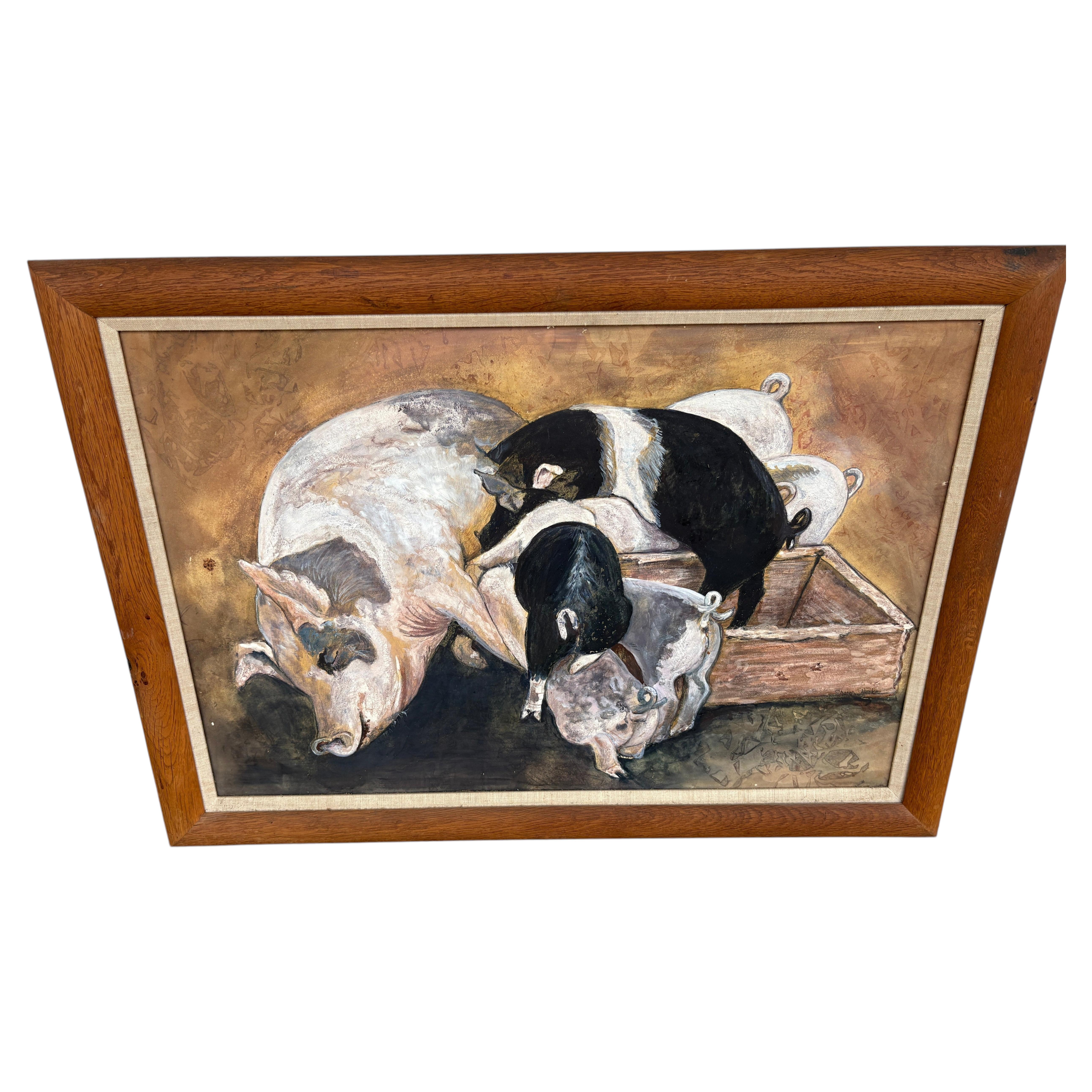
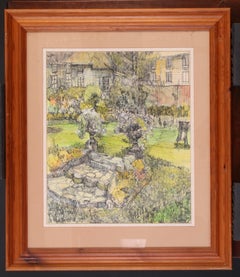
Anrid Banniza Johnston was a Swedish born English sculptor, illustrator and animalier. She was born to a Swedish mother and English father, she studied at the Slade School of Art, as a sculptor she worked in stone, wood and marble, mostly sculpting animals. She also painted posters for several zoos including London and Bristol which were extensively printed as lithographs, she worked in television in the 1930's with a Sunday afternoon programme teaching drawing and painting I suspect for children with a passion for animals. This picture is a cartoon of animals in the style of Animal Farm representing a pigs homestead where they seem to be enjoying their day. The picture is signed and dated , still in it's original frame and mount. This is a rare and unusual work for her and I do not know of another watercolor to come onto the market in the last 15 years. This picture is signed and dated, lower right.
I have included a biography of the artist for your information.
Arnrid Banniza Johnston (1895–1972)—often spelled Anrid—was a highly accomplished Swedish-born British sculptor, illustrator, and animalier. Renowned for her playful, anatomically observant depictions of wildlife, Johnston left a distinct mark on British mid-century media. Her work spanned from monumental stone carvings to iconic graphic design and pioneering 1930s television broadcasts. Johnston was born in Uddevalla, Sweden, to an English father and a Swedish mother. Her family moved to London during her childhood, where she was educated in Blackheath. Displaying an early aptitude for three-dimensional art, she attended the prestigious Slade School of Fine Art between 1914 and 1921. At the Slade, she trained under the influential sculptor James Havard Thomas. Her immense talent was quickly recognised; she won a two-year Slade scholarship and was twice awarded the Feodora Gleichen Memorial Prize for sculpture. As a sculptor, Johnston worked across diverse mediums, including stone, wood, marble, and serpentine. Her work almost exclusively celebrated the natural world, operating within the traditional animalier realm but with a modernist, clean aesthetic. Her most prominent public commission was a massive, three-sided Portland stone obelisk crafted for the courtyard of Walden House in Pimlico, London. Taking her four years to complete, the relief depicted children playing alongside a meticulously carved base of various animals. Historic England awarded the sculpture a Grade II listing in 2018 to preserve its cultural significance. Other well-known relief works from her studio included Cats on a Chimney Cowl, Squirrels, and Resting Horses. In the 1930s, Johnston successfully transitioned her deep understanding of animal anatomy into graphic illustration. She was commissioned by the Underground Group and London Transport to design commercial travel posters. Her most memorable posters promoted travel to major British wildlife institutions, including, Regents Park Zoo (London Zoo). Her famous 1930 and 1931 lithographs ("For the Zoo" and "From the Ark to Regents Park") featured a humorous, role-reversing social satire where animals peer into cages at human specimens. Whipsnade Zoo. She created striking compositions for Green Line coaches highlighting regional wildlife like giraffes, bears, and wolves, also at Bristol Zoo, she regularly painted dynamic publicity materials to encourage regional train travel. Many of these original lithographs are preserved in permanent collections, such as the London Transport Museum. Johnston was an early pioneer of educational programming during the infancy of British television. In the mid-1930s, she hosted her own Sunday afternoon broadcast with the BBC. The show was primarily aimed at children and young adults who shared her intense passion for wildlife. Using her warm personality and technical expertise, Johnston taught audiences the fundamentals of drawing and painting animals. She demonstrated how to capture basic animal proportions, movement, and expressions on live television. As the demand for heavy stone carving lessened, Johnston focused heavily on literature. Between 1930 and 1950, she wrote and illustrated more than twenty children's books. Her titles included Animal Families (1939), Animals of the Countryside, and Animals We Use (1948). Tragically, her career as an illustrator was cut short in the 1950s due to rapidly deteriorating eyesight. She spent her remaining decades quietly in England before passing away on 8 July 1972. Remembered by contemporaries as a "robust, generous, and characterful" personality, Johnston remains celebrated today as a masterful observer of animal life who made art accessible to the British public.