Florida - Art

to
1,101
4,641
3,614
4,044
3,393
6,918
Overall Width
to
Overall Height
to
146
518
10,235
11,698
159
168
265
299
322
466
989
1,608
1,406
1,323
113
6,290
3,777
1,929
1,471
861
800
690
535
444
241
174
122
101
7
10,247
8,619
2,160
7,293
3,977
2,335
2,139
2,046
1,205
1,100
1,024
1,021
1,012
830
816
769
725
642
548
515
467
466
464
9,009
6,029
3,730
3,660
3,648
1,118
253
208
200
165
5,555
1,799
22,611
231,504
156,492
Item Ships From: Florida
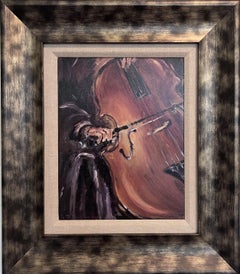
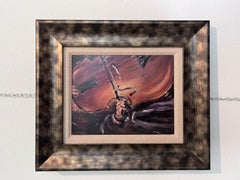
Oil on Canvas “Jimi” by Christina Major 56 x 66

Oil on Canvas “Jimi” by Christina Major 56 x 66

By Christina Major

Located in West Palm Beach, FL

Words Jimi Hendrix Music is Magic. Magic is Life. When the Power of love overcomes the love of power the world will know peace. Knowledge speaks, but wisdom listens. Before yo...

Category

2010s Realist Florida - Art

Materials

Oil

Marc Chagall 'Moses Shows the Elders the Tablets of the Law, 1966'

Marc Chagall 'Moses Shows the Elders the Tablets of the Law, 1966'

By Marc Chagall

Located in Pembroke Pines, FL

Artist: MARC CHAGALL Title: Moses Shows the Elders the Tablets of the Law (FROM STORY OF THE EXODUS) Medium: Lithograph on arches paper Image Size: 18.50x13.50 inches paper size: 20 ...

Category

1960s Modern Florida - Art

Materials

Lithograph

Rum Pum Pum in a Field of Flowers! (framed, hand signed lithograph)

Rum Pum Pum in a Field of Flowers! (framed, hand signed lithograph)

By Takashi Murakami

Located in Aventura, FL

Offset lithograph in colors on smooth wove paper. Hand signed lower right by Takashi Murakami. Hand numbered 182/300 lower right. Published by Kaikai Kiki Co., Ltd., Tokyo. Artwo...

Category

2010s Contemporary Florida - Art

Materials

Paper, Lithograph, Offset

"MaKenna" Contemporary Drawing w/Gold & White Gold Leaf by Alessandra Maria

"MaKenna" Contemporary Drawing w/Gold & White Gold Leaf by Alessandra Maria

By Alessandra Maria

Located in Palm Beach, FL

Note: Due to the size, weight, and value of this piece, we require shipping through 1stDibs, for its cost effectiveness, full insurance coverage, and reliable handling. While standar...

Category

21st Century and Contemporary Contemporary Florida - Art

Materials

Gold Leaf

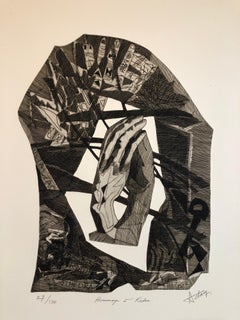
Abstract Expressionist American Modernist Oil Monotype Monoprint Painting

Abstract Expressionist American Modernist Oil Monotype Monoprint Painting

By Larry Brown

Located in Surfside, FL

Larry Brown Long-time established New York painter as well as faculty member the The Cooper Union, Brown works in oil on canvas and tempera paints on paper. He deals with themes of science and universality. EDUCATION: 1970 M.F.A. in Painting, University of Arizona 1967 BA in Painting, Washington State University SELECT GROUP EXHIBITIONS: Mixed Company: Women Choose Men, AIR Gallery, New York, NY Easy Breezy, Sears-Peyton Gallery, New York, NY From Stone and Plate: Contemporary Prints from Tamarind Institute, California State University Change of View Tamarind Institute Gallery, Albuquerque, NM Animal As Muse, The Norton Museum of Art, W. Palm Beach, FL Painting--Larry Brown, Joseph Haske, David Schoffman, Helander Gallery, New York, NY Paper Houses, David Beitzel Gallery, New York, NY Curators Choice, Albright-Knox Art Gallery, Buffalo, NY Current Trends in Abstraction-- Larry Brown, Bill Drew...

Category

1980s Abstract Expressionist Florida - Art

Materials

Monoprint, Monotype

H.O. Miethke Das Werk folio "Sunflower" collotype print

H.O. Miethke Das Werk folio "Sunflower" collotype print

By Gustav Klimt & K.K. Hof-und Staatsdruckerei

Located in Palm Beach, FL

Sunflower, no. 10 from the third installment of Das Werk Gustav Klimts Created during his residency in Litzlberg on Attersee, where Klimt and the Floge family summered from 1900-1907, Klimt explores nature’s transcendental qualities. His single sunflower is human-like, it’s golden halo is like a ring of sun-kissed hair surrounding a bald pate. It’s known that at the same time Klimt was creating this image, he was also at work on a photo essay about the Floge sisters’ clothing from their fashion salon. Their fashion house was best known for its “reform dresses” which featured loose-fitting long robes which billowed at the arms and torso. Viewed with this in mind, it is not a hard leap to imagine the lone sunflower as a self-portrait from reverse. Klimt’s balding head crowned in a golden corona forms the apex of a pyramidal flowing gown of foliage and flowers. By orienting the anthropomorphic flower at the garden’s central foreground and adorning it with repetitive motifs of round flowers of varying sizes, Klimt’s sunflower...

Category

Early 1900s Vienna Secession Florida - Art

Materials

Paper

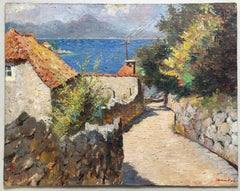
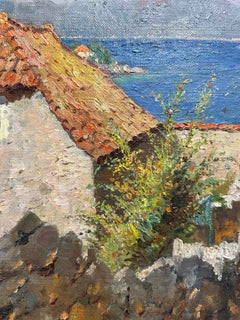
Sola Puig Mallorca Vertical Small original impressionist oil painting

Sola Puig Mallorca Vertical Small original impressionist oil painting

By Joan Sola Puig

Located in CORAL GABLES - MIAMI, FL

" Mallorca " original impressionist oil painting Sola PUIG, Joan (Barcelona 1950 ) Joan SOLÁ paints in a natural way, which reflects the Old Masters, soaking up the colour, air, s...

Category

21st Century and Contemporary Impressionist Florida - Art

Materials

Canvas, Oil

Samuel Bak Surrealist Etching Israeli Bezalel Artist "Hidden Pear", Fruit Bowl

Samuel Bak Surrealist Etching Israeli Bezalel Artist "Hidden Pear", Fruit Bowl

By Samuel Bak

Located in Surfside, FL

HIDDEN PEAR, color etching, signed in pencil, numbered 7/50, Jerusalem Print workshop blind stamp, image 7 ½ x 5 ½”, sheet 15 x 10 ¼”. Samuel Bak (born 12 August 1933) is a Polish- American painter and writer who survived the Holocaust and immigrated to Israel in 1948. Since 1993, he has lived in the United States. Samuel Bak was born in Wilno, Poland, Bak was recognized from an early age as having an artistic talent. He describes his family as secular, but proud of their Jewish identity. By 1939 when Bak was six years old, the war began and Wilno was transferred from Poland to Lithuania. When Wilno was occupied by the Germans on June 24, 1941, Bak and his family were forced to move into the ghetto. At the age of nine, he held his first exhibition inside the Ghetto. Bak and his mother sought refuge in a Benedictine convent where a Catholic nun named Maria Mikulska tried to help them. After returning to the ghetto, they were deported to a forced labour camp, but took shelter again in the convent where they remained in hiding until the end of the war. By the end of the war, Samuel and his mother were the only members of his extensive family to survive. His father, Jonas, was shot by the Germans in July 1944, only a few days before Samuel's own liberation. As Bak described the situation, "when in 1944 the Soviets liberated us, we were two among two hundred of Vilna's survivors--from a community that had counted 70 or 80 thousand." Bak and his mother as pre-war Polish citizens were allowed to leave Soviet-occupied Wilno and travel to central Poland, at first settling briefly in Lodz. They soon left Poland and traveled into the American occupied zone of Germany. From 1945 to 1948, he and his mother lived in Displaced Persons camps in Germany. He spent most of this period at the Landsberg am Lech DP camp in Germany. It was there he painted a self-portrait shortly before repudiating his Bar Mitzvah ceremony. Bak also studied painting in Munich during this period, and painted "A Mother and Son", 1947, which evokes some of his dark memories of the Holocaust and escape from Soviet-occupied Poland. In 1948, Bak and his mother immigrated to Israel. In 1952, he studied art at the Bezalel Academy of Arts and Design in Jerusalem. After serving in the Israel Defense Forces, he continued his studies in Paris (from 1956 at the École nationale supérieure des Beaux-Arts) and spent various periods of time in Rome, Paris, Switzerland and Israel before settling permanently in the United States. In 2001, Bak returned to Vilnius for the first time and has since visited his hometown several times. Samuel Bak is a conceptual artist with elements of post-modernism as he employs different styles and visual vernaculars, i.e. surrealism (Salvador Dali, Rene Magritte), analytical cubism (Picasso), pop art (Andy Warhol, Roy Lichtenstein) and quotations from the old masters. The artist never paints direct scenes of mass death. Instead, he employs allegory, metaphor and certain artistic devices such as substitution: toys instead of the murdered children who played with them, books, instead of the people who read them. Further devices are quotations of iconographical prototypes, i.e. Michelangelo's "Creation of Adam" on the Sistine Ceiling or Albrecht Dürer's famous engraving entitled "Melencholia" . In the late 1980s Bak opened up about his paintings, stating they convey “a sense of a world that was shattered.” He turns these prototypes into ironical statements. Irony in the art of Samuel Bak does not mean parody or derision, but rather disenchantment, and the attempt to achieve distance from pain. Recurring symbols are: the Warsaw Ghetto Child, Crematorium Chimneys or vast backgrounds of Renaissance landscape that symbolize the indifference of the outside world. These form a disturbing contrast with the broken and damaged images in the foreground. Samuel Bak's paintings cause discomfort, they are a warning against complacency, a bulwark against collective amnesia with reference to all acts of barbarism, worldwide and throughout the ages, through his personal experience of genocide. In Bak's piece entitled Trains Bak creates a vast grey landscape with large mounts creating the structure of a train. Massive taper candles burn in the distance further down the train tracks, surrounding an eruption. The smoke from the candles and volcano pour into a sky of dark ominous clouds that lurk over the landscape. Here Bak has created a whole new meaning for “trains.” Many of Bak’s pieces incorporate aspects of Jewish culture and the holocaust with a dark and creative twist, such as Shema Israel...

Category

20th Century Surrealist Florida - Art

Materials

Etching

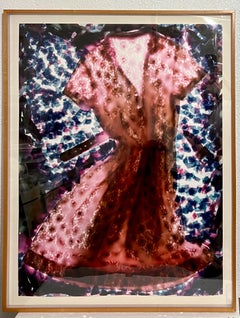
Fairy, 2025. Cyanotype photograph

Fairy, 2025. Cyanotype photograph

Located in Miami Beach, FL

The photos from the series Let Me Tell You a Story show, each one individually, certain themes through strongly narrative visual units. Each photograph is dedicated to a specific rep...

Category

2010s Abstract Florida - Art

Materials

Archival Paper
Bloody Hands. Cyanotype photograph

Bloody Hands. Cyanotype photograph

Located in Miami Beach, FL

The photos from the series Let Me Tell You a Story show, each one individually, certain themes through strongly narrative visual units. Each photograph is dedicated to a specific rep...

Category

2010s Abstract Florida - Art

Materials

Archival Paper
Carmen, NY 1946, Silver Gelatin print. Printed later.

Carmen, NY 1946, Silver Gelatin print. Printed later.

By Horst P. Horst

Located in Miami Beach, FL

This striking black-and-white photograph captures Carmen in NY enveloped in a flowing, white gown, creating a graceful, sculptural form. Her head is elegantly tilted to the side, fra...

Category

1940s Contemporary Florida - Art

Materials

Silver Gelatin

Girl & Rooster Enamel Glazed Ceramic Plaque Israeli Artist Awret Naive Folk Art

Girl & Rooster Enamel Glazed Ceramic Plaque Israeli Artist Awret Naive Folk Art

By Irene Awret

Located in Surfside, FL

This is a rare ceramic plaque painted with enamel glaze by famed Israeli German artist Irene Awret is signed Awret Safed on the verso. the actual glazed ceramic is 10X15 inches. Irèn...

Category

1950s Expressionist Florida - Art

Materials

Enamel

Untitled Abstract Composition, Abstract Expressionist Oil Painting

Untitled Abstract Composition, Abstract Expressionist Oil Painting

By Jay Milder

Located in Surfside, FL

This is being sold unframed. Jay Milder (born 1934) is an American artist and a figurative expressionist painter of the second generation New York School. Old Testament themes such ...

Category

20th Century Abstract Expressionist Florida - Art

Materials

Canvas, Oil

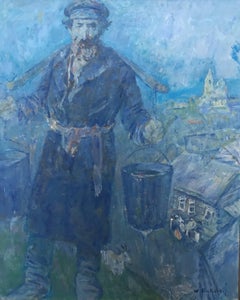
Russian Judaica Shtetl Klezmer Musicians

Russian Judaica Shtetl Klezmer Musicians

By Anatoli Lvovich Kaplan

Located in Surfside, FL

Pastel or Tempera on paper. Judaica Shtetl scene of village. Anatoli Lwowitch Kaplan was a Russian painter, sculptor and printmaker, whose works often reflect his Jewish origins. his...

Category

20th Century Modern Florida - Art

Materials

Pastel, Tempera

After the Party FS II.183 (Warhol estate stamped)

After the Party FS II.183 (Warhol estate stamped)

By Andy Warhol

Located in Aventura, FL

Screen print in colors on Arches 88 wove paper. Unsigned edition, lacking the pencil signature, but with the Estate of Andy Warhol and the Andy Warhol Foundation for the Visual Arts,...

Category

1970s Pop Art Florida - Art

Materials

Paper, Screen

Chinese Reverse Painting of a Dog

Chinese Reverse Painting of a Dog

Located in Palm Beach, FL

Antique Chinese reverse painting on glass of a dog or spaniel painted in a charming naive manner with vibrant colors, slightly oxidized.

Category

19th Century Folk Art Florida - Art

Materials

Paint

Fragments of August
Fragments of August

Fragments of August

By Lawrence Kupferman

Located in Surfside, FL

Lawrence Kupferman was born in the Boston area (b.1909 - d.1982) , and he became one of the most important abstract artists to emerge from there in the early 1940s. Kupferman worked ...

Category

20th Century Abstract Florida - Art

Materials

Pencil, Color Pencil

Mallorca Spain (Spanish Mediterranean landscape)

Mallorca Spain (Spanish Mediterranean landscape)

By James Floyd Clymer

Located in Wilton Manors, FL

Beautiful abstract painting by American artist, James Floyd Clymer (1893-1982). Mallorca, ca.1930. Watercolor and pencil on paper measures 14 x 20 inches. Signed lower margin. Ships rolled with matting removed. James Floyd Clymer ( 1893-1982 ) known for his Regionalist style of land, sea and cityscapes, created paintings with an emphasis on color and form. His works possess a clear and simple style, easily understood by the masses. Born in Perkasie Pennsylvania, 20 miles north of Philadelphia, Clymer was the youngest of seven children. Losing his mother during childbirth, he was raised by his eldest sister. He attended Drexel University in Philadelphia, studying Art and Architecture and worked as an Architect in the years following World War I. During this time, Clymer met the artist Gwenyth Waugh, daughter of the renowned marine painter, Frederick Judd Waugh. His thrust then changed from Architect to Artist. Together, the couple travelled to destinations such as Spain and Newfoundland, where they gave birth to their only daughter. In the early 1920's, Clymer and family settled in Provincetown, MA and quickly became associated with notable artists such as Helen Sawyer, Edwin Dickinson...

Category

Early 20th Century Abstract Florida - Art

Materials

Watercolor, Rag Paper, Pencil

France Provence Landscape

France Provence Landscape

Located in Wilton Manors, FL

Beautiful ca. 1940 French landscape painting. Oil on canvas measuring 18 x 25 inches. Unframed. Unsigned. Some minor flaking in sky and dirt. Otherwise good condition.

Category

Mid-20th Century Impressionist Florida - Art

Materials

Oil

Untitled #3. From the series There is an ocean in my glass

Untitled #3. From the series There is an ocean in my glass

By Ying Chen

Located in Miami Beach, FL

Ying Chen has a recurring dream: scenery consisting of cloud filled Sky, fields of grass, and a body of water. In this foggy but colorful dream, the sky is cloudy, yet everything is ...

Category

21st Century and Contemporary Florida - Art

Materials

Archival Pigment

Influence of Red (male portrait)

Influence of Red (male portrait)

By Gilbert Lewis

Located in Wilton Manors, FL

Gilbert Lewis (b.1945). Influence of Red (male portrait), ca. 1990s. Oil on masonite panel, 16 x 20 inches. Signed upper right. Excellent condition. Measures 18 x 22 inches in custom gold leaf float frame. Original gallery labels affixed on verso. Provenance: estate of the artist. Artist statement: Figurative art is a vital active process. The image has its own meaning; not storytelling, not just a picture of a face or a flower. Neither is it simply an exercise in the arrangement of shapes or colors. I want to translate my immediate impression into paint to present the image of an outstretched branch of flowers or a face – direct and simple. My art reflects human concerns expressed symbolically, through fantasy and in a more concrete manner in the process of making the representation itself. Art is my response to the image, the end result of an active process of exploration of the limits of the paint on paper within the confines of representation. The painting of a face is not just a face. My feelings are expressed through these images. My paintings speak to anyone in touch with their own humanity; to anyone else my art may be dismissed as “to personal”. Biography: Gilbert Braddy Lewis born September 25, 1945 in Hampton, Va. Son of David Blake Lewis (born in Atlanta, Ga.) and Gladys Louise Braddy [Lewis] (of Sanford, Fl.); brother of David Blake Lewis (Jr.) and Linda Lewis [Hunter]. The family resides at 3 South Linden Street, Hampton, Va. 1953 until 1962 “I studied from the age of seven, in Virginia, with two well-known Tidewater artists, Jean Craig and the late Allan Jones. The teaching methods of carefully observed studies from nature in charcoal or tempra paint, derived, of course, from the original French academic model, conveyed its impact on my early development; however, my eye and consciousness were mostly activated by the reproductions on the studio wall of works by Botticelli, Da Vinci, and Michelangelo.” Gilbert Lewis in Contemporary Philadelphia Artists: A Juried Exhibition, (Philadelphia Museum of Art 2000), p. 145 1963-68 Studies at Pennsylvania Academy of the Fine Arts with Franklin Watkins, Hobson Pittman, Morris Blackburn, and Walter Stuempfig. While a student at PAFA he shares apartment [261 South 21st Street] with PAFA students, Jody Pinto and Barbara Sosson. In 1967 he receives PAFA’s: Bergman Prize in Painting; M. Herbert Syme Prize; and Samuel Cresson Memorial Travelling Scholarship. The latter award enables Lewis to travel to Europe during the summer of 1967 where he visits museums. “In 1967, after having seen the Italian master’s work while on scholarship from the Pennsylvania Academy, I was to realize my great influences and to discover the earlier Sienese masters whose clarity and energy still move me.” Gilbert Lewis in Contemporary Philadelphia Artists: A Juried Exhibition, (Philadelphia Museum of Art 2000), p. 145 1968 Horizontal painting [of an interior with a seated woman and cat by a large window] reproduced in black and white in school catalog for Pennsylvania Academy of the Fine Arts 1968-1969, p. 24. Other students whose works are reproduced include Clayton Anderson, Barkley...

Category

1990s Realist Florida - Art

Materials

Masonite, Oil

Charley - Original Marine Oil Painting Tall Ship on Open Sea Nautical Seascape

Charley - Original Marine Oil Painting Tall Ship on Open Sea Nautical Seascape

Located in Palm Coast, FL

This expressive maritime oil painting depicts a majestic tall ship cutting through rolling open seas beneath a luminous, cloud-filled sky. The artist skillfully captures the movement...

Category

Late 20th Century Impressionist Florida - Art

Materials

Oil

Montmartre

Montmartre

By Claude Venard

Located in Boca Raton, FL

Venard had a successful career during his lifetime, punctuated by one-man shows in Paris, London, New York, Philadelphia, Chicago, Dusseldorf, Munich, Buenos Aires, Tokyo, Canada, Be...

Category

1980s Abstract Florida - Art

Materials

Gouache

Cubist Female Nude Woman

Cubist Female Nude Woman

Located in Wilton Manors, FL

Joseph Kardonne (1911-1985). Nude Woman, 1966. Watercolor on paper, sheet measures 9.5 x 13.5 inches. Signed, dated and titled lower right. Excellent condition. Born in Newark, New...

Category

Mid-20th Century Cubist Florida - Art

Materials

Watercolor

Max Eisler Eine Nachlese folio "Girlfriends II" collotype print

Max Eisler Eine Nachlese folio "Girlfriends II" collotype print

By (after) Gustav Klimt

Located in Palm Beach, FL

After Gustav Klimt, Max Eisler #1, Die Freundinnen II; multi-color collotype after 1916/17 painting in oil on canvas which was destroyed by fire in May 1945 at Immendorf Castle Lower Austria. Eisler’s choice to begin his 1931 portfolio of works by Klimt with Girlfriends II was both bold and prescient. Just 14 years later, the painting was tragically destroyed in a fire. With such a loss, this rare and exquisite image is all the more valuable by virtue of having been made in color. In works from his late period, Klimt continued his fascination with exploring female dynamics and their various forms of love. Girlfriends II is a fine example of how space, color and ornament play a noticeable role in the evolution of his symbolic language. Wide swaths of space in the background as well as the two female forms create the structure. Klimt’s strong brushstrokes show a painterly quality and a new move toward abstraction which feels very far away from his earlier work. Nor should Klimt’s economy of line be overlooked. His draughtsmanship is what infuses the female bodies with movement, emotion and a profundity of life. Both women confront the viewer’s gaze unselfconsciously, as if they are modern-day Viennese women stepping out of a Klimtesque ukiyo-e print. Characteristic of this late period, Klimt uses ornament...

Category

1930s Vienna Secession Florida - Art

Materials

Paper

1966 Photo Screenprint Collage Donald Duck Tool Box Jim Dine Pop Art Print

1966 Photo Screenprint Collage Donald Duck Tool Box Jim Dine Pop Art Print

By Jim Dine

Located in Surfside, FL

Jim Dine (American, b. 1935) Tool Box 1966 Medium: Photo Screen Print and collage Dimensions: Framed 26.5 X 21.5 sheet 24 X 19 Printed by Christopher Prater; Kelpra Studios ltd, Lon...

Category

1960s Pop Art Florida - Art

Materials

Mixed Media, Photographic Paper, Screen

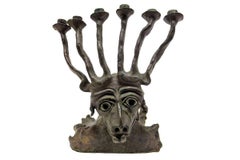
Argentine Modernist Brutalist Abstract Bronze Sculpture Jewish Latin American

Argentine Modernist Brutalist Abstract Bronze Sculpture Jewish Latin American

By Naum Knop

Located in Surfside, FL

Naum Knop (Ukrainian-Argentinean, 1917-1993) Modernist Brutalist bronze figural sculpture with heavy verdigris green finish. Melted forms in the shape of an abstract pretzel like twist. Affixed to white stone plinth. Artist signature, "NK" side of base. Good condition, shows rich green patina and aged oxidation. Measures approximately 17.5 in. x 19.5 in. x 6.5 in. Naum Knop, Argentine sculptor, was born in 1917 in Buenos Aires, into a Jewish family of Russian origin from Ukraine. His childhood was spent in the neighborhood of La Paternal where his father had a carpentry workshop, a space in which he made contact for the first time with the technique of wood carving. After finishing elementary school, he worked with the teacher Luis Fernández and soon after he dedicated himself to furniture design. Around 1935, he entered the Manuel Belgrano School of Fine Arts . Between 1941 and 1942 he attended the course for graduates taught by Alberto Lagos and Alfredo Bigatti at the National School of Fine Arts and continued his training between 1942-1945 at the Ernesto de la Cárcova High School with Soto Avedaño, Carlos de la Cárcova and José Fioravanti. At this time he put his works in dialogue with other young artists such as Libero Badii and Aurelio Macchi . Around 1947 he made his study trip abroad. He goes to California, United States, where he enters the Art Institute of Los Angeles. At the same time visit museums and galleries. In January 1948 he organized his first exhibition abroad, held at the Hall of Arts in Beverly Hills in Los Angeles. During this period he toured Chicago and then New York. That year he traveled to Europe; his itinerary includes France, Italy, Switzerland and England. As a result, he came into contact with the work of Henry Moore, Hans Jean Arp, Jacques Lipchitz, Constantin Brancusi, Umberto Boccioni, Henry Laurens, Ossip Zadkine. Artists who have an impact on the young Knop and whom he honors in his subsequent production. He returned to Argentina in 1949 and installed his workshop where he worked on ornamental carving and on pieces in which he oscillated between a synthetic figuration and abstraction. In 1956 he began his successful participation in salons , obtaining numerous awards at the national and municipal level. In 1959 he participated in the shipment to the 5th São Paulo Biennial and since then, to the success achieved at the local level, the multiple exhibitions carried out in the international field have been added. The exhibitions in Tel Aviv , Jerusalem and Rome (1966) stand out; Dusseldorf (1977); Los Angeles and Palm Spring (1981); New York (1986), San Pablo and Los Angeles(1989). During this period, his work matured, while he began to experiment with the direct wax technique, obtaining textured surfaces similar to welds that gave it a strong abstract expressionist feature. In parallel to his personal production and to the small models, the artist receives private and public commissions for which he works on large-scale sculptures and murals. Around 1967, the architect Mario R. Álvarez summons him to participate in a closed competition for the creation of a work to be located in the General San Martín Cultural Center . Libero Badii and Enio Iommi participate with the artist ; the bronze Reclining Figure Knop is chosen. Among the large-scale monuments it is worth remembering the piece Los tres soles temporarily located in Recoleta in 1984 and later installed in Maryland, United States; as well as Seated Figure (Reminiscence of Michelangelo) located in the shield of a private building in 1970. To these are added the numerous murals in which he experiments with various materials and techniques such as casting in bronze, openwork and reliefs in wood and work in cement. He was included in the The 1962 International Prize for Sculpture the jury included Argan, Romero Brest and James Johnson Sweeney the former director of the Solomon R. Guggenheim Museum in New York. The participants included Louise Nevelson and John Chamberlain for the United States; Lygia Clark for Brazil; Pietro Consagra, Lucio Fontana, Nino Franchina, and Gió Pomodoro for Italy; Pablo Serrano for Spain; and Eduardo Paolozzi, William Turnbull, and Kenneth Armitage for England. Gyula Kosice, Noemí Gerstein, Julio Gero, Naum Knop, Aldo Paparella, Enrique Romano, Eduardo Sabelli, and Luis Alberto...

Category

Mid-20th Century Abstract Florida - Art

Materials

Stone, Bronze

Life Magazine Satirical Society Cartoon Illustration

Life Magazine Satirical Society Cartoon Illustration

Located in Wilton Manors, FL

Barbara Shermund (1899-1978). Society Satirical Cartoon, ca. 1940s. Gouache on heavy illustration paper, image measures 17 x 14 inches; 23 x 20 inches in matting. Signed lower left. Very good condition but matting panel should be replaced. Unframed. Provenance: Ethel Maud Mott Herman, artist (1883-1984), West Orange NJ. For two decades, she drew almost 600 cartoons for The New Yorker with female characters that commented on life with wit, intelligence and irony. In the mid-1920s, Harold Ross, the founder of a new magazine called The New Yorker, was looking for cartoonists who could create sardonic, highbrow illustrations accompanied by witty captions that would function as social critiques. He found that talent in Barbara Shermund. For about two decades, until the 1940s, Shermund helped Ross and his first art editor, Rea Irvin, realize their vision by contributing almost 600 cartoons and sassy captions with a fresh, feminist voice. Her cartoons commented on life with wit, intelligence and irony, using female characters who critiqued the patriarchy and celebrated speakeasies, cafes, spunky women and leisure. They spoke directly to flapper women of the era who defied convention with a new sense of political, social and economic independence. “Shermund’s women spoke their minds about sex, marriage and society; smoked cigarettes and drank; and poked fun at everything in an era when it was not common to see young women doing so,” Caitlin A. McGurk wrote in 2020 for the Art Students League. In one Shermund cartoon, published in The New Yorker in 1928, two forlorn women sit and chat on couches. “Yeah,” one says, “I guess the best thing to do is to just get married and forget about love.” “While for many, the idea of a New Yorker cartoon conjures a highbrow, dry non sequitur — often more alienating than familiar — Shermund’s cartoons are the antithesis,” wrote McGurk, who is an associate curator and assistant professor at Ohio State University’s Billy Ireland Cartoon Library & Museum. “They are about human nature, relationships, youth and age.” (McGurk is writing a book about Shermund. And yet by the 1940s and ’50s, as America’s postwar focus shifted to domestic life, Shermund’s feminist voice and cool critique of society fell out of vogue. Her last cartoon appeared in The New Yorker in 1944, and much of her life and career after that remains unclear. No major newspaper wrote about her death in 1978 — The New York Times was on strike then, along with The Daily News and The New York Post — and her ashes sat in a New Jersey funeral...

Category

1940s Realist Florida - Art

Materials

Gouache

1955 Exhibition Poster

1955 Exhibition Poster

By Paul Klee

Located in Wilton Manors, FL

Original Exhibition Poster Paul Klee, Berggruen and Cie, Paris 1955. Measuring This poster is an original print, not a reproduction. The poster is in very good vintage condition wi...

Category

Mid-20th Century Abstract Florida - Art

Materials

Offset

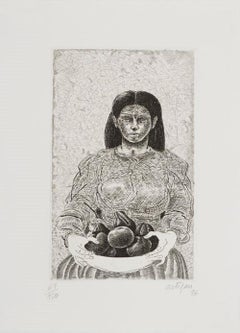
Xisco Mensua Spanish /artist 1995 original signed framed engraving print n9

Xisco Mensua Spanish /artist 1995 original signed framed engraving print n9

By Xisco Mensua

Located in Miami, FL

Xisco Mensua (Spain, 1960) Untitled from Portfolio "Junio - Julio", 1995 engraving on paper 12.6 x 9.5 in. (32 x 24 cm.) Edition of 6 Frame 16x20 in. ID: MEN1253-001-006_9 Hand-signe...
Category

1990s Contemporary Florida - Art

Materials

Paper, Engraving

Intricacies Of The Mind (huge original painting)

Intricacies Of The Mind (huge original painting)

By Peter Max

Located in Aventura, FL

Original acrylic painting on canvas. Hand signed and dated lower left by Peter Max. Artwork size: 48.25 x 58 inches. Canvas is stretched. Artwork is in excellent condition with...

Category

1970s Pop Art Florida - Art

Materials

Canvas, Acrylic

Ivory Gull /// Ornithology Bird Audubon Seascape Beach Ocean Shorebird Shell

Ivory Gull /// Ornithology Bird Audubon Seascape Beach Ocean Shorebird Shell

By John James Audubon

Located in Saint Augustine, FL

Artist: John James Audubon (American, 1785-1851) Title: "Ivory Gull" (Plate 445, No. 89) Portfolio: The Birds of America, First Royal Octavo Edition Year: 1840-1844 Medium: Original ...

Category

1840s Victorian Florida - Art

Materials

Watercolor, Lithograph

Untitled Abstract Expressionist painting

Untitled Abstract Expressionist painting

By Eve Peri

Located in Wilton Manors, FL

Watercolor on paper, sheet measures 12 x 17.5 inches. Unframed. Signed and dated lower right. Estate stamp on verso. EVE PERI (1897-1966) Born in Bangor, Maine, Eve Peri worked...

Category

Mid-20th Century Abstract Florida - Art

Materials

Watercolor, Gouache

Cubist mid-century abstract expressionist painting

Cubist mid-century abstract expressionist painting

Located in Wilton Manors, FL

Bernard Segal (1907-1986). Cubist painting, ca. 1960. Gouache and watercolor on paper, sheet measures 20 x 5.25 inches. Unsigned. Estate stamp on verso side which shows through the p...

Category

Mid-20th Century Cubist Florida - Art

Materials

Paper, Gouache

Love Mirror Oil on Canvas, Signed Magazine Cover, Circa 1937, 17x13

Love Mirror Oil on Canvas, Signed Magazine Cover, Circa 1937, 17x13

Located in Miami, FL

Love Mirror, True Experiences magazine cover, February 1937 by Female Illustrator and Pupl Artist Georgia Warren Oil on canvas 17 x 13 inches (43.2 x 33.0 cm) Signed lower left: War...

Category

1930s American Realist Florida - Art

Materials

Canvas, Oil

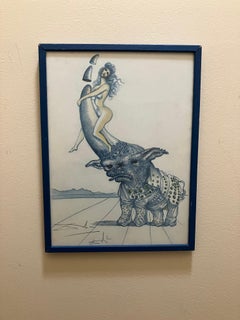
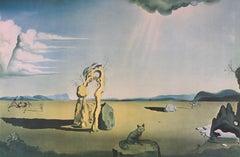
Le Jungle Humaine Le Cavalier

Le Jungle Humaine Le Cavalier

By Salvador Dalí­

Located in Hollywood, FL

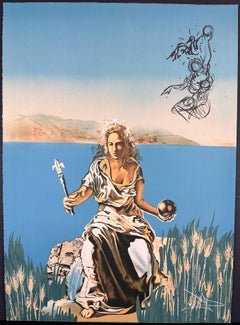
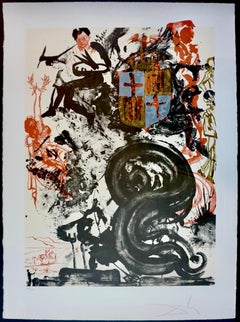
ARTIST: Salvador Dali TITLE: Le Jungle Humaine Le Cavalier MEDIUM: Lithograph SIGNED: Hand Signed by Salvador Dali PUBLISHER: Martin Lawrence EDITION NUMBER: CCXXXXVII/CCL MEA...

Category

1970s Surrealist Florida - Art

Materials

Lithograph

Pair of 19 century oil on porcelain portraits

Pair of 19 century oil on porcelain portraits

Located in San Francisco, CA

Pair of fabulous 19 century oil on porcelain portraits. These finally detailed paintings are most likely, a husband and wife. The male portrait could possibly be Napoleon the second....

Category

19th Century Realist Florida - Art

Materials

Oil

Rare 1922 German Jewish Judaica Zion Woodcut Woodblock Print Hermann Fechenbach

Rare 1922 German Jewish Judaica Zion Woodcut Woodblock Print Hermann Fechenbach

By Hermann Israel Fechenbach

Located in Surfside, FL

Title: Zion Subject: Various biblical images depicting Creation and prayer 1922 Medium: woodcut Frame: 14" x 18" Image: 12.5" x 16.75" Provenance: owned and signed verso by Peter Keil. Central panel shows the Jewish star over a crown, with inscription in Hebrew: "When God comforts Zion, He will comfort all its ruins and make its deserts look like Eden," and "You have sanctified the seventh day, the goal of creation of Heaven and Earth." This is flanked by a Palestinian farmer pioneer on the left and a Jew praying on the right. The lower tier shows six vignettes of the days of creation from Genesis. Hermann Fechenbach was born in 1897 in Württemberg, Germany. He grew up in Bad Mergentheim where his parents had an inn, which served as a meeting place for the local Jewish community. He left school early and through family connections with clothing retailers received training in window dressing. His skill with brush writing was quickly recognised by a big firm in Dortmund where he was responsible for the displays in 10 large windows. He received his conscription papers in 1916 and recalls “being as patriotic as any other fool”. In August 1917 he was involved in a grenade attack in which he was the sole survivor. With serious injuries to both legs he struggled to safety and was eventually transported to a front line “slaughterhouse” where the first of a series of amputations was performed which led to the loss of his left leg. As a result of his injuries his father dropped his opposition to him becoming an artist. His formal art education started in 1918 with training at a Stuttgart handcraft school for invalids. He attended the Academies in Stuttgart and Munich to learn painting and restoration for 3 years. He was influenced at this time by Max Liebermann. He has been compared to Kathe Kollwitz and was a contemporary of Jakob Steinhardt and hermann Struck. In 1923 he went to Florence for a year. While in Florence he started to produce a series of miniature wood engravings to illustrate the stories of Genesis. This was followed by periods in Pisa, Venice, Vienna and Amsterdam. In 1924 he returned to Stuttgart to paint in the contemporary style “Die Neue Sachlichkeit”. (The New Objectivity was a movement in German art that arose during the 1920s Weimar republic as a reaction against expressionism. The term was coined by Gustav Friedrich Hartlaub, the director of the Kunsthalle in Mannheim, who used it as the title of an art exhibition staged in 1925 to showcase artists who were working in a post-expressionist spirit. These artists—who included Max Beckmann, Otto Dix, George Grosz, Christian Schad, Rudolf Schlichter and Jeanne Mammen) Every spring and autumn he exhibited at the “Kunstgebit” which served as the showcase for all serious artists of the period. His professional status “Kunstmaler und Grafiker” was recognised by Berlin in 1926. Practically all his work from this period was sold following exhibition. In 1926 he collaborated with an architect friend to build a bungalow in Hohenheim, a non-Jewish area and a suburb of Stuttgart. Hermann alternately lived in his country bungalow and his town studio, producing portraits for sale or barter and wood engravings for his own pleasure. In 1930 he married a non-Jewish professional photographer – Greta Batze. They had a studio in Stuttgart, which was used to teach art to a group of 12 students. In 1933 the Nazi influence removed his name from the official state register together with the right to exhibit. By spending most of his time in his bungalow out of the Jewish quarter the Fechenbachs escaped being registered by the Nazis for some years. They were ostracised and abused by their non-Jewish neighbours. Hermann made weekly visits to friends in town to teach them the practical skills they would need assuming they were to escape from Germany. His energies were directed towards protection and survival. Ultimately the Nazi persecution forced the Fechenbachs to flee their homeland. They moved to Palestine for 3 months in 1938, but found the political and physical environment unsustainable. Greta arrived in England penniless in January 1939 to work as a domestic servant and to find a guarantor for her husband. Hermann arrived in May 1939. They moved to Blackheath a few months later. Hermann resumed his painting and engraving as a means of earning a living. He raised enough money to get his parents out of Germany to join his brothers in Argentina but was unable to save his twin sister Rosa who died in a Nazi concentration camp. In 1940 Hermann was interned in Bury as a suspect alien. He protested about his treatment by starting a hunger strike. Because of his persistence he was moved to a prison in Liverpool. From Liverpool he was moved to the Hutchinson Camp in the Isle of Man with fellow artist Kurt Schwitters. Arrangements were made for Greta to be accommodated near by. While interned he commenced work on “Refugee Impressions”, a series of linocut prints (no wood was available). In 1941 when released from internment the Fechenbachs came under the sponsorship of Dr. Bela Horovitz, the Austrian art publisher who in turn made an introduction to Professor Tancred Borenius. They were offered lodgings with a family in Oxford. Hermann had his first public exhibition for many years in a small gallery in Oxford in 1942. A second exhibition of oils, pencil drawings, coloured linocut and woodblock prints held later in the year was opened by the mayor of Oxford and critically acclaimed. In 1944 the first London exhibition took place at the Anglo-Palestinian club in Piccadilly. There were two exhibitions at the Ben Uri Art gallery during this period. In 1948 a second exhibition at the Anglo Palestinian club was inaugurated by a member of the Rothschild family and several members of Parliament. This was a great success. In 1944 the Fechenbachs moved to a top floor studio flat in Colet Gardens. Open exhibitions were held each Spring at the Embankment from 1946 to 1951. Movietone News produced a short feature on the artist, which was shown in cinemas in England and Germany. In 1969 he published the Genesis story in a hard back volume containing 137 prints. He started to research the fate of the entire Jewish community of Bad Mergentheim during the period of the second world war, liaising with historian Dr. Paul Sauer and Professor Max Miller, historian and theologian. In 1972 Kohlhammer published his partly autobiographical book “The last Jews of Mergentheim”. He exhibited at the Anglo-Palestinian Club & the Ben Uri Gallery in the 1940s. His works only came to prominence during the last year of his life when he exhibited at Blond Fine Art. Peter Keil part of the Junge Wilde. In 1978, the Junge Wilde painting style arose in the German-speaking world in opposition to established avant garde, minimal art and conceptual art. It was linked to the similar Transavanguardia movement in Italy, USA (neo-expressionism) and France (Figuration Libre). They were also known as the Neue Wilde. Artists included; Austria: Siegfried Anzinger, Erwin Bohatsch, Herbert Brandl, Gunter Damisch, Hubert Scheibl, Hubert Schmalix...

Category

1980s Impressionist Florida - Art

Materials

Woodcut

Beatrice Adams (British, 1876-1958) Antique Oil Painting, Portrait of a Lady

Beatrice Adams (British, 1876-1958) Antique Oil Painting, Portrait of a Lady

Located in Palm Coast, FL

This refined antique oil portrait depicts an elegant young woman wearing a black hat accented with a red feather, captured with soft modeling and restrained realism typical of Britis...

Category

Early 1900s Impressionist Florida - Art

Materials

Oil

Exposicion Noticias Del Nuevo Mundo Puerto Rican poster (Puerto Rico)

Exposicion Noticias Del Nuevo Mundo Puerto Rican poster (Puerto Rico)

By Rafael Tufino

Located in Wilton Manors, FL

Feria del Libro (Book Fair), 1966 Rafael Tufino Silkscreen on paper, measuring 20 x 29 1/2 inches ~ (50 x 73 cm) Some creasing and wear around edges. Ships rolled in tube with...

Category

Mid-20th Century Modern Florida - Art

Materials

Lithograph

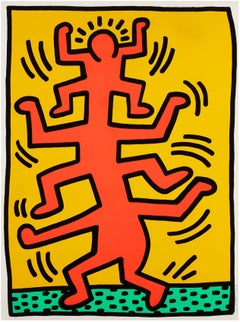
GROWING (1)
GROWING (1)

GROWING (1)

By Keith Haring

Located in Aventura, FL

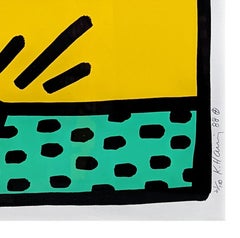
Screenprint in colors on Lenox Museum Board. Hand signed, dated and numbered by Keith Haring. Image size 38.75 x 28.5 inches. Edition 21/100 (there were also 15 artist's proofs). P...

Category

1980s Pop Art Florida - Art

Materials

Paper, Screen

Boomerang, 1974
Boomerang, 1974

Alexander CalderBoomerang, 1974, 1974

$16,000Sale Price|20% Off

Boomerang, 1974

By Alexander Calder

Located in Miami, FL

Boomerang, 1974 Lithograph in colors on Arches paper Published by Transworld Art, New York, printed by Mourlot, Paris 29.5 x 43.3 inches Signed in pencil, "A.P." apart from the edit...

Category

1970s Florida - Art

Materials

Lithograph

Abstract Painting on Canvas by Serg Graff "Funny Octopuses", COA

Abstract Painting on Canvas by Serg Graff "Funny Octopuses", COA

Located in Palm Coast, FL

This is a unique original acrylic painting on canvas in a lively fantasy abstract style by Serg Graff, titled “Funny Octopuses.” The painting bursts with color and movement, depicti...

Category

2010s Abstract Florida - Art

Materials

Acrylic

Vintage oil painting on canvas by Anna, Farm Landscape, Framed

Vintage oil painting on canvas by Anna, Farm Landscape, Framed

Located in Palm Coast, FL

This is an original vintage oil painting on canvas depicting a rural landscape. In the foreground, a rustic watermill sits beside a flowing stream, complete with a turning water whee...

Category

Mid-20th Century Impressionist Florida - Art

Materials

Oil

Floral Still Life Postage Stamp Surrealist Collage painting

Floral Still Life Postage Stamp Surrealist Collage painting

Located in Wilton Manors, FL

Mabel Barnsbee (1892-1980). Miniature Watercolor Painting Surrealist Postage Stamp Collage. Image measures 4.5 x 6.5 inches. Measuring 11 x 13 inches in original frame. The Mysti...

Category

Mid-20th Century Surrealist Florida - Art

Materials

Paper, Watercolor

PLAYBOY BUNNY
PLAYBOY BUNNY

PLAYBOY BUNNY

By Andy Warhol

Located in Aventura, FL

Synthetic polymer drawing on paper. Unsigned. Warhol Foundation stamp on verso. Sheet size 31.5 x 23.5 inches. Custom framed as pictured. Artwork is in excellent condition. Cert...

Category

1980s Pop Art Florida - Art

Materials

Polymer, Paper

Halston and his Halstonettes, Watercolor fashion portrait on paper

Halston and his Halstonettes, Watercolor fashion portrait on paper

By Manuel Santelices

Located in Miami Beach, FL

The artist has covered New York collections for over 16 years and has interviewed, as a journalist, several fashion designers and personalities for different publications. He loves t...

Category

21st Century and Contemporary Contemporary Florida - Art

Materials

Paint, Watercolor

TRIPLE SELF-PORTRAIT

TRIPLE SELF-PORTRAIT

By Norman Rockwell

Located in Aventura, FL

Collotype in colors on paper. Unsigned. Published in 1972. Copyright info in typeset lower margin. Artwork is in excellent condition. All reasonable offers will be considered.

Category

1970s American Impressionist Florida - Art

Materials

Paper, Lithograph

Large Handmade Tapestry Textile Wall Hanging Wool Mixed Media Marlene Richard

Large Handmade Tapestry Textile Wall Hanging Wool Mixed Media Marlene Richard

Located in Surfside, FL

Eclectic, mixed media wall hanging textile tapestry by Marlene (Marlen) Richard featuring abstract embroidery atop free hanging locks of fabric over a black background embellished wi...

Category

20th Century Contemporary Florida - Art

Materials

Metal

Roma 2021 M Vaticani 59bn and palazzo massimo 01bn. Figurative Photograph

Roma 2021 M Vaticani 59bn and palazzo massimo 01bn. Figurative Photograph

By Luca Artioli

Located in Miami Beach, FL

Artioli captures beauty through his camera, creating artistic, painterly images by intentionally moving the camera during long exposures. These images represent "the impression" of a...

Category

2010s Contemporary Florida - Art

Materials

Black and White, Archival Pigment

Israeli Oil Painting Ruth Schloss Child, Doll, Wagon, Kibbutz Social Realist Art

Israeli Oil Painting Ruth Schloss Child, Doll, Wagon, Kibbutz Social Realist Art

By Ruth Schloss

Located in Surfside, FL

Large magnificent colorful Ruth Schloss oil painting of a child with a wagon with a doll or a baby in a carriage stroller.. Signed in Hebrew size measures 31x43 with frame , 23x35.25 without the frame. (this is being sold unframed). Ruth Schloss (22 November 1922 – 2013) was an Israeli painter and illustrator who mainly depicted neglected scenes such as Arabs, transition camps, children and women at eye-level as egalitarian, socialist view via social realism style painting and drawing. Schloss became Israeli painting’s sensitive, conscious, remembering eye. Ruth Schloss was born on 22 November 1922, in Nuremberg, Germany, to Ludwig and Dian Schloss, as the second of three daughters of bourgeois assimilationist Jewish family well-integrated into German culture. As the Nazis came into power in 1933, her family immigrated to Israel in 1937, and settled in Kfar Shmaryahu, then an agricultural settlement. Schloss studied at the Department of Schloss graphic design at "Bezalel" from 1938 to 1942 alongside Friedel Stern and Joseph Hirsch. She was a realistic painter who focused on disadvantaged people in the society and social matters as an egalitarian. Her realism was thus an “inevitable realism,” motivated by an inner necessity: the need to observe reality as it is. Her painting repeatedly addressed the door pulled from its frame, employing drawing’s unique ability to stop time and prolong the image’s persistence in the retina, she repeatedly committed to paper - in a matter-of-fact, non-evasive manner devoid of mystery – man’s tendency to generate chaos, suffering and pain. Throughout her life, Schloss remained minimalist. Painting about human fate was the main subject of her artworks. Her natural inclination was to describe the darker aspect of human existence. 1930s The Schloss household was characterized by open, liberal spirit, in keeping with the parents’ progressive views. It deeply influenced Ruth’s mental development, as she learned to tie culture and art with sensitivity towards the weak and underprivileged. In Jerusalem, she joined a commune of Hashomer Hatzair in which she shaped her socialist views, which she maintained throughout her long career. 1940s In this period she mainly depicted landscapes of kibbutz and wretched women living hard life, children in huger, older people, refugees. After completing her art studies, Schloss joined a training group at Kibbutz Merhavia in 1942, and after two years moved to Karkur region, the nucleus established Kibutz Lehavot Habashan in the Upper Galilee. Through this time, she fell in love with the surroundings and drew landscapes. They are simple and direct with fresh, lucid lines. These paintings were selected as the main works of her first exhibition in 1949. In early 1945, Schloss started to draw illustrations in the children’s magazine Mishmar Leyeladim, and designed the logo of Al Hamishmar, the paper’s new name in 1948. In 1948, upon the founding of Mapam (United Workers’ Party), she designed her party’s emblem, which became a well-known icon. She kept working as an illustrator for Mishmar Layeladim until 1949. "Mor the Monkey" project yielded financial profits and this income was used for a study trip to Paris for two years. She was succesfull as illustrator however, she had inner conflicts of her identity as witnessed painter toward neglected class in Israeli society. First Exhibition at Mikra-Studio Gallery, 1949 She presented forty drawings on paper in her first solo exhibition, representing a selection of the themes of kibbutz landscape, its lifestyle. Schloss confidently proposed her direction through simplicity without using colors in her drawings. 1950s Between 1949 and 1951, she studied at the Académie de la Grande Chaumière in Paris. She began working in oils, with which she continued throughout the 1960s. The exhibition “Back from Paris” opened in November 1951 at Mikra-Studio Gallery . In 1951 she married Benjamin Cohen, who served as chairman of the national leadership of Hashomer Hatzair Workers Party in Tel Aviv. He was a theoretician and a man of principle, highly esteemed by its leaders who became a professor of history at Tel Aviv University. In 1953, following the Mordechai Oren affair and the publication of Moshe Sneh 's followers from Kibbutz Artzi, she and her husband left the kibbutz and moved to the agricultural farm, Kfar Shmaryahu, where she lived until her death. At a certain point in Israeli history, segments of the socialist movement felt that Israel should become part of the Communist bloc, rather than seek the support of the western world. Because the Schloss couple support of Moshe Sneh’s left-wing party, they had to leave the kibbutz. She loved to depict ordinary women as figurative on her painting without hiding or making up anything. The poet Natan Zach wrote about her works in 1955: “Her motto remains that which has been all these years: life as it is, without bluffing." Schloss’s “Pietà” (1953) became a universal cry expressing the pain of mothers on either side of the divide. In the late 1950s, she was the mother of two daughters. When she drew her daughters, unlike the universal babies she depicted, naked and with clenched fists, the painting of her children employed babyish sweetness to the full in a quiet, peaceful and heart-stirring filling rather than urgency. She also painted children in the transition camp and Jaffa in the 1950s and 1960s. 1960s-1980s – The period of Studio in Jaffa Schloss painted at a studio in Jaffa from 1962 till 1983. In this time, she turned her interest to people around her more than kibbutz – the children, mothers, and poor workers, the alleys and houses. She opened the space to the street and its dwellings, built interactions around it, and was nurtured by the presence of the outside in her work. 1960s Schloss familiarized to an Arab woman, Nabava, lived in poor. Schloss returned to painting images of old people later, and she called her painting figurative elderly people in the old age homes “waiting”. In the late 1960s, Ruth discovered acrylic paint and never turn back to oil painting. In 1965 Schloss devoted a series “Area 9 (1965)”, dedicated to the demolition of Israeli-Arab houses and the expropriation of the land, and carried a definite socio-political messages. The series was exhibited at Beit Zvi, Ramat Gan, in 1966. She was the only artist who addressed the result of the Six-Day War immediately afterward. In 1968, Schloss and Gansser-Markus presented “Drawing of War” in Zurich gallery. She expressed the war as an ultimate expression of destruction and ruin, regardless of victors and vanquished. 1970s In late 1970s Schloss began printing the selected photograph directly on the canvas, posterior reworking it in acrylic. She decided to print her work at Har-El Printers in Jaffa, and these became the surface of her painting. This technique was mainly adopted in two large series: Anne Frank (1979-1980) and Borders (1982). Through this technique she placed the figure of elder Frank next to that of the famous young Frank, and released it at the exhibition at Bet Ariela Cultural Center, Tel Aviv, in 1981. The series touched upon the Nazi Holocaust. 1980s The Lebanon War raised the question of “The Good Fence” and the effect of the war. She dedicated a large series Boarders, one of the most powerful image linked to the series is the figure of Yemenite woman raising her hand. She was the first to raise the Black Panthers demonstration to the level of a social icon. In the 1980s and again in 2000, the Intifada uprisings also led Schloss to the easel to render a good number of representational and symbolic works that in their way denounced Israel's political and military actions. 1990s – 2000s Ruth Schloss never had an exhibition in a major Israeli museum. Her works were presented in private galleries and small museums. The main museums, the Tel Aviv Museum of Art and the Israel Museum, included her works only in group exhibitions, and only in 1991 was her retrospective exhibited at the Herzliya Museum. In the 2000s, Schloss’s metaphors turned into animal kingdom and Bedouins in the south. A huge rhinoceros, birds of prey, and other "bad animals," as Cohen Evron, daughter of Ruth, calls them and "I connected this to the Nazis," said Schloss. Schloss' work after she didn't find human expression able to transmit the endless cruelty she saw in Israel's political mentality. Schloss also continued to follow and collect documentary photographs of destructions of houses from the war, the Intifada, the sequence of her work about ruin from 1949 to 2005, was a cumulative testimony about the painful history of Israel and Palestine. In 2006, a large retrospective exhibition of her work was presented at the Museum of Art in Ein Harod, curated by Tali Tamir. Education 1938-41 Bezalel Art Academy, Jerusalem, with Mordecai Ardon 1946 painting course for Kibbutz Artzi artists with Yohanan Simon and Marcel Janco 1949-51 Académie de la Grande Chaumière, Paris Awards and recognition 1965 Silver Medal, International exhibition in Leipzig, Germany 1977 Artist-in-Residence, The Cité Internationale Universitaire de Paris Selected solo exhibitions 2004 “Micha...

Category

Mid-20th Century Realist Florida - Art

Materials

Canvas, Oil

Better World
Better World

Better World

By Peter Max

Located in Hollywood, FL

Artist: Peter Max Title: Better World Size: 48 x 24 Inches (Framed: 57.25 x 33.25 Inches) Medium: Acrylic on Canvas Edition: Original Year: 2010 Notes: Max Studio Catalog Nu...

Category

2010s Modern Florida - Art

Materials

Canvas, Acrylic

Untitled - black and white photography

Untitled - black and white photography

By Leo Reinfeld

Located in New York, NY

Since 1995 I have used a great deal of my time to study the lines and curves of the female body. Long before that I already had the idea that the female body contains every line, eve...

Category

2010s Contemporary Florida - Art

Materials

Archival Pigment

Des Ongles et Du Bec (abstract female portrait)

Des Ongles et Du Bec (abstract female portrait)

By Georges Rouault

Located in Wilton Manors, FL

Artist Georges Rouault (1871, France - 1958, France) Main title "Des ongles et du bec" Etching and aquatint on wove paper. Creation date 1926 / 1948 Publisher: Etoile Filante, P...

Category

Mid-20th Century Abstract Florida - Art

Materials

Etching, Aquatint