Ohio - Art

to
131
908
393
319
161
281
Overall Width
to
Overall Height
to
50
202
1,298
510
59
61
155
132
77
109
198
166
140
58
32
430
349
284
133
56
32
27
23
21
17
8
7
1
954
833
128
609
280
215
207
153
113
109
104
86
82
80
73
57
48
40
39
36
30
28
28
831
324
278
208
208
92
62
61
50
35
566
145
231,480
157,695
Item Ships From: Ohio
Aries-The Ram
Aries-The Ram

Aries-The Ram

By Eugène Grasset

Located in Fairlawn, OH

Signed with the artist's initials lower left From: Les Douze Mois de 1889 As published in Vol. 9, No. 425 of Les Hommes d'Aujourd'hui. Published by Sagot, Paris Proof before letters...

Category

1880s Art Nouveau Ohio - Art

Materials

Lithograph

David Hostetler Female  Figurative Sculpture BMW Car Paint Art Deco Commission

David Hostetler Female Figurative Sculpture BMW Car Paint Art Deco Commission

By David Hostetler

Located in Nantucket, MA

By Commission. Casting and custom paint will take approximately 4 months. I have to get in line with my paint expert. Cape Lady is a polished bronze casting painted with Glasurit, a hand sprayed car paint. It is BMW white and BMW black. It is a limited edition of 15 with 2 artist proofs. The current edition available would be 6/15. It was cast from an original wood carving by David Hostetler...

Category

2010s Art Deco Ohio - Art

Materials

Bronze

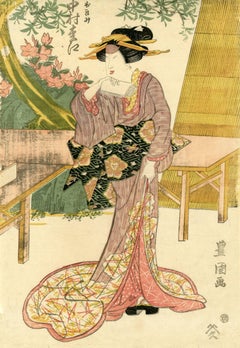
Courtesan Kumekichi
Courtesan Kumekichi

Courtesan Kumekichi

By Utagawa Kunisada (Toyokuni III)

Located in Fairlawn, OH

Courtesan Kumekichi Color woodblock, 1858 Kabuki Actor Iwai Kumesaburo III in the role of courtesan Kumekichi, who is standing in snow hold a red sake cup Publisher: Ohkuniya Kinjiro...

Category

1850s Other Art Style Ohio - Art

Materials

Woodcut

Lumber Workers (Cuidad del Carmen, State of Campeche)

Lumber Workers (Cuidad del Carmen, State of Campeche)

By Alfredo Zalce

Located in Fairlawn, OH

Lumber Workers (Cuidad del Carmen, State of Campeche) Color lithograph on wove paper, c. 1945 Signed lower right in pencil From: Mexican Art - A Portfolio of Mexican People and Place...

Category

1940s American Modern Ohio - Art

Materials

Lithograph

Untitled
Untitled

Untitled

By Leon Kelly

Located in Fairlawn, OH

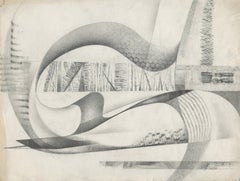
Untitled Pastel on paper, 1922 Initialed lower right (see photo) Exhibited: Francis Nauman, Leon Kelly: Draftsman Extraordinaire, New York, April 4 - May 23, 2014. Condition: excellent Image size: 11 8 7/8 inches Frame size: 18 1/4 x 16 1/4 inches Provenance: Estate of the artist The Orange Chicken...

Category

1920s Abstract Ohio - Art

Materials

Pastel

Panama Garden, Mid-century abstract expressionist modern work

Panama Garden, Mid-century abstract expressionist modern work

By Richard Andres

Located in Beachwood, OH

Richard Andres (American, 1927-2013) Panama Garden, c. 1964 acrylic on canvas signed lower right, signed and titled verso 46 x 38 inches Richard Andres was born in Buffalo, New York in 1927. A graduate of the Cleveland Institute of Art in 1950, he was immediately drafted and served for two years in the army as a mural painter. He received his Master of Arts from Kent State in 1961. A frequent exhibitor at galleries and museums and winner of multiple May Show prizes, Andres taught art in the Cleveland Public Schools for 28 years, as well as teaching the University of Buffalo, the Cleveland Institute of Art and the Western Reserve University. Very little in Richard Andres’ childhood would have predicted his love of classical music, mid-century-modern architecture and certainly not his lifelong passion for art and in particular abstract art. Richard’s father, Raymond, had no more than a third-grade education, and his mother, Clara, was one of thirteen children – only three of whom lived into adulthood and none of whom attended high school. They lived, when Richard was a boy, in a dingy area of Buffalo, NY in a walk-up apartment situated above a tavern. Raymond and Clara supplemented the income from their factory jobs in the bar downstairs with Raymond playing ragtime on the piano and Clara serving drinks. This often left Richard and his two older brothers at home alone to fend for themselves. The two older boys, Raymond and Russell, were - unlike Richard- rather rough and tumble and entertained themselves with stickball, boxing and the like. Richard, on the other hand, from a very young age liked to draw, or better yet even, to paint with the small set of watercolors he received for Christmas one year. Paper, however, at the height of the depression, was hard to come by. Luckily, Clara used paper doilies as decoration for the apartment and Richard would contentedly paint and then cut up doilies, gluing the pieces together to create collages. At eight-years-old, he discovered the Albright-Knox Museum (then known as the Albright Art Gallery) and spent several hours a week there studying the paintings. He was particularly fond of Charles Burchfield‘s landscapes, enamored with their ‘messiness’ and thinking that they somehow captured more ‘feeling’ than works he was previously familiar with. For his tenth Christmas, he asked for and received a ‘how-to’ paint book by Elliot O’Hare. Through this self-teaching, he assembled the portfolio needed for acceptance to Buffalo Technical High School where he studied Advertising Arts. In his Junior year, he was encouraged to enter a watercolor painting, “Two Barns,” in the national 1944-45 Ingersoll Art Award Contest and was one of twelve grand prize winners – each one winning one hundred dollars. More importantly the painting was exhibited at the Carnegie Institute Galleries, which resulted in his winning a national scholarship to the Cleveland School of Art (The Cleveland Art Institute). He flourished at the art school under the tutelage of faculty members such as Carl Gaertner, as well as that of visiting artists such as William Sommer and Henry George Keller. He would say in later years that Gaertner, in particular, influenced his attitude toward life as well as art. “Gaertner,” Andres said, “believed that there was no need to be a ‘tortured artist’, that an artist should rather enjoy beauty, family, and life in general.” Free to spend his days as he chose, he wandered the Cleveland Art Museum for most of the hours he was not attending classes or painting; the remaining time was spent drinking coffee at a local hangout with art school friends – which is where he met fellow Henry Keller scholarship winner, Avis Johnson. Richard was immediately smitten with Avis, but being rather shy, it took him the entire summer of 1948 to build up his courage to ask her out. Over that summer he ‘thought about Avis’ and worked in a diner to save money. He also used the hundred-dollar prize money won in High School to visit the first Max Beckmann retrospective in the United States at the City Art Museum in St. Louis. Over a half century later he spoke of that exhibit with a reverence usually reserved for spiritual matters, “I walked in and it was like nothing I had ever seen before... the color...It just glowed.” Returning to campus in the Fall, the first thing he did was go to the coffee shop in hopes of finding Avis. He did, and she, upon seeing him, realized that she was also smitten with him. They quickly became known as ‘the couple’ on campus, and a year later, with Richard being drafted for the Korean war, they were quickly married by a Justice of the Peace, celebrating after with family at Avis’s Cleveland home. As a gift, faculty member John Paul Miller...

Category

1960s Abstract Expressionist Ohio - Art

Materials

Acrylic

Ionic Column Capital

Ionic Column Capital

Located in Fairlawn, OH

Ionic Column Capital Graphite, wash, gouache and gum arabic, 4 Fev 57 (Feb 4 1857) Signed and dated lower right (see photo) Ionic columns are a classical architectural style characte...

Category

1850s Romantic Ohio - Art

Materials

Gouache

St. George and the Dragon after Raphael

St. George and the Dragon after Raphael

By Ferdinand Gaillard

Located in Fairlawn, OH

St. George and the Dragon after Raphael Engraving, 1885 Unsigned, proof before letters A engraving after a painting by Raphael (c.1504-05) now in the Musée du Louvre, Paris (inv. no....

Category

1880s French School Ohio - Art

Materials

Engraving

Carcere ascura
Carcere ascura

Carcere ascura

By Giovanni Battista Piranesi

Located in Fairlawn, OH

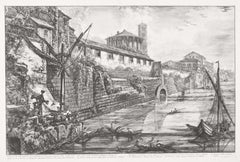
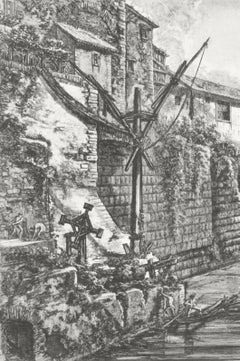
Carcere ascura Etching, 1743 Signed in the plate bottom left corner From: Prima Parte, 1743 Second edition: 1750-1778 Watermark: R 37-39 A lifetime impression printed during Piranesi’s life, before the plates are moved to Paris by his sons in the 1790’s This image foretells Piranesi's famous set, Carceri (Prisons) which is his next creative effort. Condition: Horizontal crease midway in the sheet associated with the manufacture of the paper. Visible watermark verso Small printer crease in the bottom right below the caption plate. Image size: 14 1/2 x 9 1/2 inches Reference: Robison 3 iii/VI Piranesi In Rome: Prima Parte di Architetture e Prospettive "Although Piranesi studied architecture in Venice, he never was able to find work in the field other than a few jobs involving remodeling in Rome. While Piranesi was struggling to support his architectural endeavors upon his arrival in Rome in 1740, he spent a short period of time in the studio of master painter Giovanni Battista Tiepolo (1696-1770) in addition to his apprenticeship with Giuseppe Vasi. The first production of Piranesi’s early years in Rome and a culmination of his training under Vasi, Tiepolo, and his uncle, was the Prima Parte di Architetture e Prospettive (1743). The Prima Parte was a collection of twelve etchings of imaginary temples, palaces, ruins, and a prison. During this time, Piranesi was still developing the unique style of etching he is known for today, and as such the Prima Parte differs significantly in technique compared to later works. In the Frontispiece of the Prima Parte, Piranesi’s lines are definite and exact with very little flow to them, designed in the form of traditional etching. The detail is immaculate, and yet perspective of the piece is oddly simple and familiar to the viewer. Piranesi’s technique employs miniscule markings and lines, intricately woven together to create a stippling effect. The Prima Parte, described as “rigid” by art historian Jonathan Scott, came to be seen as a stark contrast to his later sketches, which were much lighter and freer. Influenced by the style of Tiepolo, which epitomized the lightness and brightness of the Rococo period, Piranesi adopted some of the more painterly techniques of the masters he apprenticed under. Piranesi made the medium of etching appear as though it was a sketch or a painting, hence a “freer” and more fluid design in his later works. For example, the frontispiece of the Prima Parte read as an etching to Piranesi’s audience, but in his later vedute, the style of etching almost appears to be made of brushstrokes. Moreover, at the same time Piranesi was working on the Prima Parte, he aided the artist Giambattista Nolli. There is a small section of Nolli’s map...

Category

1740s Old Masters Ohio - Art

Materials

Etching

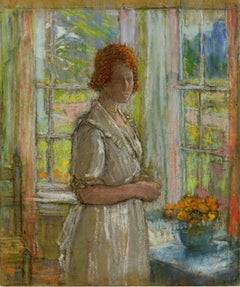
Woman on a Patio
Woman on a Patio

Woman on a Patio

By Karl Albert Buehr

Located in Fairlawn, OH

Woman on a Patio Pastel on paper, c. 1915 Unsigned Provenance: Gift of the artist to his wife, Mary Hess Buehr By decent to the artist's niece, daughter of Will Hess David Saltzman Robert Henry Adams Fine Art Thomas French Fine Art Ronald C. Sloter, Columbus, Ohio Columbus College of Art and Design (de-accessed) Exhibited at Robert Henry Adams Fine Art, 1994, the first exhibition at the North Franklin Street Gallery. One of the early Chicago artists to adopt Impressionism, Karl Buehr became a figure and landscape painter. As a figure painter, his specialty became "gorgeously colored images of young women on porches overlooking brilliant summertime gardens." (Kennedy 98) His later work often showed a female figure with serious expression engaging the viewer with a direct stare. In his landscapes, he was noted for his strong coloration. In a December 1896 student exhibition at the Art Institute, a reviewer for the "Chicago Times Herald" described Buehr's landscapes as "blithe and joyous" with "country roads brilliant in sunlight . . . fields rich in summer verdure, under soft skies painted in a high, musical key." (Gerdts 68) Buehr was born as one of seven sons to a prosperous German family who immigrated to America and settled in Chicago in 1869. He was first exposed to his signature style of Impressionism in 1888 when he enrolled in night classes at the Art Institute while working in the shipping department of a lithographic firm near the Institute. He remained a student there until 1897 and was recognized in a "Chicago Times Herald" editorial of June 13, 1897 as one of the Institute's most outstanding pupils. The next year, his art career was temporarily put on hold when he briefly enlisted with the U.S. Army in the Spanish American War. In 1899, he resumed his art studies, this time with Frank Duveneck. He exhibited a painting at the Paris Salon of 1900. In 1905, thanks to a wealthy Chicago patron, Buehr and his family moved to France. They spent the following year in Taormina, Sicily, and spent time in Venice as well. In Paris, Buehr studied at the Academy Julian with Raphael Collin for two years. Then he went to England, enrolling in the London Art School but had returned to Paris by 1908. During this time, he began painting at Giverny, the home of Impressionist leader Claude Monet (1840-1926, and by 1912, Buehr was listing that village as his home address. One of his good friends and associates at Giverny was Frederick Frieseke. One of Buehr's paintings from that time, "News from Home", was exhibited in 1913 at the French Salon in Paris and at the annual exhibit of the Chicago Art Institute. It shows a woman in floral dress sitting on a porch with a background with potted flowers and lush greenery background. Of his painting done at Giverny, Buehr wrote in 1912 to William Macbeth of Macbeth Galleries in New York: "My figures painted in and around Giverny are costumed and in appropriate out door settings." (Gerdts 68) In 1914, he returned to the United States and took a teaching position in Chicago at the Art Institute, which he held for the remainder of his life. He was married to Mary Hess, a painter of miniatures and decorative works. In 1928-29, he was a guest artist at Stanford University. Courtesy, AskArt “Karl Albert Buehr (1866–1952) was a painter born in Germany. Buehr was born in Feuerbach - near Stuttgart. He was the son of Frederick Buehr and Henrietta Doh (Dohna?). He moved to Chicago with his parents and siblings in the 1880s. In Chicago, young Karl worked at various jobs until he was employed by a lithograph company near the Art Institute of Chicago. Introduced to art at work, Karl paid regular visits to the Art Institute, where he found part-time employment, enabling him to enroll in night classes. Later, working at the Institute as a night watchman, he had a unique opportunity to study the masters and actually posted sketchings that blended in favorably with student's work. Having studied under John H. Vanderpoel, Buehr graduated with honors, while his work aroused such admiration that he was offered a teaching post there, which he maintained for many years thereafter. He graduated from the Art Inst. of Chicago and served in the IL Cav in the Spanish–American War. Mary Hess became Karl's wife—she was a student of his and an accomplished artist in her own right. In 1922, he was elected into the National Academy of Design as an Associate member. Art Studies in Europe In 1904, Buehr received a bronze medal at the St. Louis Universal Exposition, then, in 1905, Buehr and his family moved to France, thanks to a wealthy Chicago patron, and they spent the following year in Taormina, Sicily, where the artist painted local subjects, executing both genre subjects and landscapes as well as time in Venice. Buehr spent at least some time in Paris, where he worked with Raphaël Collin at the Académie Julian. Giverny and American Impressionism Prior to this time, Buehr had developed a quasi-impressionistic style, but after 1909, when he began spending summers near Monet in Giverny, his work became decidedly characteristic of that plein-air style but he began focusing on female subjects posed out-of-doors. He remained for some time in Giverny, and here he became well-acquainted with other well known expatriate America impressionists such as Richard Miller, Theodore Earl Butler, Frederick Frieseke, and Lawton Parker. It seems likely that Buehr met Monet, since his own daughter Kathleen and Monet’s granddaughter, Lili Butler, were playmates, according to George Buehr, the painter’s son. His other daughter Lydia died before adulthood due to diabetes. He returned to Chicago at the onset of World War I and taught at The Art Inst for many years. One of his noted pupils at the Art Institute was Archibald Motley...

Category

1910s Abstract Impressionist Ohio - Art

Materials

Pastel

20th Century Bucks County Colorful Landscape Painting, Italian artist

20th Century Bucks County Colorful Landscape Painting, Italian artist

By Louis Bosa

Located in Beachwood, OH

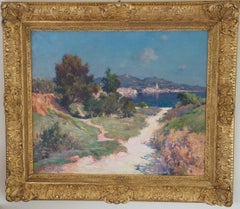
Louis Bosa (American, 1905–1981) Bucks County, 1934 Oil on canvas Signed and dated lower right 17.5 x 21.5 inches 25.5 x 29 inches, framed Born in Codroipo, a small village only a f...

Category

1930s Expressionist Ohio - Art

Materials

Oil

Cows by Woodland Pond, Toledo, Ohio, Early 20th Century Cleveland School

Cows by Woodland Pond, Toledo, Ohio, Early 20th Century Cleveland School

By Frank Wilcox

Located in Beachwood, OH

Frank Nelson Wilcox (American, 1887-1964) Cows by Woodland Pond, Toledo, Ohio, c. 1920 Watercolor and graphite on board Signed lower right 22 x 30 inches 24.75 x 32.75 inches, framed Frank Nelson Wilcox (October 3, 1887 – April 17, 1964) was a modernist American artist and a master of watercolor. Wilcox is described as the "Dean of Cleveland School painters," though some sources give this appellation to Henry Keller or Frederick Gottwald. Wilcox was born on October 3, 1887 to Frank Nelson Wilcox, Sr. and Jessie Fremont Snow Wilcox at 61 Linwood Street in Cleveland, Ohio. His father, a prominent lawyer, died at home in 1904 shortly before Wilcox' 17th birthday. His brother, lawyer and publisher Owen N. Wilcox, was president of the Gates Legal Publishing Company or The Gates Press. His sister Ruth Wilcox was a respected librarian. In 1906 Wilcox enrolled from the Cleveland School of Art under the tutelage of Henry Keller, Louis Rorimer, and Frederick Gottwald. He also attended Keller's Berlin Heights summer school from 1909. After graduating in 1910, Wilcox traveled and studied in Europe, sometimes dropping by Académie Colarossi in the evening to sketch the model or the other students at their easels, where he was influenced by French impressionism. Wilcox was influenced by Keller's innovative watercolor techniques, and from 1910 to 1916 they experimented together with impressionism and post-impressionism. Wilcox soon developed his own signature style in the American Scene or Regionalist tradition of the early 20th century. He joined the Cleveland School of Art faculty in 1913. Among his students were Lawrence Edwin Blazey, Carl Gaertner, Paul Travis, and Charles E. Burchfield. Around this time Wilcox became associated with Cowan Pottery. In 1916 Wilcox married fellow artist Florence Bard, and they spent most of their honeymoon painting in Berlin Heights with Keller. They had one daughter, Mary. In 1918 he joined the Cleveland Society of Artists, a conservative counter to the Bohemian Kokoon Arts Club, and would later serve as its president. He also began teaching night school at the John Huntington Polytechnic Institute at this time, and taught briefly at Baldwin-Wallace College. Wilcox wrote and illustrated Ohio Indian Trails in 1933, which was favorably reviewed by the New York Times in 1934. This book was edited and reprinted in 1970 by William A. McGill. McGill also edited and reprinted Wilcox' Canals of the Old Northwest in 1969. Wilcox also wrote, illustrated, and published Weather Wisdom in 1949, a limited edition (50 copies) of twenty-four serigraphs (silk screen prints) accompanied by commentary "based upon familiar weather observations commonly made by people living in the country." Wilcox displayed over 250 works at Cleveland's annual May Show. He received numerous awards, including the Penton Medal for as The Omnibus, Paris (1920), Fish Tug on Lake Erie (1921), Blacksmith Shop (1922), and The Gravel Pit (1922). Other paintings include The Trailing Fog (1929), Under the Big Top (1930), and Ohio Landscape...

Category

1920s American Modern Ohio - Art

Materials

Graphite, Watercolor

Night Garden, mid-century figural surrealist acrylic painting, Cleveland School

Night Garden, mid-century figural surrealist acrylic painting, Cleveland School

By Clarence Holbrook Carter

Located in Beachwood, OH

Clarence Holbrook Carter (American, 1904-2000) Night Garden, 1972 Acrylic on scintilla Signed and dated lower right 21.5 x 21.5 inches 24.25 x 24.25 inches, framed Clarence Holbroo...

Category

1970s American Modern Ohio - Art

Materials

Acrylic

Horses Prepared to Perform and Circus Truck, Contemporary American Modern

Horses Prepared to Perform and Circus Truck, Contemporary American Modern

By Joseph O'Sickey

Located in Beachwood, OH

Work sold to benefit the CLEVELAND INSTITUTE OF ART Joseph B. O’Sickey (American, 1918–2013) Horses Prepared to Perform and Circus Truck, Circus Series, 1991 Oil on canvas Signed an...

Category

1990s Post-Impressionist Ohio - Art

Materials

Oil

Beachside Village, Maine, 20th century landscape watercolor, Cleveland School

Beachside Village, Maine, 20th century landscape watercolor, Cleveland School

By George Adomeit

Located in Beachwood, OH

George Gustav Adomeit (American, 1879-1967) Beachside Village, Maine Watercolor on paper Signed lower right 10 x 14 inches 17.75 x 21.75 inches, framed A major painter of American ...

Category

Mid-20th Century American Modern Ohio - Art

Materials

Watercolor

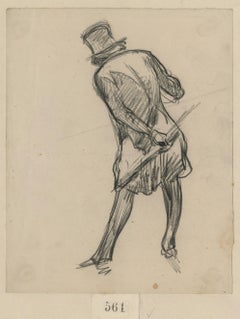
untitled (polo player on horseback)

untitled (polo player on horseback)

By Henry George Keller

Located in Fairlawn, OH

untitled (polo player on horseback) Chalk on tan paper, c. 1920 Unsigned Provenance: Gift of the artist William McGill (Keller's student) Image size: 4 3/8 x 5 ...

Category

1920s American Impressionist Ohio - Art

Materials

Chalk

Mayan, Large 20th Century Watercolor, Cleveland School, Viktor Schreckengost

Mayan, Large 20th Century Watercolor, Cleveland School, Viktor Schreckengost

By Viktor Schreckengost

Located in Beachwood, OH

Viktor Schreckengost (American, 1906-2008) Mayan Watercolor heightened with gouache over pencil on paper Signed lower right 39 x 29 inches 45.5 x 35.5 inches, framed Registered with The Viktor Schreckengost foundation, stock no. 6891 The son of a commercial potter in Sebring, Ohio, Viktor Schreckengost learned the craft of sculpting in clay from his father. In the mid-1920s, he enrolled at the Cleveland School of Art (now the Cleveland Institute of Art, or CIA) to study cartoon making, but after seeing an exhibition at the Cleveland Museum of Art he changed his focus to ceramics. Upon graduation in 1929, he studied ceramics in Vienna, Austria, where he began to build a reputation, not only for his art, but also as a jazz saxophonist. A year later, at the age of 25, he became the youngest faculty member at the CIA. In 1931, Schreckengost won the first of several awards for excellence in ceramics at the Cleveland Museum of Art, and his works were shown at the Metropolitan Museum of Art, the Art Institute of Chicago, the Panama-Pacific Exposition in San Francisco, and elsewhere. By the mid-1930s, Schreckengost had begun to pursue his interest in industrial design. For American Limoges...

Category

20th Century American Modern Ohio - Art

Materials

Gouache, Watercolor

Echo in Grey
Echo in Grey

Echo in Grey

By Adja Yunkers

Located in Fairlawn, OH

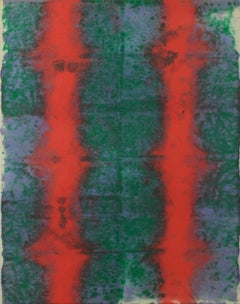
Echo in Grey Mixed media intaglio with embossing, c. 1980's Signed and numbered in pencil (see photo) Edition: 25 (24/25) Condition: Soft handling issues in top and bottom margin. Do...

Category

1980s Abstract Ohio - Art

Materials

Mixed Media

19th Century Burmese School Buddha Head of the Shan (Tai Yai) Style

19th Century Burmese School Buddha Head of the Shan (Tai Yai) Style

Located in Beachwood, OH

Burmese School, 19th Century Buddha Head of the Shan (Tai Yai) Style Wood with red lacquered pigment 25 x 13 x 10 inches dry lacquer form with finely sculpted features such as the e...

Category

19th Century Ohio - Art

Materials

Lacquer, Wood

20th century painting of monks in Venice, Italian pink figural work

20th century painting of monks in Venice, Italian pink figural work

By Louis Bosa

Located in Beachwood, OH

Louis Bosa (Italian-American, 1905–1981) Island of the Monks, c. 1930 Oil on masonite Signed lower right 14 x 24 inches 23 x 33 inches, framed Born in Codroipo, a small village only...

Category

1930s Expressionist Ohio - Art

Materials

Oil

Cattle Series Study, Early 20th Century Bovine/Cow, Cleveland School artist

Cattle Series Study, Early 20th Century Bovine/Cow, Cleveland School artist

By Henry George Keller

Located in Beachwood, OH

Henry George Keller (American, 1868-1949) Cattle Series Study, 1901 Oil on canvas Signed verso 22 x 26 inches 28.5 x 33 inches, framed Keller, a leading painter in Cleveland, was born at sea, off Nova Scotia on April 3, 1869. His earliest training was in Karlsruhe, Germany under Hermann Baisch (1846-1894), then at the Cleveland School of Art...

Category

Early 1900s Ohio - Art

Materials

Oil

Building New York
Building New York

Building New York

By Leon Kroll

Located in Fairlawn, OH

Building New York Watercolor on paper, c. 1915 Signed by the artist lower right (see photo) Partial watermark: "MADE IN ENGLAND... LINEN FIBER" Excellent, COLORS FRESH AND VIBRANT Br...

Category

1910s American Realist Ohio - Art

Materials

Watercolor

Portrait of a Startled Woman, 20th Century Monumental Oil Painting

Portrait of a Startled Woman, 20th Century Monumental Oil Painting

Located in Beachwood, OH

Robert Brooks (American, 1922-1992) Portait of a Startled Woman Monumental oil on canvas Signed lower right 80 x 42 inches Born in Fall River, Massachusetts in 1922, Robert Brooks embarked on his art career by winning modeling clay as a reward for good attendance at primary school. He became known for embellishing the margins of his school books with sketches of his friends and maybe teachers. He operated his own sign making business as a teenager, which supplied little money but lots of experience. Brooks also entered every poster and drawing competition in sight. Saturday morning classes at the Swain School of Design provided him with sound instructions in the principles of art, and as a high school senior in 1941, Brooks was awarded a scholarship to Boston's Vesper George School of art in a annual state-wide competition. During this year in Boston, he specialized in design, color and the theater arts and discovered "watercolor" as his favorite medium. At the end of his year Brooks was awarded a scholarship to continue by the Vesper George School but returned to New Bedford before the second year was out in order to work in the design department of a large textile printing concern. He was called to serve his country and after basic training, casual detachments and port of embarkation, he made his own private beachhead on New Caledonia in 1943, where he served as staff artist for The South Pacific Daily News. Brooks painted sketches and watercolors of the local scene during his daytime off-duty hours and won fast acclaim for his crisp, clean paintings...

Category

20th Century Ohio - Art

Materials

Oil

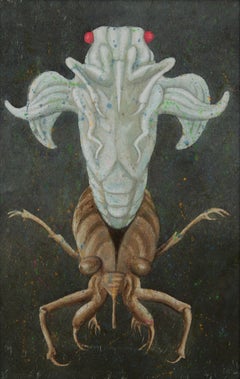
Medieval Heads, mid-century figural surrealist acrylic painting

Medieval Heads, mid-century figural surrealist acrylic painting

By Clarence Holbrook Carter

Located in Beachwood, OH

Clarence Holbrook Carter (American, 1904-2000) Cicada, c. 1960s Watercolor on scintilla 30 x 20 inches Clarence Holbrook Carter achieved a level of national artistic success that wa...

Category

1960s American Modern Ohio - Art

Materials

Acrylic

Aquarius-The Water Bearer

Aquarius-The Water Bearer

By Eugène Grasset

Located in Fairlawn, OH

Aquarius-The Water Bearer From: Les Douze Mois de 1889 As published in Vol. 9, No. 425 of Les Hommes d'Aujourd'hui. Published by Sagot, Paris Proof before letters without the calend...

Category

1890s Art Nouveau Ohio - Art

Materials

Lithograph

Ascension
Ascension

Ascension

By Maria Deguchi

Located in Fairlawn, OH

Ascension Etching and aquatint printed in red and gold leaf on Arches France paper Signed, titled, and editioned in pencil by the artist (see photos) Edition: 60 of which this number...

Category

1970s Contemporary Ohio - Art

Materials

Aquatint

Untitled (Plate 1) DLM

Untitled (Plate 1) DLM

By Alexander Calder

Located in Fairlawn, OH

Untitled (Plate 1) DLM Color lithograph, 1963 Unsigned and unnumbered (as usual) From: Derriere le Miroir, No. 141 Published by A. Maeght, Paris Image/sheet size: 14 7/8 x 11 inches...

Category

1960s American Modern Ohio - Art

Materials

Lithograph

Reclining Nude Male Figure, figural expressionist New York artist ink drawing

Reclining Nude Male Figure, figural expressionist New York artist ink drawing

By Joseph Glasco

Located in Beachwood, OH

Joseph Glasco (American, 1925-1996) Reclining Figure, facing right (Nikos) 1971 India ink on paper Signed and dated middle right 26 x 38.25 inches In original frame. Joseph Glasco ...

Category

1970s Abstract Expressionist Ohio - Art

Materials

India Ink

Terror of History No. 1, Mid-Century Abstract Acrylic & Sand, Blue and Yellow

Terror of History No. 1, Mid-Century Abstract Acrylic & Sand, Blue and Yellow

By Clarence Holbrook Carter

Located in Beachwood, OH

Clarence Holbrook Carter (American, 1904-2000) Terror of History No. 1, 1962 Acrylic and sand on scintilla Signed and dated upper left 23 x 30 inches See photos for condition. Clarence Holbrook Carter achieved a level of national artistic success that was nearly unprecedented among Cleveland School artists of his day, with representation by major New York dealers...

Category

1960s American Modern Ohio - Art

Materials

Acrylic

La Pique (The Pike)
La Pique (The Pike)

La Pique (The Pike)

By Pablo Picasso

Located in Fairlawn, OH

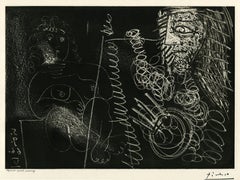
La Pique (The Pike) Lithograph, 1950 Original lithograph drawn with chalk and "frottage textures" transferred to stone, 1950. Unsigned printer's proof Inscribed on the verso in Mourl...

Category

1950s French School Ohio - Art

Materials

Lithograph

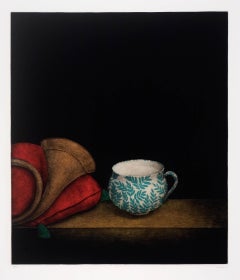
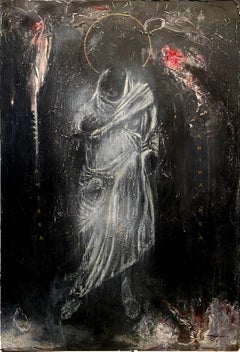
Untitled (Still Life)

Untitled (Still Life)

Located in Fairlawn, OH

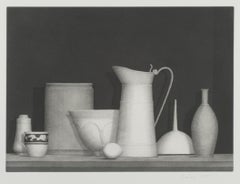
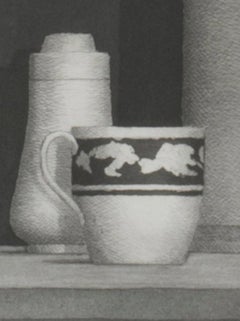
Untitled (Still Life) Etching, aquatint and soft ground, 2001 Signed in pencil (see photo) Edition: 260 Published by the Print Club of Cleveland, Publication 80, 2002 Printed by Felix Harlan at Harlan and Weaver, New York William Bailey, Modernist Figurative Painter, Dies at 89 He swathed his nudes and still lifes of eggs, vases, bottles and bowls in a breathless, deceptively serene atmosphere heavy with mystery. The painter William Bailey in 2009. He was never given a career survey in a major museum, but his influence, particulary on students at Yale, was deep.Credit...Ford Bailey By William Grimes for the New York Times April 18, 2020 William Bailey, whose pristine, idealized still lifes and female nudes made him one of the leading figures in the return of figurative art in the 1980s, died on April 13 at his home in Branford, Conn. He was 89. His death was confirmed by his daughter, Alix Bailey. Beyond his painting, Mr. Bailey influenced generations of students in his many years as a teacher at the Yale School of Art. In some of his best-known work, Mr. Bailey arranged simple objects — the eggs, bowls, bottles and vases that he once called “my repertory company” — along a severe horizontal shelf, or on a plain table, swathing them in a breathless, deceptively serene atmosphere heavy with mystery. His muted ochres, grays and powdery blues conjured up a still, timeless world inhabited by Platonic forms, recognizable but uncanny, in part because he painted from imagination rather than “They are at once vividly real and objects in dream, and it is the poetry of this double life that elevates all this humble crockery to the realm of pictorial romance,” Hilton Kramer wrote in The New York Times in 1979. Mr. Bailey’s female figures, some clothed in a simple shift or robe and others partly or entirely nude, are disconcertingly impassive, implacable and unreadable, fleshly presences breathing an otherworldly air. The critic Mark Stevens, writing in Newsweek in 1982, credited Mr. Bailey with helping to “restore representational art to a position of consequence in modern painting.” But his version of representation was entirely idiosyncratic, seemingly traditional but in fact “a modernism so contrarian,” the artist Alexi Worth wrote in a catalog essay for the Betty Cuningham Gallery in 2010, “that it feels, despite its historical sophistication, almost like a brand of outsider art.” William Harrison Bailey...

Category

Early 2000s Contemporary Ohio - Art
Materials

Etching

Brookdale, New Jersey

Brookdale, New Jersey

By Oscar Florianus Bluemner

Located in Fairlawn, OH

Brookdale, New Jersey Graphite on paper, 1922 Signed with the artist's initials l.l., and dated 1922 (see photo) Annotated "Brookdale" front and back of sheet Condition: Excellent Ar...

Category

1920s American Modern Ohio - Art

Materials

Graphite

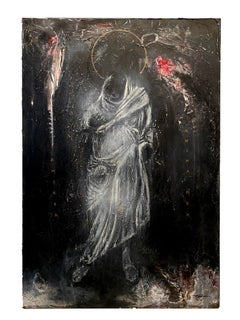
Blind Faith Ticket by Markus Pierson

Blind Faith Ticket by Markus Pierson

By Markus Pierson

Located in Woodmere, OH

Markus Pierson's work includes a vast array of paintings, drawings, sculpture, hand-pulled serigraphs and original found-object works. Framed Whimsical Markus Pierson print. Editio...

Category

Early 2000s Contemporary Ohio - Art
Materials

Color

Trio
Trio

Trio

By Georges Rouault

Located in Fairlawn, OH

Trio Color aquatint, 1938 Edition 250 printed on Montval wove paper with Maillol watermark From: Les Fleurs de Mal III (12 color aquatints) Published by Ambrose Vollard, 1940, Paris ...

Category

1930s French School Ohio - Art

Materials

Aquatint

Trompe-l'Oeil Study
Trompe-l'Oeil Study

Trompe-l'Oeil Study

By Eugene Berman

Located in Fairlawn, OH

Trompe-l'Oeil Study Watercolor on heavy wove paper, 1943 Signed with the artists initials, lower center of image; Dated 1943, lower center of image Provenance: Swann Galleries, 2007, realized $2,640 Condition: Excellent. Fresh colors. Framed with conservation glass. Sheet: 14 3/4 x 11 1/4" Frame size: 20 3/4 x 17 Berman brothers (painters) From Wikipedia, the free encyclopedia Eugene Berman in Italy in the 1960s Eugène Berman (Russian: Евгений Густавович Берман; 4 November 1899, Saint Petersburg, Russia – 14 December 1972, Rome) and his brother Leonid Berman...

Category

1930s Surrealist Ohio - Art

Materials

Watercolor

Pink Jazz, Painting, Oil on Canvas

Pink Jazz, Painting, Oil on Canvas

By Liz Zorn

Located in Yardley, PA

Oil on canvas. Stretched on heavy duty bars. Can also be shipped rolled in a tube. :: Painting :: Abstract :: This piece comes with an official certificate of authenticity signed by...

Category

2010s Abstract Ohio - Art

Materials

Oil

Théâtre du Gymnasium, Evening Parisian Winter Street Scene

Théâtre du Gymnasium, Evening Parisian Winter Street Scene

By Eugene Galien-Laloue

Located in Beachwood, OH

Eugène Galien Laloue (French, 1854-1941) Théâtre du Gymnasium Gouache and watercolor on board Signed lower left 15 x 20.5 inches 24 x 29 inches, framed Some artists or writers are c...

Category

Late 19th Century Ohio - Art

Materials

Watercolor, Gouache

Piazza Navona allagata solito farsi nelle Feste di Agosto

Piazza Navona allagata solito farsi nelle Feste di Agosto

By Giuseppe Vasi

Located in Fairlawn, OH

Piazza Navona allagata solito farsi nelle Feste di Agosto Etching, 1752 Signed in the plate lower right (see photo) From: Della Magnificenze di Roma Antica e Moderna ( The Magnificense of Ancient and Modern Rome) , (1747-1761) Volume II, The Main Squares and Obelisks, columns and other ornaments, 1752, Plate No. 26 Della Magnificenze di Roma Antica e Moderna_ (1747-61), a collection of 238 plates that was published in ten volumes. Vasi recorded all types of architecture and organized these images of contemporary Rome by subject, with each volume representing a different category of architecture. This comprehensive project provides one of the most complete views of eighteenth-century Rome Condition: Excellent Image/Plate size: 8 .25 x 12.63 inches Sheet size: 11 x 15 7/8 inches Vasi was Giovanni Battista Piranesi’s teacher. Piranesi (1720-1778) entered Vasi’s studio as an apprentice at age 20 c. 1740. Piranesi left Vasi’s employment after stabbing Vasi over the perception that Vasi was withholding secrets of the etching process. Giuseppe Vasi was an Italian engraver and painter born and trained in Sicily. He received a classical education in his hometown of Corleone and trained as a printmaker in nearby Palermo, perhaps under the tutelage of the etchers Antonino Bova and Francesco Cichè. He moved to Rome in 1736, already an established printmaker, and spent most of his career documenting the urban landscape of the city in engravings. Through his patron, the politically and culturally influential Cardinal Troiano Acquaviva d’Aragona, Vasi met other artists working in Rome, such as Sebastiano Conca, Ferdinando Fuga, and Luigi Vanvitelli. He was also influenced by his predecessors, including Giovanni Paolo Panini, Giovanni Battista Falda...

Category

1750s Old Masters Ohio - Art

Materials

Etching

Meduse
Meduse

Meduse

By Stanley William Hayter

Located in Fairlawn, OH

Meduse Etching and aquatint printed in colors, 1958 Signed, titled, numbered and dated in pencil (see photos) Edition: 50 (25/50) Etching and aquatint printed in colors ...

Category

1950s Abstract Ohio - Art

Materials

Etching, Aquatint

Staten Island Looking into Elizabeth

Staten Island Looking into Elizabeth

By Robert Hallowell

Located in Fairlawn, OH

Staten Island Looking into Elizabeth Watercolor on paper, c. 1928 Signed with the estate stamp lower right (see photo) Titled in pencil verso Part of a small group of scenes created ...

Category

1920s American Modern Ohio - Art

Materials

Watercolor

Russian Orthodox Church, Middle 19th Century

Russian Orthodox Church, Middle 19th Century

Located in Fairlawn, OH

Unknown Russian Artist Russian Orthodox Church, Middle 19th century Unsigned Illuminated in red, yellow blue and green pigments and gold leaf on paper An Illuminated manuscript folio...

Category

Mid-19th Century Old Masters Ohio - Art

Materials

Pigment

Ruine di Sepolcro antico

Ruine di Sepolcro antico

By Giovanni Battista Piranesi

Located in Fairlawn, OH

Ruine di Sepolcro antico Etching, 1743 Signed in the plate bottomleft in the caaption plate From: Prima Parte, 1743 Second edition: 1750-1778 Watermark: R 37-39 A lifetime impression printed during Piranesi’s life, before the plates are moved to Paris by his sons in the 1790’s Coniditon: Excellent/Very good Image size: 14 5/8 x 9 3/4 inches Reference: Robison 17 iii/V Piranesi In Rome: Prima Parte di Architetture e Prospettive "Although Piranesi studied architecture in Venice, he never was able to find work in the field other than a few jobs involving remodeling in Rome. While Piranesi was struggling to support his architectural endeavors upon his arrival in Rome in 1740, he spent a short period of time in the studio of master painter Giovanni Battista Tiepolo (1696-1770) in addition to his apprenticeship with Giuseppe Vasi. The first production of Piranesi’s early years in Rome and a culmination of his training under Vasi, Tiepolo, and his uncle, was the Prima Parte di Architetture e Prospettive (1743). The Prima Parte was a collection of twelve etchings of imaginary temples, palaces, ruins, and a prison. During this time, Piranesi was still developing the unique style of etching he is known for today, and as such the Prima Parte differs significantly in technique compared to later works. In the Frontispiece of the Prima Parte, Piranesi’s lines are definite and exact with very little flow to them, designed in the form of traditional etching. The detail is immaculate, and yet perspective of the piece is oddly simple and familiar to the viewer. Piranesi’s technique employs miniscule markings and lines, intricately woven together to create a stippling effect. The Prima Parte, described as “rigid” by art historian Jonathan Scott, came to be seen as a stark contrast to his later sketches, which were much lighter and freer. Influenced by the style of Tiepolo, which epitomized the lightness and brightness of the Rococo period, Piranesi adopted some of the more painterly techniques of the masters he apprenticed under. Piranesi made the medium of etching appear as though it was a sketch or a painting, hence a “freer” and more fluid design in his later works. For example, the frontispiece of the Prima Parte read as an etching to Piranesi’s audience, but in his later vedute, the style of etching almost appears to be made of brushstrokes. Moreover, at the same time Piranesi was working on the Prima Parte, he aided the artist Giambattista Nolli. There is a small section of Nolli’s map...

Category

1740s Old Masters Ohio - Art

Materials

Etching

Untitled (Venice canal, man departing the gondola)

Untitled (Venice canal, man departing the gondola)

By Levon West

Located in Fairlawn, OH

Untitled (Venice canal, man departing the gondola) Drypoint, c. 1930-1931 Signed in pencil lower right (see photo) Annotated in the lower margin: "Just a souvenir made ___ Monclair L...

Category

1930s American Impressionist Ohio - Art

Materials

Drypoint

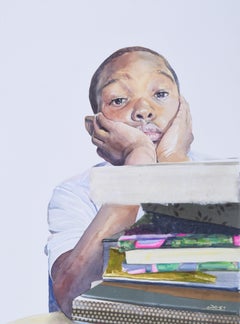
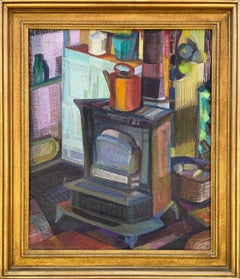
untitled

untitled

By Darius Steward

Located in Fairlawn, OH

Signed with the artist's initials lower right Watercolor on Twinrocker heavy weight paper

Category

2010s Contemporary Ohio - Art
Materials

Watercolor

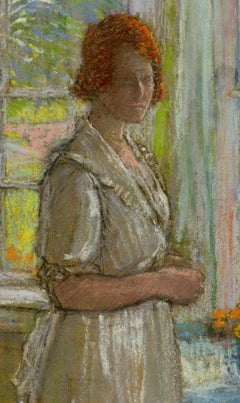
Gaiety Burlesk
Gaiety Burlesk

Gaiety Burlesk

By Reginald Marsh

Located in Fairlawn, OH

Gaiety Burlesque Etching, 1930 Unsigned (as usual for the Whitney edition); Numbered in pencil lower left; Blind stamp of the Whitney Museum (WM) lower right Edition: 114, regular ed...

Category

1930s American Modern Ohio - Art
Materials

Etching

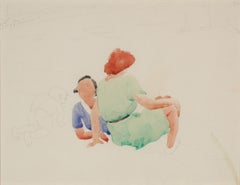
Father Stefan Fridolin, "Schatzbehalter" (Treasury of the True Riches

Father Stefan Fridolin, "Schatzbehalter" (Treasury of the True Riches

Located in Fairlawn, OH

Father Stefan Fridolin, "Schatzbehalter" (Treasury of the True Riches of Salvation): The 30th Figure - Astrological Diagram with Scene of the Nativity Woodcut, 1491 Unsigned, as issued Published by Anton Koberger Diagram has Zodiac signs on outer ring, planets in the lower registers, and Nativity in the center. Condition: Very good for a 15h century woodcut, with the usual slight age stains Sheet size: 11 1/2 x 8 1/4 inches Wogelmut was the teacher of Albrecht Durer and employed young Durer in many project of the last decade of the 15th century. Michel Wolgemut Biography Wolgemut trained with his father Valentin Wolgemut (who died in 1469 or 1470) and is thought to have been an assistant to Hans Pleydenwurff in Nuremberg. He worked with Gabriel Malesskircher in Munich early in 1471, leaving the city after unsuccessfully suing Malesskircher's daughter for breach of contract, claiming she had broken off their engagement. He then returned to his late father's workshop in Nuremberg, which his mother had maintained since Valentin's death. In 1472 he married Pleydenwurff's widow and took over his workshop;[3] her son Wilhelm Pleydenwurff worked as an assistant, and from 1491 a partner, to Wolgemut. Some consider Wilhelm a finer artist than Wolgemut, however he died in January 1494, when he was probably still in his thirties. Wilhelm's oeuvre remains unclear, though works in various media have been attributed to him. Woodcuts Michael Wolgemut, Danse Macabre, 1493 Two large and copiously illustrated books have woodcuts supplied by Wolgemut and his stepson Wilhelm Pleydenwurff; both were printed and published by Germany's largest publisher, the Nuremberger Anton Koberger, who was also Dürer's godfather. The first is the Schatzbehalter der wahren Reichthumer des Heils (1491); the other is the Historia mundi, by Schedel (1493), usually known as the Nuremberg Chronicle...

Category

15th Century and Earlier Old Masters Ohio - Art
Materials

Woodcut

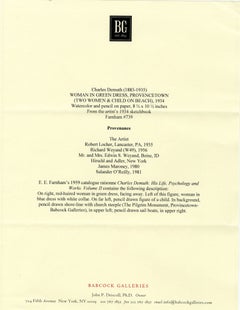
Untitled

Untitled

By Ray H. French

Located in Fairlawn, OH

Signed and dated "1962" by the artist lower right. Mixed media on heavy paper. Done for a show to fund a trip to Italy.

Category

1960s Abstract Ohio - Art
Materials

Ink, Mixed Media

The Irish Fair
The Irish Fair

The Irish Fair

By George Wesley Bellows

Located in Fairlawn, OH

Irish Fair Lithograph, 1923 Signed and numbered in pencil by the artist (see photo) Titled "Irish Fair" by the artist in pencil Edition: 84 Housed in an archival frame with acid free matting (see photo) Provenance: Estate of the artist, Bellows Family Trust H.V. Allison & Company (label) Private Collection, Columbus References And Exhibitions: Reference: Mason 153 Note: An illustration commissioned by The Century Company for Don Byrne's novel The Wind Bloweth Image: 18 7/8 x 21 3/8" Frame: 29 1/2 x 30 1/2" “Eleven on a hot July morning, and the little town...

Category

1920s Ashcan School Ohio - Art
Materials

Lithograph

Golf (Wall Plaque)
Golf (Wall Plaque)

Golf (Wall Plaque)

By Viktor Schreckengost

Located in Fairlawn, OH

Golf (Wall Plaque) Polychromed ceramic, c. 1930-1 Signed with the artist's initials: VS recto Very rare, only a few produced prior to the closure of Cowan Pottery Format: Round ceramic plate, 11 1/4 inches Designed by the artist while working for Cowan Pottery in 1930. One of Cowan's clients, an interior designer, requested plates decorated with different outdoor activities. Others in the series included "Swimming," "Tennis," "Polo," and "The Hunt." According to Henry Adams, the number of examples created was very limited due to the closing of Cowan Pottery in 1931. Very rare Condition: Good, with the usual craquelure of the glazes used. Note: Industrial design democratizes high style, and Mr. Schreckengost was widely considered among the most democratic industrial designers. He made, quite literally, the stuff of life — things found routinely in homes, backyards and garages in this country and around the world. He designed bicycles for Sears and everyday china for American Limoges...

Category

1930s Art Deco Ohio - Art
Materials

Ceramic