Art by Medium: Linocut

to
279
476
147
224
74
50
Overall Width
to
Overall Height
to
1
620
353
4
14
65
33
106
74
79
113
72
273
207
94
50
18
12
10
7
7
4
1
538
382
50
354
184
168
129
125
115
93
57
54
49
45
45
41
40
31
28
27
21
19
18
974
181,824
96,773
79,215
77,923
73
57
38
24
23
124
204
456
412
Medium: Linocut
Spiral (automatic thoughts)

Spiral (automatic thoughts)

Located in Fairfield, CT

Spiral (automatic thoughts) 2025 Linocut and gyotaku prints, indigo dye, paper rice bags, vintage washi from Kashiki Seishi, Konnyaku 88 1/2 x 75 in.

Category

2010s Contemporary Art by Medium: Linocut

Materials

Rice Paper, Dye, Washi Paper, Linocut

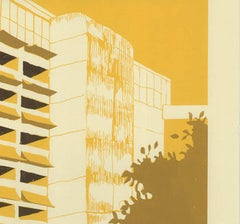
"Hotel Lobby, " Linoleum Cut by Alexander Tillotson

"Hotel Lobby, " Linoleum Cut by Alexander Tillotson

Located in Milwaukee, WI

"Hotel Lobby" is a linoleum print by Alexander Tillotson. It features the view of a hotel lobby from the viewpoint of the back of two men. Thick lines and minimal negative space give...

Category

1930s American Modern Art by Medium: Linocut

Materials

Linocut

'Chittering & Chattering VI'  Folk bright blue/white linoleum bird block print

'Chittering & Chattering VI' Folk bright blue/white linoleum bird block print

By Lisa Houck

Located in Wellesley, MA

This is one of a series of 6 related bird prints, identical in size and each the same shade of bright blue and white, which are as commanding individually as they are in groupings. Lisa Houck is a very established New England area artist as recognized for her public installations, paintings, watercolors, textiles and mosaics as her work with linocuts and woodblock prints. At times reminiscent of Folk and Aborigine art, inspired as well by James Audubon and Hokusai, Houck is widely known for a gorgeous and elegant sensibility which is both playful and quite serious that is uniquely her own. Lisa Houck 'Chittering and Chattering VI' Linoleum Block Print, Edition 10 11 1/2 x 11 1/2 Inches (Image Size) Sold individually or as sets of 2, 3, 4, 5 or 6. These prints are unframed. Also available is a separate series of 8 larger linoleum block prints (editions of 10 each, 35 1/4 x 23 1/4 inches image size) of very related bird themes each in a different shade of blue. These series are also sold individually or as sets of 2, 3, 4, 5, 6, 7 or 8. Among the many large public art commissions the artist has completed for interior and exterior sites in Boston and nationwide in mosaic and mural format are permanent installations for The Dana Farber Cancer Institute, Children's Hospitals in Boston and Waltham, The Frieda Garcia Park, Fort Point Channel, The Cambridge Senior Center, and 4 libraries in Broward County, Florida. LISA HOUCK Education and Professional Affiliations: Tufts University/School of the Museum of Fine Arts, Boston, MA: M.F.A. 1989. Rhode Island School of Design, Providence, RI: B.F.A. 1975. Boston Printmakers SELECTED SOLO EXHIBITIONS: Beth Urdang Gallery, Boston, MA 2017 Cambridge Arts Council, Gallery 344, “A Long Walk with No Destination”, Cambridge, MA 2016 Beth Urdang Gallery, Wellesley, MA 2015 Patricia Carega Gallery: “White Line Woodcuts,” Center Sandwich, NH 2014 Rivers School, Weston, MA 2008 Bentley College: “All About the Square,” Waltham, MA 2003. Barton-Ryan Gallery: “Improbable Botanicals and Landscapes,” Boston, MA 2000. Randall Beck Gallery: Boston, MA 1993, 1991. Barbara Singer Fine Art: Cambridge, MA 1991. Coyote Gallery: Cambridge, MA 1989. Tufts University: “MFA Thesis Exhibition,” Cohen Arts Center, Medford, MA 1988. Modestino Gallery: Cambridge, MA 1987, 1986. New England School of Art and Design: Boston, MA 1986. Mott House: “The Comet and Other Phenomena,” Washington, DC 1986. SELECTED GROUP EXHIBITIONS: Arsenal Center for the Arts, “Big Print”, Watertown, MA 2016 FPAC Gallery, Fort Point Channel, “Mosaic Muse”, Boston, MA 2016 Art of Mosaic: Piecing it Together, Fuller Craft Museum, Brockton, MA 2013 National Mosaic Exhibit on Cape Cod, 2011 Fancy Plants: Bentley University, 2010 Contemporary Mosaics: Attleboro Arts Museum, 2010 Boston Children’s Museum: “I See Trees,” 2009. Somerville Museum: “Art of Mosaic,” 2009. Milton Academy: “Design/Build,” 2009. Danforth Museum: Members Show, 2007 Boston Printmakers: North American Print Biennial, 2005. Peabody Essex Museum: “In Nature’s Company,” Salem, MA 2004. Cambridge Art Association: “Hot Colors,” (Best in Show Award), Cambridge, MA 2002. Tufts University: “Alumni Exhibition,” Aidekman Gallery, Medford, MA 2001. Acacia Gallery: Gloucester, MA 2000. Wiggin Gallery: “Women in Watercolor,” Boston Public Library, Boston, MA 2000. New Art Center: “Lasting Impressions: Looking at the Land,” Newton, MA 1997. Bernard Toale Gallery: “The Pet Show,” Boston, MA 1996. Albers Gallery: Memphis, TN 1994, 1992,1991. Pritam & Eames: East Hampton, NY 1992. Boston Center for the Arts: Boston, MA 1989. DeCordova Museum: “Explorations in Handmade Paper,” Lincoln, MA 1989. Fuller Museum of Art: “RISD Alumni in Boston,” Brockton, MA 1989. St. Botolph Club: Boston, MA 1988. Danforth Museum: “Symmetry and Pattern in Art and Nature,” Framingham, MA 1986. Brunnier Museum: “Images of the Universe,” Ames, IA 1986. New England School of Art and Design: “A Celebration of the Return of Halley’s Comet,” Boston, MA 1985. Rose Art Museum: “Boston Printmakers,” Waltham, MA 1985. Fuller Museum of Art: “Triennial Exhibition,” Brockton, MA 1983. Cambridge Arts Council: “Lofty Views and Heightened Perspectives,” Cambridge, MA 1983. The Boston Company The Boston Public Library Brigham and Women’s Hospital Brunnier Museum, Ames, IA Coopers & Lybrand Fidelity Investments Fogg Art Museum Goodwin Procter Harvard Business School Harvard Community Health Plan SELECTED PUBLIC COLLECTIONS, NUMEROUS PRIVATE COLLECTIONS: Museum of Fine Arts, Boston Fogg Art Museum Boston Athenaeum The Boston Company The Boston Public Library Brigham and Women’s Hospital Fidelity Investments Goodwin Procter Harvard Business School Harvard Community Health Plan Brunnier Museum, Ames, IA Coopers & Lybrand Herman Miller Lahey Clinic Massachusetts General Hospital Massachusetts Mutual Corporation Montgomery Watson Harza Neiman Marcus New England Medical Center State Street Bank and Trust Valley Hospital, NJ GRANTS/PROJECTS: Herman Miller Lahey Clinic Massachusetts General Hospital Massachusetts Mutual Corporation Montgomery Watson Harza Museum of Fine Arts, Boston Neiman Marcus New England Medical Center State Street Bank and Trust Valley Hospital, NJ “City Square with Reflecting Pool,” 6’ X 6’ mosaic for Iron Street Park in Boston. Located on the corner of A Street and Iron Street in Boston, commissioned for this new park in Boston by a private client in 2014. Children’s Hospital, Waltham, MA: eleven-panel, oil-on-wood painting for the lobby, 2005. Grant from Massachusetts Cultural Council, 2005. For a ceramics program in the public schools, sponsored by the Dedham Cultural Council. John Hancock Financial Services: Frieda Garcia Park. Commission to create two mosaic murals incorporating children’s art from the community, 2004. Murals are 8’ X 10’ and 8’ x 22’. Broward County Cultural Affairs Office/Public Art Department, Florida: Public Art Commission to create paintings and printed materials for four libraries in Broward County, 2003. Dana Farber Cancer Institute/Jimmy Fund Clinic, Boston, MA: eight panel mosaic for the reception area. Architect: Miller, Dyer, Spears, 2003. Massachusetts Port Authority, Logan International Airport, Terminal E, Boston, MA: Six digital reproductions of paintings. Project Coordinator: Urban Arts Institute, 2001. ”The Rare Tropical Cod,” part of the Cavalcade of Cod, a school of 5’5” fiberglass fish sculptures which were displayed throughout the city of Boston in the fall of 2000. Sponsored by Boston’s B2K Committee. Poster and button and display banners for First Night Boston, 1998. Grant from the City of Cambridge to create murals for the Cambridge Senior Center, 1995. Administered by the Cambridge Arts Council. Fellowship in the Visual Arts, Massachusetts Cultural Council, 1994. Administered by the New England Foundation for the Arts. Grant from Arts on the Line, Cambridge, MA for temporary art in the subway including a 36-foot painting for the Kendall Square subway station, Cambridge, MA 1988. Grant from the Cambridge Arts Council for a mural for the Cambridge River...
Category

2010s Folk Art Art by Medium: Linocut

Materials

Linocut

Young Turk

Gary HumeYoung Turk, 2012

$4,960Sale Price|20% Off

Young Turk

By Gary Hume

Located in Boston, MA

Artist: Hume, Gary Title: Young Turk Series: A Series of Linocuts Date: 2012 Medium: Linocut Unframed Dimensions: 52.6875" x 36.375" Framed Dimensions: 60.50" x 44" Si...

Category

21st Century and Contemporary Contemporary Art by Medium: Linocut

Materials

Linocut

Cock's Head by Michael Rothenstein, 1959

Cock's Head by Michael Rothenstein, 1959

Located in Kingsclere, GB

Cock's Head by Michael Rothenstein, 1959 Additional information: Medium: linocut with applied texture 72.4 x 47.9 cm 28 1/2 x 18 7/8 in signed and numbered in pencil Michael Rothen...

Category

20th Century Art by Medium: Linocut

Materials

Linocut

Florentine

Florentine

By Henri Matisse

Located in London, GB

Linocut on Daragnès paper, Edition of 25 Paper size: 52 x 33 cms (20 1/2 x 13 ins) image size: 18.5 x 14.3 cms (7 5/8 x 5 5/8 ins)

Category

1930s Impressionist Art by Medium: Linocut

Materials

Linocut

Serie Milagritos

Serie Milagritos

Located in Toronto, ON

11" x 7.5" Unframed 2 Ink Linoleum Print on Paper Hand Signed by Iván Bautista

Category

2010s Art by Medium: Linocut

Materials

Linocut

Alberto Magnelli (after) - Composition

Alberto Magnelli (after) - Composition

By Alberto Magnelli

Located in Collonge Bellerive, Geneve, CH

Alberto Magnelli (after) Untitled (Composition) Linoleum cut (after the original) on yellow wove paper 32 x 24 cm 1959 From XXe siècle (No. 13) Published in Paris by San Lazzaro, th...

Category

1950s Abstract Geometric Art by Medium: Linocut

Materials

Linocut

Dame, My Dear Dame : linocut print

Dame, My Dear Dame : linocut print

Located in New York, NY

FDEZ’s artwork draws on allegory, sarcasm, symbolism & impactful images, to compose works that critique social and political issues from the world we live in, with the intent to capt...

Category

2010s Contemporary Art by Medium: Linocut

Materials

Linocut

West from Mancos

West from Mancos

Located in Colorado Springs, CO

Linocut Reduction with the Artist's signature on the bottom right of the piece with an edition number. 1/15

Category

21st Century and Contemporary Impressionist Art by Medium: Linocut

Materials

Linocut

Night labyrinth, 1974

Night labyrinth, 1974

By Will Faber

Located in Barcelona, CT

The painting is being offered with a work and authenticity certificate

Category

1970s Abstract Art by Medium: Linocut

Materials

Linocut

Elder, My Dear Elder : linocut print

Elder, My Dear Elder : linocut print

Located in New York, NY

FDEZ’s artwork draws on allegory, sarcasm, symbolism & impactful images, to compose works that critique social and political issues from the world we live in, with the intent to capt...

Category

2010s Contemporary Art by Medium: Linocut

Materials

Linocut

Musée Municipal D’Art Moderne Céret

Musée Municipal D’Art Moderne Céret

By Pablo Picasso

Located in Laguna Beach, CA

Signed and numbered to lower margin ‘46/125 Picasso’. This work is number 46 from the edition of 125 printed by Arnéra, Vallauris and published by Musée Municipal d'Art Moderne, Cére...

Category

Mid-20th Century Art by Medium: Linocut

Materials

Linocut

Then Water Came and Quenched the Fire, Abstract Painting on Lithograph, 1984

Then Water Came and Quenched the Fire, Abstract Painting on Lithograph, 1984

By Frank Stella

Located in New York, NY

Frank Stella, Then Water Came and Quenched the Fire (from Illustrations after El Lissitzky's Had Gadya), 1984 Lithograph, linoleum cut and screenprint in colors with handcoloring and...

Category

Late 20th Century American Modern Art by Medium: Linocut

Materials

Paper, Acrylic, Lithograph, Linocut, Screen

Nicole (12/12)

Nicole (12/12)

By Alex Katz

Located in Fort Lauderdale, FL

Alex Katz was born in Brooklyn, New York in 1927. In 1928, at the outset of the Depression, his family moved to St. Albans, a diverse suburb of Queens that had sprung up between the two wars. Katz was raised in St. Albans by his Russian parents. His mother had been an actress and possessed a deep interest in poetry and his father, a businessman, also had an interest in the arts. Katz attended Woodrow Wilson High School for its unique program that allowed him to devote his mornings to academics and his afternoons to the arts. In 1946, Katz entered The Cooper Union Art School in Manhattan, a prestigious college of art, architecture, and engineering. At The Cooper Union, Katz studied painting under Morris Kantor and was trained in Modern art theories and techniques. Upon graduating in 1949, Katz was awarded a scholarship for summer study at the Skowhegan School for Painting and Sculpture in Maine, a grant that he would renew the following summer. During his years at Cooper Union, Katz had been exposed primarily to modern art and was taught to paint from drawings. Skowhegan exposed him to painting from life, which would prove pivotal in his development as a painter and remains a staple of his practices today. Katz explains that Skowhegan’s plein air painting gave him “a reason to devote my life to painting.” Katz’s first one-person show was held at the Roko Gallery in 1954. Katz had begun to develop greater acquaintances with the New York School and their allies in the other arts; he counted amongst his friends’ figurative painters Larry Rivers and Fairfield Porter, photographer Rudolph Burckhardt, and poets John Ashbery, Edwin Denby, Frank O’Hara, and James Schuyler. From 1955 to 1959, usually following a day of painting, Katz made small collages of figures in landscapes from hand-colored strips of delicately cut paper. In the late 1950s, he moved towards greater realism in his paintings. Katz became increasingly interested in portraiture, and painted his friends and his wife and muse, Ada. He embraced monochrome backgrounds, which would become a defining characteristic of his style, anticipating Pop Art and separating him from gestural figure painters and the New Perceptual Realism. In 1959, Katz made his first cutout, which would grow into a series of flat “sculptures;” freestanding or relief portraits that exist in actual space. In the early 1960s, influenced by films, television, and billboard advertising, Katz began painting large-scale paintings, often with dramatically cropped faces. In 1965, he also embarked on a prolific career in printmaking. Katz would go on to produce many editions in lithography, etching, silkscreen, woodcut and linoleum cut. After 1964, Katz increasingly portrayed groups of figures. He would continue painting these complex groups into the 1970s, portraying the social world of painters, poets, critics, and other colleagues that surrounded him. He began designing sets and costumes for choreographer Paul Taylor in the early 1960s, and he has painted many images of dancers throughout the years. In the 1980s, Katz took on a new subject in his work: fashion models in designer clothing. In the late 1980s and 1990s, Katz focused much of his attention on large landscape paintings, which he characterizes as “environmental.” Rather than observing a scene from afar, the viewer feels enveloped by nearby nature. Katz began each of these canvases with “an idea of the landscape, a conception,” trying to find the image in nature afterwards. In his landscape paintings, Katz loosened the edges of the forms, executing the works with greater painterliness than before in these allover canvases. In 1986, Katz began painting a series of night pictures—a sharp departure from the sunlit landscapes he had previously painted, forcing him to explore a new type of light. Variations on the theme of light falling through branches appear in Katz’s work throughout the 1990s and into the 21st century. At the beginning of the new millennium, Katz also began painting flowers in profusion, covering canvases in blossoms similar to those he had first explored in the late 1960s, when he painted large close-ups of flowers in solitude or in small clusters. More recently Katz began painting a series of dancers and one of nudes, which was the subject of a 2011 exhibition at the Kestnergesellschaft in Hanover. Katz’s work continues to grow and evolve today. Alex Katz's work has been the subject of more than 200 solo exhibitions and nearly 500 group exhibitions internationally since 1951. In 2010, Alex Katz Prints was on view at the Albertina Museum in Vienna, which showed a retrospective survey of over 150 graphic works from a recent donation to the museum by Katz of his complete graphic oeuvre. The National Portrait Gallery in London presented an exhibition titled Alex Katz Portraits. In June 2010, The Farnsworth Art Museum in Rockland, Maine opened Alex Katz: New Work, exhibiting recent large-scale paintings inspired by his summers spent in Maine. Katz was also represented in a show at the Metropolitan Museum of Art, New York, curated by Marla Prather, entitled Facing the Figure: Selections from the Permanent Collection, 2010. In 2009-2010, Alex Katz: An American Way Of Seeing was on view at the Sara Hildén Art Museum, Tampere, Finland; Musée Grenoble, Grenoble, France; and the Museum Kurhaus Kleve, Kleve, Germany. In 2007, Alex Katz: New York opened at the Irish Museum of Modern Art, Dublin, Ireland. The show, which included approximately 40 paintings and aquatints, was the first exhibition to concentrate primarily on Katz’s relationship with his native city. The Jewish Museum, New York, presented Alex Katz Paints Ada in 2006-2007, an exhibition of 40 paintings focused on Katz’s wife, Ada, dating from 1957 to 2005. It coincided with an exhibition devoted to Katz’s paintings of the 1960s at PaceWildenstein, Alex Katz: The Sixties, on view from April 27 through June 17, 2006 at 545 West 22nd Street. Alex Katz in Maine, an exhibition of landscapes and portraits made over six decades, opened at The Farnsworth Art Museum and Wyeth...

Category

2010s Contemporary Art by Medium: Linocut

Materials

Linocut

Halsey (12/12)

Halsey (12/12)

By Alex Katz

Located in Fort Lauderdale, FL

Alex Katz was born in Brooklyn, New York in 1927. In 1928, at the outset of the Depression, his family moved to St. Albans, a diverse suburb of Queens that had sprung up between the two wars. Katz was raised in St. Albans by his Russian parents. His mother had been an actress and possessed a deep interest in poetry and his father, a businessman, also had an interest in the arts. Katz attended Woodrow Wilson High School for its unique program that allowed him to devote his mornings to academics and his afternoons to the arts. In 1946, Katz entered The Cooper Union Art School in Manhattan, a prestigious college of art, architecture, and engineering. At The Cooper Union, Katz studied painting under Morris Kantor and was trained in Modern art theories and techniques. Upon graduating in 1949, Katz was awarded a scholarship for summer study at the Skowhegan School for Painting and Sculpture in Maine, a grant that he would renew the following summer. During his years at Cooper Union, Katz had been exposed primarily to modern art and was taught to paint from drawings. Skowhegan exposed him to painting from life, which would prove pivotal in his development as a painter and remains a staple of his practices today. Katz explains that Skowhegan’s plein air painting gave him “a reason to devote my life to painting.” Katz’s first one-person show was held at the Roko Gallery in 1954. Katz had begun to develop greater acquaintances with the New York School and their allies in the other arts; he counted amongst his friends’ figurative painters Larry Rivers and Fairfield Porter, photographer Rudolph Burckhardt, and poets John Ashbery, Edwin Denby, Frank O’Hara, and James Schuyler. From 1955 to 1959, usually following a day of painting, Katz made small collages of figures in landscapes from hand-colored strips of delicately cut paper. In the late 1950s, he moved towards greater realism in his paintings. Katz became increasingly interested in portraiture, and painted his friends and his wife and muse, Ada. He embraced monochrome backgrounds, which would become a defining characteristic of his style, anticipating Pop Art and separating him from gestural figure painters and the New Perceptual Realism. In 1959, Katz made his first cutout, which would grow into a series of flat “sculptures;” freestanding or relief portraits that exist in actual space. In the early 1960s, influenced by films, television, and billboard advertising, Katz began painting large-scale paintings, often with dramatically cropped faces. In 1965, he also embarked on a prolific career in printmaking. Katz would go on to produce many editions in lithography, etching, silkscreen, woodcut and linoleum cut. After 1964, Katz increasingly portrayed groups of figures. He would continue painting these complex groups into the 1970s, portraying the social world of painters, poets, critics, and other colleagues that surrounded him. He began designing sets and costumes for choreographer Paul Taylor in the early 1960s, and he has painted many images of dancers throughout the years. In the 1980s, Katz took on a new subject in his work: fashion models in designer clothing. In the late 1980s and 1990s, Katz focused much of his attention on large landscape paintings, which he characterizes as “environmental.” Rather than observing a scene from afar, the viewer feels enveloped by nearby nature. Katz began each of these canvases with “an idea of the landscape, a conception,” trying to find the image in nature afterwards. In his landscape paintings, Katz loosened the edges of the forms, executing the works with greater painterliness than before in these allover canvases. In 1986, Katz began painting a series of night pictures—a sharp departure from the sunlit landscapes he had previously painted, forcing him to explore a new type of light. Variations on the theme of light falling through branches appear in Katz’s work throughout the 1990s and into the 21st century. At the beginning of the new millennium, Katz also began painting flowers in profusion, covering canvases in blossoms similar to those he had first explored in the late 1960s, when he painted large close-ups of flowers in solitude or in small clusters. More recently Katz began painting a series of dancers and one of nudes, which was the subject of a 2011 exhibition at the Kestnergesellschaft in Hanover. Katz’s work continues to grow and evolve today. Alex Katz's work has been the subject of more than 200 solo exhibitions and nearly 500 group exhibitions internationally since 1951. In 2010, Alex Katz Prints was on view at the Albertina Museum in Vienna, which showed a retrospective survey of over 150 graphic works from a recent donation to the museum by Katz of his complete graphic oeuvre. The National Portrait Gallery in London presented an exhibition titled Alex Katz Portraits. In June 2010, The Farnsworth Art Museum in Rockland, Maine opened Alex Katz: New Work, exhibiting recent large-scale paintings inspired by his summers spent in Maine. Katz was also represented in a show at the Metropolitan Museum of Art, New York, curated by Marla Prather, entitled Facing the Figure: Selections from the Permanent Collection, 2010. In 2009-2010, Alex Katz: An American Way Of Seeing was on view at the Sara Hildén Art Museum, Tampere, Finland; Musée Grenoble, Grenoble, France; and the Museum Kurhaus Kleve, Kleve, Germany. In 2007, Alex Katz: New York opened at the Irish Museum of Modern Art, Dublin, Ireland. The show, which included approximately 40 paintings and aquatints, was the first exhibition to concentrate primarily on Katz’s relationship with his native city. The Jewish Museum, New York, presented Alex Katz Paints Ada in 2006-2007, an exhibition of 40 paintings focused on Katz’s wife, Ada, dating from 1957 to 2005. It coincided with an exhibition devoted to Katz’s paintings of the 1960s at PaceWildenstein, Alex Katz: The Sixties, on view from April 27 through June 17, 2006 at 545 West 22nd Street. Alex Katz in Maine, an exhibition of landscapes and portraits made over six decades, opened at The Farnsworth Art Museum and Wyeth...

Category

2010s Contemporary Art by Medium: Linocut

Materials

Linocut

Man
Man

Man

By Elizabeth Catlett

Located in Missouri, MO

Elizabeth Catlett “Man” 1975 (The Print Club of Cleveland Publication Number 83, 2005) Woodcut and Color Linocut Printed in 2003 at JK Fine Art Editions Co., Union City, New Jersey Signed and Dated By The Artist Lower Right Titled Lower Left Ed. of 250 Image Size: approx 18 x 12 inches Elizabeth Catlett (1915-2012) is regarded as one of the most important women artists and African American artists of our time. She believed art could affect social change and that she should be an agent for that change: “I have always wanted my art to service black people—to reflect us, to relate to us, to stimulate us, to make us aware of our potential.” As an artist and an activist, Catlett highlighted the dignity and courage of motherhood, poverty, and the working class, returning again and again to the subject she understood best—African American women. The work below, entitled, “Man”, is "carved from a block of wood, chiseled like a relief. Catlett, a sculptor as well as a printmaker, carves figures out of wood, and so is extremely familiar with this material. For ‘Man’ she exploits the grain of the wood, allowing to to describe the texture of the skin and form vertical striations, almost scarring the image. Below this intense, three-dimensional visage parades seven boys, printed repetitively from a single linoleum block in a “rainbow roll” that changes from gold to brown. This row of brightly colored figures with bare feet, flat like a string of paper dolls, raise their arms toward the powerful depiction of the troubled man above.” Biography: Elizabeth Catlett (1915-2012) Known for abstract sculpture in bronze and marble as well as prints and paintings, particularly depicting the female figure, Elizabeth Catlett is unique for distilling African American, Native American, and Mexican art in her work. She is "considered by many to be the greatest American black sculptor". . .(Rubinstein 320) Catlett was born in Washington D.C. and later became a Mexican citizen, residing in Cuernavaca Morelos, Mexico. She spent the last 35 years of her life in Mexico. Her father, a math teacher at Tuskegee Institute in Alabama, died before she was born, but the family, including her working mother, lived in the relatively commodious home of his family in DC. Catlett received a Bachelor of Arts degree from Howard University, where there was much discussion about whether or not black artists should depict their own heritage or embrace European modernism. She earned a Master of Fine Arts degree in 1940 from the University of Iowa, where she had gone to study with Grant Wood, Regionalist* painter. His teaching dictum was "paint what you know best," and this advice set her on the path of dealing with her own background. She credits Wood with excellent teaching and deep concern for his students, but she had a problem during that time of taking classes from him because black students were not allowed housing in the University's dormitories. Following graduation in 1940, she became Chair of the Art Department at Dillard University in New Orleans. There she successfully lobbied for life classes with nude models, and gained museum admission to black students at a local museum that to that point, had banned their entrance. That same year, her painting Mother and Child, depicting African-American figures won her much recognition. From 1944 to 1946, she taught at the George Washington Carver School, an alternative community school in Harlem that provided instruction for working men and women of the city. From her experiences with these people, she did a series of paintings, prints, and sculptures with the theme "I Am a Negro Woman." In 1946, she received a Rosenwald Fellowship*, and she and her artist husband, Charles White, traveled to Mexico where she became interested in the Mexican working classes. In 1947, she settled permanently in Mexico where she, divorced from White, married artist Francisco Mora...

Category

Late 19th Century American Modern Art by Medium: Linocut

Materials

Linocut, Woodcut

Diurnes (Femme Assise En Pyjama De Plage II)

Diurnes (Femme Assise En Pyjama De Plage II)

By Pablo Picasso

Located in Missouri, MO

Pablo Picasso "Diurnes" (Femme Assise En Pyjama De Plage II) 1962 Linocut printed in ochre and brown, 1962, on Arches paper Inscribed "Epreuve D'Artist" (Artist Proof) lower left, as...

Category

1960s Modern Art by Medium: Linocut

Materials

Linocut

Four Cities
Four Cities

Alex CornoFour Cities, 2014

Price Upon Request

Four Cities

By Alex Corno

Located in Dallas, TX

This portfolio, of four prints engraved on linoleum and printed on paper, includes the linocuts titled: Dallas, Amarillo, Albuquerque and Santa Fe. Valley House Gallery & Sculptur...

Category

21st Century and Contemporary Abstract Art by Medium: Linocut

Materials

Linocut

Linocut art for sale on 1stDibs.

Find a wide variety of authentic Linocut art available on 1stDibs. While artists have worked in this medium across a range of time periods, art made with this material during the 21st Century is especially popular. If you’re looking to add art created with this material to introduce a provocative pop of color and texture to an otherwise neutral space in your home, the works available on 1stDibs include elements of blue, purple, orange, green and other colors. There are many well-known artists whose body of work includes ceramic sculptures. Popular artists on 1stDibs associated with pieces like this include Mino Maccari, (after) Pablo Picasso, Rob Barnes, and Pablo Picasso. Frequently made by artists working in the Contemporary, Modern, all of these pieces for sale are unique and many will draw the attention of guests in your home. Not every interior allows for large Linocut art, so small editions measuring 0.01 inches across are also available