By Thomas Willeboirts Bosschaert
Located in Greven, DE
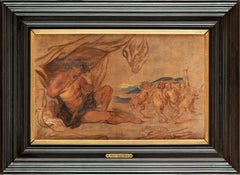
Thomas Willeboirts Bosschaert (1614–1654) – Pan Plays to the Dance of the Putti, Oil Sketch (Modello)
This oil sketch by the Flemish Baroque painter Thomas Willeboirts Bosschaert, a leading history painter in the Antwerp circle of Peter Paul Rubens and Anthony van Dyck, shows Pan playing the flute to a ring of dancing putti and a young satyr. The attribution has been confirmed by Prof. Hans Vlieghe, and the work is published in the artist's catalogue raisonné (Axel Heinrich, 2003, cat. A 58).
Oil on canvas, 35 x 51 cm (13 3/4 x 20 1/8 in)
**The Composition**
At the left edge, a dark-haired flute player sits in a recess hung with drapery; before him, a fallen bowl spills its water. On the right, five putti dance in a circle – the one on the left, with goat legs, identifiable as a young satyr. A dark mountain landscape fills the background beneath a sky lit by a rising or setting sun.
The flute player is most readily read as Pan, god of shepherds and music, traditionally shown with his pipes, associated with dance and at home in the mountains of Arcadia. An interpretation as Bacchus, god of wine and ecstasy, is also possible: satyrs belong to his retinue, and the spilling water may allude to Lethe, the river of the underworld and symbol of oblivion.
**An Oil Sketch in the Rubens Tradition**
The partly unfinished execution reveals the work as a preparatory oil sketch (modello). Some passages, such as the flute player, are almost fully worked up, while the putti and the horizon are only indicated in outline. Such sketches, made in preparation for larger history paintings, are characteristic of the working practice of Rubens, Van Dyck and their collaborators.
The sketch is closely related to Bosschaert's Children's Bacchanal in Kassel, in which a crowd of putti celebrates around the drunken infant Bacchus; the compositional structure and the treatment of the putti are strikingly similar. Further parallels appear in his Cupid with a Tamed Lion (Amor Triumphans) and in his oil sketch Venus Restraining Mars – Allegory of War, which features the same standing putto facing the viewer.
The work also demonstrates Bosschaert's close stylistic affinity with Van Dyck. Van Dyck's Triumph of Bacchus shows comparable putti, the same concentration of figures on the right, a similar yellowish sky and a fallen bowl (there filled with fruit). His Rest on the Flight into Egypt likewise places a ring of dancing putti on the right, with the Holy Family in place of the flute player on the left. A possible model is a print by the Italian artist Giulio Carpioni (1613–1678), which shows a very similar composition in reverse: dancing putti, one of them a goat-legged satyr, beside a curly-haired flute player with goat's legs.
This oil sketch is a significant addition to Bosschaert's oeuvre, illustrating both his spontaneous working method and his stylistic closeness to Van Dyck.
Presented in a black ebonised profile frame with gilt slip.
**The Artist**
Born in Bergen op Zoom in 1614, Thomas Willeboirts Bosschaert trained in Antwerp under Gerard Seghers...
Category
17th Century Baroque Plate Glass Figurative Paintings