Located in Sitges, Barcelona
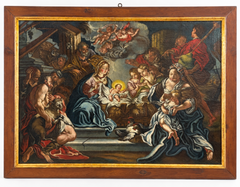
Glory to God in the Highest, Monumental Catalan Nativity Oil Painting
Artist: Mossèn Ramon Gimbert Canals (Spanish, 1882–1969)
Title: Glory to God in the Highest
Date: 1959
Medium: Oil on canvas
Dimensions: 65 × 92 cm — 25.59 × 36.22 in
Signature: Signed “R. Gimbert” lower right
Verso: Dated 1959 and inscribed with two passages from the Gospel of Luke
Artist’s mark: Personal emblem bearing the words “Spiritualitas – Sensibilitas – Pulchrumrum” on the reverse
Frame: Unframed
Condition: Good vintage condition, with craquelure, surface texture and signs of age consistent with a painting created in 1959. Please examine the photographs carefully, as they form part of the condition description.
Description
An exceptional and highly ambitious Nativity painted in 1959 by the Catalan priest and artist Mossèn Ramon Gimbert Canals.
Entitled Glory to God in the Highest, the painting presents a richly populated and deeply spiritual interpretation of the birth of Christ and the Adoration of the Shepherds. The Virgin Mary, the Christ Child and Saint Joseph occupy the luminous centre of the composition, surrounded by shepherds, children, musicians and animals, while angels descend dramatically from above.
Rather than following a static or conventional devotional formula, Gimbert transforms the biblical episode into a vibrant nocturnal vision. The humble stable becomes a meeting place between heaven and earth: the earthly figures gather closely around the newborn Christ, while the angels appear through light, movement and translucent colour.
At the centre of the painting, a radiant celestial light illuminates the Holy Family and acts as the spiritual and compositional focus of the scene. The intense blue of the night visible through the opening on the left contrasts with the warm ochres, reds, greens and pearly whites of the figures. This alternation between darkness and illumination reinforces the central Christian symbolism of divine light entering the human world.
The composition is remarkably complex. Every figure contributes to the biblical narrative through gesture, expression and direction of gaze. The shepherds approach the Child with humility, musicians celebrate the miraculous event, animals evoke the simplicity of the stable and angels proclaim the divine message from above.
Despite the number of figures, the scene remains unified by the circular movement created around the Virgin and Child. The different groups are connected by their gestures and gazes, drawing the viewer progressively toward the newborn Christ.
Gimbert’s brushwork is loose, expressive and highly atmospheric. Areas of carefully observed figuration coexist with passages of fluid, almost visionary painting. The richly worked surface, softened contours and shimmering blues and greens create an image that appears to emerge simultaneously from memory, prayer and spiritual contemplation.
The painting is signed “R. Gimbert” in the lower-right corner. On the reverse, the artist wrote the date 1959 together with two passages from the Gospel of Luke directly connected with the Nativity:
“Glory to God in the highest, and on earth peace to men of good will.”
“Mary kept all these words, pondering them in her heart.”
The inscriptions correspond to Luke 2:14 and Luke 2:19. Their presence confirms the precise biblical meaning of the composition and creates an unusually direct connection between the artist’s pictorial vision and his religious vocation.
The reverse also bears Gimbert’s documented personal emblem: a lamp surrounded by the Latin words “Spiritualitas”, “Sensibilitas” and “Pulchrum” — spirituality, sensitivity and beauty. This emblem is known from the catalogues accompanying his solo exhibitions and encapsulates the three principles upon which he based his artistic identity.
Created in 1959, the painting dates from the same year in which Gimbert presented an individual exhibition at the Casa del Libro in Barcelona. Its scale, sophisticated multi-figure composition, biblical inscriptions and personal emblem distinguish it from the Catalan landscapes for which the artist is more frequently encountered on the market.
This is not merely a decorative religious painting, but a personal visual statement by an artist who was simultaneously a painter and a Catholic priest. It brings together Gimbert’s faith, imagination and artistic ambition in one of the most elaborate compositions known within his production.
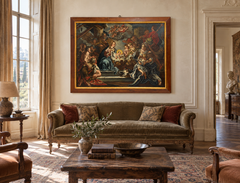
The painting is offered unframed, allowing its new owner to select a frame appropriate to its interior and personal taste.
Artistic context and inspiration
The dramatic union of earthly and celestial space belongs to the great European tradition of Nativity and Adoration scenes.
Gimbert’s elongated angels, spiritual intensity and supernatural illumination invite comparison with the religious paintings of El Greco, particularly in the way the visible world opens toward a higher spiritual realm.
The contrast between nocturnal darkness and concentrated divine light also recalls the biblical compositions of Rembrandt, in which illumination carries both narrative and theological meaning.

At the same time, the dreamlike suspension of the figures and the poetic coexistence of people, musicians and animals evoke aspects of Marc Chagall’s visionary religious imagery. The decorative rhythm, softened contours and intimate spirituality can also be situated near the sacred paintings of Maurice Denis and the Symbolist revival of religious art.
These comparisons establish the painting within a broader history of European religious and visionary art and are not intended to imply direct artistic dependence.
Artist biography
Mossèn Ramon Gimbert Canals was born in Sant Quirze de Terrassa —now Sant Quirze del Vallès, Barcelona— in 1882 and died in Barcelona in 1969. He was a Catalan painter and Catholic priest whose religious vocation developed alongside a sustained artistic career.
After studying at the diocesan seminary, Gimbert was ordained as a priest in 1908. In 1924 he was appointed sacristan of Barcelona Cathedral, and in 1966 he became a beneficed priest of the same institution.
His documented artistic career includes participation in the Tenth Autumn Salon, held at Madrid’s Palacio del Retiro in 1930. He also participated in the Barcelona Spring Exhibitions of 1935 and 1936.
In 1935, Gimbert presented an individual exhibition at the prestigious Galeries Laietanes in Barcelona. A further solo exhibition was held at the Casa del Libro in 1959, the same year in which the present Nativity was painted.
His known production includes Catalan landscapes, interiors, figurative scenes and religious compositions. His paintings combine the Catalan figurative tradition with expressive brushwork, atmospheric colour and a deeply personal spiritual sensibility.
Gimbert frequently signed his paintings “R. Gimbert” and also employed a distinctive personal emblem incorporating a lamp and the Latin words “Spiritualitas”, “Sensibilitas” and “Pulchrum”. The same documented emblem appears on the reverse of this painting.
Figurative Paintings
Religious Paintings
Modern
Symbolist
Post-Impressionist
Religious Art
1950–1959
Nativity
Adoration of the Shepherds
Virgin Mary
Christ Child
Saint Joseph
Angels
Shepherds
Musicians
Animals
Biblical Scene
Christian Art
Religious Interior
Canvas
Oil Paint
Nativity oil painting, Adoration of the Shepherds, Glory to God in the Highest, Spanish religious painting, Catalan religious art, biblical oil painting, Virgin Mary painting...
Category
1950s Modern Figurative Paintings