1890s Art

1,885 Results
to
204
1,071
363
256
113
147
Overall Width
to
Overall Height
to
7,650
21,586
166,376
236,260
2,155
2,348
4,722
6,516
6,001
15,869
21,300
26,651
19,314
14,110
5,461
228
194
74
33
8
8
5
5
3
2
1,143
718
13
1,300
708
427
376
337
217
190
179
172
145
129
125
115
95
94
83
69
62
61
55
729
664
515
431
343
60
39
33
25
24
720
225
1,080
869
Period: 1890s
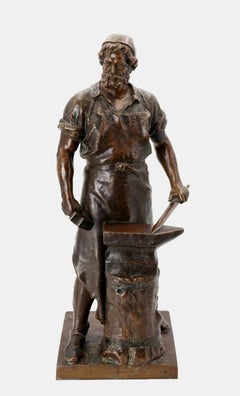
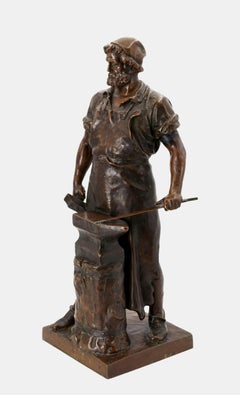
The Blacksmith of Solingen / - The Double-edged Sword -

The Blacksmith of Solingen / - The Double-edged Sword -

Located in Berlin, DE

Wilhelm Albermann (1835 Werden an der Ruhr - 1913 Cologne), The Blacksmith of Solingen, after 1895. Bronze-color patinated zinc cast on plinth, 47 cm (height) x 20 cm (width) x 16 cm (depth), weight 5.5 kg. Signed “Albermann.” on the plinth and identified as a cast by “AKT.[TIEN] GES.[ELLSCHAFT] GLADENBECK BERLIN”. Dedication on the front: “Mr. Ing. F. Kuhlmann to the wedding. Management and officials of the Hannoversche Waggonfabrik. Aircraft construction department". - The zinc showing through in spots, the patina somewhat stained, the right upper arm under the sleeve retouched in black. - The Double-edged Sword - The figure is a reduction of Wilhelm Albermann's 1895 fountain figure of the armourer of Solingen, who has always been identified with the historical blacksmith Peter Hahn. In 1839, Karl Simrock wrote the poem “The Blacksmith of Solingen" and thus coined the legendary figure. The first and penultimate verses read: A blacksmith spoke to Solingen With every bayonet, That came to his diligence: "Oh, that Fritz had it!" The war took its course, Many battles were fought, Which often made him fearful and anxious In his soul. The blacksmith had given up his trade to fight for Frederick the Great. Not least because of his strength and will to fight, the battles were won. With his fountain sculpture, Albermann has given the legendary blacksmith a figurative form and at the same time created a landmark for the city of Solingen, which was once famous for the art of sword forging and today still stands for the production of high-quality knives. During the bombing raid in November 1944, the fountain was destroyed along with the entire old town of Solingen. Only the head remained. The broad-shouldered blacksmith stands securely behind his anvil, his leather apron tied around him, and has just finished a sword blade with his own "weapon" - the blacksmith's hammer. His entire body shows the strength with which he wields the hammer, but also the strain of this activity, as evidenced by the wide open shirt, the somewhat 'untidy' apron, and especially the furrowed face. However, the blacksmith does not look at the finished work, but resolutely and at the same time thoughtfully into the distance, in line with the quoted verse from Simrock's poem that the battles "often made him fearful and anxious in his soul". There is certainly something melancholy in his gaze, fed by the knowledge of the necessity of forging swords and taking up arms and their deadly use - experiences Albermann had to make during his own war missions. The flowing full beard gives his gaze into the distance an almost prophetic character. In keeping with the craft of the perfectly formed art of blacksmithing, the detailed casting reproduces the respective materials depicted in perfect form: the leather apron convincingly conveys the impression of leather and lies - also in the back view - like a second formed layer over the body, while the shirt and trousers illustrate their own textile qualities. Due to its masterful execution and profound content, the “Blacksmith of Solingen”, which has survived in its cast reproductions, remains Albermann's most famous work to this day. About the artist The son of a carpenter, Wilhelm Albermann began an apprenticeship as a joiner, but then followed his artistic calling and trained as a sculptor in Elberfeld. In 1855, at the age of twenty, he was drafted into the army in Berlin, where he served until 1857. Albermann attended the Berlin Art Academy on the side and began regular studies after his service. While still a student, he completed commissioned works for his teachers August Fischer and Hugo Hagen. His first independent commissions followed, enabling him to establish a flourishing sculpture studio in Cologne in 1865. His artistic activities were repeatedly interrupted by military service, and he took part in the German-Danish War in 1864, the war against Austria in 1866, and the Franco-Prussian War in 1870/71. After his last war service, Albermann, already a respected artist, founded a commercial drawing school at the request of the city government, where he taught the modeling class and served as director until 1896. In 1890 he also worked for the "Society for the Promotion of Sculpture in the Rhineland and Westphalia". Albermann was one of the most prolific sculptors in Cologne in the second half of the 19th century. He created numerous monuments, fountains, tomb sculptures, architectural ornaments, and domestic statues. At its peak, his workshop employed up to thirty sculptors and stonemasons at a time. GERMAN VERSION Wilhelm Albermann (1835 Werden an der Ruhr - 1913 Köln), Der Schmied von Solingen, nach 1895. Bronzefarben patinierter Zinkguss auf gegossener Plinthe, 47 cm (Höhe) x 20 cm (Breite) x 16 cm (Tiefe), Gewicht 5,5 kg. Auf der Plinthe mit „Albermann.“ signiert und als Guss der „AKT.[TIEN] GES.[ELLSCHAFT] GLADENBECK BERLIN“ ausgewiesen. Schauseitige Widmung: „Herrn Ing. F. Kuhlmann zur Vermählung. Direktion und Beamte der Hannoverschen Waggonfabrik. Abt. Flugzeugbau“. - Punktuelles Durchscheinen des Zinks, Patina etwas fleckig, der rechte Oberarm unter dem Ärmel schwarz retuschiert. - Die Zweischneidigkeit des Schwertes - Die Figur ist eine Reduktion von Wilhelm Albermanns 1895 geschaffener Brunnenfigur des Waffenschmieds von Solingen, der seit jeher mit dem historischen Schmied Peter Hahn identifiziert wurde. 1839 hatte Karl Simrock das Gedicht „Der Schmied von Solingen“ verfasst und damit die legendäre Figur geprägt. Die erste und die vorletzte Strophe lauten: Zu Solingen sprach ein Schmied Bei jedem Bajonette, Das seinem Fleiß geriet: »Ach, daß der Fritz es hätte!« Der Krieg ging seinen Gang, Man schlug noch viele Schlachten, Die oft ihm angst und bang' In seiner Seele machten. Der Schmied hatte sein Handwerk ruhen lassen, um selbst für Friedrich den Großen zu kämpfen. Nicht zuletzt durch seine Kraft und seinen Kampfeswillen verliefen die Schlachten siegreich. Dem legendären Schmied verlieht Albermann mit seiner Brunnenskulptur eine bildliche Gestalt und schuf damit zugleich ein Wahrzeichen der Stadt Solingen, die einst für die Kunst des Schwerterschmiedens berühmt war und bis heute für die Herstellung qualitätvoller Messer einsteht. Beim Bombenangriff im November 1944 wurde mit der gesamten Solinger Altstadt auch der Brunnen zerstört. Einzig der Kopf blieb erhalten. Mit sicherem Stand und umgebundener Lederschürze steht der breitschultrige Schmied hinter seinem Amboss und hat gerade mit seiner eigenen ‚Waffe‘ – dem Schmiedehammer – eine Schwertklinge fertiggestellt. Seinem gesamten Körper ist die Kraft abzulesen, mit der er den Hammer führt, aber auch die Anstrengung dieser Tätigkeit, wovon das weit geöffnete Hemd, die etwas ‚unordentlich‘ arrangierte Schürze und vor allem das zerfurchte Gesicht zeugen. Der Schmied schaut aber nicht auf das vollendete Werk, sondern entschlossen und zugleich sinnierend in die Ferne, entsprechend der zitierten Zeile von Simrocks Gedicht, dass die Schlachten „oft ihm angst und bang‘ in seiner Seele machten“. Der Blick hat durchaus etwas Melancholisches, dass sich aus dem Wissen um die Notwendigkeit, Schwerter zu schmieden und zu den Waffen zu greifen und deren tödlichem Einsatz speist – Erfahrungen, die Albermann bei seinen eigenen Kriegseinsätze machen musste. Der wallende Vollbart verleiht dem in die Ferne schauenden Blick einen beinahe prophetischen Charakter. Dem Handwerk der formvollendenden Schmiedekunst entsprechend, gibt der detaillierte Guss die jeweils dargestellten Materialien in vollendeter Ausformung wieder: Die Lederschürze vermittelt überzeugend den Eindruck des Leders und liegt – auch in der Rückenansicht – wie eine zweite ausgeformte Schicht über dem Körper, während das Hemd und die Hose...

Category

Realist 1890s Art
Materials

Metal

“Close of the Day”
“Close of the Day”

“Close of the Day”

By Harold Sutton Palmer

Located in Southampton, NY

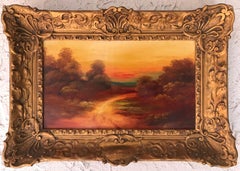
Beautiful oil painting on board of a sunset in Epsom, England by the British painter, Harold Sutton Palmer. Signed S. Palmer lower right. The painting is it’s original frame. Gold painted over original gilding. Overall framed measurements are 14 by 20 inches. Condition is very good. Epsom is a market town in Surrey, England, 13.7 miles (22.0 km) southwest of London, between Ashtead and Ewell. The town straddles chalk downland (Epsom Downs...

Category

Barbizon School 1890s Art

Materials

Oil, Board

Le Choix du Modèle - Etching by Eugène Champollion d'après M. Fortuny

Le Choix du Modèle - Etching by Eugène Champollion d'après M. Fortuny

Located in Roma, IT

Le Choix du Modèle is an original artwork realized by Eugène Champollion in 1898. Etching on paper. Signed on plate on the lower right corner. Etching d'aprés Fortuny. Fortuny is written on plate on the lower right corner. Mint conditions. Passepartout included (cm 39.5 x 49). very beautiful etching realized representing the choice of a model. The scene is represented in a big hall with huge colums on the background. On the right side of the composition, a female figure on a proscenium and, on the left side there are some people well-dressed watching the female figure. The artwork has been realized by Eugène Champollion (Embrun, 1848 - Lettret, 1901) a French engraver and illustrator and one of the pupils on Léon...

Category

1890s Art

Materials

Etching

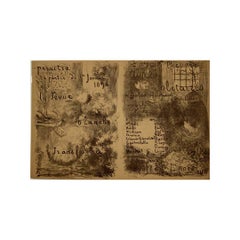
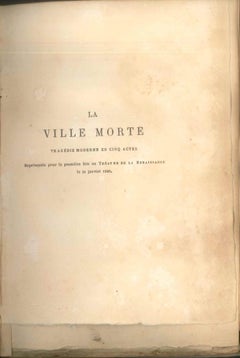
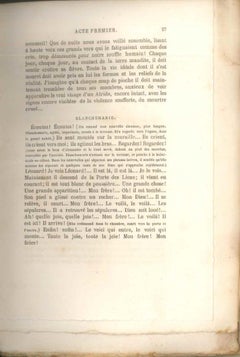
La Ville Morte - Rare Book by Gabriele D'Annunzio - 1898

La Ville Morte - Rare Book by Gabriele D'Annunzio - 1898

Located in Roma, IT

Original title: La ville morte. Tragédie moderne en cinq actes. Représentée pour la première fois au Théatre de la Renaissance le 21 janvier 1898. Specimen number 1 of 50 numbered copies printed on Holland paper. La città morta is one of the first tragedies written by Gabriele D'Annunzio, performed for the first time at the Renaissance Theater (Paris) on January 21, 1898 by Sarah Bernhardt. On Italian stages it was performed by the superb Eleonora Duse...

Category

Modern 1890s Art

Materials

Paper

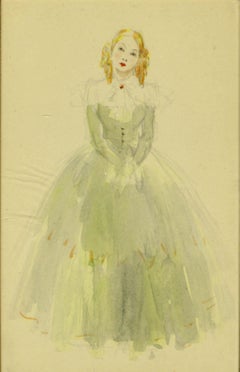
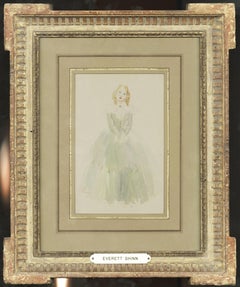
Girl with the Golden Curls

Girl with the Golden Curls

By Everett Shinn

Located in Fairlawn, OH

Girl with the Golden Curls Watercolor, c. 1895 Unsigned Provenance: Davis Galleries, New York (see photo of label on reverse) Condition: Mounted to support by the artist ...

Category

American Impressionist 1890s Art

Materials

Watercolor

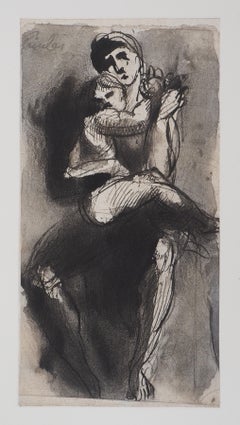
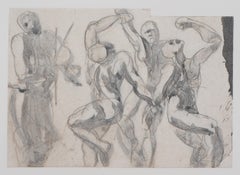
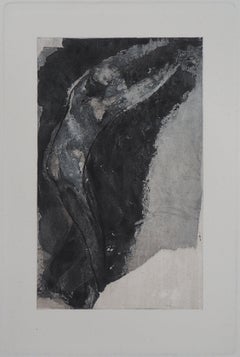
Dance - Etching, 1897

Dance - Etching, 1897

By (after) Auguste Rodin

Located in Paris, IDF

Auguste RODIN (after) Dance, 1897 Etching enhanced with watercolor On vellum 31 x 42.5 cm (c. 12.2 x 16.7 inches) Edition limited to 125 copies, send with the certificate of authent...

Category

Modern 1890s Art

Materials

Etching

Shadow - Etching, 1897

Shadow - Etching, 1897

By (after) Auguste Rodin

Located in Paris, IDF

Auguste RODIN (after) Shadow, 1897 Etching enhanced with watercolor On vellum 42.5 x 31 cm (c. 16.7 x 12.2 inches) Edition limited to 125 copies, send with the certificate of authen...

Category

Modern 1890s Art

Materials

Etching

“Sunset, Dorking"
“Sunset, Dorking"

“Sunset, Dorking"

By Harold Sutton Palmer

Located in Southampton, NY

Beautiful oil painting on board of a sunset Dorking in England by the British painter, Harold Sutton Palmer. Signed S. Palmer lower right. The painting is it’s original frame. Gold...

Category

Barbizon School 1890s Art

Materials

Oil, Board

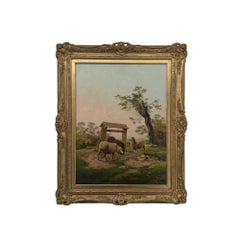
Victorian Scottish Landscape Oil Painting of Sheep, 24x30 Inches

Victorian Scottish Landscape Oil Painting of Sheep, 24x30 Inches

Located in Roswell, GA

This Victorian Scottish landscape oil painting by Edward Hargitt (1835–1895) depicts sheep resting within the expansive Scottish countryside. Painted in a classical style with careful attention to landscape, atmosphere, and natural detail, the work reflects Hargitt’s deep connection to Scotland and its rural scenery. Born in Edinburgh, Hargitt studied at the Royal Scottish Academy under the influential landscape painter Horatio McCulloch. He exhibited at the Royal Academy in London and became a member of the Royal Institute of Painters in Water Colours. Hargitt was particularly known for Highland landscapes, moors, lochs, and pastoral subjects in which animals provide scale and animation. A memorable detail of Hargitt’s life is that he was also a respected ornithologist, and his intense interest in the Scottish natural world informed the careful observation evident in his paintings. His work remains represented in private collections and continues to appear at European auction. This Scottish sheep...

Category

Victorian 1890s Art

Materials

Oil

Sailor's supper  - Original lithograph - 1897

Sailor's supper - Original lithograph - 1897

By Jacques Baseilhac

Located in Paris, IDF

Jacques BASEILHAC Sailor's supper Original lithograph Printed signature in the plate 1897/98 On vellum 40 x 31 cm (c. 16 x 12") INFORMATION : Published by 'Estampe Moderne, Paris,...

Category

Art Nouveau 1890s Art

Materials

Lithograph

Storm Sky Over the Farm

Storm Sky Over the Farm

By Amos Sangster

Located in Buffalo, NY

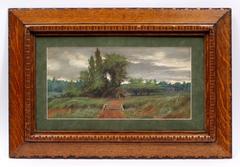
An original antique watercolor by American artist Amos Sangster featuring a dramatic allegorical composition and spectacular hand carved frame.

Category

American Realist 1890s Art
Materials

Paper, Watercolor

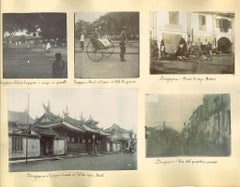
Ancient Views of Singapore - Original Albumen Print - 1890s

Ancient Views of Singapore - Original Albumen Print - 1890s

Located in Roma, IT

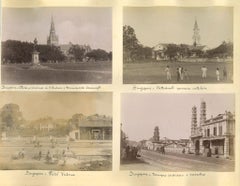
Ancient Views of Johor and Singapore is a set of 9 original vintage Albumen prints on a single cardboard 25 x 34 cm. Size of photos: 4 of 10.5x15.5 and other five on the rear. Goo...

Category

Modern 1890s Art

Materials

Photographic Paper

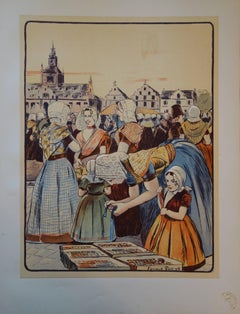
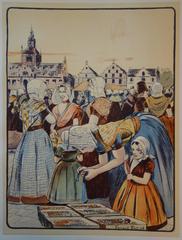
Un marché en Zélande -  original lithograph (1897/98)

Un marché en Zélande - original lithograph (1897/98)

By Fernand Piet

Located in Paris, IDF

Fernand Piet Un marché en Zéland Original lithograph Plate signed 1897/98 Printed on paper Vélin Size 40 x 31 cm (c. 16 x 12in) INFORMATION : Published by 'Estampe Moderne, Paris,...

Category

Art Nouveau 1890s Art

Materials

Lithograph

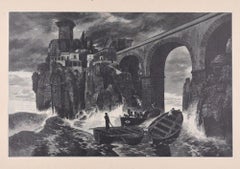
Pirates attack the Castle on the Sea - Original Woodcut by J.J. Weber - 1898

Pirates attack the Castle on the Sea - Original Woodcut by J.J. Weber - 1898

By Arnold Bocklin (After)

Located in Roma, IT

Image dimensions: 23 x 35 cm. Original Title: Von Piraten überfallene Burg am Meer Pirates attack the Castle on the sea is a black and white xylograph on Japon applied on ivory-colored paper, after Arnold Böcklin...

Category

Symbolist 1890s Art
Materials

Woodcut

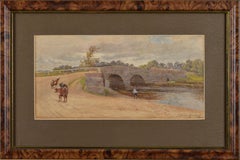
Meadow around Geneva

Meadow around Geneva

Located in Genève, GE

Work on paper Golden wooden frame 72 x 61 x 7 cm

Category

French School 1890s Art

Materials

Watercolor, Gouache

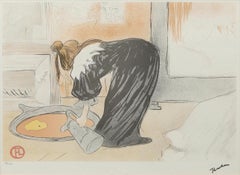
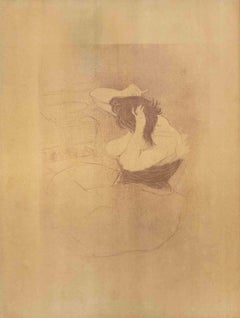
Femme qui se peigne-La Coiffure - Lithograph after H. de Toulouse-Lautrec-1900s

Femme qui se peigne-La Coiffure - Lithograph after H. de Toulouse-Lautrec-1900s

By Henri de Toulouse-Lautrec

Located in Roma, IT

Femme qui se peigne - La Coiffureis a color lithograph realized after Henri de Toulouse Lautrec in 1896.  cm. 59 x 46 ; matted. Monogrammed on plate. Good conditions. This specim...

Category

Post-Impressionist 1890s Art

Materials

Paper, Lithograph

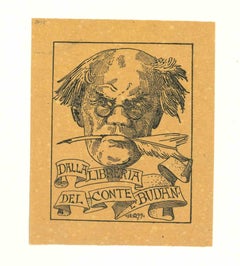
Ex Libris Conte Budan - Original Woodcut - 1899

Ex Libris Conte Budan - Original Woodcut - 1899

Located in Roma, IT

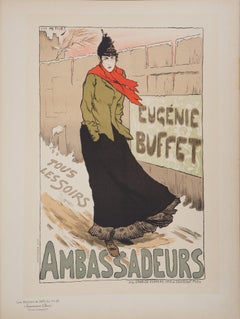
Ex Libris Conte Budan is an original Contemporary Artwork realized in 1899. Original B/W woodcut print on ivory-colored paper. The work is glued on cardboard. Dated on the low...

Category

Modern 1890s Art
Materials

Woodcut

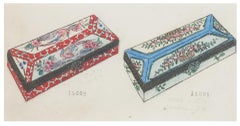
Porcelain Boxe - Original China ink and Watercolor - 1890s

Porcelain Boxe - Original China ink and Watercolor - 1890s

Located in Roma, IT

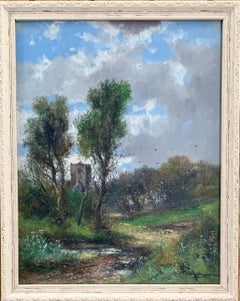
"Porcelain Boxe" 1890s is an original China ink and watercolor drawing on ivory-colorated paper by Anonymous Artist of XIX Century. Inn very good condition. Not signed.

Category

Modern 1890s Art
Materials

Ink, Watercolor

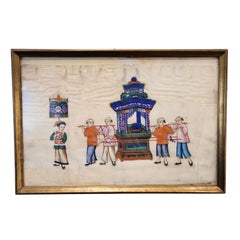
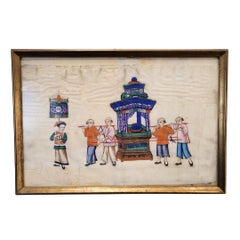
Chinese painting on rice paper “Procession” Guangzhou

Chinese painting on rice paper “Procession” Guangzhou

Located in Valladolid, ES

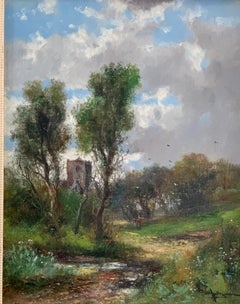
Exquisite Chinese painting on rice paper, similar to gouache, dating from the late Qing Dynasty (19th century) to the early 20th century. Its iconography, technique, and composition ...

Category

Qing 1890s Art
Materials

Rice Paper