By Georges Henri Manesse
Located in Saint Augustine, FL
Artist: Georges Henri Manesse (French, 1854-1940)
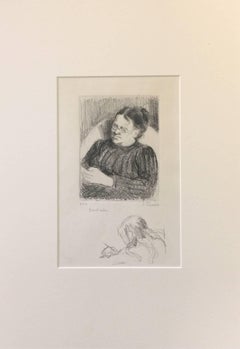
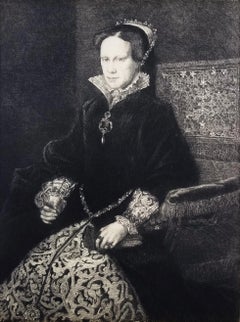
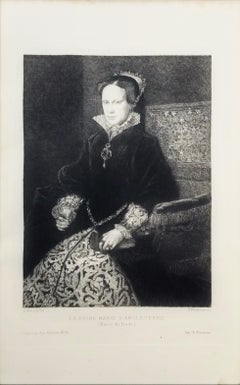
Title: "La Reine Marie d'Angleterre (Queen Mary of England)"
Portfolio: Gazette des Beaux-Arts
Year: 1893
Medium: Original Etching on cream laid paper
Limited edition: approx. 1,500
Printer: Chardon Wittman, Paris, France
Publisher: Gazette des Beaux-Arts, Paris, France
Sheet size: 10.69" x 7.13"
Image size: 7" x 5.25"
Reference: Sanchez/Seydoux 1893-7
Condition: Light discoloration at edges. It is otherwise a strong impression in excellent condition
Notes:
This etching is after a painting from 1554 by Dutch artist Anthonis Mor (c. 1517-1577). Comes with its original tissue cover sleeve.
This etching was published by Gazette des Beaux-Arts. The Gazette des Beaux-Arts was a French art review, found in 1859 by Édouard Houssaye, with Charles Blanc as its first chief editor. Assia Visson Rubinstein was chief editor under the direction of George Wildenstein from 1928 until 1960. Her papers, which include all editions of the Gazette from this period, are intact at the Cantonal and University Library of Lausanne in Dorigny. The Gazette was a world reference work on art history for nearly 100 years - one other editor in chief, from 1955 to 1987, was Jean Adhémar. It was bought in 1928 by the Wildenstein family, whose last representative was Daniel Wildenstein, its director from 1963 until his death in 2001. The review closed in 2002.
Mary I...
Category
Old Masters 1890s Art
MaterialsLaid Paper, Etching, Intaglio