1990s Art

to
2,003
4,368
3,069
2,758
1,768
2,035
Overall Width
to
Overall Height
to
7,706
21,688
163,555
226,855
2,013
2,278
4,942
6,521
5,853
15,026
20,531
25,757
18,663
14,088
5,503
4,768
1,895
1,798
1,158
491
301
182
147
92
76
70
21
15
5
7,282
5,192
927
4,962
2,533
1,704
1,593
1,270
1,183
934
875
708
689
673
625
595
565
344
329
312
311
293
284
4,483
3,645
2,008
1,637
1,509
490
176
176
146
126
2,556
3,651
9,560
4,137
Period: 1990s
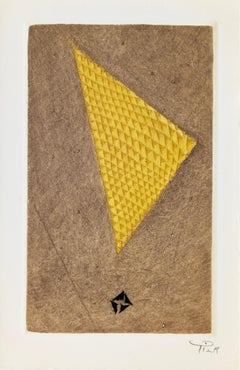
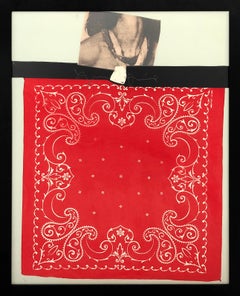
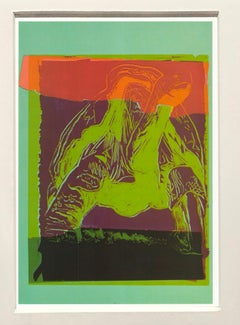
Virgin Mary Poster

Virgin Mary Poster

By Kiki Smith

Located in New York, NY

Screenprint on handmade Napalese paper. Edition of 3000. Printed by Universität für angewandte Kunst, Vienna. Published by MAK Galerie, Österreichisches Museum für angewandte Kunst, ...

Category

Contemporary 1990s Art

Materials

Handmade Paper, Screen

Untitled Ref. 94016
Untitled Ref. 94016

Untitled Ref. 94016

By Carlos Capelan

Located in Miami Beach, FL

Capelán's work stands out for its rigorous handling of diverse artistic techniques and procedures, ranging from drawing to installation, including painting, printmaking, photography,...

Category

Contemporary 1990s Art

Materials

Canvas, Mixed Media

Dialouge amoureux

Dialouge amoureux

By Corneille

Located in Östermalm, Stockholms län

Publisher GKM. Unframed. Edition of 250 ex. Signed, dated and numbered. Free shipment worldwide. Corneille, one of the founders of the COBRA group, has passed away. He died in Paris...

Category

Contemporary 1990s Art

Materials

Screen

Rod Kennedy 'Route 66 (Black & White)' 1995- Poster

Rod Kennedy 'Route 66 (Black & White)' 1995- Poster

Located in Brooklyn, NY

This vintage-style recreation of the iconic Route 66 poster, designed by graphic artist Rod Kennedy, stands out with its bold black background. Featuring each state insignia along th...

Category

1990s Art

Materials

Offset

Orpheus - Late 20th Century British watercolour by Robert O'Rorke

Orpheus - Late 20th Century British watercolour by Robert O'Rorke

Located in London, GB

ROBERT O’RORKE (Born 1945) Orpheus Signed and dated l.r.: Rbt O’Rorke ’93; signed, dated 1993 and inscribed The Dance No.3 on a label attached to the backboard Watercolour on grey ...

Category

Romantic 1990s Art

Materials

Watercolor

Fingers and Holes (Black and White)

Fingers and Holes (Black and White)

By Bruce Nauman

Located in Hollywood, FL

Artist: Bruce Nauman Title: Fingers and Holes (Black and White) Size: 30 x 40 Inches Medium: Lithograph and Screenprint Edition: Edition of 50. AP #7/10 Year: 1994 Notes: Hand Signed, Dated and Numbered by the Artist in Pencil. Printed by Gemini Gel #36.34. From the collection of Brook Alexander Gallery, NYC. Fingers and Holes, a captivating artistic exploration initiated by Bruce Nauman (American, born 1941), originated from a unique challenge he set for himself. Using his non-dominant hand, he drew his right hand, and vice versa, meticulously annotating each sketch with the count of holes formed between the fingers. This seemingly simple endeavor evolved into a profound study of algebraic topology, a mathematical field investigating fundamental properties of distorted objects, such as solids and voids. Nauman ingeniously translated his anatomical sketches into this abstract language. In this realm of mathematical inquiry, seemingly dissimilar objects transform into one another. A coffee cup and a doughnut, for instance, are considered equivalents due to their shared characteristic of having an unbroken surface surrounding a single "hole," a concept known as homeomorphisms. Nauman's deep dive into topology revealed connections between disparate elements, encapsulated in his statement, “Things that don’t look alike morphose one into another.” However, Fingers and Holes goes beyond mathematical intricacies. It delves into the realm of transformation—topological, visual, and linguistic. The iconic "three fingers, one hole" gesture, a symbol of sexual intercourse in what Nauman referred to as "kids’ sign language," served as a pivotal motif. This gesture reappeared in various forms within the series, including daisy chain formations and overlays on clowns' handshakes, which Nauman identified through his exploration. The clowns in Nauman’s work epitomize ambiguity, embodying a spectrum from humor to threat. Their double handshakes, simultaneously obsequious and aggressive, mirror the complexities of human interactions. Nauman found inspiration in this ambiguity, appreciating the clowns for their enigmatic nature. By integrating the "three fingers, one hole" motif into the handshake of his clown prints...

Category

Contemporary 1990s Art

Materials

Lithograph, Screen

"Bodega Bay"
"Bodega Bay"

"Bodega Bay"

Located in Astoria, NY

Hiromichi Iwashita (Japanese, b. 1942), "Bodega Bay" Diptych, 28 September 1995, mixed media on paper, both signed and dated, vertical composition titled, each floating in black fram...

Category

Minimalist 1990s Art

Materials

Mixed Media, Pencil, Graphite, Paint, Paper

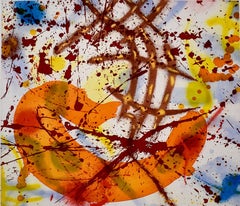
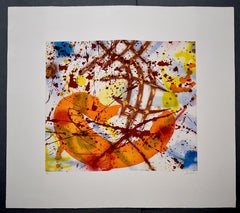
SFE-080RC

SFE-080RC

By Sam Francis

Located in Östermalm, Stockholms län

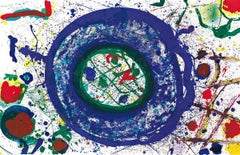
Untitled. SFE-080RC. Artwork size : 56 x 76 cm. Frame size : 75 x 97 x 4 cm Museum glass anti-reflective. Signed and numbered 46/75 ex. Sam Francis Archive Number : SF-353. Free shipment worldwide. Sam Francis’s paintings are a journey into a dream, a voyage into the landscapes of the soul where colours are lights on fire. Alongside names such as Jackson Pollock, Willem de Kooning and Franz Kline, Sam Francis is an artist who has succeeded in demonstrating a total mastery of abstract expressionism’s impassioned and spontaneous genre. The explosions of colour – red, blue, green and yellow – the streaks, strokes and bold lines of his pictures are the physical synthesis of the deepest crevices of the soul. His colours create rhythmical motifs that, characteristically enough, can be called the “musicality” of his paintings. The work of Sam Francis provides a visible meeting place for the conscious and the unconscious. His pictures are the cross-fertilisation of what has already been experienced with what exists still only as desire, a struggle between melancholy and merrymaking. Influenced by C.G. Jung, the father of psychoanalysis, Sam Francis spent a large portion of his life exploring the premise that dreams, instincts and intuition provide, the keys which unlock the mysteries and meaning of our inner lives. He was also fascinated by the four ancient elements – earth, water, air and fire – which developed into a leitmotif in his work. Sam Francis was born in San Mateo in California, USA in 1923. After starting to paint at the age of around twenty, he soon found himself increasingly consumed by the power of art. He spent much of the 1950s in Paris, from where he not only made frequent excursions to a number of European cities, but also embarked on many journeys to South America and Asia. He continued to move from place to place, primarily in the USA and Japan, right up until his death in 1994. Sam Francis’s first...

Category

Abstract Expressionist 1990s Art

Materials

Etching

Raymond Pettibon Santa Monica 1999 (announcement)

Raymond Pettibon Santa Monica 1999 (announcement)

By Raymond Pettibon

Located in NEW YORK, NY

Raymond Pettibon Santa Monica, CA 1999: Rare vintage Raymond Pettibon illustrated announcement card published on the occasion of: “Works By: Pettibon, Kelly, Goldin, Holzer:” November 3 thru December 1 1999: IKON, LTD./Kay Richards Contemporary Art: Santa Monica, California. Medium: offset printed announcement card. 1999. Approx Dimensions: 4 x 5.25 inches Very good overall vintage condition; unsigned from an edition of unknown. Raymond Pettibon is a contemporary American artist known for his stylized ink drawings combining images and text. His inventive narratives blend historical content with consumer culture to yield incisive critiques of contemporary society. “I was making my work as transparent as possible, without equivocations, without calling attention to itself, without apology,” he explained. “There's a lot of conventions in the art world that are not to be transgressed, but my economy of means doesn't abide by those strictures.” Born Raymond Ginn on June 16, 1957 in Tucson, AZ, the artist is self-taught, but cites drawings by William Blake, Edward Hopper, Francisco Goya, and John Sloan as instructive to his practice. Deriving inspiration from comics, cartoons, and other pop culture iconography, Pettibon began designing album covers and ephemera for his brother’s band Black Flag in the mid-1970s. He went on to produce cover art for Sonic Youth, the Minutemen, and the Foo Fighters. In 2017, the artist was the subject of the major retrospective “Raymond Pettibon: A Pen of All Work,” held at the New Museum in New York, where he currently lives and works. Today, his works can be found in the collections of the Centre Georges Pompidou in Paris, The Museum of Modern Art in New York, and the Tate Gallery in London, among others. Related categories: Raymond Pettibon poster...

Category

Street Art 1990s Art

Materials

Offset

Belport NY, Landscape, archived number 3784

Belport NY, Landscape, archived number 3784

By Arthur Pinajian

Located in La Canada Flintridge, CA

Painting sizes is 27x34 in., oil on canvas. Signed lower right. The Pinajian estate certificate is included. About twelve years ago, Professor William Innes Homer (1929-2012), the f...

Category

Abstract Expressionist 1990s Art

Materials

Oil

"Requiem/Let Them Be, " Etching and Aquatint signed by Joan Snyder

"Requiem/Let Them Be, " Etching and Aquatint signed by Joan Snyder

By Joan Snyder

Located in Milwaukee, WI

"Requiem" is an original etching and aquatint by Joan Snyder. The artist signed the piece, and the edition is of 120. This piece features abstract, expressionist text and an striking portrait of a woman with red lipstick on a pink background. 25 5/8" x 20" art 32" x 26" frame Joan Snyder was born on April 16, 1940, in Highland Park, New Jersey. She received her AB from Douglass College in New Brunswick, New Jersey (1962), and an MFA from Rutgers University in New Brunswick, New Jersey (1966). She was the recipient of a National Endowment for the Arts Fellowship (1974) and a John Simon Guggenheim Memorial Fellowship (1983). Snyder lives in Brooklyn and Woodstock, New York. Although Snyder’s paintings are often placed under various art-movement umbrellas—Abstract...

Category

Contemporary 1990s Art

Materials

Etching, Aquatint

"Swimmers", New York, NY, 1995

"Swimmers", New York, NY, 1995

By Jose Picayo

Located in Hudson, NY

This photograph is printed on Japanese Paper. The price is for an unframed photograph. 11" X 14" Edition of 25. The Robin Rice Gallery is pleased to announce, 25 Years of Polaroi...

Category

Contemporary 1990s Art

Materials

Photographic Paper

“Feu Henrix” from the serie ”The day after”

“Feu Henrix” from the serie ”The day after”

By Arman

Located in Östermalm, Stockholms län

“Feu Henrix” from the serie ”The day after” Original sculpture 8 copies. Number 4/8 in the edition. Acquired directly from the artist. Bocquel fondeur. Free shipment worldwide. Ar...

Category

Contemporary 1990s Art

Materials

Bronze

Mike Tyson with Dove - portrait of boxing legend, fine art photography, 1990

Mike Tyson with Dove - portrait of boxing legend, fine art photography, 1990

By Michel Comte

Located in Vienna, AT

All prints are limited edition. Available in multiple sizes. High-end framing on request. All prints are done and signed by the artist. The collector receives an additional certificate of authenticity from the gallery. Mike Tyson is a legend even beyond the boxing world. This high-contrast black-and-white portrait shows a closeup of his face and chest in profile. He is holding a white dove in front of his face as if to kiss it. Contrasted by the dark background, the bird becomes the focal point of the image. The huge man holding it appears even bigger next to the small bird, yet his gentle gesture toward the bird gives the image a peaceful and meditative vibe. The saturated colors of the broiling desert against the piercing blue of the clear sky or the cool palette of an intimate black-and-white portrait, Michel Comte can do it all. The Swiss star...

Category

Contemporary 1990s Art

Materials

Silver Gelatin

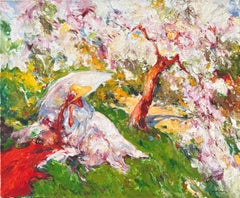
Modernist Straw Flower Still Life

Modernist Straw Flower Still Life

By Frederico Domondon

Located in Soquel, CA

A rich painterly still life of sunflowers with bold, multicolor background by San Francisco artist Frederico Domondon (American, b. 1964). Signed "Domondon" lower left. Framed in a b...

Category

American Impressionist 1990s Art
Materials

Canvas, Oil

Untitled (Abstraction)

Untitled (Abstraction)

By Jack Roth

Located in Astoria, NY

Jack Roth (American, 1927-2004), Untitled, Acrylic on Canvas, circa 1990, marked "JR-3837" verso with "Jack Roth Estate" stamps, unframed. 24.25" H x 18" W x 1" D. Provenance: The ...

Category

Abstract 1990s Art

Materials

Canvas, Acrylic

American Female Abstract painter Modernist Still Life w/ Fruits GALLERY LABEL

American Female Abstract painter Modernist Still Life w/ Fruits GALLERY LABEL

By Peri Schwartz

Located in New York, NY

Peri Schwartz (born October 4, 1951, Brooklyn, New York) is an American painter and printmaker. She was born in Brooklyn, New York and raised in Far Rockaway, New York. She received her BFA from Boston University College of Fine Arts in 1973 and an MFA from Queens College in 1975. Up for sale is a wonderful Still Life with fruits Painting...

Category

Abstract Expressionist 1990s Art
Materials

Charcoal, Pastel, Mixed Media, Gouache

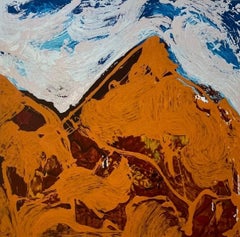
Abstract Colorado Mountain Landscape Drawing by Eric Bransby, 1940s WPA Artwork

Abstract Colorado Mountain Landscape Drawing by Eric Bransby, 1940s WPA Artwork

By Eric Bransby

Located in Denver, CO

This vibrant abstract Colorado landscape drawing by acclaimed American modernist Eric Bransby (1916–2020) captures the dynamic energy and color of the Rocky Mountain terrain. Express...

Category

Abstract 1990s Art

Materials

Oil Pastel, Pastel, Archival Paper

"Girl in Water", Orlando, Florida, 1996

"Girl in Water", Orlando, Florida, 1996

By Lynda Churilla

Located in Hudson, NY

Listing is for UNFRAMED print. Inquire within for framing. Edition 1 of 20. If the exhibition piece is sold or the customer orders a different print size, the photograph is p...

Category

Contemporary 1990s Art

Materials

Archival Pigment

Three Friends - Painting by Salvatore Travascio - 1995

Three Friends - Painting by Salvatore Travascio - 1995

Located in Roma, IT

"Three Friends" is an oil painting on canvas mounted on a wooden frame created by the artist Salvatore Travascio in 1993. This painting is part of a series of works in which the hum...

Category

Contemporary 1990s Art

Materials

Oil

Jupiter

Marlene SiffJupiter, 1991

$19,800Sale Price|20% Off

Jupiter

Located in New York, NY

The wall sculpture Jupiter came about from the Vogue Magazine Virgo horoscope in September 1991, my birthday month. It stated that Jupiter was in my sign and all my wishes would come...

Category

Abstract Geometric 1990s Art

Materials

Acrylic

"Not Intended For Office Viewing Series Section F" Oil Pastel by Reginald K. Gee

"Not Intended For Office Viewing Series Section F" Oil Pastel by Reginald K. Gee

By Reginald K. Gee

Located in Milwaukee, WI

"Not Intended For Office Viewing Series, Section F" is an original oil pastel drawing on illustration board by Reginald K. Gee. The artist signed the piece lower right. This piece fe...

Category

Contemporary 1990s Art

Materials

Oil Pastel, Illustration Board

"Still Life with Japanese Vase", New York, NY, 1998

"Still Life with Japanese Vase", New York, NY, 1998

By Jose Picayo

Located in Hudson, NY

This photograph is printed on Japanese Paper. The price is for an unframed photograph. 11" X 14" Edition of 25. The Robin Rice Gallery is pleased to announce, 25 Years of Polaroi...

Category

Contemporary 1990s Art

Materials

Photographic Paper

"Ecstasy", Kate Moss

"Ecstasy", Kate Moss

By Ellen von Unwerth

Located in Zurich, CH

Ellen VON UNWERTH (*1954, Germany) "Ecstasy", Kate Moss, 1995 Silver gelatin print, later print 50 x 40 cm (19 3/4 x 15 3/4 in.) Edition of 15 Biography: Born in Germany in 1954, El...

Category

Contemporary 1990s Art

Materials

Silver Gelatin

Ecological, Kate Moss, Paris

Ecological, Kate Moss, Paris

By Ellen von Unwerth

Located in Zurich, CH

Ellen VON UNWERTH (*1954, Germany) Ecological, Kate Moss, Paris, 1995 Unique Polaroid 10.8 x 8.5 cm (4 1/4 x 3 3/8 in.) Biography: Born in Germany in 1954, Ellen von Unwerth is wide...

Category

Contemporary 1990s Art

Materials

Polaroid

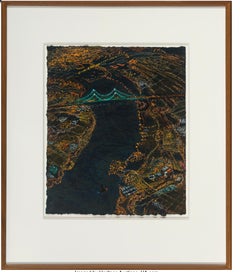
Giner Bueno 16 Reparando redes original painting

Giner Bueno 16 Reparando redes original painting

By Giner Bueno

Located in CORAL GABLES - MIAMI, FL

Giner Bueno (1935-2000) Reparando Las Redes Painter from Alicante, son of the painter Luis Giner Valls. He studied at the School of Arts and Crafts of Valencia and finished his stu...

Category

Expressionist 1990s Art
Materials

Canvas, Acrylic

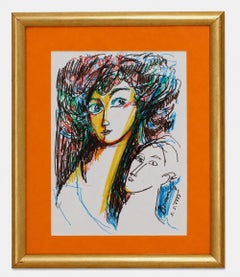
Untitled 109 (Abstract Photography)

Untitled 109 (Abstract Photography)

By Richard Caldicott

Located in London, GB

Untitled 109 (Abstract Photography) C print. Unframed. Richard Caldicott is most well known for this earlier work series which used Tupperware containers as the subject for his pho...

Category

Abstract 1990s Art
Materials

C Print

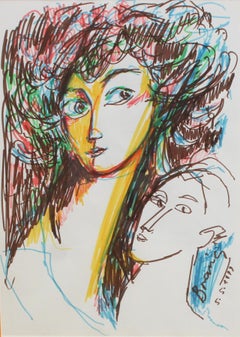
"India, " Abstract Woodcut and Monotype signed by Carol Summers

"India, " Abstract Woodcut and Monotype signed by Carol Summers

By Carol Summers

Located in Milwaukee, WI

"India" is a woodcut and monotype signed by Carol Summers. Here, Summer's abstract language for landscape imagery is taken to its most extreme: The image offers a view of a highly stylized waterfall, with red water falling down behind green foliage below. A hint of light blue at the lower left suggests a continuation of the water's flow. Above, purples and yellows mist upward from the power of the water. The playfulness of the image is enhanced by Summers' signature printmaking technique, which allows the ink from the woodblock to seep through the paper, blurring the edges of each form. Summers' signature can be found in pencil at the bottom of the rightmost blue form, with the title and edition at the bottom of the leftmost blue form. A copy of this print can be found in the collection of the Fine Arts Museums of San Francisco. 37.25 x 24.88 inches, artwork 48.5 x 35.5 inches, frame Numbered 44 from the edition of 75 Carol Summers (1925-2016) has worked as an artist throughout the second half of the 20th century and into the first years of the next, outliving most of his mid-century modernist peers. Initially trained as a painter, Summers was drawn to color woodcuts around 1950 and it became his specialty thereafter. Over the years he has developed a process and style that is both innovative and readily recognizable. His art is known for it’s large scale, saturated fields of bold color, semi-abstract treatment of landscapes from around the world and a luminescent quality achieved through a printmaking process he invented. In a career that has extended over half a century, Summers has hand-pulled approximately 245 woodcuts in editions that have typically run from 25 to 100 in number. His talent was both inherited and learned. Born in 1925 in Kingston, a small town in upstate New York, Summers was raised in nearby Woodstock with his older sister, Mary. His parents were both artists who had met in art school in St. Louis. During the Great Depression, when Carol was growing up, his father supported the family as a medical illustrator until he could return to painting. His mother was a watercolorist and also quite knowledgeable about the different kinds of papers used for various kinds of painting. Many years later, Summers would paint or print on thinly textured paper originally collected by his mother. From 1948 to 1951, Carol Summers trained in the classical fine and studio arts at Bard College and at the Art Students League of New York. He studied painting with Steven Hirsh and printmaking with Louis Schanker. He admired the shapes and colors favored by early modernists Paul Klee (Sw: 1879-1940) and Matt Phillips (Am: b.1927- ). After graduating, Summers quit working as a part-time carpenter and cabinetmaker (which had supported his schooling and living expenses) to focus fulltime on art. That same year, an early abstract, Bridge No. 1 was selected for a Purchase Prize in a competition sponsored by the Brooklyn Museum. In 1952, his work (Cathedral, Construction and Icarus) was shown the first time at the Museum of Modern Art in New York City in an exhibition of American woodcuts. In 1954, Summers received a grant from the Italian government to study for a year in Italy. Woodcuts completed soon after his arrival there were almost all editions of only 8 to 25 prints, small in size, architectural in content and black and white in color. The most well-known are Siennese Landscape and Little Landscape, which depicted the area near where he resided. Summers extended this trip three more years, a decision which would have significant impact on choices of subject matter and color in the coming decade. After returning from Europe, Summers’ images continued to feature historical landmarks and events from Italy as well as from France, Spain and Greece. However, as evidenced in Aetna’s Dream, Worldwind and Arch of Triumph, a new look prevailed. These woodcuts were larger in size and in color. Some incorporated metal leaf in the creation of a collage and Summers even experimented with silkscreening. Editions were now between 20 and 50 prints in number. Most importantly, Summers employed his rubbing technique for the first time in the creation of Fantastic Garden in late 1957. Dark Vision of Xerxes, a benchmark for Summers, was the first woodcut where Summers experimented using mineral spirits as part of his printmaking process. A Fulbright Grant as well as Fellowships from the Louis Comfort Tiffany Foundation and the Guggenheim Foundation followed soon thereafter, as did faculty positions at colleges and universities primarily in New York and Pennsylvania. During this period he married a dancer named Elaine Smithers with whom he had one son, Kyle. Around this same time, along with fellow artist Leonard Baskin, Summers pioneered what is now referred to as the “monumental” woodcut. This term was coined in the early 1960s to denote woodcuts that were dramatically bigger than those previously created in earlier years, ones that were limited in size mostly by the size of small hand-presses. While Baskin chose figurative subject matter, serious in nature and rendered with thick, striated lines, Summers rendered much less somber images preferring to emphasize shape and color; his subject matter approached abstraction but was always firmly rooted in the landscape. In addition to working in this new, larger scale, Summers simultaneously refined a printmaking process which would eventually be called the “Carol Summers Method” or the “ Carol Summers Technique”. Summers produces his woodcuts by hand, usually from one or more blocks of quarter-inch pine, using oil-based printing inks and porous mulberry papers. His woodcuts reveal a sensitivity to wood especially its absorptive qualities and the subtleties of the grain. In several of his woodcuts throughout his career he has used the undulating, grainy patterns of a large wood plank to portray a flowing river or tumbling waterfall. The best examples of this are Dream, done in 1965 and the later Flash Flood Escalante, in 2003. In the majority of his woodcuts, Summers makes the blocks slightly larger than the paper so the image and color will bleed off the edge. Before printing, he centers a dry sheet of paper over the top of the cut wood block or blocks, securing it with giant clips. Then he rolls the ink directly on the front of the sheet of paper and pressing down onto the dry wood block or reassembled group of blocks. Summers is technically very proficient; the inks are thoroughly saturated onto the surface of the paper but they do not run into each other. The precision of the color inking in Constantine’s Dream in 1969 and Rainbow Glacier in 1970 has been referred to in various studio handbooks. Summers refers to his own printing technique as “rubbing”. In traditional woodcut printing, including the Japanese method, the ink is applied directly onto the block. However, by following his own method, Summers has avoided the mirror-reversed image of a conventional print and it has given him the control over the precise amount of ink that he wants on the paper. After the ink is applied to the front of the paper, Summers sprays it with mineral spirits, which act as a thinning agent. The absorptive fibers of the paper draw the thinned ink away from the surface softening the shapes and diffusing and muting the colors. This produces a unique glow that is a hallmark of the Summers printmaking technique. Unlike the works of other color field artists or modernists of the time, this new technique made Summers’ extreme simplification and flat color areas anything but hard-edged or coldly impersonal. By the 1960s, Summers had developed a personal way of coloring and printing and was not afraid of hard work, doing the cutting, inking and pulling himself. In 1964, at the age of 38, Summers’ work was exhibited for a second time at the Museum of Modern Art. This time his work was featured in a one-man show and then as one of MoMA’s two-year traveling exhibitions which toured throughout the United States. In subsequent years, Summers’ works would be exhibited and acquired for the permanent collections of multiple museums throughout the United States, Europe and Asia. Summers’ familiarity with landscapes throughout the world is firsthand. As a navigator-bombardier in the Marines in World War II, he toured the South Pacific and Asia. Following college, travel in Europe and subsequent teaching positions, in 1972, after 47 years on the East Coast, Carol Summers moved permanently to Bonny Doon in the Santa Cruz Mountains in Northern California. There met his second wife, Joan Ward Toth, a textile artist who died in 1998; and it was here his second son, Ethan was born. During the years that followed this relocation, Summers’ choice of subject matter became more diverse although it retained the positive, mostly life-affirming quality that had existed from the beginning. Images now included moons, comets, both sunny and starry skies, hearts and flowers, all of which, in one way or another, remained tied to the landscape. In the 1980s, from his home and studio in the Santa Cruz mountains, Summers continued to work as an artist supplementing his income by conducting classes and workshops at universities in California and Oregon as well as throughout the Mid and Southwest. He also traveled extensively during this period hiking and camping, often for weeks at a time, throughout the western United States and Canada. Throughout the decade it was not unusual for Summers to backpack alone or with a fellow artist into mountains or back country for six weeks or more at a time. Not surprisingly, the artwork created during this period rarely departed from images of the land, sea and sky. Summers rendered these landscapes in a more representational style than before, however he always kept them somewhat abstract by mixing geometric shapes with organic shapes, irregular in outline. Some of his most critically acknowledged work was created during this period including First Rain, 1985 and The Rolling Sea, 1989. Summers received an honorary doctorate from his alma mater, Bard College in 1979 and was selected by the United States Information Agency to spend a year conducting painting and printmaking workshops at universities throughout India. Since that original sabbatical, he has returned every year, spending four to eight weeks traveling throughout that country. In the 1990s, interspersed with these journeys to India have been additional treks to the back roads and high country areas of Mexico, Central America, Nepal, China and Japan. Travel to these exotic and faraway places had a profound influence on Summers’ art. Subject matter became more worldly and nonwestern as with From Humla to Dolpo, 1991 or A Former Life of Budha, 1996, for example. Architectural images, such as The Pillars of Hercules, 1990 or The Raja’s Aviary, 1992 became more common. Still life images made a reappearance with Jungle Bouquet in 1997. This was also a period when Summers began using odd-sized paper to further the impact of an image. The 1996 Night, a view of the earth and horizon as it might be seen by an astronaut, is over six feet long and only slightly more than a foot-and-a-half high. From 1999, Revuelta A Vida (Spanish for “Return to Life”) is pie-shaped and covers nearly 18 cubic feet. It was also at this juncture that Summers began to experiment with a somewhat different palette although he retained his love of saturated colors. The 2003 Far Side of Time is a superb example of the new direction taken by this colorist. At the turn of the millennium in 1999, “Carol Summers Woodcuts...

Category

Contemporary 1990s Art
Materials

Monotype, Woodcut

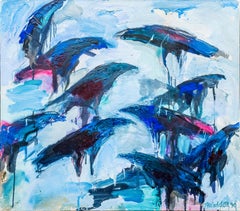
Thomas M Nicholas Winter Country Scene Northeast Oil

Thomas M Nicholas Winter Country Scene Northeast Oil

Located in Detroit, MI

SALE ONE WEEK ONLY The untitled oil painting of a quiet country winter scene is a typical subject matter for T. M. Nicholas who is considered by many to be among the most prominent painter of his generation and specifically of the Rockport School of Art. Painting is signed in the lower right front corner. He grew up admiring the rugged beauty of the U.S. northeast coastline especially the landscapes of coastal New England. His father, esteemed painter, Tom Nicholas...

Category

1990s Art
Materials

Canvas, Oil

Faux Couple

Faux Couple

By Silvia Lareo-Vazquez

Located in Hudson, NY

Listing is for UNFRAMED print. Inquire within for framing. If the exhibition piece is sold or the customer orders a different print size, the photograph is produced upon purchase...

Category

Contemporary 1990s Art
Materials

Silver Gelatin