1810s Prints and Multiples

534 Results
to
7
485
26
24
3
Overall Width
to
Overall Height
to
267
147
1
300
15
15
4,967
10,632
59,106
25,591
759
1,038
2,043
2,272
2,490
5,049
7,978
13,833
8,611
4,599
4,074
309
218
11
457
213
206
200
190
121
97
93
72
49
48
30
19
13
12
11
11
10
10
10
494
86
50
8
8
11
477
518
20
Period: 1810s
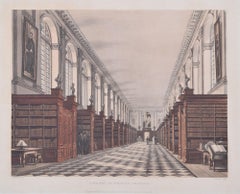
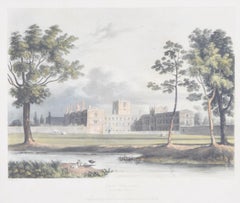
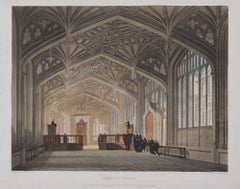
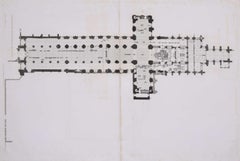
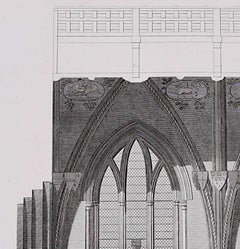
Jesus College, Cambridge 1815 engraving by Joseph Stadler for Ackermann

Jesus College, Cambridge 1815 engraving by Joseph Stadler for Ackermann

By Joseph Constantine Stadler

Located in London, GB

To see our other Oxford and Cambridge pictures, including an extensive collection of works by Ackermann, scroll down to "More from this Seller" and below it click on "See all from this Seller" - or send us a message if you cannot find the view you want. Joseph Constantine Stadler (1755 - 1828) after William Westall (1781 - 1850) Jesus College...

Category

Realist 1810s Prints and Multiples

Materials

Aquatint

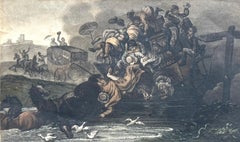
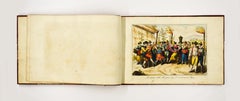
“A Trip to Scarbro’”

“A Trip to Scarbro’”

By Thomas Rowlandson

Located in Southampton, NY

Rare, original hand colored etching (Aquatint) from the Poetical Sketches of Scarborough titled “A Tro to Scarbro’”. Condition is good. Executed in 1813. Under glass. The etching ...

Category

Academic 1810s Prints and Multiples

Materials

Etching, Aquatint

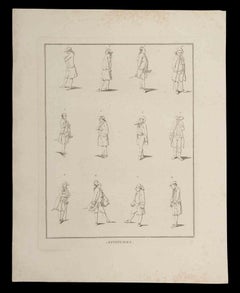
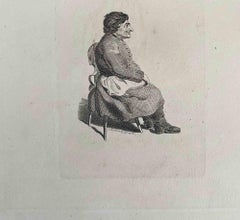
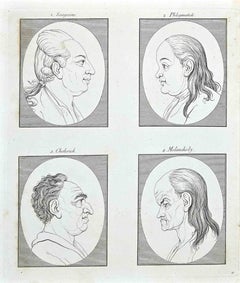
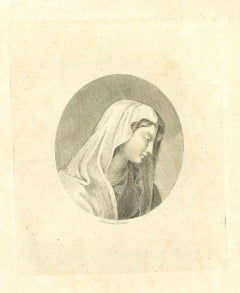
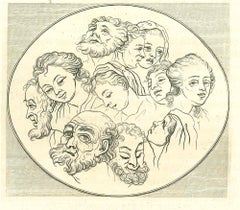
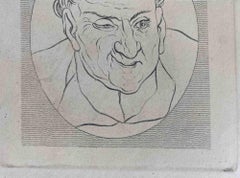
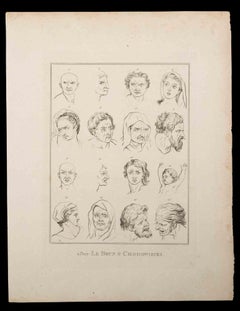
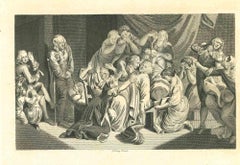
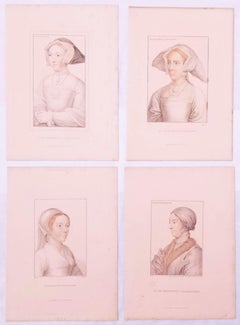
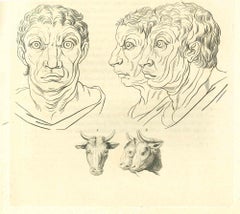
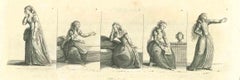
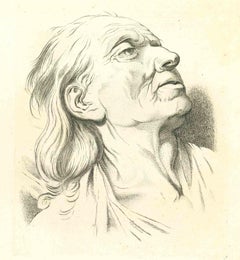
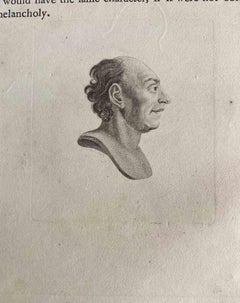
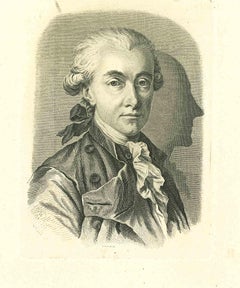
Portraits - Etching by Thomas Holloway - 1810

Portraits - Etching by Thomas Holloway - 1810

By Thomas Holloway

Located in Roma, IT

Portraits is an artwork realized by Thomas Holloway for Johann Caspar Lavater's "Essays on Physiognomy, Designed to promote the Knowledge and the Love of Mankind", London, Bensley, ...

Category

Modern 1810s Prints and Multiples

Materials

Etching

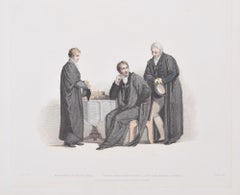
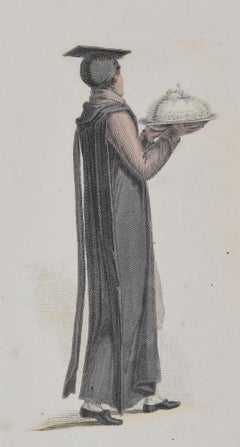
MA Masters of Arts and Trinity College, Cambridge member engraving by John Agar

MA Masters of Arts and Trinity College, Cambridge member engraving by John Agar

By Rudolph Ackermann

Located in London, GB

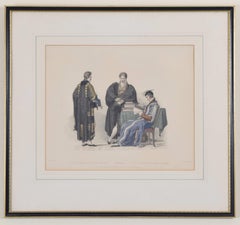
To see our other Oxford and Cambridge pictures, including an extensive collection of works by Ackermann, scroll down to "More from this Seller" and below it click on "See all from this Seller" - or send us a message if you cannot find the view you want. John Samuel Agar (1773 - 1858) after John Uwins (1782 - 1857) Pensioner of Trinity College, Cambridge, Masters of Arts, and Sizer (1815) Hand-coloured aquatint 25 x 30 cm Published by Rudolph Ackermann (1764 - 1834). An engraving of a pensioner of Trinity College, Masters of Arts, and a sizer (that is, an undergraduate who received some form of assistance such as meals, lower fees or lodging during his period of study, in some cases in return for doing a defined job) from Ackermann's 'A History of the University of Cambridge, Its Colleges, Halls and Public Buildings'. The four figures walk forward with ceremonial accoutrements, possibly to a graduation ceremony. At Cambridge, a sizar was originally an undergraduate student who financed his studies by undertaking more or less menial tasks within his college but, as time went on, was increasingly likely to receive small grants from the college. Certain colleges, including St John's and Trinity, distinguished between two categories of sizar: there were specific endowments for specific numbers of sizars who were called "proper sizars"; those who were not so endowed, but who were maintained by fellow-commoners and fellows were called subsizars. Isaac Newton matriculated as subsizar at Trinity College. Richard S. Westfall noted that sizars were considerably more successful in gaining degrees than the gentlemen who entered Cambridge in the seventeenth century. Pensioners, on the other hand, paid a fixed annual fee in order to study. Thomas Uwins RA RWS was a British painter in watercolour and oil, and a book illustrator. He became a full member of the Old Watercolour Society and a Royal Academician, and held a number of high-profile art appointments including the librarian of the Royal Academy, Surveyor of Pictures to Queen Victoria and the Keeper of the National Gallery. In the late 1790s he began producing work for Ackermann's collections. John Samuel Agar was an English portrait painter and engraver, who exhibited his works at the Royal Academy from 1796 to 1806 and at the British Institution until 1811. He was at one time president of the Society of Engravers. Rudolph Ackermann published many of his engravings. Ackermann was an Anglo-German bookseller, inventor, lithographer, publisher and businessman. He attended the Latin school in Stollberg, but his wish to study at the university was made impossible by lack of financial means, and he therefore became a saddler like his father. He worked as a saddler and coach-builder in different German cities, moved from Dresden to Basel and Paris, and then, 23 years old, settled in London. He established himself in Long Acre, the centre of coach-making in London and close to the market at Covent Garden. Ackermann then moved to Little Russell Street where he published Imitations of Drawings of Fashionable Carriages (1791) to promote his coach-making. Other publications followed. In 1795 he established a print-shop and drawing-school at 96 Strand. Here Ackermann set up a lithographic press and began a trade in prints. He later began to manufacture colours and thick carton paper for landscape and miniature painters. Within three years the premises had become too small and he moved to 101 Strand, in his own words "four doors nearer to Somerset House", the seat of the Royal Academy of Arts. Between 1797 and 1800 Ackermann rapidly developed his print and book publishing business, encompassing many different genres including topography, caricature, portraits, transparencies and decorative prints. During the Napoleonic wars, Ackermann was an energetic supporter of the Allied cause and made significant contributions to British propaganda through his publication of anti-Napoleonic prints...

Category

1810s Prints and Multiples
Materials

Aquatint

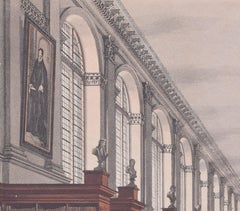
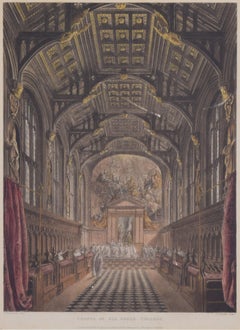
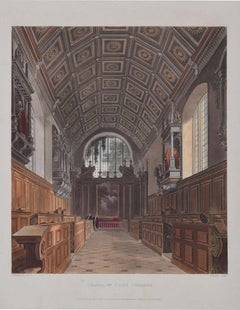
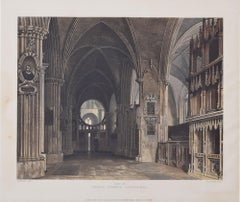
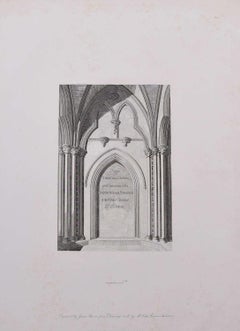
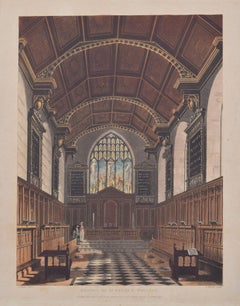
Chapel of All Souls College, Oxford engraving by Joseph Stadler for Ackermann

Chapel of All Souls College, Oxford engraving by Joseph Stadler for Ackermann

By Joseph Constantine Stadler

Located in London, GB

To see our other Oxford and Cambridge pictures, including an extensive collection of works by Ackermann, scroll down to "More from this Seller" and below it click on "See all from th...

Category

Realist 1810s Prints and Multiples

Materials

Aquatint

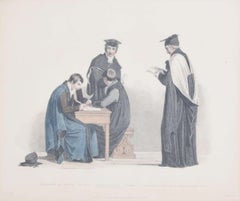
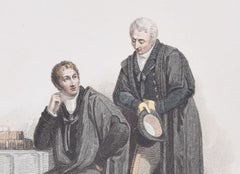
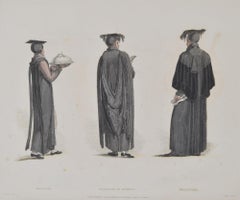
University of Oxford Bachelor engraving by Agar after Uwins for Ackermann

University of Oxford Bachelor engraving by Agar after Uwins for Ackermann

By Rudolph Ackermann

Located in London, GB

To see our other Oxford and Cambridge pictures, including an extensive collection of works by Ackermann, scroll down to "More from this Seller" and below it click on "See all from this Seller" - or send us a message if you cannot find the view you want. John Samuel Agar (1773 - 1858) after John Uwins (1782 - 1857) Servitor, Bachelor of Divinity, Collector (1814) Aquatint with original hand colouring 24 x 29 cm Published by Rudolph Ackermann (1764 - 1834). A Servitor; Bachelor of Divinity; and Collector of the University of Oxford. Thomas Uwins RA RWS was a British painter in watercolour and oil, and a book illustrator. He became a full member of the Old Watercolour Society and a Royal Academician, and held a number of high-profile art appointments including the librarian of the Royal Academy, Surveyor of Pictures to Queen Victoria and the Keeper of the National Gallery. In the late 1790s he began producing work for Ackermann's collections. John Samuel Agar was an English portrait painter and engraver, who exhibited his works at the Royal Academy from 1796 to 1806 and at the British Institution until 1811. He was at one time president of the Society of Engravers. Rudolph Ackermann published many of his engravings. Ackermann was an Anglo-German bookseller, inventor, lithographer, publisher and businessman. He attended the Latin school in Stollberg, but his wish to study at the university was made impossible by lack of financial means, and he therefore became a saddler like his father. He worked as a saddler and coach-builder in different German cities, moved from Dresden to Basel and Paris, and then, 23 years old, settled in London. He established himself in Long Acre, the centre of coach-making in London and close to the market at Covent Garden. Ackermann then moved to Little Russell Street where he published Imitations of Drawings of Fashionable Carriages (1791) to promote his coach-making. Other publications followed. In 1795 he established a print-shop and drawing-school at 96 Strand. Here Ackermann set up a lithographic press and began a trade in prints. He later began to manufacture colours and thick carton paper for landscape and miniature painters. Within three years the premises had become too small and he moved to 101 Strand, in his own words "four doors nearer to Somerset House", the seat of the Royal Academy of Arts. Between 1797 and 1800 Ackermann rapidly developed his print and book publishing business, encompassing many different genres including topography, caricature, portraits, transparencies and decorative prints. During the Napoleonic wars, Ackermann was an energetic supporter of the Allied cause and made significant contributions to British propaganda through his publication of anti-Napoleonic prints...

Category

1810s Prints and Multiples
Materials

Aquatint

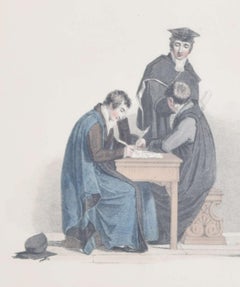
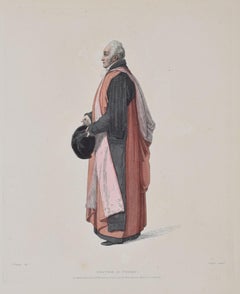
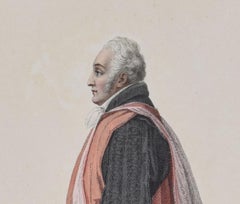
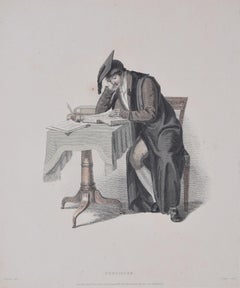
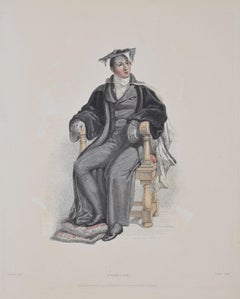
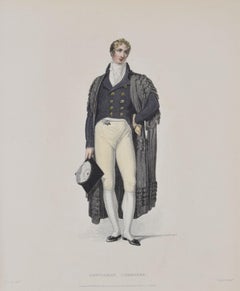
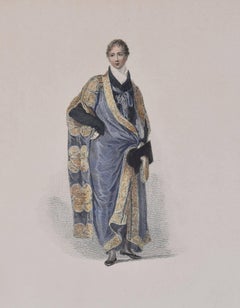
University of Cambridge Nobleman engraving by John Agar

University of Cambridge Nobleman engraving by John Agar

By Rudolph Ackermann

Located in London, GB

To see our other Oxford and Cambridge pictures, including an extensive collection of works by Ackermann, scroll down to "More from this Seller" and below it click on "See all from this Seller" - or send us a message if you cannot find the view you want. John Samuel Agar (1773 - 1858) after John Uwins (1782 - 1857) Nobleman, Cambridge (1815) Aquatint with original hand colouring 30 x 25 cm Published by Rudolph Ackermann (1764 - 1834). An engraving of a nobleman studying at Cambridge, from Ackermann's 'A History of the University of Cambridge, Its Colleges, Halls and Public Buildings'. Thomas Uwins RA RWS was a British painter in watercolour and oil, and a book illustrator. He became a full member of the Old Watercolour Society and a Royal Academician, and held a number of high-profile art appointments including the librarian of the Royal Academy, Surveyor of Pictures to Queen Victoria and the Keeper of the National Gallery. In the late 1790s he began producing work for Ackermann's collections. John Samuel Agar was an English portrait painter and engraver, who exhibited his works at the Royal Academy from 1796 to 1806 and at the British Institution until 1811. He was at one time president of the Society of Engravers. Rudolph Ackermann published many of his engravings. Ackermann was an Anglo-German bookseller, inventor, lithographer, publisher and businessman. He attended the Latin school in Stollberg, but his wish to study at the university was made impossible by lack of financial means, and he therefore became a saddler like his father. He worked as a saddler and coach-builder in different German cities, moved from Dresden to Basel and Paris, and then, 23 years old, settled in London. He established himself in Long Acre, the centre of coach-making in London and close to the market at Covent Garden. Ackermann then moved to Little Russell Street where he published Imitations of Drawings of Fashionable Carriages (1791) to promote his coach-making. Other publications followed. In 1795 he established a print-shop and drawing-school at 96 Strand. Here Ackermann set up a lithographic press and began a trade in prints. He later began to manufacture colours and thick carton paper for landscape and miniature painters. Within three years the premises had become too small and he moved to 101 Strand, in his own words "four doors nearer to Somerset House", the seat of the Royal Academy of Arts. Between 1797 and 1800 Ackermann rapidly developed his print and book publishing business, encompassing many different genres including topography, caricature, portraits, transparencies and decorative prints. During the Napoleonic wars, Ackermann was an energetic supporter of the Allied cause and made significant contributions to British propaganda through his publication of anti-Napoleonic prints...

Category

1810s Prints and Multiples
Materials
Aquatint