1950s Figurative Sculptures

to
14
68
18
14
2
6
Overall Width
to
Overall Height
to
188
656
2,300
7,475
93
37
101
112
56
226
174
236
278
66
56
8
4
3
3
2
1
37
32
22
22
18
16
16
16
12
12
8
8
7
7
7
6
6
4
4
4
54
33
26
12
10
42
8
7
3
2
54
51
Period: 1950s
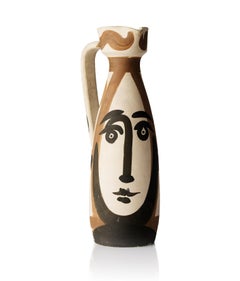
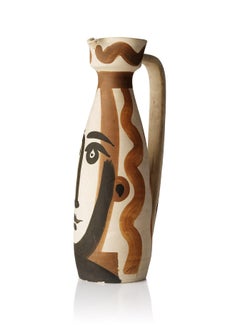
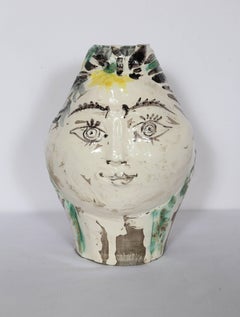
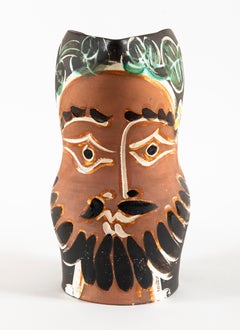
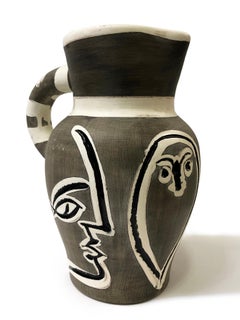
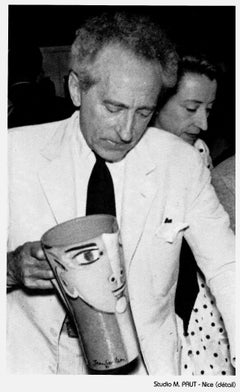
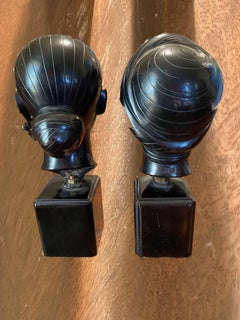
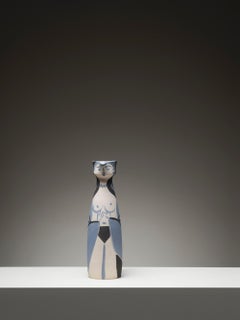
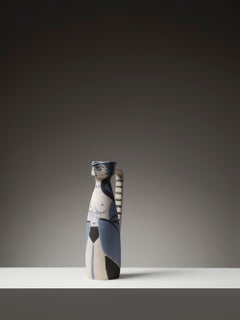
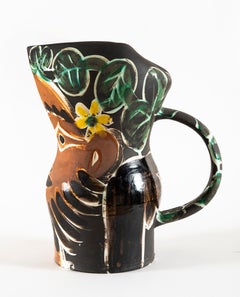
Visage (A.R. 288)
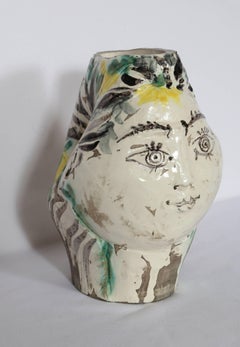
Visage (A.R. 288)

Visage (A.R. 288)

By Pablo Picasso

Located in Östermalm, Stockholms län

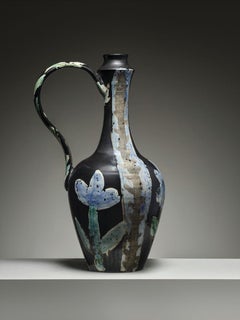
Visage (A.R. 288), 1955 White earthenware ceramic pitcher with colored engobe and glaze Edition of 500 Stamped “Picasso” and “Madoura Plein Feu” (underneath) The piece is in excelle...

Category

Modern 1950s Figurative Sculptures

Materials

Ceramic

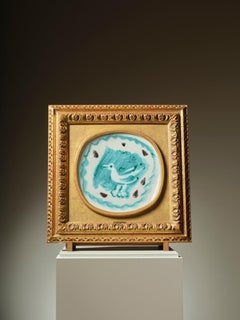
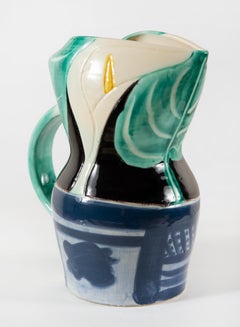
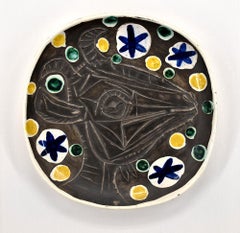
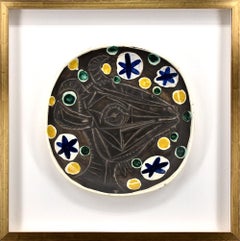
Fleurs
Fleurs

Fleurs

By Pablo Picasso

Located in PARIS, FR

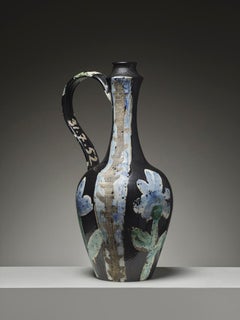
• An authenticated work This work is authenticated by Paloma Ruiz Picasso and Diana Widmaier Ruiz Picasso, who issued a certificate of authenticity on October 7, 2024. • A dated wor...

Category

Modern 1950s Figurative Sculptures

Materials

Ceramic

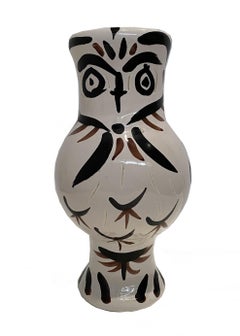
Chouette Visage de Femme (A.R.144)

Chouette Visage de Femme (A.R.144)

By Pablo Picasso

Located in PARIS, FR

• Picasso began working with ceramics in 1946 at the Madoura workshop in Vallauris, marking the beginning of an important and highly productive chapter in his career. What initially ...

Category

Modern 1950s Figurative Sculptures

Materials

Ceramic

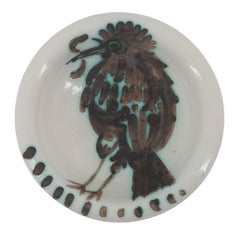
Oiseau Posé
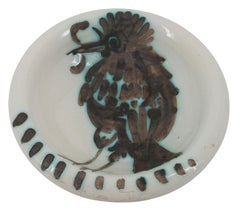
Oiseau Posé

Oiseau Posé

By Pablo Picasso

Located in PARIS, FR

• An authenticated work Stamped on the base “Madoura plein feu,” this unique painted and partially glazed ceramic is accompanied by a certificate of authenticity issued by Claude Rui...

Category

Modern 1950s Figurative Sculptures

Materials

Ceramic

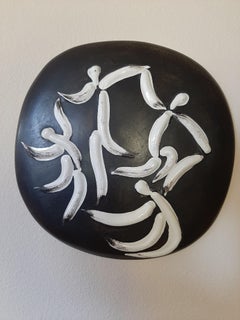
Four Dancers
Four Dancers

Four Dancers

By Pablo Picasso

Located in New York, NY

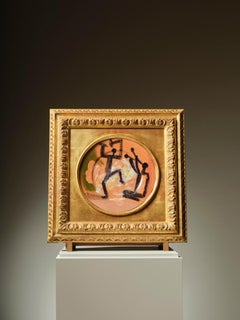
Partially glazed terre-de-faïence convex wall plaque painted in black and white, 1956. Edition of 450. With the Madoura Plein Feu and Empreinte Originale de Picasso stamps, verso. ...

Category

Cubist 1950s Figurative Sculptures

Materials

Clay, Ceramic

Faune à la Diaule
Faune à la Diaule

Faune à la Diaule

By Pablo Picasso

Located in PARIS, FR

• An authenticated work This work is authenticated by Claude Ruiz Picasso, who issued a certificate of authenticity on January 17, 2019. • A signed and dated work Dated July 11, 195...

Category

Modern 1950s Figurative Sculptures

Materials

Ceramic

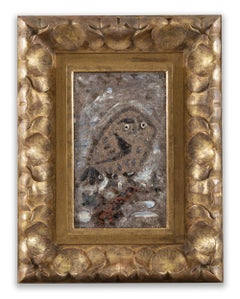
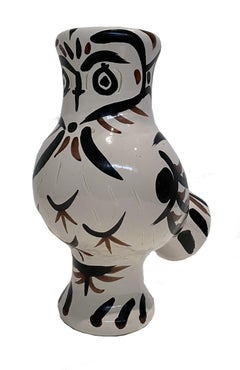
Hibou
Hibou

Hibou

By Pablo Picasso

Located in PARIS, FR

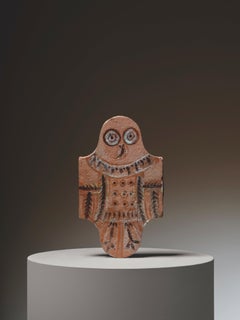
• A unique ceramic by Pablo Picasso This work is a unique ceramic by Pablo Picasso, dated on the reverse, reflecting the artist’s direct and personal intervention in the creation of ...

Category

Modern 1950s Figurative Sculptures

Materials

Ceramic

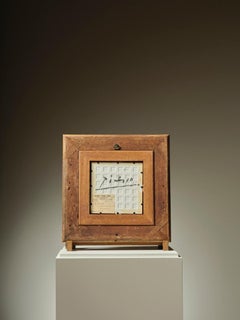
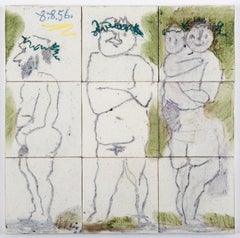
Famille, Têtes Laurées : Quatre Personnages

Famille, Têtes Laurées : Quatre Personnages

By Pablo Picasso

Located in PARIS, FR

• A unique ceramic work by Pablo Picasso Famille, Têtes Laurées : Quatre Personnages is a unique ceramic composition by Pablo Picasso, dated August 8, 1956, with the date inscribed a...

Category

Modern 1950s Figurative Sculptures

Materials

Ceramic

Bouteille Gravée (A.R.249)

Bouteille Gravée (A.R.249)

By Pablo Picasso

Located in PARIS, FR

• Picasso began working with ceramics in 1946 at the Madoura workshop in Vallauris, marking the beginning of an important and highly productive chapter in his career. What initially ...

Category

Modern 1950s Figurative Sculptures

Materials

Ceramic

Hibou
Hibou

Hibou

By Pablo Picasso

Located in PARIS, FR

• Signed and certified work This unique ceramic was executed in Vallauris in 1957 and is accompanied by a certificate of authenticity issued by Paloma Ruiz Picasso and Diana Widmaier...

Category

Modern 1950s Figurative Sculptures

Materials

Ceramic

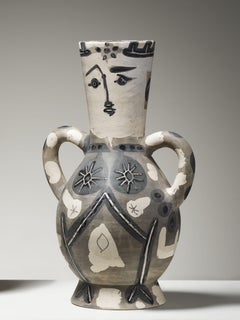
Vase Deux Anses Hautes (A.R. 141)

Vase Deux Anses Hautes (A.R. 141)

By Pablo Picasso

Located in PARIS, FR

• Picasso began working with ceramics in 1946 at the Madoura workshop in Vallauris, marking the beginning of an important and highly productive chapter in his career. What initially ...

Category

Modern 1950s Figurative Sculptures

Materials

Ceramic

Vase Deux Anses Hautes (A.R.213)

Vase Deux Anses Hautes (A.R.213)

By Pablo Picasso

Located in PARIS, FR

• Picasso began working with ceramics in 1946 at the Madoura workshop in Vallauris, marking the beginning of an important and highly productive chapter in his career. What initially ...

Category

Modern 1950s Figurative Sculptures

Materials

Ceramic

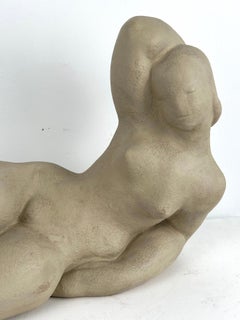
Relining Nude (WG6)
Relining Nude (WG6)

Relining Nude (WG6)

By Waylande Gregory

Located in Wilton Manors, FL

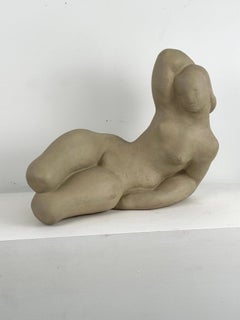
Waylande Gregory (1905-1971). Nude Reclining, ca. 1950's. Painted composite cast from original sculpted in 1930's. Casting sanctioned and approved by the artist during his lifetime in partnership with MPI, Museum Pieces Incorporated. Very few examples were produced and even fewer survive. Waylande Gregory was considered a major American sculptor during the 1930's, although he worked in ceramics, rather than in the more traditional bronze or marble. Exhibiting his ceramic works at such significant American venues for sculpture as the Whitney Museum of American Art in New York City and at the venerable Pennsylvania Academy of the Fine Arts in Philadelphia, he also showed his ceramic sculptures at leading New York City galleries. Gregory was the first modern ceramist to create large scale ceramic sculptures, some measuring more than 70 inches in height. Similar to the technique developed by the ancient Etruscans, he fired his monumental ceramic sculptures only once. Gregory was born in 1905 in Baxter Springs, Kansas and was something of a prodigy. Growing up on a ranch near a Cherokee reservation, Gregory first became interested in ceramics as a child during a native American burial that he had witnessed. He was also musically inclined. In fact, his mother had been a concert pianist and had given her son lessons. At eleven, he was enrolled as a student at the Kansas State Teacher's College, where he studied carpentry and crafts, including ceramics. Gregory's early development as a sculptor was shaped by the encouragement and instruction of Lorado Taft, who was considered both a major American sculptor as well as a leading American sculpture instructor. In fact, Taft's earlier students included such significant sculptors as Bessie Potter Vonnoh and Janet Scudder. But, Taft and his students had primarily worked in bronze or stone, not in clay; and, Gregory's earliest sculptural works were also not in ceramics. In 1924, Gregory moved to Chicago where he caught the attention of Taft. Gregory was invited by Taft to study with him privately for 18 months and to live and work with him at his famed "Midway Studios." The elegant studio was a complex of 13 rooms that overlooked a courtyard. Taft may have been responsible for getting the young man interested in creating large scale sculpture. However, by the 1920's, Taft's brand of academic sculpture was no longer considered progressive. Instead, Gregory was attracted to the latest trends appearing in the United States and Europe. In 1928 he visited Europe with Taft and other students. "Kid Gregory," as he was called, was soon hired by Guy Cowan, the founder of the Cowan Pottery in Cleveland, Ohio, to become the company's only full time employee. From 1928 to 1932, Gregory served as the chief designer and sculptor at the Cowan Pottery. Just as Gregory learned about the process of creating sculpture from Taft, he literally learned about ceramics from Cowan. Cowan was one of the first graduates of Alfred, the New York School of Clayworking and Ceramics. Alfred had one of the first programs in production pottery. Cowan may have known about pottery production, but he had limited sculptural skills, as he was lacking training in sculpture. The focus of the Cowan Pottery would be on limited edition, table top or mantle sculptures. Two of the most successful of these were Gregory's Nautch Dancer, and his Burlesque Dancer. He based both sculptures on the dancing of Gilda Gray, a Ziegfield Follies girl. Gilda Gray was of Polish origin and came to the United States as a child. By 1922, she would become one of the most popular stars in the Follies. After losing her assets in the stock market crash of 1929, she accepted other bookings outside of New York, including Cleveland, which was where Gregory first saw her onstage. She allowed Gregory to make sketches of her performances from the wings of the theatre. She explained to Gregory, "I'm too restless to pose." Gray became noted for her nautch dance, an East Indian folk dance. A nautch is a tight, fitted dress that would curl at the bottom and act like a hoop. This sculpture does not focus on Gray's face at all, but is more of a portrait of her nautch dance. It is very curvilinear, really made of a series of arches that connect in a most feminine way. Gregory created his Burlesque Dancer at about the same time as Nautch Dancer. As with the Nautch Dancer, he focused on the movements of the body rather than on a facial portrait of Gray. Although Gregory never revealed the identity of his model for Burlesque Dancer, a clue to her identity is revealed in the sculpture's earlier title, Shimmy Dance. The dancer who was credited for creating the shimmy dance was also Gilda Gray. According to dance legend, Gray introduced the shimmy when she sang the Star Spangled Banner and forgot some of the lyrics, so, in her embarrassment, started shaking her shoulders and hips but she did not move her legs. Such movement seems to relate to the Burlesque Dancer sculpture, where repeated triangular forms extend from the upper torso and hips. This rapid movement suggests the influence of Italian Futurism, as well as the planar motion of Alexander Archipenko, a sculptor whom Gregory much admired. The Cowan Pottery was a victim of the great depression, and in 1932, Gregory changed careers as a sculptor in the ceramics industry to that of an instructor at the Cranbrook Academy in Bloomfield Hills, Michigan. Cranbrook was perhaps the most prestigious place to study modern design in America. Its faculty included the architect Eliel Saarinen and sculptor Carl Milles. Although Gregory was only at Cranbrook for one and one half years, he created some of his finest works there, including his Kansas Madonna. But, after arriving at Cranbrook, the Gregory's had to face emerging financial pressures. Although Gregory and his wife were provided with complimentary lodgings, all other income had to stem from the sale of artworks and tuition from students that he, himself, had to solicit. Gregory had many people assisting him with production methods at the Cowan Pottery, but now worked largely by himself. And although he still used molds, especially in creating porcelain works, many of his major new sculptures would be unique and sculpted by hand, as is true of Kansas Madonna. The scale of Gregory's works were getting notably larger at Cranbrook than at Cowan. Gregory left the surface of Kansas Madonna totally unglazed. Although some might object to using a religious title to depict a horse nursing its colt, it was considered one of Gregory's most successful works. In fact, it had a whole color page illustration in an article about ceramic sculpture titled, "The Art with the Inferiority Complex," Fortune Magazine, December, 1937. The article notes the sculpture was romantic and expressive and the sculpture was priced at $1,500.00; the most expensive sculpture...

Category

Art Deco 1950s Figurative Sculptures

Materials

Plaster
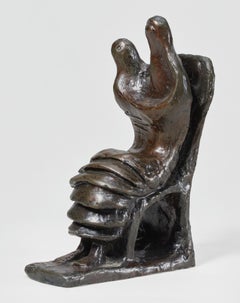
Female torso
Female torso

Female torso

Located in Täby, SE

This female torso represents the young woman's strength and vulnerability. It´s was conceived in the 70ths and is signed with the artists initials on a thumbprint. Gunnar Knut Nilsson, born 1904 in Karlskrona, died 1995 in Versailles in France, was a Swedish sculptor. Gunnar Nilsson studied watercolor painting and modeling at the Technical Vocational School in Karlskrona in 1918-19 and on his own in addition to working as a clerk at Finspångs Metallwerk. His debut exhibition was in Finspång in 1927. With the help of a local fundraiser, and after the encouragement of Carl Eldh, he traveled to Paris in 1928 to study sculpture for, among others, Charles Despiau and Paul Niclausse. In Paris he socialized with Bror Hjorth, whose former studio he also rented, Carl Frisendahl and Alberto Giacometti. He came to belong to "Le groupe des Neuf'' with Paul Cornet...
Category

French School 1950s Figurative Sculptures

Materials

Bronze

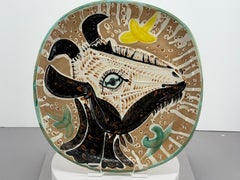
Tête de chèvre de profil (Goat's Head in Profile)

Tête de chèvre de profil (Goat's Head in Profile)

By Pablo Picasso

Located in Palo Alto, CA

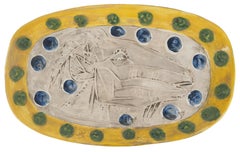
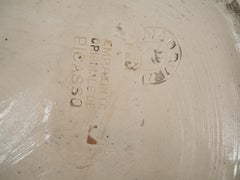
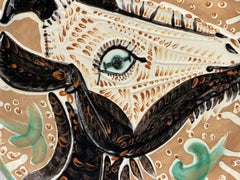
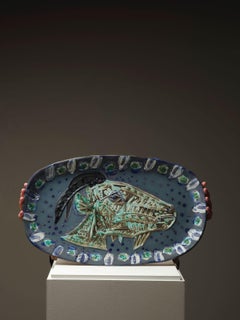
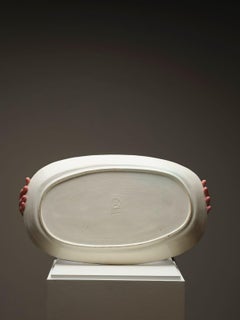
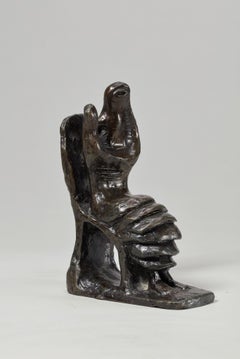
Created in 1952, Tête de chèvre de profil (Goat’s Head in Profile) 1952 A.R. 145, is a Madoura oblong dish of white earthenware clay with decoration in engobes on partial brushed glaze (mat blue, green, ivory, black). From an edition of 250, this work is stamped with the 'Empreinte Originale de Picasso' and 'Madoura Plein Feu' pottery stamps on verso. Pablo Picasso ceramic Tête de chèvre de profil (Goat’s Head in Profile), 1952 A.R. 145 is a playful and exuberant work of art that highlights Picasso’s capability as a well-rounded artist. Using lines, circles, and earthy colors, he showcases a goat’s head in profile. This work takes its viewers on a journey of sensation as we plunge into the crevices of the ridges that give texture to the coating of the plate. The sensation attributes to the liveliness of the goat as we can almost feel and touch it. Moving from the goat’s profile, we see heavy uses of blue dots outlining the head, reaching out towards the perimeter of the plate. These embellishments can be described as eccentric and imaginative—all of which perfectly designate Picasso as a prolific artist. Electric green, rustic blue, and tranquil beige are all a part of the color palette that bring out all the intricate details and accents. This work encapsulates the mastery of him as an experimenter and innovator. Taking us on a whimsical journey through the sensation of touch and color, this outstanding work embodies Picasso’s ingenious artistic talents. Catalogue Raisonné: Pablo Picasso ceramic Goat...
Category

Modern 1950s Figurative Sculptures

Materials

Ceramic

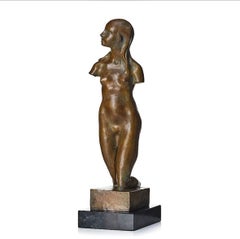
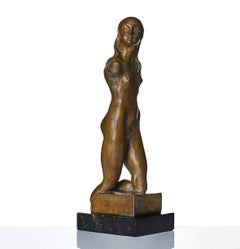
The Dancer - Sculpture by Giacomo Manzù - 1957
The Dancer - Sculpture by Giacomo Manzù - 1957
By Giacomo Manzú

Located in Roma, IT

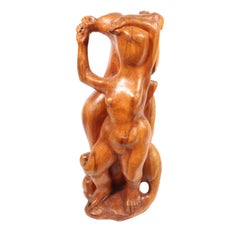
The Dancer is a sculpture realized by Giacomo Manzù in 1957. Unique piece. Exhibitions:  Manzù. L’Uomo e l’Artista, Palazzo Venezia, Roma 2002-2003 Manzù-Marino. Gli ultimi moderni,...

Category

Modern 1950s Figurative Sculptures

Materials

Bronze

Le Barbu (A.R.217)
Le Barbu (A.R.217)

Le Barbu (A.R.217)

By Pablo Picasso

Located in PARIS, FR

• Picasso began working with ceramics in 1946 at the Madoura workshop in Vallauris, marking the beginning of an important and highly productive chapter in his career. What initially ...

Category

Modern 1950s Figurative Sculptures

Materials

Ceramic

Tête de Chèvre de Profil (A.R.145)

Tête de Chèvre de Profil (A.R.145)

By Pablo Picasso

Located in PARIS, FR

• Picasso began working with ceramics in 1946 at the Madoura workshop in Vallauris, opening an important new chapter in his career. • He created over 3,500 ceramic works, transformi...

Category

Modern 1950s Figurative Sculptures

Materials

Ceramic

Egee assise h cm 70
Egee assise h cm 70

Egee assise h cm 70

By Antoniucci Volti

Located in Villafranca Di Verona, IT

Numbered and limited to 8 copies Artwork signed Authenticity: Sold with certificate of Authenticity Invoice from the gallery Sculpture: bronze, metal, bronze patina Display: The sc...

Category

1950s Figurative Sculptures

Materials

Metal, Bronze

Joueur de flûte (Flute Player), 1951

Joueur de flûte (Flute Player), 1951

By Pablo Picasso

Located in Palo Alto, CA

Utilizing the minimalist design motifs frequently found in his ceramics, Pablo Picasso ceramic Joueur de flûte (Flute Player ), 1951 creates an intricate and harmonious work that pla...

Category

Modern 1950s Figurative Sculptures

Materials

Clay

Trois Personnages sur Tremplin (Three Figures on a Trampoline), A.R. 375

Trois Personnages sur Tremplin (Three Figures on a Trampoline), A.R. 375

By Pablo Picasso

Located in Palo Alto, CA

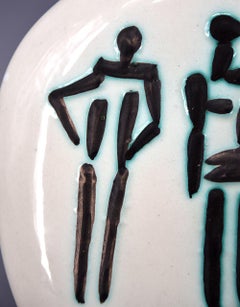
Created in 1956, this Madoura small convex wall plaque of white earthenware clay with engraving accentuated with oxidized paraffin in a glaze bath (ivory, brown) is from the edition ...

Category

Modern 1950s Figurative Sculptures

Materials

Ceramic, Clay, Earthenware, Glaze

Egèe assise h cm 140

Egèe assise h cm 140

By Antoniucci Volti

Located in Villafranca Di Verona, IT

Numbered and limited to 8 copies Artwork signed Authenticity: Sold with certificate of Authenticity Invoice from the gallery Sculpture: bronze, metal, bronze patina Display: The sc...

Category

1950s Figurative Sculptures

Materials

Metal, Bronze

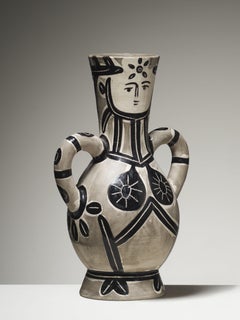
Pichet Gravé Gris (Ceramic Pitcher)

Pichet Gravé Gris (Ceramic Pitcher)

By Pablo Picasso

Located in Aventura, FL

White earthenware ceramic pitcher painted in black, white and grey patina with knife engraving and partial brushed glaze. Inscribed 'Edition Picasso' in black and with the Edition P...

Category

Cubist 1950s Figurative Sculptures

Materials

Earthenware, Ceramic

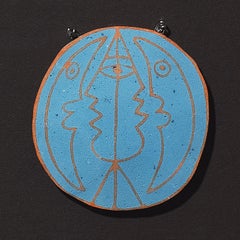
Visage dans un ovale (Face in an Oval), A.R. 273

Visage dans un ovale (Face in an Oval), A.R. 273

By Pablo Picasso

Located in Palo Alto, CA

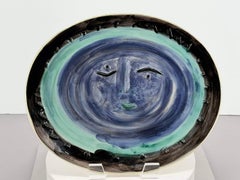
Created in 1955, Pablo Picasso ceramic Visage dans un ovale (Face in an Oval), 1955 A.R. 273 is a Madoura white earthenware clay oval dish with decoration in engobes and oxides (blue...

Category

Modern 1950s Figurative Sculptures

Materials

Clay, Earthenware, Glaze

Scène de tauromachie (Tauromachy Scene), 1959

Scène de tauromachie (Tauromachy Scene), 1959

By Pablo Picasso

Located in Palo Alto, CA

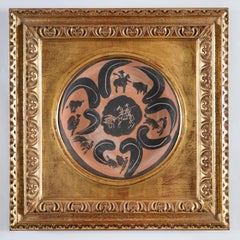
Pablo Picasso Scène de tauromachie (Tauromachy Scene), 1959, is a dynamic and visually compelling ceramic created during Picasso’s celebrated collaboration with the renowned Madoura ...

Category

Modern 1950s Figurative Sculptures

Materials

Clay

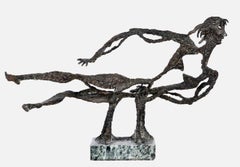
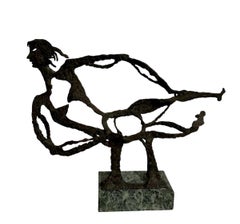
Futurist abstract figurative bronze sculpture with animal theme

Futurist abstract figurative bronze sculpture with animal theme

Located in Florence, IT

The bronze was first presented at the VII Quadriennale Nazionale d'Arte in Rome, which was held at the Palazzo delle Esposizioni from November 22, 1955 to April 30, 1956, with Fausto...

Category

Futurist 1950s Figurative Sculptures

Materials

Bronze

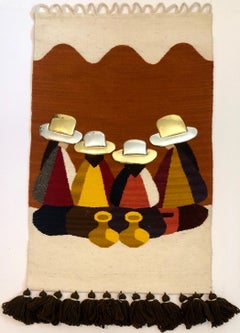
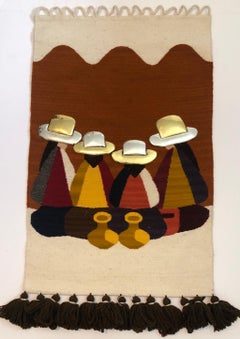
Vintage Handwoven Tapestry Wool, Metal Folk Art Rug Weaving Wall Hanging

Vintage Handwoven Tapestry Wool, Metal Folk Art Rug Weaving Wall Hanging

By Olga Fisch

Located in Surfside, FL

Olga Fisch was born in Hungary, studied in Germany and lived in Morocco and Ethiopia before receiving asylum as a Jewish refugee in Ecuador in 1939. For her Indian-inspired designs, Mrs. Fisch uses natural black and white sheep...

Category

Folk Art 1950s Figurative Sculptures

Materials

Wool

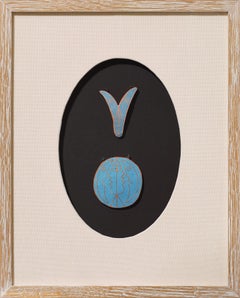
Hmong Ethnic Framed Necklace Silver Plated Metal Laos Thailand

Hmong Ethnic Framed Necklace Silver Plated Metal Laos Thailand

Located in Valladolid, ES

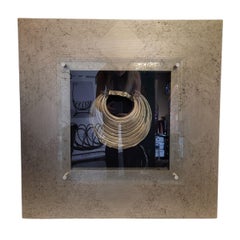
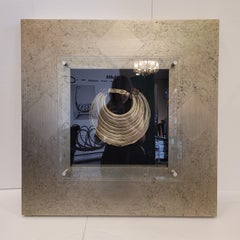
Framed Hmong Ethnic Necklace, Silver Plated Metal, 20th Century – Laos, Thailand Extraordinary and rarely seen ethnic necklace made of silver plated metal, from Thailand. Recently f...

Category

Tribal 1950s Figurative Sculptures

Materials

Wood

Oiseau
Oiseau

Oiseau

By Pablo Picasso

Located in PARIS, FR

An authenticated work This ceramic piece has been authenticated by Paloma Ruiz-Picasso (the artist’s daughter) and Diana Widmaier-Picasso (the artist’s granddaughter) on December 9, ...

Category

Modern 1950s Figurative Sculptures

Materials

Ceramic

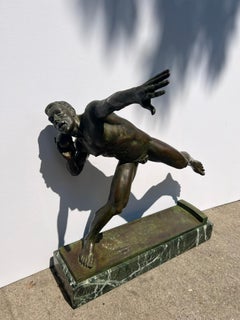
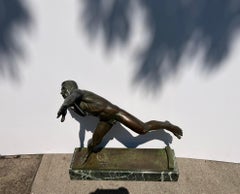
American Bronze Sculpture of Male Nude Athlete during Shot Put.

American Bronze Sculpture of Male Nude Athlete during Shot Put.

By Clemente Spampinato

Located in New York, NY

Clemente Spampinato, born in 1912 in Calabria, Italy, was a versatile artist and sports enthusiast. He created Bronze Trophies and Medallions for the Olympics and Italian sporting events in the 1930s and '40s. After becoming a U.S. citizen in 1947, he moved to New York, where he channeled his artistic passion into capturing the essence of the American West, specializing in sports and Western-themed sculptures. His work, celebrated for its realism and dynamic portrayal of athletic movements, is exhibited in museums, galleries, and private collections across the United States, Canada, and Europe. Selected sculptures can be seen in various locations, including Washington DC, Cooperstown, NY, Canton, OH, New Orleans, LA, and the complete collection is on display in Sea Cliff, New York. Large Bronze Nude Of Male Athlete During A Shot Put...

Category

Academic 1950s Figurative Sculptures

Materials

Bronze

Two Women
Two Women

Two Women

By Robert Lohman

Located in Indianapolis, IN

Lohman studied at John Herron Art Institute, and Cranbrook and Yale for graduate work. Assisted Carl Milles at Cranbrook Academy before becoming Director of Fine Arts there from 1947...

Category

Modern 1950s Figurative Sculptures

Materials

Wood

Femme Fleur
Femme Fleur

Femme Fleur

By Antoniucci Volti

Located in Villafranca Di Verona, IT

Numbered and limited to 12 copies ( 8 + 4 P.A) Artwork signed Authenticity: Sold with certificate of Authenticity Invoice from the gallery Sculpture: bronze, metal, bronze patina ...

Category

1950s Figurative Sculptures

Materials

Metal, Bronze

Visage de femme (Woman's Face), 1953

Visage de femme (Woman's Face), 1953

By Pablo Picasso

Located in Palo Alto, CA

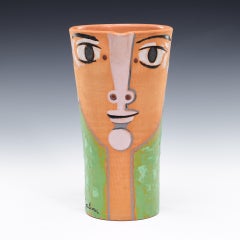
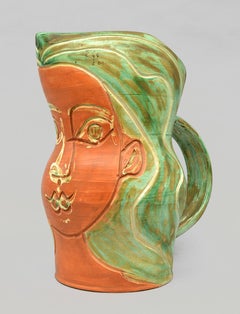
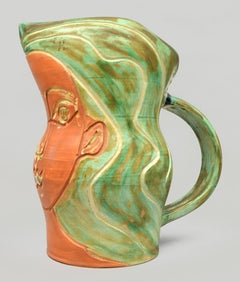
Pablo Picasso ceramic Visage de femme (Woman's Face), 1953 is a vibrantly colored pitcher decorated with contrasting saturated greens against chestnut ...

Category

Modern 1950s Figurative Sculptures

Materials

Ceramic, Clay, Earthenware, Glaze, Engraving

Picador, A.R. 200
Picador, A.R. 200

Picador, A.R. 200

By Pablo Picasso

Located in Palo Alto, CA

Created in 1953, ceramic Picador A.R. 200 is a round plate of white earthenware clay with oxidized paraffin decoration (brown, green, white) in a stanniferous enamel bath...

Category

Abstract 1950s Figurative Sculptures

Materials

Enamel

Fleet Moment
Fleet Moment

Fleet Moment

By Doris Caesar

Located in Greenwich, CT

Featured in the Doris Caesar catalog by Martin H. Bush, page 110.

Category

Expressionist 1950s Figurative Sculptures

Materials

Bronze

Pair of Iron Egret Wall Sculptures

Pair of Iron Egret Wall Sculptures

Located in Milford, NH

A wonderful pair of patinated iron egret bird wall sculptures, one reaching for the sky and one focused forward, each signed on the weighted bases “Maxfield Parrish Jr, March 1956”. ...

Category

1950s Figurative Sculptures

Materials

Iron

Metropolis
Metropolis

Metropolis

By Maxine Kim Stussy 1

Located in West Hollywood, CA

Presenting a monumental original wood assemblage sculpture by American artist Maxine Kim Stussy(1923 - 2020) "Metropolis", is an original unique wood assemblage using solid wood mac...

Category

Modern 1950s Figurative Sculptures

Materials

Wood